
In This Article
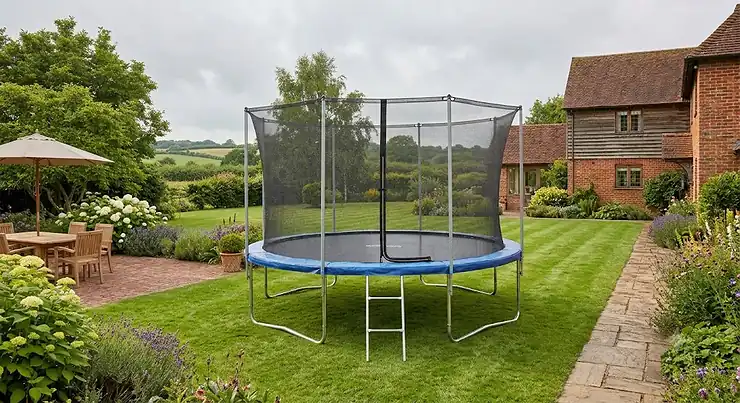
A 16ft trampoline is the largest round garden trampoline widely sold in the UK, offering the biggest jumping surface, the highest weight capacity, and the deepest bounce of any standard domestic size. If your garden can genuinely swallow one — and we mean genuinely, not “it’ll probably be fine” — it’s the size that turns a trampoline from a kids’ toy into a proper family fitness feature that teenagers and adults will still be using in five years. That’s the promise, anyway. The reality depends enormously on which model you actually buy, because “16ft” describes a diameter, not a build quality, and the gap between a flimsy budget frame and a properly engineered one is bigger than most shoppers expect until something bends.
We’ve spent time digging through real specifications, aggregated UK customer feedback, and independent safety guidance to work out which models genuinely earn their spot in this size category. This isn’t a rehash of Amazon listings — every product here comes with honest analysis of who it actually suits, where the compromises sit, and whether the premium options are worth the extra outlay. According to the Royal Society for the Prevention of Accidents, garden trampolines cause a meaningful number of A&E visits every year in England, so we’ve woven safety commentary throughout rather than bolting it on as an afterthought.
Quick Comparison Table
Before we get into the full reviews, here’s the fast version for anyone short on time.
| Trampoline | Shape | Weight Limit | Best For |
|---|---|---|---|
| Kanga 16ft Trampoline Package | Round | 150kg | Budget-conscious families wanting max size |
| Kanga Hi-Power 16ft | Round | 150kg | Older kids and teens wanting a firmer bounce |
| MERACH 16ft Outdoor Trampoline | Round | 150kg | Families wanting extras (basketball hoop) included |
| GYMAX 16FT Recreational Trampoline | Round | ASTM-rated | Shoppers who want independently tested certification |
| JumpKing 11.5ft x 16ft Rectangular Combo Pro | Rectangular | 120kg | Gymnasts and confident jumpers wanting even bounce |
| ActivePlus XL 16ft Trampoline | Round | 150kg | Buyers who want a full accessory bundle in one box |
| Superjumper 16ft Trampoline | Round | 150kg | Tightest budgets who still want the full 16ft size |
Looking at this table, a clear pattern emerges: round 16ft trampolines dominate the category, and most of them converge around a 150kg weight limit, which tells you that’s roughly the ceiling current spring and frame technology can support at this size without a significant cost jump. The one outlier is the JumpKing 11.5ft x 16ft Rectangular Combo Pro, whose lower 120kg rating is the trade-off for its more even, gymnastics-style bounce — a classic case of a spec that looks worse on paper but makes sense once you understand what it’s optimised for.
💬 Ready to see which one fits your garden? Scroll down for the full breakdown — or jump straight to your favourite below.
Top 7 16ft Trampolines: Expert Analysis
We picked these seven because between them they cover every realistic buyer: the parent trying to keep costs down, the family that wants bells and whistles, and the household with a teenager who’s outgrown their old 12ft and wants something that actually challenges them. Below is our honest, spec-and-review-backed take on each — not a rewritten spec sheet, but a genuine top rated 16ft trampoline review built from what the manufacturers publish and what real owners consistently report.
1. Kanga 16ft Trampoline Package — biggest jump area for the money
The standout here is straightforward: this is one of the more affordable ways into the full 16ft category without dropping to an unbranded frame of unknown origin. Sitting at 88cm off the ground, the frame gives a genuine 14ft 8in jump mat inside the 16ft outer ring — a detail worth knowing, because “16ft” always refers to the frame diameter, not the bounce surface, and a few centimetres of padding and enclosure eat into that on every model in this list. The trampoline carries a 150kg maximum user weight and ships with a zipped safety enclosure as standard.
Based on the spec comparison with pricier rivals, this is a “standard” spring trampoline, meaning the bounce favours lighter and younger jumpers rather than delivering the aggressive lift that teenagers or adults might want. That’s not a flaw so much as a design decision — it suits families whose primary users are children aged roughly 8–13 rather than a household of grown adults chasing serious air. Reviewers on the Kanga Trampoline Warehouse listing consistently describe the trampoline as sturdy and quieter in use than cheaper alternatives, alongside positive comments about the telephone support offered during and after purchase.
Pros:
- ✅ Full 16ft frame at one of the more accessible price points
- ✅ 150kg weight limit suits mixed-age family use
- ✅ Reviewers note quieter operation than budget rivals
Cons:
- ❌ Standard spring count means a gentler bounce for adults
- ❌ Basic enclosure lacks the reinforced top-ring seen on pricier models
At the time of research, prices for this package sit in the mid-£200s to low-£300s range — always check current price before buying, as trampoline pricing shifts with steel costs and seasonal demand. For families prioritising size over sporting performance, this represents genuinely solid value.
2. Kanga Hi-Power 16ft Trampoline Package — firmer bounce for older jumpers
The standout feature is right there in the name: a higher spring count than the standard Kanga, which translates into a noticeably firmer, more responsive bounce. What that means in practice is that lighter children will find it harder to compress the mat and generate height, while older kids, teens and adults will get the springy, energetic bounce that a standard-spec trampoline can’t quite deliver. The maximum user weight remains 150kg, the same ceiling as its sibling model.
Here’s what most buyers overlook about spring count: more springs doesn’t automatically mean “better” — it means a different bounce character suited to heavier or more experienced jumpers. If your household is mostly under-10s, this model could actually feel less fun for them than the standard version, since they’ll struggle to get the mat moving. For a garden shared by teenagers and adults, though, it’s the more satisfying choice, and it retains the same 150kg capacity and zipped enclosure design as the standard Kanga.
Pros:
- ✅ Noticeably firmer, more energetic bounce than standard-spec models
- ✅ Well suited to teenagers and adult users
- ✅ Shares Kanga’s reputation for sturdy, low-noise construction
Cons:
- ❌ Less forgiving bounce for jumpers under around 30kg
- ❌ Costs more than the standard Kanga for the spring upgrade alone
Expect a price in the £300–£400 range at the time of research, sitting a step above the standard package. If your family has outgrown a smaller trampoline’s gentle bounce, this is the more grown-up option in the Kanga range.
3. MERACH Trampoline 16ft with Basketball Hoop — most complete out-of-box bundle
MERACH’s standout move is bundling a basketball hoop, ball and pump into the box, turning a straightforward garden trampoline into something closer to a mini sports court. The frame uses galvanised steel pipes in a W-shaped configuration, rated to a maximum load of 330lb (150kg), and the springs are described as high-tensile and tested through more than 50,000 cycles — a genuinely useful durability metric, since spring fatigue (not frame failure) is usually the first thing to go on a heavily used trampoline.
What the spec sheet won’t tell you outright, but the padding description implies, is that MERACH has paid attention to the small stuff: EVA foam spring covers of “moderate thickness,” a high-density polyethylene safety net with a tight, uniform weave, and an anti-slip textured ladder that stays grippy in wet UK weather — a genuinely relevant detail here, unlike in drier climates. MERACH is a relatively young company (founded 2018) that’s built its reputation primarily in home fitness equipment, so this outdoor trampoline is a newer addition to their range rather than their core specialism, which is worth bearing in mind when weighing brand pedigree against Kanga or JumpKing’s longer trampoline-specific track record.
Pros:
- ✅ Basketball hoop, ball and pump included at no extra cost
- ✅ Springs tested to 50,000+ cycles for measurable durability
- ✅ Anti-slip ladder texture performs well in damp conditions
Cons:
- ❌ Trampoline-specific brand history is shorter than dedicated rivals
- ❌ 1-year warranty is on the shorter side for this price bracket
Pricing at the time of research sits broadly in the £300–£450 range depending on colour and current promotions. For families who want the “everything in one box” experience, this is hard to beat on paper.
4. GYMAX 16FT Recreational Trampoline — independently certified build
The standout feature here is certification: GYMAX’s 16ft model is tested against the ASTM F381-16 and ASTM F2225-15 standards, an American testing framework that, while not a UK-specific mark, still represents an independently verified safety benchmark rather than a manufacturer’s own claims. At the full 16ft size, the frame uses 108 rust-resistant springs — noticeably more than most round competitors at this diameter — paired with a galvanised steel frame and foam-covered tubing designed to resist corrosion through wet British winters.
Based on the spec comparison, more springs generally means a smoother, more evenly distributed bounce with fewer “dead zones” near the frame edge, which matters more on a 16ft mat than a smaller one simply because there’s more surface to cover. The enclosure runs the full 360 degrees with a buckle-and-zipper double-lock system, addressing one of the more common safety criticisms levelled at budget trampolines — namely, enclosures that can be nudged open mid-bounce. Reviewers of GYMAX’s smaller trampoline sizes consistently flag straightforward assembly as a strength, though large-format reviews specifically for the 16ft version remain comparatively limited, so treat that as a reasonable inference rather than a confirmed pattern at this exact size.
Pros:
- ✅ Independently tested to recognised ASTM safety standards
- ✅ 108 springs for a smoother, more even bounce across the mat
- ✅ Double-lock zip-and-buckle enclosure closure
Cons:
- ❌ ASTM is a US standard, not a UK-specific certification mark
- ❌ Fewer verified UK-specific 16ft reviews than more established brands
At the time of research, GYMAX 16ft models sit around the £275–£370 range, positioning it as a genuine mid-range contender rather than a budget or premium pick.
5. JumpKing 11.5ft x 16ft Rectangular Combo Pro — best for serious jumpers and gymnasts
This is the one genuine change of shape on our list, and it’s the standout for a reason: JumpKing’s “Three Bounce Zones” rectangular design is engineered to stop jumpers being drawn toward the centre of the mat — the opposite of how a round trampoline behaves — which is precisely why rectangular frames are the preferred shape for anyone practising actual gymnastic moves rather than just bouncing for fun. The tri-layer welded tube sockets add reinforcement at every stress point, and the frame is finished in galvanised steel with black powder-coated legs for extra corrosion resistance.
Here’s the trade-off buyers need to weigh honestly: the maximum user weight sits at 120kg (18 stone), noticeably lower than the 150kg typical of the round trampolines on this list. That’s not a manufacturing shortcut — rectangular spring geometry distributes tension differently, and JumpKing’s own guidance is explicit that exceeding the limit risks spring damage. What most buyers overlook about rectangular trampolines is that the “16ft” figure here refers to the long axis; the actual footprint (11.5ft x 16ft) needs a rectangular clearance zone, not a circular one, so measure your garden accordingly before assuming it’ll fit the same space as a round 16ft model. JumpKing includes a deluxe ladder and tie-down kit as standard, and the company donates £5 to an autism and ADHD charity per trampoline sold — a small but genuine point of difference for socially conscious buyers.
Pros:
- ✅ Three Bounce Zones design gives consistent edge-to-edge bounce
- ✅ Tri-layer welded sockets add serious structural reinforcement
- ✅ Includes deluxe ladder and tie-down kit as standard
Cons:
- ❌ Lower 120kg weight limit than round 16ft alternatives
- ❌ Rectangular footprint needs more careful garden measuring
Expect to pay toward the upper end of this category, broadly in the £400–£550 range at the time of research, reflecting its position as the premium 16ft trampoline pick on this list for buyers chasing performance over raw size.
6. ActivePlus XL 16ft Trampoline — best accessory bundle for the price
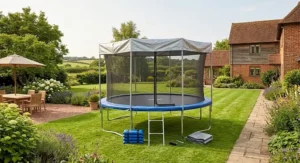
The standout advantage of this model, according to independent trampoline review site coverage, is what comes in the box beyond the trampoline itself: a ladder, a dedicated shoe bag mounted near the ladder, and a full weatherproof cover — accessories that would typically cost extra if bought separately, and are frequently the first things owners regret not having. The frame uses six galvanised legs rather than the four or five seen on some budget rivals, which independent reviewers note gives noticeably better stability for trick-based bouncing, and the safety pads are described as thicker than typical entry-level competitors.
Honest analysis here has to acknowledge the flip side: the enclosure itself is functional rather than impressive, using standard foam-covered poles and unremarkable netting rather than the reinforced top-ring systems seen on the MERACH or GYMAX models above. The UV-resistant mat is rated for permanent outdoor use, and the 150kg weight capacity puts it in line with the rest of the round trampolines here. Independent review coverage summarised the overall experience as solid rather than spectacular — a trampoline that “does its job” without particularly exciting design touches, which for many budget-conscious buyers is exactly the right compromise.
Pros:
- ✅ Ladder, shoe bag and weatherproof cover included as standard
- ✅ Six-leg frame offers above-average stability for the price
- ✅ Thicker safety padding than typical entry-level rivals
Cons:
- ❌ Enclosure design is basic compared with reinforced-net competitors
- ❌ Nothing particularly distinctive about the overall aesthetic
At the time of research, this model typically sits in the £250–£350 range once bundled with its included accessories, which is genuinely competitive once you account for what you’d otherwise buy separately.
7. Superjumper 16ft Trampoline — tightest budget without dropping the size
The standout feature is simply availability of the full 16ft size at a genuinely accessible price point, built around rust-resistant steel tubing and a firmly sewn, UV-resistant mat. It’s described by independent trampoline retailers as a consistent UK best-seller in its category, rated to support a substantial user weight in line with other budget-tier 16ft models. If your absolute priority is “the biggest trampoline for the least money,” this is the one to have on your shortlist.
The honest trade-off is that budget pricing at this size inevitably means fewer refinements elsewhere — expect a simpler enclosure, a more basic ladder, and springs that, while functional, won’t match the cycle-tested longevity claims of pricier rivals like MERACH. What the spec sheet won’t tell you, but general budget-trampoline patterns strongly suggest, is that owners at this price tier should expect to replace enclosure netting or spring pads sooner than on premium models — typically within three to four years of regular UK-weather use rather than five-plus. That’s a reasonable trade for the upfront saving, provided you budget for it mentally from day one.
Pros:
- ✅ Full-size 16ft frame at the most accessible price point here
- ✅ Rust-resistant steel tubing suited to UK garden conditions
- ✅ Long-standing reputation as a consistent UK best-seller
Cons:
- ❌ Basic enclosure and ladder compared with mid-range rivals
- ❌ Likely earlier replacement of consumable parts (net, pads)
Pricing at the time of research is generally the lowest of the seven, often under £300 — check current price and availability, as budget-tier stock can fluctuate more than branded ranges.
Setting Up and Maintaining Your 16ft Trampoline
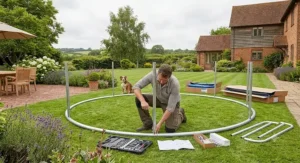
A 16ft trampoline is not a fifteen-minute job. Realistically, budget two to three hours with two adults working together, and resist the temptation to rush the enclosure poles into place before every spring is properly seated — a partially sprung mat under enclosure tension is a classic way to bend a pole on day one. Start with the frame flat on the ground exactly as illustrated in the manual (not “close enough”), attach the legs in the sequence specified, then work the springs on evenly around the circumference rather than completing one side first, which keeps tension balanced and stops the frame racking out of shape.
Once assembled, the first 30 days matter more than people expect. New springs stretch and settle, so recheck tension after the first fortnight of regular use and retighten any enclosure netting that’s gone slack. Common early mistakes include skipping the ground anchor kit (a genuine risk in exposed UK gardens where autumn gales can flip an unsecured frame), positioning the trampoline too close to fences or overhanging branches, and placing it directly on hard-standing without impact-absorbing matting underneath — grass alone doesn’t count as adequate cushioning around the fall zone. For ongoing maintenance, a quick monthly check of spring hooks, pad stitching and net integrity will catch small issues — a fraying stitch, a loosening bolt — before they become expensive replacement jobs, and a proper winter cover (or partial disassembly in exposed locations) will meaningfully extend the mat and pad’s working life.
✨ Sorted your setup plan? Compare our top picks again below before you commit.
Real Garden Scenarios: Matching Families to the Right 16ft Trampoline
If you’re a family with two children aged 7 and 11, on a tight budget, with a medium-sized garden and moderate weekend use, the standard Kanga 16ft Trampoline Package or the Superjumper 16ft Trampoline make the most sense — both give you the full jump area younger children need without paying for a firmer bounce or extras they won’t use for years yet.
If you’re a household with two teenagers who’ve outgrown their childhood trampoline and want to keep using it into adulthood, the Kanga Hi-Power 16ft or the JumpKing Rectangular Combo Pro are the stronger picks — the firmer bounce and gymnastics-style even bed suit older, heavier, more confident jumpers who want genuine height and control rather than a gentle bob.
If you’re a family that wants the trampoline to double as an all-round activity hub — sports practice, birthday parties, all-weather garden use — the MERACH 16ft with Basketball Hoop earns its keep through the bundled extras, while the ActivePlus XL suits buyers who specifically want the ladder-shoe bag-cover combination sorted in one purchase rather than assembled piecemeal afterwards.
Common 16ft Trampoline Problems and Practical Fixes
Problem: the bounce feels dead or inconsistent within the first year. This is almost always spring fatigue or uneven tensioning rather than a faulty product — recheck that every spring is fully hooked and evenly stretched, and replace any springs showing visible stretching or rust before they fail unevenly.
Problem: the enclosure net has sagged or developed gaps. UV exposure and repeated zip use are the usual culprits. Tightening the top-ring tension (where fitted) solves minor sagging; persistent gaps near zip seams usually mean it’s time for a replacement net rather than a repair.
Problem: rust appearing on frame joints after a wet UK winter. Even galvanised steel can show surface rust at weld points and joints where the coating is thinnest. A wire brush and a cold-galvanising touch-up spray, applied at the first sign of orange staining, will stop it spreading significantly.
Problem: the trampoline has shifted or lifted slightly in high wind. This is a safety issue, not just a cosmetic one — install a proper ground anchor kit immediately rather than relying on the trampoline’s own weight, particularly if you’re in an exposed or coastal UK location.
Problem: pads have gone hard, cracked or faded. Closed-cell foam degrades more slowly than open-cell foam, but every pad eventually succumbs to UV and rain cycling. Budget for pad replacement roughly every three to five years depending on model quality and exposure, and treat it as routine maintenance rather than a product failure.
How to Choose the Best 16 Foot Trampoline: Your Decision Framework
Working through these seven criteria in order will get most buyers to the right decision faster than scrolling endless listings:
- Measure your garden first, not last. Allow at least 20 feet of clear space in each direction around a round 16ft trampoline, or the equivalent rectangular clearance for shaped models — this single step eliminates more unsuitable options than any spec comparison.
- Establish your primary user weight range. If adults or teenagers over roughly 100kg will use it regularly, prioritise 150kg-rated round models over lower-limit alternatives.
- Decide round versus rectangular early. Round suits general family bouncing and centres jumpers safely; rectangular suits gymnastics-style, edge-to-edge bounce for confident, experienced users.
- Check what’s actually included. Ladder, cover, anchor kit and shoe bag can add real value or real extra cost depending on whether they’re bundled — factor this into any price comparison.
- Weigh spring count against bounce firmness. More or higher-tension springs suit heavier, older jumpers; fewer or standard springs suit younger children who need a gentler response.
- Look for verifiable safety testing. EN71-14 compliance is the UK/EU baseline; certifications like ASTM add further independent verification, though they’re not UK-specific standards.
- Budget for consumables from day one. Nets, pads and springs are wear items on every trampoline regardless of brand — build replacement costs into your real total cost of ownership, not just the purchase price.
If your garden is genuinely tight on space, choose a smaller size rather than squeezing in a 16ft frame with inadequate clearance, because reduced fall-zone space is a real safety compromise, not just an aesthetic one.
Common Mistakes When Buying a 16ft Trampoline
The single most common mistake is buying on size alone without checking the actual weight limit against who’ll be using it — a 150kg-rated round trampoline and a 120kg-rated rectangular one both carry the “16ft” label, but they’re not interchangeable for a household of adults and teenagers. The second is skipping the ground-space measurement entirely and assuming “16ft trampoline” means “16ft total footprint,” when enclosure poles, guy ropes and the RoSPA-recommended fall-zone clearance all add meaningfully to the space actually required.
A third frequent error is treating included accessories as pure bonus value without checking their quality — a bundled ladder or cover that needs replacing within a year isn’t really free, it’s deferred cost. Finally, many buyers underestimate ongoing costs: springs, pads and netting are consumables on every trampoline, and choosing purely on upfront price without factoring in likely replacement cycles often costs more over five years than paying slightly more for a better-specified model initially.
16ft Trampoline Brand Comparison: Kanga vs MERACH vs JumpKing vs GYMAX
| Brand | Known Strength | Weakness to Weigh | Best For |
|---|---|---|---|
| Kanga | Established UK trampoline specialist, strong support reputation | Basic enclosure design on entry models | Budget-to-mid buyers wanting brand trust |
| MERACH | Cycle-tested springs, generous accessory bundle | Newer to outdoor trampolines specifically | Families wanting an all-in-one bundle |
| JumpKing | Purpose-built rectangular engineering, charity donation | Lower weight limit, needs more precise space planning | Serious jumpers and gymnastics practice |
| GYMAX | Independently ASTM-tested build | US-centric standard, fewer UK-specific 16ft reviews | Buyers prioritising verified certification |
Reading across this table, the clearest pattern is that no single brand wins on every axis: Kanga and Superjumper compete primarily on UK trampoline pedigree and price accessibility, MERACH and ActivePlus XL differentiate through bundled accessories, and JumpKing and GYMAX each lean on a specific engineering or certification story rather than trying to be all things to all buyers. Choosing between them really comes down to which single factor — brand trust, bundled value, bounce performance or certification — matters most for your household.
What to Expect: Real-World Bounce Performance on a Large Trampoline
Specs on a page don’t translate directly into how a trampoline actually feels underfoot, so it’s worth setting expectations properly. A top bounce large trampoline like any of the 150kg-rated round models here will give noticeably more lift and a wider “sweet spot” than a smaller 10ft or 12ft trampoline, simply because there’s more mat surface generating spring tension. That said, standard-spring models (like the base Kanga) genuinely feel gentler underfoot than higher-spring-count alternatives (like the Kanga Hi-Power or GYMAX), so don’t assume every 16ft trampoline bounces the same regardless of spec — it doesn’t.
Bouncing on a trampoline of this scale is also a legitimate form of moderate-to-vigorous physical activity, which matters given current NHS physical activity guidelines for children and young people recommend an average of 60 minutes of such activity daily. A well-chosen 16ft trampoline, used safely and with proper supervision, can genuinely contribute meaningful chunks of that recommended activity — though it obviously shouldn’t be the only source of exercise in a child’s week.
Is a Premium 16ft Trampoline Worth the Extra Cost?
The honest answer is: it depends what “premium” is actually buying you. Paying more for a genuinely reinforced frame, cycle-tested springs, or purpose-engineered bounce geometry (as with the JumpKing Rectangular Combo Pro) buys real, measurable performance and durability differences. Paying more purely for brand recognition or marketing polish, without any corresponding spec improvement, doesn’t necessarily buy anything functionally different from a well-reviewed mid-range model.
Our honest take, based on the spec comparison across this list: the jump from budget to mid-range (roughly the gap between Superjumper and MERACH) buys meaningfully better spring longevity and accessory value. The further jump from mid-range to the JumpKing premium pick buys a genuinely different bounce category rather than just “more of the same, but nicer” — which makes it worth the extra outlay specifically for serious or older jumpers, and much less necessary for a family whose primary users are under 10.
16ft Trampoline Long-Term Durability: What Actually Wears Out First
Across every model in this category, the wear pattern is remarkably consistent, and it’s worth knowing before you buy so nothing catches you off guard. Springs go first — expect visible stretching, surface rust, or reduced bounce responsiveness somewhere between year two and year four depending on usage frequency and spring quality, with cycle-tested ranges like MERACH’s 50,000-cycle claim theoretically pushing that further out. Enclosure netting is next, typically showing UV degradation (fading, brittleness) before any structural failure, usually needing replacement around the four-to-six-year mark on well-maintained trampolines and considerably sooner on ones left uncovered through UK winters.
Padding tends to outlast netting if it’s closed-cell foam with a quality PVC covering, but open-cell foam (more common on true budget models) can degrade within two to three seasons of exposure. The frame itself is usually the last thing to fail — galvanised steel, properly maintained with occasional rust touch-ups at weld points, can realistically outlast every other component by years. The practical takeaway: budget for spring and net replacement as routine maintenance on any 16ft trampoline, regardless of brand, rather than treating early wear as a product defect.
Long-Term Cost & Maintenance: The Real Total Cost of Ownership
The purchase price is only the starting figure. Realistic five-year ownership costs should factor in: a replacement enclosure net (typically needed once within that window), one or two spring replacements or a full spring set if usage is heavy, occasional pad replacement, and a decent winter cover if one wasn’t included — a cover alone can meaningfully extend the working life of pads and mat by shielding them from UV and rain cycling. Models like the ActivePlus XL, which bundle a cover from day one, effectively front-load part of that cost into the initial purchase rather than leaving it as a later surprise.
Cost-per-use is a genuinely useful way to compare options here: a £250 budget trampoline used daily by an active family for five years works out considerably cheaper per session than the same price spent on a rarely-used impulse buy, regardless of brand. The models offering the best long-term value in this list are generally the ones balancing reasonable upfront cost against demonstrably tested components — which, on the evidence available, points toward MERACH and GYMAX as the stronger cost-per-use performers among the mid-range options.
Safety, Regulations & Garden Space Guide for 16ft Trampolines
New domestic trampolines sold in the UK should meet the EN71-14:2014 safety standard, and it’s worth checking this explicitly on any listing before buying, since it’s the baseline safety benchmark for this category. Beyond the standard itself, safe use matters just as much as the product spec: RoSPA guidance is clear that supervision alone isn’t a guarantee of safety, since more than half of recorded trampoline accidents happen while a responsible adult is present, and that a genuine majority of injuries involve more than one jumper bouncing at the same time.
Garden trampolines don’t generally require planning permission in England and Wales, but there are real neighbourly considerations worth thinking through before installation — particularly around overlooking issues on a structure this tall, where the right to privacy set out under the Human Rights Act can become relevant in genuinely persistent disputes, even though it doesn’t grant an automatic right to block a neighbour’s trampoline outright. Positioning matters practically too: keep the trampoline well clear of fences, overhanging branches and hard surfaces, use impact-absorbing matting in the fall zone rather than relying on grass alone, and always fit a ground anchor kit given how exposed most UK gardens are to seasonal winds. If you’re ever concerned about a specific product’s safety compliance, UK Trading Standards guidance outlines exactly how to report concerns.
🔍 Ready to choose your 16ft trampoline? Check current prices on our top picks above before you decide.
FAQ
❓ What is the best 16ft trampoline for a family garden?
❓ How much space do I need for a 16ft trampoline?
❓ What weight limit does a typical 16ft trampoline have?
❓ How long does a 16ft trampoline usually last?
❓ Is a 16ft trampoline suitable for younger children?
Conclusion
Choosing among these seven comes down to being honest with yourself about who’ll actually use it and how often. For most budget-conscious families wanting the full 16ft experience without overspending, the Kanga 16ft Trampoline Package or Superjumper 16ft Trampoline deliver genuine value. Households with teenagers or adults chasing a proper bounce should look seriously at the Kanga Hi-Power or the JumpKing Rectangular Combo Pro, while anyone wanting extras bundled in from day one will get the most out of MERACH or the ActivePlus XL. The GYMAX sits comfortably in the middle as the pick for buyers who most value independently verified testing.
None of these are the “wrong” choice in isolation — they’re built for genuinely different households, budgets and bounce preferences, and the analysis above should make it clear which profile fits yours. What matters more than which single model you choose is following the safety guidance throughout this piece: proper anchoring, sensible supervision, one jumper at a time, and realistic budgeting for the consumable parts every 16ft trampoline eventually needs. Get those fundamentals right, and any of the seven trampolines above should give your family years of genuinely good use.
✨ Don’t Miss These Exclusive Deals! 🔍 Take your garden setup to the next level with these carefully selected 16ft trampolines. Click on any highlighted product to check current pricing and availability. These picks will help you create the kind of authentic family fun your household will actually use for years to come!
Recommended for You
- Heavy Duty 14ft Trampoline: 7 Toughest Picks for 2026
- Best 14ft Trampoline UK 2026: 7 Top Picks Ranked & Reviewed
- Heavy Duty 12ft Trampoline UK: 7 Toughest Picks for 2026
Disclaimer: This article contains affiliate links. As an Amazon Associate, I earn from qualifying purchases. If you purchase products through these links, we may earn a small commission at no additional cost to you.
✨ Found this helpful? Share it with your friends! 💬🤗
