In This Article
A balance bar for fitness trampoline users is a height-adjustable T-shaped or looped handle that fixes to (or replaces) two legs of a rebounder, giving you something solid to hold while you bounce. It steadies beginners, reassures older jumpers and opens up upper-body moves, provided it genuinely fits your frame.
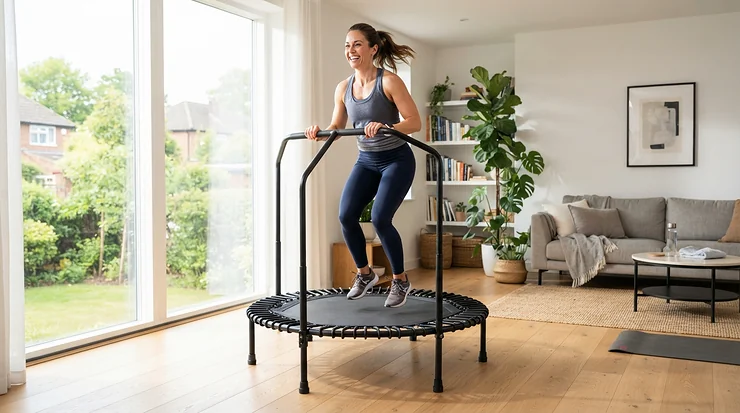
Here’s what the glossy product photos rarely mention: a rebounder is a wobbly little platform by design. That’s the whole point. The mat gives, your joints thank you, and your balance does the heavy lifting. Rebound exercise is essentially low-impact movement on an elastic surface, and elastic surfaces are lovely right up until you step off-centre on a tired Tuesday evening. One steady hand on a bar changes the mood completely. Nervous? Hold on. Confident? Barely touch it. Either way, a good balance bar for fitness trampoline use turns “I think I’ll try that” into “I’ll do that again tomorrow”.
The catch is compatibility. Rebounders aren’t standardised. Leg diameters differ, leg counts differ, 39-inch and 44-inch frames differ, and some brands design bars that will only ever fit their own machines. So this guide does three jobs. It compares seven real bars and bar-included options. It explains how to check fit before you click “buy”. And it shows you how to set the thing up so it doesn’t rattle loose by week three.
One honest note before we start: I haven’t bounced on any of these. Everything below comes from manufacturer specifications, installation guides and the patterns that repeat across retailer reviews, and where I couldn’t verify something, I say so. Prices move constantly, so you’ll see bands rather than exact figures. Check the current price on Amazon UK before you buy.
Quick Comparison: Balance Bar for Fitness Trampoline Options at a Glance
Seven options, one table. Read the “Fits” column first, because a bar that doesn’t fit is just an expensive clothes rail.
| Bar | Height range | Fits | Best For |
|---|---|---|---|
| Fit Bounce Pro Stability Bar | 10 settings (range varies by listing) | Fit Bounce Pro II and Maximus Pro bungee rebounders | Owners of the matching rebounder |
| JumpSport 39″ Handle Bar | 30–40 in (about 76–102 cm) above mat | 39-inch arched-leg JumpSport models | Permanent-spot rebounders |
| JumpSport Quick-Release 39″ Handle Bar | 20–40 in (about 51–102 cm) above mat | 39-inch arched or straight-leg JumpSport models | Anyone who stores the rebounder |
| bellicon T Bar Handle | 85–100 cm above mat | bellicon rebounders | Premium-rebounder owners |
| Needak Stabilizing Bar | 29, 34 or 41 in (about 74–104 cm), mat to grip | Needak rebounders only | Flex-friendly, space-saving storage |
| Leaps & Rebounds 40″ Adjustable Stabilizer Bar | 49, 52 or 55 in (about 124–140 cm) from floor | Claims to fit most rebounders | Widest-fit gamble on a budget |
| ACON Fit Round Rebounder with Balance Handlebar | Height-adjustable (steps not stated) | Bundle: bar included | Starting from scratch |
Looking at the comparison above, the Fit Bounce Pro Stability Bar, bellicon T Bar Handle and Needak Stabilizing Bar are the safest picks if you own the matching rebounder, and the riskiest if you don’t. The Leaps & Rebounds 40″ Adjustable Stabilizer Bar is the only standalone model here that claims broad compatibility, though its heights are measured from the floor rather than the mat. The ACON Fit Round Rebounder with Balance Handlebar skips the fit puzzle entirely by arriving as a bundle.
💬 Just one click — help others make better buying decisions too!😊
Top 7 Balance Bar for Fitness Trampoline Options: Expert Analysis
I ranked these on four things: how certain the fit is, how much height adjustment you get, how comfortable the grip looks on paper, and how rigid the bar feels in reviewers’ reports. Context matters too. Rebounding classes typically run on a small, firm trampoline with a handlebar for stability, according to Fit&Well’s explainer, which tells you the bar isn’t a beginner’s crutch. It’s standard kit.
1. Fit Bounce Pro Stability Bar — ten height settings for mixed-height households
The headline here is range. Listings describe ten adjustable heights, which matters if your household spans a petite grandparent and a six-foot teenager.
It’s a solid metal bar (retailers describe both steel and alloy) made exclusively for the Fit Bounce Pro II and Maximus Pro bungee rebounders. “Exclusively” is the operative word, because this is a bar for those machines rather than a generic one. Ten holes mean you can fine-tune grip height by a few centimetres instead of leaping between three fixed settings.
Based on the spec comparison, this is the no-guesswork choice for owners of the matching rebounder and a non-starter for everyone else. Reviewers consistently describe it as easy to fit and sturdy, with older jumpers saying it gives them something to grab when stepping on and off. The recurring complaint is fit tolerance: a few buyers mention holes that don’t line up perfectly or a leg tube that was too small on one side, so test-fit it the day it arrives.
Pros:
- ✅ Ten height settings suit very different users
- ✅ Solid metal build feels reassuringly sturdy
- ✅ Easy installation on the matching rebounder
Cons:
- ❌ Useless on any non-matching rebounder
- ❌ Occasional hole-alignment complaints from buyers
Price: I couldn’t verify a current UK price, but accessories like this typically sit in the £40–£80 band, so check the current price. Value verdict: excellent if it matches your rebounder, pointless if it doesn’t.
2. JumpSport 39″ Handle Bar — flush-fit padded bar built into the frame
The standout is rigidity. Because this bar takes the place of two rebounder legs, it becomes part of the frame rather than something clamped on.
Retailer listings give six height settings from 30 to 40 inches (roughly 76–102 cm) above the mat, a padded handle and wide legs. It’s steel, and one listing puts it at around 4 kg, which is heft you’ll feel. It fits 39-inch arched-leg models including the 220, 250, 350, 350f, 370, 350 PRO and 370 PRO. It won’t fit 44-inch frames, and one retailer lists the 200 and 230F as incompatible.
On paper, frame-integrated means less flex and fewer loose-fitting surprises. The trade-off is that you can’t whip it off for storage. It’s best for a rebounder that lives in one spot, a studio corner or a spare-room permanent bounce zone. Reviewers describe it as very sturdy, and several older or unsteady jumpers say they feel noticeably safer. Common complaints are the price (one reviewer noted it costs as much as some cheaper rebounders) and the fact it isn’t included with the trampoline. One buyer returned theirs because they stand their rebounder against a wall and wanted a quick-release.
Pros:
- ✅ Replaces legs for rigid, frame-integrated stability
- ✅ Six heights cover most adult jumpers
- ✅ Padded handle makes long sessions comfortable
Cons:
- ❌ Awkward to remove when you need storage space
- ❌ Fits only 39-inch JumpSport models
Price: indicatively £60–£110 (check current price). Value verdict: strong for dedicated spots, weak for wall-stored rebounders.
3. JumpSport Quick-Release 39″ Handle Bar — attach and detach without fuss
If product 2 is the permanent fixture, this is its commuter cousin. The headline feature is that it comes on and off easily, which suits anyone who stores their rebounder between sessions.
Listings give ten height settings from 20 to 40 inches (about 51–102 cm) above the mat, and compatibility with 39-inch arched or straight-legged models including the 200, 220, 230f, 250, 350, 350f, 370, 350 PRO and 370 PRO. That lowest setting is genuinely useful. A 20-inch grip height suits smaller jumpers and seated-to-standing rehab-style routines, where a tall bar would be pointless. It’s also designed with clubs in mind, with simplified storing and stacking.
My honest take: this is the better pick for flexible households, and the fixed bar is the better pick for rigid, never-moves setups. The review pool is the weakness. I found only two reviews on the retailer page, both positive, which isn’t enough to draw conclusions. Treat the sturdy-feeling reports for the fixed version as indicative only.
Pros:
- ✅ Quick attach and detach for easy storage
- ✅ Ten settings, starting as low as 20 inches
- ✅ Fits both arched and straight 39-inch legs
Cons:
- ❌ Very small review pool to judge durability
- ❌ More moving parts than a fixed bar
Price: indicatively £70–£120 (check current price). Value verdict: worth the premium if you fold or move your rebounder.
4. bellicon T Bar Handle — premium bar for premium rebounders
The hook is the badge. This is the maker-approved bar for bellicon rebounders, and a retailer listing says it fits all of them.
The specs: an adjustable range of 85–100 cm above the mat, a weight of 3.5 kg, an open footprint of around 118 × 59 × 7 cm, and a two-year home warranty. That 15 cm of adjustment is narrower than most rivals. In practice it suits average-to-tall adults and may feel high for shorter jumpers. The bar dismantles for storage, which helps if you tuck a rebounder behind a door.
I’d argue it’s the only logical choice if you own a bellicon, because the fit question evaporates. The Fitshop listing I viewed had no published reviews, so I can’t summarise sentiment, and anything about durability is a manufacturer claim until buyers weigh in. The listing I found was an ex-display, pre-order item at around £180, which tells you the price tier.
Pros:
- ✅ Maker-matched fit for bellicon rebounders
- ✅ Dismantles for tidy storage
- ✅ Two-year home warranty
Cons:
- ❌ Narrow 15 cm height adjustment range
- ❌ Premium price and no verified reviews yet
Price: roughly £150–£250 range (check current price). Value verdict: fair for bellicon owners, poor for everyone else.
5. Needak Stabilizing Bar — flexes with you and packs into four pieces
The distinctive trick is flex. The maker says the bar flexes as you bounce to increase your sense of stability, which is the opposite of the rigid-bar philosophy.
It adjusts to 29, 34 and 41 inches (about 74, 86 and 104 cm) from jump surface to hand grip, and splits into four pieces. It works with all Needak rebounders, folding or non-folding, hard or soft bounce, but the maker states it’s designed for Needak rebounders only. You can attach up to two bars to one rebounder. Installation needs a long screwdriver: you slide sleeves over two legs separated by one leg, with spring buttons pointing away from the frame.
A flexing bar is gentler on the wrists and shoulders when you grab it mid-wobble, and that’s a real advantage for older jumpers. The two-bar option is also clever for people who want symmetrical support. I couldn’t find verified UK consumer reviews, so all I can report is the maker’s positioning: recommended for older users but suitable for everyone.
Pros:
- ✅ Flexing design softens sudden grabs
- ✅ Splits into four pieces for storage
- ✅ Two bars possible for symmetrical support
Cons:
- ❌ Maker says Needak rebounders only
- ❌ Installation needs a screwdriver and patience
Price: I couldn’t verify UK pricing, so treat £80–£150 as indicative and check the current price. Value verdict: great for Needak owners; skip otherwise.
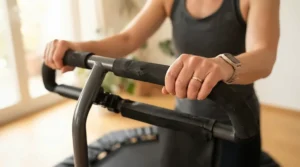
6. Leaps & Rebounds 40″ Adjustable Stabilizer Bar — the nearest thing to a one-size-fits-most option
This is the widest-fit gamble on the list. It attaches by slipping around any two legs, and the listing claims it fits fitness rebounders generally.
It’s steel with cushioned foam handles and three heights: 49, 52 and 55 inches (about 124, 132 and 140 cm) measured from the floor to the top of the bar. That floor-based measurement matters. If your mat sits roughly 25–30 cm off the floor, the grip lands somewhere between waist and lower-chest height for an average adult above the mat. One firm caveat from the listing: it’s not compatible with trampolines bought before around mid-April 2019, because the T-bar was redesigned.
A “fits all” claim deserves a tape measure, not blind faith. Measure your leg tube diameter first. I couldn’t verify UK reviews or confirm consistent UK availability, so check the Amazon UK listing carefully and read the return policy.
Pros:
- ✅ Broad-fit design slips around any two legs
- ✅ Cushioned foam grips for comfort
- ✅ Often the lowest-cost standalone option
Cons:
- ❌ Heights measured from floor, not mat
- ❌ Excludes rebounders bought before April 2019
Price: indicatively £30–£60 (check current price). Value verdict: good value if your legs match, risky if you don’t measure.
7. ACON Fit Round Rebounder with Balance Handlebar — bar included, so no fit gamble
The hook is simplicity. Rebounder and bar are designed together, so the compatibility puzzle simply disappears.
It’s a 1.12 m (about 44-inch) round rebounder, with an extended, height-adjustable balance handlebar, in black or white. The listing gives the trampoline weight as 13.2 kg, light enough to shift between rooms. It’s intended for indoor use. The same range also includes a 1.41 m hexagon version and an Active Handlebar variant, so you can match the bar to the kind of workout you plan.
I’d frame this as the “start from scratch” option. If you’re buying a rebounder anyway and want a bar, a bundle beats hunting for compatible add-ons. The downside is that it isn’t an upgrade for a rebounder you already own. I couldn’t verify customer reviews, and the listing’s claims about beginners and older adults are marketing, not evidence.
Pros:
- ✅ Bar and rebounder designed to fit together
- ✅ Height-adjustable bar suits different users
- ✅ Larger 1.12 m surface than standard 40-inch models
Cons:
- ❌ Pointless if you already own a rebounder
- ❌ No verified reviews found
Price: bundle pricing varies, so check current price. Value verdict: sensible for new buyers, wasteful for existing owners.
✨ Don’t Miss These Carefully Chosen Options!
🔍 Take your rebounding to the next level with a bar that genuinely fits. Click on any highlighted product name to check current pricing and availability on Amazon UK, and match it to your frame before you order. A steadier, more confident workout starts with the right match!
Practical Guide: How to Fit a Balance Bar for Fitness Trampoline Frames
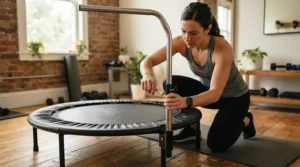
Setup is where good bars go wrong. The steps below follow the Needak Stabilizing Bar installation guide, and other brands vary, so always follow your own manual.
- Flip the rebounder unfolded onto its back, legs pointing up.
- Choose two legs. The Needak guide says to pick two legs separated by one leg.
- Remove the rubber leg tips with your thumbs. Smearing a little petroleum jelly inside makes them easier to refit.
- Slide the sleeve over the legs and replace the tips.
- Check the spring buttons point away from the frame (they can slide out of position in transit).
- Assemble and set the height, then flip upright and test.
First-use tip: set the bar lower than you think you need. You can always raise it. A second tip: stand on the mat before you commit to a height. The mat dips under your weight, which shifts the real grip height.
Maintenance is simple. Once a month, check fixings, wipe the grips and look for scuffs on the leg tips. Common mistakes in the first 30 days include forcing a sleeve onto a leg it doesn’t fit, leaving spring buttons half-seated, and treating the bar as a handrail to lean your full weight on. It’s a balance aid.
Real-World Scenarios: Matching a Balance Bar for Fitness Trampoline to Your Home
Three hypothetical buyers, three different answers.
Scenario 1: the cautious returner. She’s 66, returning to exercise, and has a bellicon in the lounge. Budget isn’t the main issue, and fit certainty is. The bellicon T Bar Handle is the obvious route, with its 85–100 cm range suiting an upright posture.
Scenario 2: the shared rebounder. A family of four with one 40-inch rebounder, a shared spare room and a 5ft 0in to 6ft 2in height spread. They need a wide adjustment range. If they own the matching rebounder, the Fit Bounce Pro Stability Bar with ten settings is the neatest fix. If they own a JumpSport, the JumpSport Quick-Release 39″ Handle Bar with its 20–40 inch spread is the stronger match.
Scenario 3: the fresh start. A first-time buyer in a small flat, wanting a rebounder that tucks away. The ACON Fit Round Rebounder with Balance Handlebar removes the fit risk, while the Relaxdays Trampoline with Handrail (a foldable 102 cm model with a handrail around 113 cm high, rated to 120 kg) is another bundled route to consider. Both avoid the add-on compatibility lottery.
Problem → Solution Guide: Fixing Common Balance Bar Headaches
Problem 1: the bar wobbles. Check each sleeve is fully seated over its leg, and that spring buttons have clicked into their holes. Loose leg tips can also add play.
Problem 2: it won’t fit the leg. Don’t force it. Measure the leg’s outer diameter, compare it to the listing, and return it if there’s a mismatch.
Problem 3: wrong height for different users. In a mixed household, choose a bar with plenty of settings, like the Fit Bounce Pro Stability Bar or JumpSport Quick-Release 39″ Handle Bar, and mark each person’s hole with tape.
Problem 4: sweaty, slippery grip. Wipe foam grips after sessions, and replace worn padding. Decathlon’s listing page shows spare grips exist for its Fitness Trampoline 500, which hints at how replaceable good grips should be.
Problem 5: storage. If space is tight, choose a bar that comes apart, such as the four-piece Needak Stabilizing Bar or the bellicon T Bar Handle, which can be dismantled.
How to Choose a Balance Bar for Fitness Trampoline Frames
Short answer: match the bar to the frame first, then to the people. Here’s the sequence I’d follow.
- Identify your rebounder. Note the brand, model and diameter (for example, 39-inch versus 44-inch). Many bars are model-specific.
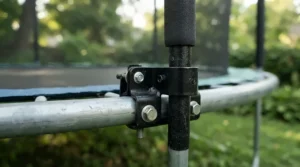
- Measure the legs. Count the legs and measure their outer diameter. A sleeve-on bar depends on this.
- Pick the attachment style. Leg-replacing bars are rigid, sleeve-on bars are flexible about fit, and quick-release bars are best for storage.
- Check height range. Compare the lowest and highest settings to your shortest and tallest users, and note whether it’s measured from the mat or the floor.
- Inspect the grip. Padded, comfortably thick grips beat bare metal over a 20-minute session.
- Read the returns policy. Compatibility claims sometimes fail in practice, so make sure you can send it back.
Frame Compatibility: Legs, Tubes and the Fit That Makes or Breaks It
Frame compatibility is the single biggest reason people return bars. Rebounders look similar, but the details differ.
Start with size. JumpSport’s own listings separate 39-inch and 44-inch frames, and one retailer states its 39-inch bar will not work on 44-inch models. Then look at leg type, because arched and straight legs behave differently, and some bars list one or both. Count your legs too, since the Needak instructions rely on picking two legs separated by one leg.
Here’s a practical trick for measuring leg diameter without calipers. Wrap a piece of string around the leg, mark where it overlaps, measure the length in millimetres, then divide by 3.14. That gives the outer diameter.
Beware of date-sensitive compatibility, too. The Leaps & Rebounds 40″ Adjustable Stabilizer Bar excludes trampolines bought before around mid-April 2019. And some bars are shaped differently altogether: the GladiatorFit Support Bar (128 × 40 × 10 cm, about 5 kg, steel) is described as designed for positioning on a 100 cm mini fitness trampoline, and is easy to position and remove. It’s listed on a Swiss Decathlon page, so confirm UK availability before you plan around it.
Universal Rebounder Balance Bar: Marketing Promise or Genuine Option?
A universal rebounder balance bar is a bar sold on the promise that it fits any rebounder. The honest answer is that “universal” usually means “fits many, within limits”. Sleeve-on designs such as the Leaps & Rebounds 40″ Adjustable Stabilizer Bar have the strongest claim, because they slip around legs rather than bolting into a specific frame. Brand-specific bars like the Fit Bounce Pro Stability Bar, bellicon T Bar Handle and Needak Stabilizing Bar are explicit about not being universal.
The real-world pattern from reviews is that fit problems show up in leg tube size and hole alignment. One buyer of the Fit Bounce Pro Stability Bar reported a lower leg tube too small on one side, and that’s the sort of tolerance issue a universal rebounder balance bar can magnify across many frame shapes.
Will a Universal Bar Fit My Rebounder?
Will a universal bar fit my rebounder? Possibly, but check four things before you buy:
- Leg diameter matches the bar’s sleeve size.
- Leg style (arched or straight) is supported.
- Purchase date, if the maker has redesigned the bar (as with the 2019 cut-off above).
- Return policy, in case it doesn’t.
If all four check out, you’re probably fine. If the seller can’t tell you the sleeve diameter, treat that as a warning sign.
Adjustable Height Rebounder Handle Bar: Getting the Grip Height Right
An adjustable height rebounder handle bar is only useful if the range fits the people using it. Compare the numbers carefully, because makers measure differently: the bellicon T Bar Handle gives 85–100 cm above the mat, the JumpSport 39″ Handle Bar gives 30–40 inches above the mat, the JumpSport Quick-Release 39″ Handle Bar goes from 20 to 40 inches, the Needak Stabilizing Bar measures mat to hand grip, and the Leaps & Rebounds 40″ Adjustable Stabilizer Bar measures from the floor.
A reasonable starting point, based on posture rather than any official standard, is a grip that lets your elbow bend comfortably with shoulders relaxed. Too high and you’ll hunch your shoulders. Too low and you’ll stoop. For most adults, that tends to land around waist height standing on the mat.
Pick a bar with finer steps if several people share it. The Fit Bounce Pro Stability Bar‘s ten settings and the JumpSport Quick-Release 39″ Handle Bar‘s ten settings give far more flexibility than a three-step design. Remember that the mat dips under your weight, so adjust while standing on it, not while looking at the empty frame.
Padded Grip Rebounder Handlebar: What Comfort Really Looks Like
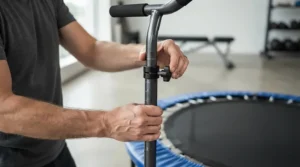
A padded grip rebounder handlebar sounds like a nicety until you’ve held cold bare steel for twenty minutes. Padding does three jobs: it insulates, it spreads pressure across your palm, and it adds friction when your hands get warm.
Check what’s on offer. The JumpSport 39″ Handle Bar has a padded handle, and the Leaps & Rebounds 40″ Adjustable Stabilizer Bar has cushioned foam handles. For others, grip details weren’t clearly stated in the listings I found, so verify before you buy.
Avoid assuming thicker is better. An oversized foam tube can be harder to grip, especially for smaller hands or arthritic fingers. Look for a diameter you can close your fingers around comfortably. Texture matters too: smooth foam can turn slippery with sweat, so wipe it down after sessions. Finally, think about replacements. Foam compresses over months of use, and makers that sell spare grips make life easier over the long term.
Handlebar Stability: Why Bars Wobble and How to Stop It
Handlebar stability depends on three things: the connection to the frame, the bar’s own flex, and the floor beneath it.
Connection first. Sleeve-on bars rely on tight leg fit and fully seated spring buttons, and the Needak guide explicitly warns that buttons can slide out of position during shipping. Leg-replacing bars like the JumpSport 39″ Handle Bar avoid sleeve play by becoming part of the frame. Next, flex. The Needak Stabilizing Bar is designed to flex with you, so some give isn’t a fault there. Rigid designs should feel solid.
Floor surface completes the trio. A rebounder on slippery laminate can creep, which makes even a rigid bar feel unstable. A non-slip mat beneath the feet helps.
A simple test: with the rebounder empty, push the bar gently side to side. Any clunking suggests loose fixings or a leg tip not fully seated. And remember the bar is a balance aid, not a hand-hold to hang your body weight from. Check your manufacturer’s guidance on the loads it’s built for.
Balance Bar for Fitness Trampoline vs Alternatives: Which Setup Wins?
Is an add-on bar better than a bundle, or than nothing at all? The table compares the realistic options.
| Option | Stability | Flexibility | Best For |
|---|---|---|---|
| Add-on bar (e.g. JumpSport 39″ Handle Bar) | High if fit is right | Removable on some models | Owners of an existing rebounder |
| Bundle (e.g. ACON Fit Round Rebounder with Balance Handlebar, Relaxdays Trampoline with Handrail) | High, designed together | Fixed to that rebounder | First-time buyers |
| No bar | Depends entirely on your balance | Maximum freedom | Confident, experienced jumpers |
| Improvised support (chair, worktop) | Low and unpredictable | Awkward | Nobody; avoid |
The analysis is straightforward. An add-on bar suits you if you already own a compatible rebounder, while a bundle like the ACON Fit Round Rebounder with Balance Handlebar removes the fit risk for new buyers. Skipping a bar is fine for confident jumpers, but improvised furniture supports are a false economy: a chair can slide, and a worktop can’t flex with you.
A 2024 review in the Journal of Education, Health and Sport concluded that mini-trampoline bouncing can improve balance and cardiovascular fitness, while noting that injuries are common and precautions matter. That’s the argument for a bar in one sentence.
Balance Bar for Fitness Trampoline Use for Seniors, Beginners and Recovering Jumpers
For older adults and anyone returning to exercise, a balance bar for fitness trampoline sessions is mostly a confidence tool. Reviewers of the Fit Bounce Pro Stability Bar describe using it when stepping on and off, and several JumpSport reviewers say they feel safer with a bar.
Medical guidance matters here. An NHS trust falls resource notes that regular strength and balance exercise can reduce the risk of falls, and that a programme should be tailored to the individual and overseen by a trained professional. It also suggests discussing any concerns with your GP before starting. A bar is helpful, but it doesn’t replace that advice.
For beginners, start with short sessions of two or three minutes, holding the bar with both hands, then progress to one hand and eventually fingertip contact. Choose a low setting for gentle marching or heel-lifts. For recovery, ask your physio what range of movement suits you before deciding on bar height. The lower settings on the JumpSport Quick-Release 39″ Handle Bar may suit seated-to-standing routines, while a taller bar suits upright bouncing.
Long-Term Cost and Maintenance for a Balance Bar for Fitness Trampoline
Cost per use is where a bar earns its keep. A £60 bar used four times a week for three years works out to roughly 10p a session. That’s cheaper than a coffee, and arguably a better investment than a rebounder you never use because you feel unsteady.
| Bar | Indicative price band | Fit certainty | Best For |
|---|---|---|---|
| Fit Bounce Pro Stability Bar | £40–£80 | High (matching rebounder) | Fit Bounce Pro II owners |
| JumpSport 39″ Handle Bar | £60–£110 | High (listed models) | Permanent spots |
| JumpSport Quick-Release 39″ Handle Bar | £70–£120 | High (listed models) | Frequent storage |
| bellicon T Bar Handle | £150–£250 | High (bellicon only) | Premium setups |
| Needak Stabilizing Bar | £80–£150 | High (Needak only) | Needak owners |
| Leaps & Rebounds 40″ Adjustable Stabilizer Bar | £30–£60 | Medium (measure first) | Budget broad-fit |
| ACON Fit Round Rebounder with Balance Handlebar | Bundle, check price | Guaranteed | New buyers |
These bands are indicative, drawn from retailer listings during research, and I couldn’t verify current UK prices for every item, so check the current price before buying. Looking at the table, the Leaps & Rebounds 40″ Adjustable Stabilizer Bar is the cheapest route but demands the most checking, while the bellicon T Bar Handle costs the most and removes the most uncertainty. The two JumpSport bars sit in the middle, and your storage habits decide which one wins.
Maintenance is minimal: monthly bolt checks, wiping grips and replacing worn foam. The bellicon T Bar Handle carries a two-year home warranty, which is worth knowing when you compare totals.
FAQ
❓ How much does a balance bar for fitness trampoline use cost in the UK?
❓ Is a balance bar for fitness trampoline sessions worth it for older adults?
❓ Where can I buy a balance bar for fitness trampoline setups online?
❓ Do I need tools to fit a rebounder balance bar?
❓ Can I fold or store my rebounder with the bar attached?
Conclusion
The best balance bar for fitness trampoline sessions is the one that fits your frame and your people, not the one with the longest feature list. If you own a matching rebounder, go brand-specific: the Fit Bounce Pro Stability Bar for Fit Bounce Pro II owners, the bellicon T Bar Handle for bellicon fans, or the Needak Stabilizing Bar for Needak machines. If you use a 39-inch JumpSport, choose between the rigid JumpSport 39″ Handle Bar and the removable JumpSport Quick-Release 39″ Handle Bar according to your storage habits.
If you own something else, the Leaps & Rebounds 40″ Adjustable Stabilizer Bar is the budget broad-fit gamble, as long as you measure first. And if you’re starting from scratch, the ACON Fit Round Rebounder with Balance Handlebar removes the fit puzzle altogether.
Before you buy, check the leg diameter, the frame size, the height range and the return policy. Do that, and your balance bar will do what it should: fade into the background while you bounce with a little more confidence.
✨ Ready to Bounce with Confidence?
🤸 Compare the seven options above, click your favourite highlighted name to check current pricing and availability, and give your rebounder the steady hand it deserves. Your next workout could feel a lot more secure!
Recommended for You
- Rebounder Accessories Bundle: 7 Essential Upgrades (2026 UK)
- Rebounder Under £150 For Low-Impact Cardio: 7 Smart Buys (2026)
- Rebounder For Mental Health & Stress Relief: 7 Calming Picks 2026
Disclaimer: This article contains affiliate links. As an Amazon Associate, I earn from qualifying purchases. If you purchase products through these links, we may earn a small commission at no additional cost to you.
✨ Found this helpful? Share it with your friends! 💬🤗
