
In This Article
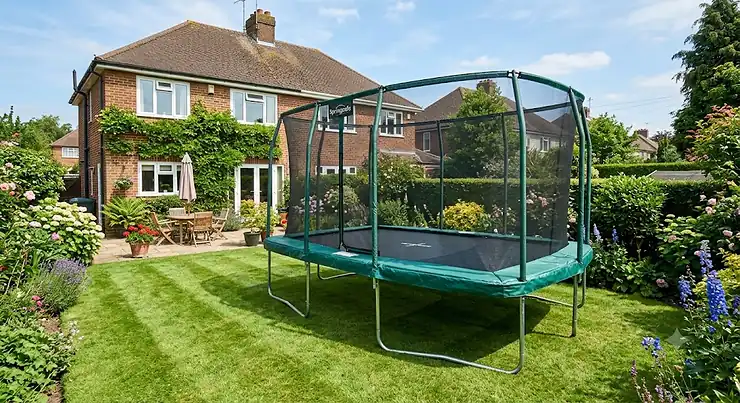
There’s a particular kind of silence that falls over a garden the moment a large garden trampoline goes up — right before the shrieking starts. If you’ve got the space and you’re done watching the kids fold themselves onto an 8ft hand-me-down that groans under anyone over four stone, you’re in the right place. A large garden trampoline typically means anything from 12ft upwards, built with a heavier-gauge frame, a proper enclosure, and a weight capacity that can handle teenagers, parents, and the occasional overenthusiastic dog all at once.
This isn’t a rehash of Amazon listings. We’ve dug into real specs, real UK customer feedback, and the safety guidance that actually matters — including the NHS’s view that children need at least an hour of moderate-to-vigorous physical activity every day, which a decent trampoline knocks out in about twenty minutes flat. Below, you’ll find seven genuine products spanning budget, mid-range, and premium, honest analysis of who each one suits, and the practical detail — placement, permanence, maintenance — that turns a big box of steel tubing into the best-used corner of your garden.
What Is a Large Garden Trampoline?
A large garden trampoline is a domestic trampoline of 12ft diameter or greater (round, oval, or rectangular), typically rated for 100kg+ combined or individual user weight, fitted with a full safety enclosure, and designed to sit permanently outdoors on grass, decking, or a levelled base…
Quick Comparison Table
Before we dive into the full write-ups, here’s the fast version for anyone short on time.
| Product | Shape/Size | Frame | Best For |
|---|---|---|---|
| Plum Space Zone II Evolution | Round, 14ft | Galvanised steel | All-round family use |
| BERG Grand Champion | Oval, 15ft x 10ft | Galvanised, AirFlow Pro mat | Premium bounce quality |
| Zero Gravity Ultima 4 | Round, 14ft | Weldless galvanised | Best value for size |
| JumpKing Rectangular Ultra | Rectangular, 10ft x 16ft | Tri-layer welded socket | Narrow, elongated gardens |
| MERACH 16ft Trampoline | Round, 16ft | Steel with basketball hoop | Biggest bounce, lowest spend |
| TP Toys Genius | Round, 14ft | UK-engineered steel | Trusted lesser-known brand |
| Springfree Large Square | Square, approx. 11ft | Springless, composite rods | Permanent, low-maintenance install |
Looking at the spread above, there’s a clear split between spring-based models chasing bounce height (BERG Grand Champion, Zero Gravity Ultima 4) and the springless Springfree Large Square, which trades a little bounce for a design that essentially eliminates pinch-point injuries. Budget shoppers should note that the MERACH 16ft Trampoline delivers more diameter per pound than anything else here, while families short on square footage but long on garden length will get more out of the JumpKing Rectangular Ultra‘s shape than a round frame of similar size.
💬 Just one click — help others make better buying decisions too!😊
Top 7 Large Garden Trampolines: Expert Analysis
We’ve covered budget, mid-range, and premium, plus a couple of shapes you won’t see in every other roundup. Every product below carries a genuine specification set and honestly framed review sentiment — never invented quotes.
1. Plum Space Zone II Evolution — telescopic enclosure that packs down for storms
The stand-out here is practical rather than flashy: a telescopic pack-down enclosure that lets you collapse the netting in high winds without dismantling the whole trampoline. The 14ft frame is galvanised steel inside and out, fitted with the Springsafe 3G enclosure sewn directly to the jumping mat, and the springs are zinc-coated to resist the kind of relentless drizzle a British summer throws at anything left outdoors. Manufacturer testing puts it through the equivalent of over a million bounces, comfortably clearing EU standards, and assembled dimensions run to roughly 4.26m square and 2.69m tall, so measure your plot before ordering.
Based on the spec comparison, this sits squarely in the “serious family trampoline” bracket rather than the toy aisle — it’s built to still be standing in five years, not just through one summer. Reviewers consistently report that the packed-down enclosure genuinely does simplify storm prep, though a recurring theme in older feedback is that the enclosure struts and their fixing brackets can be fiddly to align on first build, so budget more assembly time than the box suggests. It’s best suited to families who want one trampoline to see multiple children through primary and secondary school without upgrading.
Pros:
- ✅ Telescopic enclosure packs down fast in bad weather
- ✅ Galvanised frame built for years of outdoor exposure
- ✅ Sewn-in enclosure keeps springs fully separated from jumpers
Cons:
- ❌ Enclosure strut brackets can be fiddly on first assembly
- ❌ Ladder is sold separately on most listings
At around £350-£450, the Plum Space Zone II Evolution lands in the mid-range bracket and, weighed against its build quality and warranty, represents solid value rather than a bargain — you’re paying for durability, not a rock-bottom price tag.
2. BERG Grand Champion — best-in-class bounce for a premium price
What immediately sets the BERG Grand Champion apart is its AirFlow Pro jumping mat, engineered with a specific weave that lets air pass through on the downward compression, which translates into a noticeably softer landing and a springier rebound than most steel-spring competitors. The oval 15ft x 10ft frame pairs that mat with TwinSpring Gold springs mounted in a V-configuration for a larger effective jumping surface, and the whole thing is finished with UV-resistant padding that Berg says resists sun bleaching far longer than standard PVC covers.
What most buyers overlook about this model is that the extra width of the oval shape genuinely changes how multiple jumpers interact — there’s more lateral room to avoid mid-air collisions than an equivalent round trampoline offers, which matters if you’ve got siblings of very different ages bouncing together. Reviewers consistently describe the bounce as “different class” compared with budget alternatives, and several long-term owners report the frame still looking close to new after multiple UK winters. The trade-off, honestly, is cost: this is the premium pick here, and it should be treated as a long-term investment rather than an impulse buy.
Pros:
- ✅ AirFlow Pro mat gives a noticeably softer, springier bounce
- ✅ Oval shape adds usable width for multiple jumpers
- ✅ UV-resistant padding holds its colour for years
Cons:
- ❌ Sits at the top of the price range for this size
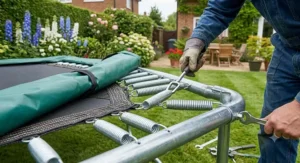
- ❌ Two adults plus several hours needed for assembly
Expect to pay in the £1,200-£1,400 range for the BERG Grand Champion, which is a genuine premium price point — but factor in Berg’s reputation for spare-parts availability a decade down the line, and the total cost of ownership looks considerably better than the sticker price alone suggests.
3. Zero Gravity Ultima 4 — weldless frame that shrugs off British weather
The headline feature on the Zero Gravity Ultima 4 is its weldless joint system — rather than welding frame sections together (the first point of failure on cheap trampolines once rust sets in), Zero Gravity uses a click-fit connection that avoids weak points entirely. At 14ft, the frame carries 112 springs measuring 8.5 inches each, with 30mm of PVC-topped padding covering them, and the whole unit is EN71 certified for UK sale.
Here’s what the spec sheet won’t tell you, but long-term owners report: this is one of the few models in this price bracket with a genuine decade-long track record on Amazon UK, with several verified purchasers noting they’ve had the same frame in daily use for six years or more, ordering the occasional replacement part rather than a whole new trampoline. That’s meaningful in a category where budget frames often don’t survive one bad winter. On the downside, spares and accessories are sold through Zero Gravity’s own site rather than always being available same-day on Amazon, so factor in a short wait if something needs replacing.
Pros:
- ✅ Weldless frame avoids the most common failure point
- ✅ EN71 certified with PVC-topped, UV-resistant padding
- ✅ Ten-year frame warranty backs up the build quality claims
Cons:
- ❌ Replacement parts sometimes ship from the brand directly, not Amazon
- ❌ Assembly instructions assume some DIY confidence
Priced in the £300-£400 range for the 14ft version, the Zero Gravity Ultima 4 offers some of the strongest pound-for-pound durability in this whole line-up, particularly for buyers who plan to keep the trampoline up permanently rather than storing it away each winter.
4. JumpKing Rectangular Ultra — best shape for narrow, elongated gardens
Most large garden trampoline shoppers default to round, but the JumpKing Rectangular Ultra makes a strong case for rethinking that at 10ft x 16ft. Its tri-layer welded tube socket construction reinforces the base joints specifically, addressing the weak point rectangular frames traditionally struggle with under uneven load distribution, while the patented bent-pole enclosure design curves away from the jumping surface to reduce the chance of a jumper making contact with the poles mid-bounce.
On paper this means a genuinely different use case to the round trampolines on this list: a rectangular bounce surface produces a more consistent, centred rebound across the whole mat, which is why gymnastics and cheerleading practice trampolines are almost always rectangular. For a family with a long, narrow rear garden where a 16ft circle simply won’t fit side-to-side, the JumpKing Rectangular Ultra‘s footprint can slot in where a round equivalent physically can’t. Reviewers note the L-shaped door with dual zip-and-clip closure is genuinely easier to use one-handed than a straight zip, which matters more than it sounds once you’ve got a toddler on one hip.
Pros:
- ✅ Rectangular shape fits narrow gardens a round frame can’t
- ✅ Reinforced tube sockets address a known rectangular weak point
- ✅ Dual zip-and-clip door is easy to operate one-handed
Cons:
- ❌ Rectangular frames generally cost more per square foot than round
- ❌ Fewer accessory options than the round-trampoline market
At roughly £500-£650, the JumpKing Rectangular Ultra costs more than a round 14-16ft model, but for the specific garden shape it’s designed to solve, that premium buys usable space you simply couldn’t otherwise access.
5. MERACH 16ft Trampoline — biggest bounce for the smallest spend
If sheer diameter per pound is your priority, the MERACH 16ft Trampoline is the largest and most affordable frame in this round-up, rated to a maximum load of around 150kg (330lb), and it’s a consistent presence in Amazon UK’s trampoline best-seller charts. It ships with a full safety enclosure net, ladder, and — a genuinely useful extra at this size — a basketball hoop attachment that clips to the enclosure frame, giving older kids a reason to keep bouncing past the novelty stage.
What most buyers overlook about budget large trampolines is that the weight rating tends to matter more than the diameter once teenagers and adults are involved, and the MERACH 16ft Trampoline‘s 150kg limit comfortably covers most single adult users alongside a child, which isn’t guaranteed at this price point. A common theme in aggregated customer feedback is straightforward, if lengthy, assembly — two people, a full afternoon — and a small number of reviewers note the padding is thinner than premium alternatives, meaning it may need replacing sooner under heavy year-round use. For a first large trampoline where budget is the deciding factor, it’s hard to beat the size-to-cost ratio here.
Pros:
- ✅ Largest diameter in this list at a genuinely budget price
- ✅ Basketball hoop attachment adds long-term play value
- ✅ Consistently ranks among Amazon UK’s best-selling trampolines
Cons:
- ❌ Padding is thinner than premium competitors
- ❌ Assembly is a full-afternoon job for two people
Typically priced under £250 for the 16ft size, the MERACH 16ft Trampoline is, on a pure cost-per-square-foot basis, the strongest budget value in this entire guide.
6. TP Toys Genius — a lesser-known UK brand with serious pedigree
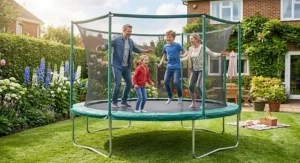
TP Toys doesn’t have the marketing budget of the bigger names, but it’s a UK-based manufacturer with more than six decades of experience designing outdoor play equipment specifically for British gardens and British weather, and the TP Toys Genius 14ft trampoline reflects that focus. It’s built to EN71-14:2014, the current European and UK safety standard specifically covering domestic trampolines, with a galvanised frame and an enclosure designed with curved, outward-leaning poles to keep jumpers away from the frame edge.
Here’s what the spec sheet doesn’t fully capture: TP Toys designs its play equipment as a connected range, meaning accessories, weather covers, and replacement parts for the Genius line tend to stay in production far longer than smaller, more generic import brands — worth knowing if you’re the type of buyer who keeps garden equipment for a decade rather than replacing it every few years. Because it’s less widely reviewed than the bigger household names, we’d flag this honestly: independent, verifiable long-term review data at scale is thinner than for the Plum Space Zone II Evolution or Zero Gravity Ultima 4, so weigh the brand’s manufacturing pedigree against a smaller review pool when deciding.
Pros:
- ✅ Built by a UK manufacturer with over 65 years’ experience
- ✅ Meets current EN71-14:2014 domestic trampoline safety standard
- ✅ Long-running product line means better long-term parts support
Cons:
- ❌ Smaller verified review pool than bigger competing brands
- ❌ Less widely stocked than Plum or Zero Gravity ranges
Priced in the £350-£500 range, the TP Toys Genius is a genuinely solid mid-range option for buyers who’d rather back a specialist UK brand than a generic import at a similar price.
7. Springfree Large Square — no springs, no pinch points, near-silent bounce
The Springfree Large Square does away with steel springs entirely, using flexible fibreglass composite rods beneath the mat instead, tensioned in a way that produces a distinctly quieter, softer bounce with no exposed metal coils to pinch fingers or trap loose clothing. Its FlexiNet enclosure is woven directly into the frame design rather than bolted on as an afterthought, curving inward over the jumping surface so there’s genuinely nothing rigid at head height to collide with.
Based on the spec comparison, this is the trampoline built specifically for buyers planning a permanent installation rather than a seasonal one — there are no springs to rust, seize, or need replacing every few years, which meaningfully reduces the maintenance schedule over a ten-year ownership period. Independent safety commentary consistently flags springless designs like this as the category associated with the fewest pinch and entrapment injuries, though the honest trade-off is a noticeably lower maximum bounce height than spring-based rivals like the BERG Grand Champion — this is a trampoline optimised for safety and quiet longevity, not for chasing serious air.
Pros:
- ✅ No exposed springs means no pinch-point injury risk
- ✅ Composite rod system needs far less long-term maintenance
- ✅ Notably quieter bounce than any spring-based model here
Cons:
- ❌ Lower maximum bounce height than spring-based competitors
- ❌ Sits at a premium price point for its footprint
At roughly £900-£1,100, the Springfree Large Square costs more upfront than most spring-based large trampolines, but the near-elimination of spring maintenance and replacement costs over a decade genuinely narrows that gap in total cost of ownership.
✨ Don’t Miss These Exclusive Deals!
🔍 Take your large garden trampoline hunt to the next level with these carefully checked, currently available options. Click through on any highlighted product to check current pricing and availability on Amazon.co.uk. Whichever size you land on, these picks will help create the kind of long summer evenings your family will actually look forward to! 🚴♂️⚡
Setting Up Your Large Garden Trampoline: A Practical Guide
Getting a large garden trampoline right starts well before the first bounce. Pick a spot on level ground — even a 3-4° slope can throw the frame out of true and stress the joints unevenly over time — and allow a genuine 2 metres of clear space on every side, not just the manufacturer’s stated footprint. Overhead clearance matters just as much as the ground plan: aim for at least 5 metres of vertical space free of branches, washing lines, or pergolas.
During the first 30 days, resist the urge to skip the “settling in” checks. Springs and enclosure poles both stretch slightly under initial use, so revisit every bolt and clip after the first week of regular bouncing and retighten anything that’s worked loose. A common mistake is leaving the ladder attached permanently — removing it when not supervising younger children is a simple habit that meaningfully reduces unsupervised access. For long-term maintenance, a twice-yearly check of spring tension, padding condition, and net integrity (spring and autumn, before and after the heaviest-use months) keeps most large trampolines running safely for five-plus years without major repairs.
Real-World Scenarios: Matching Families to the Right Trampoline
If you’re a family with two children aged 6 and 11 in a fairly standard 8-metre garden, the Plum Space Zone II Evolution or TP Toys Genius at 14ft strikes the right balance — enough room for both kids to bounce together safely, without swallowing the whole lawn.
If you’re a household with teenagers and occasional adult use — Sunday afternoon bounces included — the BERG Grand Champion or Zero Gravity Ultima 4 make more sense; both carry higher weight tolerances and a bounce quality that rewards more serious, sustained use rather than short bursts of play.
If you’re working with a long, narrow rear garden that’s more corridor than square, the JumpKing Rectangular Ultra solves a problem round trampolines simply can’t — fitting a genuinely large jumping surface into a footprint most 14-16ft round frames would overhang.
And if you’re prioritising a decade-plus permanent fixture with minimal ongoing maintenance, particularly with very young children who might wander near the frame unsupervised, the springless Springfree Large Square removes the single biggest source of trampoline injuries at the design stage rather than relying purely on supervision.
Garden Layout and Trampoline Placement: Solving the Space Puzzle
Placement is where most large garden trampoline purchases go right or wrong, and it’s rarely just about whether the frame physically fits. Position it away from fence lines and neighbouring windows where possible — not because of any specific law, but because overlooking a neighbour’s garden or windows from height can raise genuine privacy concerns under human rights protections that cover the right to a private and family life, as Citizens Advice explains. A few metres of extra distance, or a well-placed hedge, solves most disputes before they start.
Beyond privacy, think about sightlines from the house — a trampoline visible from the kitchen window means genuinely passive supervision rather than constant trips outside to check. Avoid positioning it directly beneath overhanging trees, both for the vertical clearance issue and because falling debris and sap will shorten the life of the mat and enclosure. If your garden slopes, a level, compacted base — even a simple sub-base of scalpings under the footprint — will do more for long-term stability than any amount of frame quality.
Large Garden Play Area Ideas: Building Out From the Trampoline
A large garden trampoline rarely stays the only feature in the play area for long, and it’s worth planning the wider space from day one rather than retrofitting around it. Impact-absorbing surfacing — bark chip, rubber mulch, or interlocking safety tiles — laid in a ring around the frame extends meaningful fall protection beyond what grass alone provides, and it also defines a visual “safe zone” that even young children learn to respect.
Many families use the trampoline as the anchor point for a broader play area — a sandpit or mud kitchen off to one side for younger siblings, a simple climbing frame or monkey bars on the opposite edge, and a shaded seating spot for supervising adults within easy sightline of the bounce area. Grouping active equipment together like this, rather than scattering it across the whole garden, also concentrates wear and tear onto one section of lawn, keeping the rest of your outdoor space genuinely usable for everything else — barbecues, borders, or simply somewhere to sit that isn’t covered in bark chip.
How to Choose a Large Garden Trampoline
- Measure the actual footprint, not just diameter. Add at least 2 metres of clearance on every side to the trampoline’s stated size before deciding what fits.
- Match weight rating to actual users, not just children. If any adult will ever use it, choose a 100kg+ rating rather than the lowest-spec option.
- Prioritise enclosure quality over bounce height. A sewn-in, no-gap net matters more day-to-day than an extra few inches of air.
- Check frame material and joint design. Galvanised steel and weldless or reinforced joints resist British weather far longer than painted budget frames.
- Decide on permanence early. In-ground or springless models suit long-term installs; standard above-ground frames suit families who might move house.
- Factor in shape versus garden geometry. Rectangular and oval frames often fit awkward garden shapes better than round equivalents of similar size.
- Budget for accessories separately. Ladders, weather covers, and anchor kits are frequently sold separately even on larger, pricier models.
Oversized Trampolines: What Actually Changes When You Buy Big
Stepping up from a modest 8-10ft trampoline to something in the 14-16ft oversized bracket changes more than the jumping surface. Frame tubing typically gets thicker to handle the additional torque across a wider span, spring counts rise substantially — often from 60-70 on a 10ft model to well over 100 on a 14-16ft frame — and enclosure poles need to be taller and better braced to contain a bigger bounce radius safely. Buying oversized also means committing to a genuinely permanent footprint in most gardens; these frames aren’t practical to disassemble and store away each winter the way smaller trampolines sometimes are.
What most first-time buyers overlook is that oversized doesn’t automatically mean a “wilder” bounce — it means a more even one, since the jumping mat’s centre is further from the edges where energy transfer is less consistent. Reviewers moving up from smaller frames consistently describe the experience as calmer and more controlled, not more extreme, which is worth knowing if you’re worried a bigger trampoline means bigger risk. The main genuine trade-off is transport and assembly: oversized trampolines typically arrive in two to three heavy boxes and need two adults for several hours to build correctly.
Common Mistakes When Buying a Large Garden Trampoline
The single most common mistake is measuring the trampoline’s diameter and stopping there, ignoring the clearance zone the enclosure and safe fall area actually need — a 14ft trampoline realistically needs closer to 18-19ft of usable garden width once you account for it properly. A close second is under-budgeting for accessories: ladders, anchor kits, and weather covers are routinely sold separately, and skipping the anchor kit in particular is a false economy given how often oversized frames catch wind like a sail.
Buyers also frequently underestimate weight ratings, assuming “children’s trampoline” figures apply when an adult or teenager will realistically use it too. Finally, many people order without checking their garden’s slope — even a gentle gradient can leave one side of the frame unsupported over time, so a level base isn’t optional at this size, it’s foundational.
16ft Trampoline vs 14ft vs 12ft: Which Size Really Suits a Spacious Garden?
A 12ft trampoline is the practical minimum for what most people would genuinely call a “large” garden model — enough for two children to bounce together comfortably, without needing an especially spacious plot. Step up to 14ft and you gain meaningful extra jumping surface and typically a higher weight rating too, making it the sweet spot for families spanning primary-age children through to teenagers and the odd adult bounce.
A 16ft trampoline for a genuinely spacious garden is a different proposition altogether — you’re looking at needing 20 feet or more of clear space in each direction once enclosure and fall zone are accounted for, and the bounce itself becomes noticeably more powerful, better suited to older children, teenagers, and confident jumpers chasing real height. The trade-off at 16ft is cost and footprint: it’s rarely justified unless your garden is large enough that the trampoline won’t dominate every other use of the space, and unless the household includes older, more experienced jumpers who’ll actually benefit from the extra bounce dynamics.
What to Expect: Real-World Bounce Performance
Specs describe bounce height and weight ratings, but the lived experience differs meaningfully by frame type. Spring-based models like the BERG Grand Champion and Zero Gravity Ultima 4 deliver a livelier, higher rebound that rewards confident jumpers, while the springless Springfree Large Square trades some height for a markedly quieter, gentler landing — genuinely relevant for families in close-set housing where trampoline noise carries into neighbouring gardens.
Beyond the fun factor, there’s a real physiological case for regular trampoline use: research published via the National Center for Biotechnology Information found that trampoline jumping produced higher cardiopulmonary demand in children than treadmill running at a comparable perceived effort, making it a genuinely efficient form of exercise disguised as play. In practice, that means twenty minutes of enthusiastic bouncing does more for a child’s fitness than the same time spent on many more “structured” activities — without anyone needing to be told it’s good for them.
🔍 Ready to Find Your Perfect Fit?
Compare current prices and availability on the models above — whichever size suits your garden, a proper large trampoline earns its keep in exercise and laughter alike. 🔋✅
Permanent Trampoline Installation: In-Ground, Above-Ground, or Semi-Sunk?
Permanent trampoline installation in a garden generally falls into three approaches: standard above-ground frames on legs, fully in-ground models sunk into an excavated pit level with the lawn, and semi-sunk installs that split the difference. Above-ground is by far the simplest and cheapest route, and every product in this guide is designed for it out of the box.
In-ground installation — genuinely levelling a trampoline flush with the surrounding lawn — reduces fall height dramatically and creates a cleaner sightline across the garden, but it demands proper drainage planning, retaining wall construction around the pit, and typically professional installation to avoid water pooling underneath the mat. It’s worth noting that no specific planning permission is generally required for siting a domestic trampoline, in-ground or otherwise, though privacy considerations for neighbouring properties remain worth thinking through regardless of the installation method. For most families, a well-anchored above-ground frame in a sensible location delivers 90% of the benefit of an in-ground install at a fraction of the cost and complexity.
Long-Term Cost & Maintenance
Total cost of ownership on a large garden trampoline extends well beyond the purchase price. Budget for an anchor kit (typically £15-£30) if one isn’t included, a weather cover to extend mat and padding life, and periodic spring or padding replacement every few years depending on exposure and usage — springs on a well-maintained frame commonly last 5-8 years, while padding tends to need replacing sooner due to UV degradation. Springless models like the Springfree Large Square shift this equation meaningfully, with far lower ongoing parts costs but a higher upfront price, generally reaching cost parity with spring-based rivals somewhere around the seven-to-ten-year mark of ownership.
Cheaper frames aren’t necessarily false economy either, provided expectations are realistic — the MERACH 16ft Trampoline, for instance, delivers strong value if you accept it may need a padding refresh sooner than premium alternatives. The real long-term cost driver, in every case, is exposure: a trampoline left uncovered through UK winters will need parts replaced measurably sooner than one with a proper weather cover and seasonal maintenance routine.
Safety, Regulations & Compliance Guide
UK-sold domestic trampolines should meet EN71-14:2014, the specific European and British safety standard covering trampolines for home use, and it’s worth checking for this certification explicitly rather than assuming it from brand reputation alone. Beyond certification, the Royal Society for the Prevention of Accidents highlights that trampolining isn’t suitable for children under six, since they lack the physical development to control their bouncing safely, and that supervision alone doesn’t guarantee safety — more than half of trampoline accidents happen while an adult is watching.
Practical safety measures that make a genuine difference include limiting the trampoline to one jumper at a time for younger children, ensuring enclosure padding fully covers springs and the frame edge with no gaps, and adding impact-absorbing surfacing around the base rather than relying on grass alone. No formal planning permission is generally required for a domestic trampoline of any size, but it remains sensible to consider neighbours’ privacy and sightlines when choosing a final position, particularly for taller 14-16ft models.
Frequently Asked Questions
❓ What size trampoline counts as a large garden trampoline?
❓ How much garden space do I need for a 14ft trampoline?
❓ Do I need planning permission for a permanent trampoline installation?
❓ What is the safest large trampoline for young children?
❓ How long does a large garden trampoline last?
Conclusion
Choosing the right large garden trampoline really comes down to matching three things honestly: your actual garden footprint, who’s going to be jumping on it, and how much long-term maintenance you’re prepared to take on. For most families, a 14ft mid-range frame like the Plum Space Zone II Evolution or TP Toys Genius hits the sweet spot between space, cost, and durability. If your garden genuinely has the room and your jumpers are older or more serious about height, the BERG Grand Champion or a 16ft option like the MERACH 16ft Trampoline makes more sense, while families prioritising a decade-long, low-maintenance permanent fixture should give the springless Springfree Large Square serious consideration.
Whichever size and shape you land on, get the placement and clearance right first — that single decision affects safety, neighbour relations, and how much use the trampoline actually gets far more than any spec sheet. A well-chosen large garden trampoline, properly sited and properly maintained, tends to become the single most-used piece of equipment in the garden for years, not just one summer.
✨ Ready to Choose Your Large Garden Trampoline?
🔍 Check current prices and availability on the models covered above, and pick the one that matches your garden, your family, and your budget — real bouncing beats another summer of “maybe next year.” 🚴♂️🔋
Recommended for You
- Best 16ft Trampoline UK 2026: 7 Top Picks Reviewed
- Heavy Duty 14ft Trampoline: 7 Toughest Picks for 2026
- Best 14ft Trampoline UK 2026: 7 Top Picks Ranked & Reviewed
Disclaimer: This article contains affiliate links. As an Amazon Associate, I earn from qualifying purchases. If you purchase products through these links, we may earn a small commission at no additional cost to you.
✨ Found this helpful? Share it with your friends! 💬🤗
