
In This Article
A garden trampoline is supposed to be the thing that gets everyone off the sofa. But buy the wrong one, and within a season the mat sags, the springs stretch like old elastic, and the whole thing bounces about as well as a wet mattress. If you’ve ever watched a “family-size” trampoline visibly wince every time an adult gets on, you already know why a proper heavy duty 14ft trampoline matters more than the marketing photos let on.
This guide cuts through the vague “suitable for all ages” language you’ll find on most listings. We’ve pulled together seven genuinely reinforced 14ft trampolines sold in the UK, checked their actual weight limits against manufacturer data, and worked out which frame, spring and mat combinations hold up when a teenager and two adults all want a go on the same afternoon. Whether you’re after a strong large trampoline for a mixed-age household, a model with a properly documented high weight limit, or simply the most durable option your budget allows, you’ll find it broken down here — specs explained in plain English, not just listed and left for you to guess at.
We’ll also cover the bits Amazon listings tend to skip: how commercial-grade spring systems actually differ from the bargain-bin variety, what a 160kg weight limit trampoline realistically looks like on the UK market right now, and where reinforced 14ft trampolines for adults earn their higher price tag versus where that price is just branding. According to RoSPA’s trampoline safety guidance, garden trampoline injuries are common enough that build quality genuinely matters, not just for longevity but for safety — so we’re treating this as a proper buying decision, not a Boxing Day impulse purchase.
Quick Comparison Table
| Trampoline | Weight Limit | Shape | Best For |
|---|---|---|---|
| Zero Gravity Ultima 4 14ft | 150kg | Round | Budget buyers wanting a genuine 150kg rating |
| Rebo Base Jump 14FT (Halo II) | Up to 150kg | Round | First-time buyers on a tighter budget |
| Kanga Hi-Power 14ft | 150kg | Round | Mixed-age families with teens and adults |
| Plum Magnitude 14ft | 125-150kg (size-dependent) | Round | Exposed, rain-prone gardens |
| JumpKing High Jump 14ft | 140-159kg | Round | Buyers chasing the highest realistic weight limit |
| Kanga Blue 9x14ft | 150kg | Rectangular | Serious jumpers wanting a directed bounce |
| BERG Grand Champion 14ft | 375kg | Round | Premium buyers who want headroom to spare |
Looking across the table, the pattern is obvious once you know what to look for: round 14ft trampolines from established UK garden brands cluster tightly around a 150kg single-user limit, while only a couple of models — the JumpKing High Jump 14ft and the BERG Grand Champion 14ft — push meaningfully past that ceiling. Rectangular options like the Kanga Blue 9x14ft don’t necessarily raise the weight limit, but they change how that limit performs in practice, concentrating lift in the centre of the mat rather than spreading it thin across a circle.
💬 Found a favourite already? Bookmark this page and scroll down for the full breakdown before you buy.
Top 7 Heavy Duty 14ft Trampolines: Expert Analysis
1. Zero Gravity Ultima 4 14ft — best budget pick with a genuine 150kg limit
The Zero Gravity Ultima 4 14ft is proof that “budget” doesn’t have to mean “flimsy,” provided you know where to look. Built on a fully galvanised steel frame with 112 springs measuring 8.5 inches, it carries a documented 150kg user weight limit — a figure that’s unusually well substantiated for a trampoline in this price bracket, since the manufacturer publishes it directly rather than burying it in a PDF. The curved-pole “click and release” enclosure is a small but genuinely useful touch: in high wind, you can detach the poles in minutes instead of wrestling with screws.
Based on the spec comparison, this model earns its heavy duty label through structural basics rather than flashy extras — thick 30mm padding, reinforced frame joints, and a Grade A Permatron jumping bed. It’s best suited to families who want real weight capacity without paying premium-brand prices, and to first-time buyers who’d rather not gamble on an unknown import brand. Aggregated feedback on the manufacturer’s own storefront sits around 4.8 out of 5 across well over a hundred verified purchases, with recurring praise for the 10-year frame warranty giving buyers genuine confidence rather than empty reassurance.
Pros:
- ✅ Published 150kg weight limit backed by manufacturer data
- ✅ Quick-release enclosure poles for storm-proofing
- ✅ 10-year frame warranty shows real confidence
Cons:
- ❌ Padding thickness trails premium rivals slightly
- ❌ Assembly instructions could be clearer for beginners
At the time of research, pricing sits in the £260-£300 range depending on colourway. For buyers prioritising verified weight capacity over brand prestige, it’s difficult to beat on value.
2. Rebo Base Jump 14FT (Halo II) — toughest springs for the price
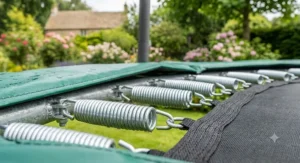
The Rebo Base Jump 14FT (Halo II) takes a different route to durability: longer springs. At 180mm, they’re noticeably longer than the 8.5-inch (216mm-equivalent, but thinner-gauge) springs found on some rivals, which in practice means a softer, more forgiving bounce that puts less cumulative stress on the frame joints over time. The Halo II enclosure system uses a central horizontal rod rather than a full pole cage, which keeps the net taut without eating into jumping space.
What most buyers overlook about spring length is that it isn’t just about bounce height — longer springs distribute load more gradually, which is exactly what you want on a trampoline that’s going to see adult use regularly rather than occasionally. This makes the Base Jump a sensible pick for households where an older teenager or a parent will be using it several times a week, not just on birthdays. Reviewers on major UK retail sites consistently describe the frame as “solid” and single out the tool kit and instructions as more complete than typical budget bundles, though a handful of buyers note the surround pad needs re-tensioning after the first summer.
Pros:
- ✅ Longer 180mm springs ease stress on the frame
- ✅ Halo II enclosure maximises usable jump space
- ✅ Comprehensive tool kit included as standard
Cons:
- ❌ Surround pad may need re-tensioning after heavy use
- ❌ Fewer colour options than some competitors
Expect a price in the £220-£280 range at the time of research. It’s a strong reinforced 14ft trampoline to buy if you want durability without stretching to the mid-range brands.
3. Kanga Hi-Power 14ft — best all-rounder for mixed-weight families
The Kanga Hi-Power 14ft is built specifically for households where jumpers vary wildly in size — think a nine-year-old and their 90kg dad on the same trampoline across a weekend. Its “hi-power” spring count is genuinely higher than Kanga’s standard 14ft model, which pushes the rated weight limit up to 150kg while keeping the bounce controlled rather than erratic under a heavier user.
Here’s what the spec sheet won’t tell you outright, but the design implies clearly: more springs mean more force is needed to compress the mat fully, so very light children may find the bounce feels slightly flatter than on a lower-spring-count trampoline. That’s a deliberate trade-off, not a flaw — it’s what lets the frame handle a 150kg adult without the mat bottoming out against the ground on a big jump. For a garden where teenagers and adults are the primary users, that trade-off works firmly in your favour. Retailer-verified reviews frequently mention straightforward assembly (commonly cited at around four hours for two people) and consistently note that the 150kg limit is treated as a strict, non-negotiable figure by the brand rather than an aspirational one — one recurring, minor gripe is that the ladder rungs feel a touch narrow underfoot.
Pros:
- ✅ Higher spring count genuinely raises real-world capacity
- ✅ 150kg limit is treated as a firm, tested figure
- ✅ Straightforward two-person assembly reported widely
Cons:
- ❌ Bounce feels flatter for lighter children
- ❌ Ladder rungs are narrower than some rivals
At the time of research, this sits in the £330-£380 range. Genuinely one of the best strong large trampolines for households that span multiple weight classes.
4. Plum Magnitude 14ft — best rust-proofing for exposed gardens
British weather is not kind to garden steelwork, and the Plum Magnitude 14ft is engineered with that specifically in mind. Its standout feature is the “Tramp Klamp” bracket system, which fully encases the leg-and-frame joints rather than leaving bolted connections exposed — the single most common rust-entry point on cheaper trampolines. The frame itself is galvanised both inside and out, not just on the visible surface.
On paper this means a longer usable lifespan in gardens that catch driving rain or sit in a low, damp corner of the plot, where lesser frames start showing surface rust within eighteen months. The patented 3G enclosure curves inward at the base to shield users from the springs while flaring outward above head height, adding genuinely usable jumping room without extending the overall footprint. This is a trampoline built by a brand with over 25 years in outdoor play equipment, and reviewers consistently single out the joint protection as the standout feature that separates it from cheaper 14ft models — though a few buyers note the enclosure poles themselves are bare foam rather than fabric-covered, which weathers faster than the frame does.
Pros:
- ✅ Tramp Klamp joints resist rust far longer than exposed bolts
- ✅ 3G enclosure adds space without a bigger footprint
- ✅ Backed by 25+ years of UK outdoor play expertise
Cons:
- ❌ Enclosure poles are bare foam, not fabric-wrapped
- ❌ Weight limit varies by size, so check the 14ft figure specifically
Pricing typically falls in the £280-£340 range at the time of research. If your garden is exposed to the elements, this is the reinforced 14ft trampoline worth the extra thought.
5. JumpKing High Jump 14ft — highest verified weight limit near 160kg
If a 160kg weight limit trampoline is specifically what you’re after, the JumpKing High Jump 14ft gets closer than almost anything else round-framed and readily available in the UK. Its documented range sits at 140-159kg, built on 16-gauge (4.5mm-diameter tube) galvanised steel with four W-shaped legs rather than the more common U-shaped design, which spreads ground contact over a wider area and resists sideways flex under a heavier jumper.
What the spec sheet doesn’t spell out is how much that W-leg design matters in practice: it’s the difference between a trampoline that stays planted when a 100kg-plus adult lands slightly off-centre and one that rocks unnervingly on its feet. Compliance with both ASTM and TUV standards gives this model international testing credibility beyond the UK’s own BS EN 71-14 mark, which matters if you want independent verification rather than just a manufacturer’s own claim. Fitness-retailer reviewers highlight the tri-layer socket joint system as unusually robust for a domestic trampoline, and the 10-year frame warranty against 5 years on the jumping bed reflects genuine confidence in the steel, even where softer components wear faster.
Pros:
- ✅ 140-159kg weight limit, near the top of the domestic market
- ✅ W-shaped legs resist sideways flex under heavier users
- ✅ Dual ASTM and TUV certification for independent testing
Cons:
- ❌ Pricier than standard round 14ft competitors
- ❌ Availability can be inconsistent between UK retailers
At the time of research, expect a price in the £400-£480 range. For heavier adult users specifically, this is arguably the strongest heavy duty outdoor play equipment for adults on this list at a round-frame price point.
6. Kanga Blue 9x14ft — best shape for serious bouncers
Switch from round to rectangular and the physics change. The Kanga Blue 9x14ft uses 88 springs run along its long sides rather than distributed in a circle, which concentrates lift in the centre of the mat and produces a noticeably more consistent, directed jump — the reason gymnastics coaches tend to favour rectangular formats over round ones for anyone developing technique.
Here’s what most buyers overlook when comparing shapes rather than sizes: a rectangular trampoline’s 150kg weight limit behaves differently under load than a round one’s identical figure, because the flattest, most predictable bounce zone sits dead centre rather than tapering off toward the edges. That makes this model particularly well suited to teenagers and adults working on specific jumps rather than casual family bouncing, and its 2.0mm hot-galvanised frame — identical spec to Kanga’s round range — gives it the same structural pedigree in a different footprint. The trade-off is a longer, narrower garden requirement than a round 14ft model of similar jump area, so it suits deep-but-not-wide plots better than square ones. Retailer reviews repeatedly describe the spring tensioning as noticeably firmer underfoot than round equivalents, which some users love and others find takes a session or two to adjust to.
Pros:
- ✅ Centre-concentrated bounce suits technique-focused jumpers
- ✅ Identical 2.0mm galvanised frame spec to Kanga’s round range
- ✅ Single-user 150kg limit is a firm, stated figure
Cons:
- ❌ Needs a longer, narrower plot than round equivalents
- Pricing sits around the £480-£550 range at the time of research. A genuinely strong choice if serious jumpi❌ Firmer bounce takes adjustment for casual usersng technique matters more than casual family fun.
7. BERG Grand Champion 14ft — premium pick built for heaviest use
At the top of this list, the BERG Grand Champion 14ft is in a different weight class entirely — literally. Its published limit of 375kg dwarfs every round trampoline covered so far, built around BERG’s TwinSpring Gold system, which pairs a shorter, stiffer inner spring with a longer outer spring to boost load capacity without sacrificing bounce quality. The AirFlow jumping mat is designed with additional venting to reduce wind resistance and drag on the frame during use.
Based on the spec comparison, this is less a “heavy duty” trampoline than a genuinely commercial-grade spring system dropped into a domestic garden, and the price reflects that positioning. It’s aimed at buyers who want serious headroom above their actual expected usage — a large family with several teenagers, a household that regularly hosts groups of kids, or simply anyone who never wants weight capacity to be the reason they can’t join in. The Deluxe safety enclosure and documented multi-year warranty back up the premium positioning, and independent reviewers consistently rate the AirFlow mat’s durability and bounce consistency as class-leading, even after several UK winters, though the recommended minimum age of around 12 for full use of the model reflects how powerful its bounce actually is.
Pros:
- ✅ 375kg weight limit is dramatically higher than round rivals
- ✅ TwinSpring Gold system boosts capacity without harsh bounce
- ✅ AirFlow mat rated for strong long-term durability
Cons:
- ❌ Significantly pricier than every other model here
- ❌ Powerful bounce means a higher recommended minimum age
At the time of research, this sits in the £850-£1,000+ range. It’s an investment, but for households that genuinely need commercial-grade headroom, it’s the clearest justification for the spend on this list.
Full Comparison: Specs, Price Ranges and Best-Fit Buyer
| Trampoline | Weight Limit | Frame | Price Range | Best For |
|---|---|---|---|---|
| Zero Gravity Ultima 4 14ft | 150kg | Galvanised steel, 112 springs | £260-£300 | Budget buyers |
| Rebo Base Jump 14FT (Halo II) | ~150kg | 180mm springs | £220-£280 | First-time buyers |
| Kanga Hi-Power 14ft | 150kg | Hi-spring-count steel | £330-£380 | Mixed-weight families |
| Plum Magnitude 14ft | 125-150kg | Tramp Klamp galvanised | £280-£340 | Exposed/damp gardens |
| JumpKing High Jump 14ft | 140-159kg | 16-gauge W-leg steel | £400-£480 | Heavier adult users |
| Kanga Blue 9x14ft | 150kg | 2.0mm galvanised, rectangular | £480-£550 | Serious jumpers/technique |
| BERG Grand Champion 14ft | 375kg | TwinSpring Gold system | £850-£1,000+ | Maximum headroom, premium |
Read across this table and the value curve becomes clear: you pay roughly linearly for weight capacity up until the JumpKing High Jump 14ft, at which point the BERG Grand Champion 14ft breaks the pattern entirely by more than doubling the weight limit for roughly double the price — genuinely good value if you need that headroom, genuinely wasted money if you don’t. For most mixed-age UK households, the Kanga Hi-Power 14ft or Zero Gravity Ultima 4 14ft sit in the sensible middle ground where price and real-world capacity line up best.
✨ Don’t Miss These Exclusive Deals!
🔍 Take your garden setup to the next level with these carefully selected trampolines. Click on any highlighted model to check current pricing and availability. The right pick will give your whole family — not just the kids — genuinely durable, worry-free bouncing for years to come!
What Makes a Trampoline “Heavy Duty”? Frame, Springs and Mat Explained
A heavy duty 14ft trampoline is a reinforced garden trampoline built with a thicker-gauge steel frame, a higher-tensile spring system, and a load-rated jumping mat, typically supporting single-user weights of 125kg to 375kg depending on the model — well above the 80-100kg ceiling common on smaller, budget-focused trampolines.
Three components decide whether that “heavy duty” label is earned or just marketing. Frame gauge is the steel tube’s wall thickness, usually 1.2mm to 2.0mm on domestic models — thinner gauges flex more under repeated loading and fatigue faster. Spring count and length determine how load spreads across the mat; more springs generally raise capacity, but only if the frame gauge is rated to match, otherwise you’ve just built a stronger mat on a weaker frame. And mat material — usually permatron or polypropylene weave — determines how the jumping surface itself handles repeated stress without stretching permanently out of shape, which is why cheap mats sag into a bowl shape within a season even on a perfectly sturdy frame.
The strongest large trampoline on paper isn’t necessarily the one with the single biggest number in its spec sheet — it’s the one where frame, springs and mat are all rated to the same standard, so no single component becomes the weak link.
How to Choose a Heavy Duty 14ft Trampoline
- Check the published weight limit, not the “family size” label. Marketing terms like “family” or “adult-friendly” mean nothing without an actual kilogram figure from the manufacturer.
- Match frame gauge to expected use. For regular adult use, look for 1.4mm steel or thicker; anything below that is better suited to occasional, lighter use.
- Count the springs and check their length. More springs generally mean higher capacity, but longer springs (170mm+) distribute stress more gently over time.
- Confirm the enclosure height and closure system. A taller net with a lockable zip matters more as jumper height and weight increase.
- Look for BS EN 71-14 compliance as a baseline. This is the UK’s domestic trampoline safety standard, and any model sold legitimately should meet it.
- Factor in garden shape before shape of trampoline. Round suits most gardens; rectangular needs a longer, narrower plot but rewards technique-focused jumpers.
- Read the warranty terms on frame versus mat separately. A 10-year frame warranty paired with only 1-2 years on the mat or springs tells you where the manufacturer expects wear to happen first.
Commercial-Grade Spring System Trampoline: What “Commercial-Grade” Actually Means
The phrase “commercial-grade” gets used loosely across trampoline listings, but it has a fairly specific meaning when it’s accurate: springs and frame components rated to handle sustained, repeated heavy loading — the kind you’d expect in a trampoline park rather than a back garden used a few times a week.
In practice, that means thicker-gauge spring wire (often 3.2mm or above), dual-spring systems like BERG’s TwinSpring Gold that pair a stiff inner spring with a more flexible outer one, and frame tubing gauge matched to handle the higher tension those springs generate. What most buyers overlook is that a commercial-grade spring system only delivers its full benefit if the frame and mat around it are rated to match — bolt heavy-duty springs onto a standard frame and you’ve simply moved the weak point rather than removed it. Among the models covered here, the BERG Grand Champion 14ft is the clearest genuine example of a matched commercial-grade system; the JumpKing High Jump 14ft and Kanga Hi-Power 14ft both step meaningfully in that direction without the full commercial price tag.
Trampolines With a 160kg Weight Limit: What’s Realistically Available
Buyers searching specifically for a 160kg weight limit trampoline are often surprised how few round, domestic 14ft models genuinely reach that figure — most established UK garden brands cluster their round trampolines at exactly 150kg, which appears to function as an industry-standard ceiling for that frame style rather than a coincidence.
| Model | Documented Limit | How Close to 160kg |
|---|---|---|
| JumpKing High Jump 14ft | 140-159kg | Effectively at the ceiling for a round frame |
| Kanga Hi-Power 14ft | 150kg | 10kg short, but a firmly tested figure |
| Zero Gravity Ultima 4 14ft | 150kg | 10kg short, budget-tier equivalent |
| BERG Grand Champion 14ft | 375kg | Comfortably exceeds 160kg by a wide margin |
The takeaway here is that 160kg specifically sits right at the practical limit of what a standard round steel frame can support before you need a fundamentally different engineering approach — which is exactly why the BERG Grand Champion 14ft doesn’t inch past that figure but leaps over it, using a different spring architecture entirely rather than just thicker steel. If 160kg is a hard requirement rather than a rough target, the JumpKing High Jump 14ft is the closest like-for-like match; if you want real margin above it, the BERG is the safer long-term bet.
Heavy Duty 14ft Trampolines for Adults
Buying specifically for adult use changes the calculus. A trampoline rated for children technically holding a higher number doesn’t mean it performs well under sustained adult bouncing, because repeated heavier loading accelerates spring fatigue and frame stress in ways occasional lighter use never triggers.
For adults using a trampoline regularly — several sessions a week rather than the odd go — prioritise both the weight limit and the frame gauge together, not the weight limit alone. The JumpKing High Jump 14ft and BERG Grand Champion 14ft are the clearest fits here, both built on frame specifications designed to absorb repeated, not just occasional, heavy loading. If budget is the deciding factor, the Kanga Hi-Power 14ft‘s higher spring count still makes it a genuinely usable option for adult exercise routines, provided you accept a firmer, less generous bounce than the premium models offer. One practical point worth flagging: even models rated for 150kg or more are generally single-user limits, so two adults bouncing together — even if their combined weight sits under the stated figure — isn’t what the rating covers.
Practical Usage Guide: Setup, First 30 Days and Maintenance
Getting a heavy duty 14ft trampoline set up correctly matters more than with smaller models, simply because there’s more steel, more springs, and more force involved if something’s assembled wrong. Start on level, well-draining ground — even a slight slope concentrates stress unevenly across the legs over time, accelerating wear on one side of the frame. Leave at least 2 metres of clear space on all sides and 5 metres overhead, well beyond what feels necessary until you remember a bounce under a heavier adult reaches noticeably higher than a child’s.
During the first 30 days, springs stretch and settle into their working tension — this is normal, but it’s worth re-checking spring hooks and enclosure net tension after the first two weeks of regular use, since initial “bedding in” can leave a few springs looser than the rest. A common mistake is skipping this check entirely and only noticing uneven tension once the mat starts sitting visibly off-centre. Beyond the first month, a simple maintenance schedule pays for itself: a monthly visual check of springs and frame joints for rust or wear, a seasonal tightening of enclosure poles, and — genuinely useful and rarely mentioned in manuals — rotating your entry point slightly every few weeks if the trampoline gets heavy daily use, since a single well-worn access route stresses the mat and net unevenly over a season.
Winter care deserves its own mention for UK gardens specifically: a breathable weather cover reduces moisture pooling on the mat, which is a bigger cause of premature mat degradation than cold temperatures alone.
Real-World Scenarios: Which Trampoline Fits Your Household
Consider three genuinely different households, because “best trampoline” honestly depends on who’s using it. A family with two children under 10 and occasional adult supervision doesn’t need the same trampoline as a household with three teenagers and two adults who all want a proper bounce most weekends — and neither of those matches a couple in their 30s buying primarily for their own low-impact cardio sessions.
For the young-children household prioritising safety margin and budget over maximum weight capacity, the Zero Gravity Ultima 4 14ft covers the realistic use case comfortably, with capacity to spare as the kids grow into teenagers. For the mixed-age, multi-teenager household where weight capacity genuinely gets tested most weekends, the Kanga Hi-Power 14ft or JumpKing High Jump 14ft make more sense, since their higher spring counts and frame gauges are specifically built for that repeated heavier use rather than just theoretically rated for it. And for adults using a trampoline primarily as low-impact exercise — where consistency of bounce and long-term frame durability under near-daily use matter more than headline weight figures — the BERG Grand Champion 14ft‘s commercial-grade spring system earns its premium price precisely because it’s engineered for that sustained, repetitive load pattern rather than occasional family fun.
Buyer’s Decision Framework
If budget is your primary constraint and weight limit needs are moderate (under 150kg), choose the Zero Gravity Ultima 4 14ft or Rebo Base Jump 14FT, because both deliver genuinely tested capacity at the lowest realistic price point on this list.
If your household spans a wide weight range across regular users, choose the Kanga Hi-Power 14ft, because its higher spring count is specifically engineered to handle variable loads without the bounce feeling erratic.
If a specific high weight limit near 160kg is a hard requirement, choose the JumpKing High Jump 14ft, because it’s the closest documented match among round-frame domestic models.
If your garden is exposed to consistent rain or damp conditions, choose the Plum Magnitude 14ft, because its Tramp Klamp joint protection specifically targets the most common failure point in UK weather.
If you want serious headroom above any realistic household need, choose the BERG Grand Champion 14ft, because its commercial-grade spring system is the only option here built to a fundamentally higher engineering standard rather than an incrementally reinforced one.
Common Mistakes When Buying a Reinforced 14ft Trampoline
The most common mistake is treating “14ft” as a proxy for “heavy duty” — size and weight capacity are related but not the same thing, and plenty of 14ft trampolines carry the same modest weight limit as much smaller models. Always check the published kilogram figure directly rather than assuming a bigger frame automatically means a stronger one.
A second frequent error is ignoring frame gauge entirely in favour of comparing spring counts alone. More springs distributed across a thin-gauge frame doesn’t raise real-world capacity nearly as much as the same spring count on a properly rated frame — the two specs need reading together, not separately. Buyers also commonly underestimate garden space requirements, forgetting that the stated diameter doesn’t include the enclosure’s outward flare or the recommended safety clearance around the perimeter, which can add a metre or more in every direction. Finally, many buyers skip checking whether the weight limit is per-person or combined; nearly every model on this list, including the highest-capacity BERG Grand Champion 14ft, rates its limit as strictly single-user, not a total across multiple simultaneous jumpers.
14ft Trampolines vs Smaller Models: Is Bigger Really Stronger?
| Factor | Standard 8-10ft Trampoline | Heavy Duty 14ft Trampoline |
|---|---|---|
| Typical weight limit | 80-120kg | 125-375kg |
| Frame gauge | Often 1.0-1.2mm | Typically 1.4-2.0mm |
| Spring count | 48-72 | 88-112+ |
| Suitable for regular adult use | Rarely | Yes, model-dependent |
| Garden space needed | Smaller plots | 5m+ clearance recommended |
The data here confirms what the earlier sections implied: a bigger diameter tends to come bundled with a genuinely stronger build, but it’s the frame gauge and spring specification driving that difference, not the size number itself. A poorly specified 14ft trampoline can still underperform a well-built 10ft model in raw weight capacity, so treat size as a strong correlating signal rather than a guarantee when comparing heavy duty outdoor play equipment for adults specifically.
Long-Term Cost & Maintenance: The Real Cost of Ownership
The purchase price is only part of the real cost. Replacement enclosure netting for a 14ft trampoline typically runs £25-£55, spring cover padding £35-£60, and a full replacement jumping mat £60-£100 — costs that recur roughly every 3-7 years depending on usage intensity and how well the frame itself was specified in the first place.
Here’s where the value/ROI case for spending more upfront gets genuinely interesting: a cheaper trampoline with a lower frame gauge tends to need its mat and springs replaced sooner, because those components absorb disproportionate stress when the frame itself flexes more than it should under load. Over a 7-10 year ownership period, a well-specified model like the Kanga Hi-Power 14ft or JumpKing High Jump 14ft often works out cheaper per year of use than a budget option needing two full spring or mat replacements in the same timeframe — even though the sticker price is higher on day one. Frame warranties matter here too: a 10-year frame warranty, common across most models on this list, effectively removes the biggest cost risk from the equation, leaving only the wearable components as your ongoing maintenance budget.
Safety, Regulations & Standards for Heavy Duty Outdoor Play Equipment
UK domestic trampolines fall under the British Standard BS EN 71-14:2018, which covers frame, spring and enclosure safety requirements — though it’s worth noting this standard specifically excludes public trampolines, fitness trampolines, and models with added features like basketball hoops, so always confirm your chosen model is covered under the domestic standard rather than assuming it automatically applies.
Beyond the baseline standard, safety practice matters as much as certification. RoSPA’s own guidance notes that more than half of trampoline accidents occur while under supervision, which underlines that watching isn’t the same as active spotting — a trained spotter genuinely reduces risk in ways passive supervision doesn’t. For heavy duty models specifically rated for adult use, the practical safety consideration shifts slightly: it’s less about the trampoline failing structurally (well-specified models rarely do) and more about ensuring the enclosure and padding are genuinely rated for the higher-impact landings that come with adult-weight jumping. If you’re ever concerned about a specific product’s safety compliance, the UK government maintains a searchable product recalls and alerts database covering toys and outdoor play equipment, which is worth checking before and after purchase.
Frequently Asked Questions
❓ What weight limit should I look for in a heavy duty 14ft trampoline?
❓ Are heavy duty 14ft trampolines safe for adults?
❓ How much does a reinforced 14ft trampoline cost in the UK?
❓ What's the difference between a standard spring system and a commercial-grade one?
❓ Do bigger trampolines automatically have higher weight limits?
Conclusion
A genuinely heavy duty 14ft trampoline earns that label through matched engineering, not marketing copy — frame gauge, spring specification and mat material all rated to work together, not just one impressive number on a listing page. Across the seven models covered here, the right choice depends less on chasing the single highest weight figure and more on matching that figure honestly to how your household will actually use it: the Zero Gravity Ultima 4 14ft and Rebo Base Jump 14FT cover most families comfortably at a sensible price, the Kanga Hi-Power 14ft, Plum Magnitude 14ft and Kanga Blue 9x14ft each solve a specific real-world problem — mixed weights, damp gardens, technique-focused jumping — and the JumpKing High Jump 14ft and BERG Grand Champion 14ft exist for households that need genuine adult-focused headroom above the domestic norm.
Whichever you land on, the research pays off in years of reliable use rather than a sagging mat by next summer. Check current pricing directly before buying, since trampoline prices shift with stock levels and season, and always confirm the specific size variant’s weight limit rather than assuming it matches other sizes in the same range.
✨ Ready to Bounce Safely for Years to Come?
🔍 Compare current prices on any of these seven heavy duty 14ft trampolines and pick the one that actually matches how your family plans to use it. Click through to check availability before stock runs low this season!
Recommended for You
- Best 14ft Trampoline UK 2026: 7 Top Picks Ranked & Reviewed
- Heavy Duty 12ft Trampoline UK: 7 Toughest Picks for 2026
- 12ft Trampoline With Enclosure: 7 Best UK Picks for 2026
Disclaimer: This article contains affiliate links. As an Amazon Associate, I earn from qualifying purchases. If you purchase products through these links, we may earn a small commission at no additional cost to you.
✨ Found this helpful? Share it with your friends! 💬🤗
