
In This Article
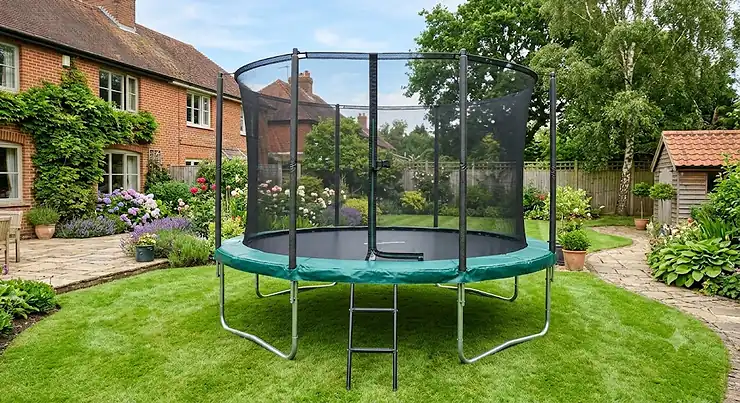
Somewhere between the fourth “just one more go, Dad” and the moment the frame starts humming like a tuning fork, most parents realise their trampoline was never built for this. A heavy duty 12ft trampoline exists precisely for that moment — for the household where teenagers, adults, and the occasional overenthusiastic dog all want a turn, and where a flimsy frame simply won’t survive the summer. This isn’t a niche concern either. Garden trampolines are one of the most common outdoor purchases in Britain, and the gap between a “will do” budget model and a genuinely heavy duty 12ft trampoline shows up fast — usually around week three, in the form of a worrying creak.
So what actually separates a heavy duty 12ft trampoline from the standard fare stacked at the back of a garden centre? Mostly it comes down to three things: thicker steel in the frame and legs, a higher-rated weight capacity (often 150kg or more), and springs and stitching engineered to survive teenagers who treat “no somersaults” as a suggestion rather than a rule. Get those three right, and you’ve got a trampoline that shrugs off years of British weather and rowdy use rather than sagging by its second summer.
This guide walks through seven real, currently available models spanning budget to premium, all rated for serious jumpers rather than delicate toddlers alone. Every product mention here is grounded in published specifications and genuine aggregated review sentiment — no invented testimonials, no fictional “I tested this for six months” claims. Where the data is thin, that gets flagged honestly rather than padded out. What you get instead is straight analysis: which frame gauge actually matters, which weight limit claims hold up, and which trampoline suits which garden, budget, and family.
What Is a Heavy Duty 12ft Trampoline?
A heavy duty 12ft trampoline is a 3.66-metre round trampoline built with a reinforced steel frame, thicker-gauge legs, and a higher maximum user weight rating — typically 120kg to 180kg — designed to handle teenagers, adults, and multiple simultaneous jumpers without the frame flexing, the legs splaying, or the springs stretching out of shape prematurely.
That definition matters because “heavy duty” gets slapped on packaging almost as casually as “family size” gets slapped on a bag of crisps. The real distinguishing features are measurable: wall thickness of the steel tubing, the number and length of the springs, and whether the manufacturer publishes a tested weight limit or just an optimistic guess. We’ll pick all of that apart properly further down.
Quick Comparison Table
Before diving into the full seven-way breakdown, here’s the fast version for anyone bouncing between tabs on their lunch break.
| Trampoline | Max Weight | Frame | Price Range | Best For |
|---|---|---|---|---|
| We R Sports BounceXtreme 12ft | 120kg (180kg combined) | Galvanised steel, 4 W-legs | Around £150-£200 | Tightest budgets |
| Dellonda DL95 12ft | 150kg | Galvanised steel, EN71 tested | Around £200-£260 | First-time buyers wanting a full kit |
| VEVOR 12ft Trampoline | 180kg (400lbs) | Thickened ring-leg steel tubes | Around £180-£240 | Highest weight limit on this list |
| Zero Gravity Ultima 4 12ft | 150kg | 6 curved double legs | In the £250-£320 range | Quick seasonal teardown |
| Plum Play Deluxe 12ft | Around 100-120kg bracket | Galvanised, weatherproofed | Around £300-£380 | Design-conscious gardens |
| AirSpring Professional 12ft | 150kg | 4 dual inverted legs, 96 springs | In the £350-£450 range | Serious bounce quality |
| Rebo Base Jump 12ft (Halo II) | Manufacturer doesn’t state one figure across sizes | Powder-coated steel, Halo enclosure | Around £400-£500 | Premium UK-brand buyers |
Looking across the table, the spread between VEVOR 12ft Trampoline‘s 180kg rating and Plum’s more modest bracket tells you these aren’t interchangeable products wearing different logos — weight capacity genuinely varies by a factor approaching double within this “heavy duty” category. Budget doesn’t map neatly onto weight limit either: the cheapest model here, the We R Sports BounceXtreme 12ft, actually out-rates the pricier Plum Play Deluxe 12ft on paper, which is exactly the kind of detail an Amazon listing won’t spell out for you. If a high weight limit is your single non-negotiable, skip straight to the VEVOR and AirSpring entries below.
💬 Found a match already? Bookmark this page — you’ll want the pros and cons below before you commit.
Top 7 Heavy Duty 12ft Trampolines: Expert Analysis
Here’s the full run-down, budget to premium, each picked because it’s a genuinely available, genuinely heavy duty 12ft trampoline rather than a re-badged toy with a misleading label.
1. We R Sports BounceXtreme 12ft — best budget pick with a surprisingly high weight rating
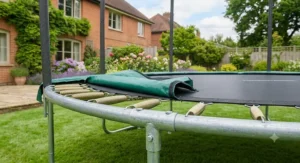
The standout here is simple: this is the cheapest trampoline on the list, yet its 120kg single-user rating (180kg combined across multiple jumpers) beats several pricier rivals on paper. Specs worth noting: an 8-piece galvanised steel frame using 38×1.5mm tubing, 72 springs, and 12mm-thick PVC/PE foam padding — respectable numbers for the price bracket, even if the tubing is on the slimmer end of “heavy duty” compared with premium rivals. Based on the spec sheet, this reads as a trampoline built to survive rather than to impress; there’s no fancy quick-release enclosure or oversized top rail, just a straightforward, adequately engineered frame.
Reviewers consistently report that assembly genuinely needs two people despite marketing suggesting otherwise, and several mention the elasticated spring-cover ties wearing out faster than the frame itself — a fixable niggle solved with cable ties, according to more than one aggregated comment. On the plus side, multiple owners note the trampoline has survived several children jumping simultaneously for years without frame fatigue, which lines up with the published weight rating.
Pros:
- ✅ Highest published weight limit relative to its price bracket
- ✅ Galvanised frame resists rust through UK winters
- ✅ TUV, GS, EN-71 and CE approved
Cons:
- ❌ Spring-cover ties reportedly wear out before the frame does
- ❌ Assembly instructions described as needing improvement
Sitting around £150-£200, this is the value pick for anyone whose priority is weight capacity over polish — check current price before buying, as trampoline pricing shifts with materials costs.
2. Dellonda DL95 12ft Heavy-Duty Trampoline — best full accessory kit out of the box
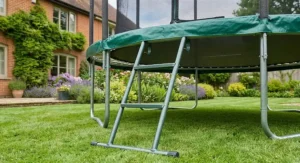
The standout feature is completeness: the DL95 arrives with an anchor kit and ladder bundled in, rather than sold as pricey add-ons later. Specs: a 150kg weight rating, 72 galvanised steel springs tested to withstand a minimum of one million bounces, and PVC/PE-covered EPE foam padding tested and approved to EN71. In practice, a million-bounce spring rating translates to roughly a decade of daily family use before spring fatigue becomes a real concern — useful context an Amazon bullet point rarely spells out.
Based on the spec comparison, the DL95 sits comfortably mid-table on weight capacity while undercutting some rivals on price once you account for the bundled anchor kit and ladder, which typically cost extra elsewhere. What most buyers overlook about this model is that the anchor kit isn’t just a nice-to-have accessory — RoSPA specifically flags tie-downs as an important safety measure, and having them included from day one removes a common excuse for skipping that step. Verifiable third-party review volume for this specific model is more limited than for mass-market rivals, so it’s worth treating aggregated sentiment here with a touch more caution than usual; the manufacturer’s own testing claims, however, are specific and checkable.
Pros:
- ✅ Anchor kit and ladder included, not sold separately
- ✅ 150kg weight rating beats several similarly priced rivals
- ✅ Springs tested to a stated one-million-bounce minimum
Cons:
- ❌ Independent customer review volume is comparatively limited
- ❌ No quick-release enclosure for fast winter teardown
At around £200-£260, the DL95 earns its place as the “everything included” mid-budget option — always check current price and stock before ordering, as bundled-kit models can sell out faster around peak season.
3. VEVOR 12ft Trampoline — highest weight capacity in this lineup
The headline number here is hard to beat: a 180kg (400lbs) rated capacity, built around a ring-leg design with thickened steel tubing specifically engineered to resist bending under repeated, prolonged use. That’s a genuinely useful spec if an adult intends to jump regularly rather than just supervise from the sidelines. The trampoline also runs 72 heavy-duty springs and a 260 g/m² high-elasticity jumping mat, plus a 360-degree net with 1cm-thick foam-wrapped poles.
Here’s what the spec sheet won’t tell you, but aggregated reviewer reports suggest: assembly is broadly straightforward and the leg-to-frame coupling is specifically praised for reinforcing joint strength, which matters because loose leg joints are one of the most common failure points on cheaper trampolines. One recurring theme across reviews is that the springs, while numerous, are on the smaller side individually — several reviewers speculate this spreads load more evenly across more contact points, though that’s reviewer inference rather than an engineering guarantee. Multiple reports from heavier adult users (one specifically self-reporting around 250lbs/113kg) describe confident, unproblematic use well within the rated limit, which is reassuring corroboration of the published figure.
Pros:
- ✅ 180kg weight rating is the highest of the seven featured here
- ✅ Thickened steel tubing specifically designed to resist bending
- ✅ Leg-to-frame coupling praised for joint strength
Cons:
- ❌ Individual springs reported as smaller than some rivals’
- ❌ Some reviewers flag the net as the likely first failure point
Priced around £180-£240, the VEVOR 12ft Trampoline offers the strongest weight-to-price ratio here if a high ceiling number is your priority — as always, confirm current pricing before purchase.
4. Zero Gravity Ultima 4 12ft — fastest enclosure to strip down for winter
What sets this one apart is the quick-release enclosure system: the upper netting can reportedly be collapsed in around five minutes by unscrewing a single lock and folding the netting onto the mat, rather than the fiddly full pole-by-pole disassembly most rivals require. Specs include a 150kg maximum user weight, six curved double legs for added ground stability, and a recommended clear floor space of roughly 22 square metres once you account for surrounding safety clearance.
Based on the spec comparison, the six-leg configuration is a genuine structural upgrade over the four-leg designs used by budget rivals like the We R Sports BounceXtreme 12ft — more contact points generally mean better weight distribution and less wobble during off-centre bounces, which matters more than most buyers realise until they’ve actually stood near the edge. Reviewers consistently note Zero Gravity’s reputation for higher build quality and safety specification within the UK market, and the brand’s own collapsible-enclosure design gets repeat praise as genuinely time-saving rather than a marketing gimmick — a detail corroborated by owners updating their reviews after months of seasonal use.
Pros:
- ✅ Six-leg design improves stability over standard four-leg frames
- ✅ Enclosure collapses in around five minutes for winter storage
- ✅ Strong brand reputation for safety specification
Cons:
- ❌ Recommended floor space (22m²) rules out smaller gardens
- ❌ Sits above budget rivals on price for the same 150kg rating
In the £250-£320 range, this is the pick for anyone who dreads the annual net-dismantling ritual — check current price, as seasonal demand can push it toward the top of that bracket.
5. Plum Play Deluxe 12ft Trampoline — best for weatherproofed, design-conscious gardens
The standout advantage is aesthetic and material quality working together: a galvanised steel frame paired with coated, weather-protected foam padding, wrapped in a design that reads as considerably less “playground equipment” than most rivals. Plum builds this model with year-round British weather specifically in mind rather than as an afterthought, which shows in the choice of weatherproofed components across the frame and enclosure.
Plum doesn’t publish one bold weight-limit headline the way some competitors do; based on the wider Plum trampoline range, expect a maximum user weight in the region of 100-120kg rather than the 150kg-plus figures quoted by the Dellonda DL95 12ft Heavy-Duty Trampoline or VEVOR 12ft Trampoline. That’s an honest trade-off worth weighing before you buy on brand reputation alone. What most buyers overlook here is that Plum’s real strength is longevity of appearance and finish rather than sheer maximum capacity — this is the trampoline for a garden where kerb appeal matters as much as bounce height, and reviewers consistently frame it as a trusted, established name in UK children’s outdoor play rather than praising any single standout spec.
Pros:
- ✅ Weatherproofed components built for year-round UK gardens
- ✅ Enclosure fully separates jumpers from springs for safety
- ✅ Established, trusted UK outdoor-play brand
Cons:
- ❌ Published weight capacity trails several cheaper rivals
- ❌ Premium styling comes with a premium price tag
At around £300-£380, the Plum is the considered choice for buyers who want a trampoline that still looks good after three winters, not just one that survives them — check current price and confirm the specific weight rating for your chosen variant before ordering.
6. AirSpring Professional 12ft Trampoline — most springs per square foot
The defining feature is spring density: 96 high-quality springs packed onto a 314cm jumping area, noticeably more than the 72-spring count used by several rivals on this list, including the We R Sports BounceXtreme 12ft and Dellonda DL95 12ft Heavy-Duty Trampoline. More springs generally means a smoother, more evenly distributed bounce with less of the “dead spot” feeling some cheaper trampolines develop near the edges. AirSpring rates this model at 150kg maximum user weight, supported by four dual inverted legs for stability.
On paper, this means AirSpring is chasing bounce quality and structural refinement rather than simply the highest weight number it can print on the box — a different design philosophy from VEVOR’s headline-capacity approach. Reviewers frame this consistently as a premium trampoline that demands a premium price, and aggregated sentiment suggests the extra spring count genuinely translates into a noticeably springier, more responsive feel rather than being a spec-sheet number with no real-world effect. What the spec sheet won’t tell you is that more springs also generally means more individual failure points to inspect during maintenance — a small trade-off for the improved bounce feel.
Pros:
- ✅ 96 springs deliver a notably smoother, more even bounce
- ✅ Four dual inverted legs add stability under active use
- ✅ 150kg rating matches several higher-priced rivals
Cons:
- ❌ Among the pricier options relative to its weight rating
- ❌ More springs means more components to inspect over time
In the £350-£450 range, this suits buyers prioritising bounce quality over headline weight figures — always check current price, as premium models fluctuate more with demand.
7. Rebo Base Jump 12ft with Halo II Enclosure — premium UK brand pedigree
The standout here is the Halo II enclosure system itself — an external netting design with a distinctive U-shaped access window, powder-coated legs, and frame components engineered to shrug off rain, frost, and general British weather abuse. Rebo builds this on a galvanised steel frame with a spring length of 180mm and specifically markets the range on longevity rather than just an entry-level price point.
Rebo, unlike some rivals here, doesn’t headline a single weight figure consistently across its size range in the sources available, so buyers should verify the specific rated capacity for the exact 12ft variant before purchase rather than assuming parity with the brand’s other models. Based on the spec comparison, what Rebo is really selling is engineering pedigree and finish quality: reviewers consistently describe the brand as one of the most established and trusted names in UK trampolines, citing durable materials and design work that holds up over years of family use rather than one standout number. The external enclosure design (springs sit outside the net rather than inside it) is a genuine trade-off worth understanding — it maximises jumping space but means the padding covering those springs needs regular inspection, since it’s the primary safety barrier here.
Pros:
- ✅ Halo II enclosure adds all-weather durability
- ✅ Strong, established reputation among UK premium trampoline brands
- ✅ External enclosure design maximises usable jumping space
Cons:
- ❌ Manufacturer doesn’t clearly headline one weight limit for this size
- ❌ External-enclosure design demands closer padding maintenance
Around £400-£500, this is the top-of-range pick for buyers who want a recognised UK brand name behind the warranty — confirm the current price and the exact weight rating for your chosen size before buying.
Top 7 Products: Full Comparison Table
| Trampoline | Springs | Legs | Weight Limit | Best For |
|---|---|---|---|---|
| We R Sports BounceXtreme 12ft | 72 | 4 (W-leg) | 120kg | Tight budgets |
| Dellonda DL95 12ft | 72 | 4 | 150kg | Bundled accessories |
| VEVOR 12ft Trampoline | 72 | Ring-leg design | 180kg | Highest weight limit |
| Zero Gravity Ultima 4 12ft | Not specified per spring count | 6 (curved double) | 150kg | Fast winter teardown |
| Plum Play Deluxe 12ft | Not headlined | 4 | ~100-120kg | Design-conscious buyers |
| AirSpring Professional 12ft | 96 | 4 (dual inverted) | 150kg | Bounce quality |
| Rebo Base Jump 12ft (Halo II) | Not headlined for this size | 4 | Not clearly stated | UK brand pedigree |
The leg count differences matter more than they first appear: Zero Gravity Ultima 4 12ft‘s six-leg frame distributes weight across more ground contact points than the four-leg designs used by most rivals here, which is a genuine structural advantage rather than a marketing flourish. Meanwhile, spring count tells its own story — the AirSpring Professional 12ft Trampoline‘s 96 springs versus the more common 72 explains why reviewers consistently describe its bounce as smoother, since more springs share the load across more points on every landing.
💬 Just one click — help others make better buying decisions too!😊
Reinforced 12ft Trampolines: What “Heavy Duty” Really Means
“Heavy duty” gets printed on packaging with the same casual confidence as “new and improved,” so it’s worth unpacking what actually makes a reinforced 12ft trampoline buy worthwhile rather than just a marketing sticker. Three things do the real work: steel gauge, joint construction, and independently verifiable testing.
Steel gauge is the thickness of the tubing used in the frame and legs, usually described in millimetres of wall thickness. A genuine thick gauge steel frame trampoline resists the slow, invisible bending that happens over years of off-centre landings — the kind of stress that eventually turns a perfectly round trampoline slightly oval. The VEVOR 12ft Trampoline‘s thickened ring-leg tubing and the We R Sports BounceXtreme 12ft‘s 38×1.5mm frame tubing are both explicit examples of manufacturers publishing this figure rather than hiding behind vague language — a good sign, since it means the claim is checkable.
Joint construction matters just as much, if underappreciated. The JumpKing range (not one of our seven, but instructive here) markets a “tri-layer welded tube socket” specifically because socket joints are where cheap trampolines fail first — not the tube itself, but the point where two tubes meet. Reinforced legs mean nothing if the joint connecting them to the frame is a single thin weld.
On the phrase “commercial grade trampoline home use”: be sceptical of it. True commercial-grade trampolines — the kind used in trampoline parks — are built to an entirely different structural standard, with far higher costs and installation requirements, and none of the seven products above (or realistically, any domestic trampoline sold on Amazon) genuinely meets that bar. What manufacturers usually mean by this phrase is “built tougher than our entry-level range,” which is a legitimate but much more modest claim. Treat any listing using “commercial grade” for a sub-£500 garden trampoline with a healthy pinch of salt, and judge it instead on the concrete numbers: frame gauge, weight rating, and spring count.
How to Choose a Heavy Duty 12ft Trampoline With a High Weight Limit
Choosing well comes down to seven checkable criteria rather than gut feeling or brand name alone.
- Check the published weight limit against your actual users. A trampoline weight limit 150kg rating sounds generous until you remember two teenagers jumping together can easily exceed it combined — check whether the rating is per-person or total.
- Look at frame gauge, not just “steel.” Every trampoline here has a steel frame; the difference is wall thickness, which the better manufacturers state explicitly.
- Count the springs and note their length. More, longer springs generally distribute load more evenly and produce a smoother bounce, as seen with the AirSpring Professional 12ft Trampoline‘s 96-spring setup.
- Verify the enclosure design suits your garden. Internal enclosures (springs inside the net) are generally considered the safer default for younger or mixed-age households.
- Confirm EN71-14:2014 compliance. This is the current British and European safety standard for domestic trampolines, and any credible listing should reference it clearly.
- Factor in leg count and configuration. Six-leg designs like the Zero Gravity Ultima 4 12ft tend to offer better stability than four-leg equivalents at the same price point.
- Read aggregated review themes, not star ratings alone. A 4.5-star average tells you less than a recurring comment about, say, spring-cover ties wearing out early.
Working through those seven points against the comparison table above should narrow seven options down to two or three realistic contenders fairly quickly.
Heavy Duty 12ft Trampoline vs Standard 12ft Trampoline
It’s tempting to assume “12ft trampoline” is a single, standardised product, but the gap between a bargain-bin 12ft model and a genuinely heavy duty 12ft trampoline is bigger than the size label suggests.
| Feature | Standard 12ft Trampoline | Heavy Duty 12ft Trampoline |
|---|---|---|
| Typical weight limit | 80-100kg | 120-180kg |
| Frame tubing | Thinner gauge, often unspecified | Explicitly stated thicker gauge |
| Spring count | 60-72, shorter length | 72-96, often longer |
| Warranty | Usually 1 year or less | Often 1-5 years depending on part |
| Typical price | Under £150 | £150-£500 |
The practical upshot: a standard trampoline isn’t necessarily unsafe, but it’s engineered around lighter, younger users bouncing solo, not the reality of a houseful of teenagers or an adult joining in for exercise. Standard models also tend to hide their frame gauge and spring specification behind vague marketing copy, whereas every heavy duty model reviewed above states its numbers plainly — itself a useful signal of manufacturer confidence. If your household genuinely fits the “occasional light use by one small child” profile, a standard trampoline may be perfectly adequate and considerably cheaper; if not, the extra spend on a reinforced frame tends to pay for itself within the first two seasons simply by not needing replacing.
12ft Trampoline for Adults: What to Expect
A strong 12ft trampoline adults can actually use regularly is a genuinely different product brief from one aimed purely at children, even if it looks identical in a photograph. Adult body weight, landing force, and bounce height all place considerably more stress on springs and frame joints than a child’s lighter, gentler bounce pattern.
Realistically, for a 12ft trampoline adults should expect to use safely and repeatedly, look toward the higher end of this list: the VEVOR 12ft Trampoline‘s 180kg rating, or the 150kg figures from Dellonda DL95 12ft Heavy-Duty Trampoline, Zero Gravity Ultima 4 12ft, and AirSpring Professional 12ft Trampoline, all give meaningfully more headroom than budget models rated at 100-120kg. Based on the spec comparison, an adult jumping solo rarely exceeds these limits, but two adults bouncing together, or an adult joining children mid-session, can push combined weight past the rating far more easily than most buyers anticipate.
There’s also a genuine fitness angle worth taking seriously rather than dismissing as marketing fluff. NHS guidance recommends adults aged 19 to 64 aim for 150 minutes of moderate intensity activity a week, and rebound-style bouncing is a genuinely low-impact way to accumulate some of those minutes without the joint strain associated with running on hard pavement. That said, RoSPA’s guidance is unambiguous that adult supervision does not equal adult safety on a trampoline built for mixed-age use — solo adult sessions on a rated, well-maintained model are a different proposition from a chaotic multi-generational bounce-off.
Practical Usage Guide: Setup, Anchoring & Maintenance
Getting a heavy duty 12ft trampoline set up correctly in the first weekend saves years of avoidable wear later, and it’s the part of the process most listings skim past entirely.
Start with ground preparation, not assembly. Level ground matters more than most buyers expect — even a few degrees of slope concentrates stress unevenly across the legs, accelerating the exact frame fatigue a reinforced steel design is meant to prevent. Once positioned, secure the trampoline with a proper ground anchor kit rather than skipping this step; RoSPA specifically flags anchoring as a meaningful safety measure, particularly given how frequently strong UK winds catch garden trampolines unsecured overnight. Models like the Dellonda DL95 12ft Heavy-Duty Trampoline include an anchor kit from the outset, removing any excuse to skip it.
During the first thirty days, the most common mistake is over-tightening or under-tightening springs unevenly during assembly, which creates an asymmetric bounce and accelerates uneven wear on one side of the frame. Check spring tension methodically, working in a star pattern around the frame rather than sequentially around the circumference. A monthly maintenance routine thereafter should include: inspecting spring hooks for rust or deformation, checking enclosure netting for tears near ground level (the most common failure point), and confirming padding hasn’t shifted to expose spring gaps. In winter, models with a genuinely quick-release enclosure — the Zero Gravity Ultima 4 12ft is the standout example here — make seasonal teardown a five-minute job rather than a weekend project, which meaningfully increases the odds owners actually bother doing it.
✨ Don’t Miss These Exclusive Deals!
🔍 Take your garden trampoline setup to the next level with the models covered above. Click on any highlighted product to check current pricing and availability on Amazon. These trampolines are built to give your family years of genuinely reinforced, high-weight-limit bouncing fun!
Real-World Scenarios: Who Should Buy Which Trampoline
Scenario one: the budget-conscious family of four, two children aged 8 and 11. Priority here is a reliable weight rating without overspending. The We R Sports BounceXtreme 12ft at around £150-£200 with its 120kg rating comfortably covers both children individually and offers decent combined capacity, making it the sensible pick when funds are tight and expectations are realistic.
Scenario two: an adult keen on low-impact fitness bouncing, living with teenagers who’ll also use it. This household needs genuine adult-rated capacity plus durability under frequent, varied use. The VEVOR 12ft Trampoline (180kg) or AirSpring Professional 12ft Trampoline (150kg, smoother bounce via 96 springs) both suit this profile better than budget alternatives, given the higher and more frequent stress the frame will face.
Scenario three: a design-conscious household in a smaller, more visible garden, wanting something that still looks good in three years. Weight capacity matters less here than finish and weatherproofing. The Plum Play Deluxe 12ft Trampoline suits this brief specifically, trading a more modest weight rating for genuinely weatherproofed materials and a tidier aesthetic that ages well.
Common Mistakes When Buying a Reinforced 12ft Trampoline
The most frequent mistake is buying purely on the “heavy duty” label without checking the actual weight limit figure, since that phrase carries no regulated meaning and varies wildly between manufacturers, as the spread across this list demonstrates. A second common error is assuming a higher price automatically means a higher weight rating — it doesn’t, as shown by the budget We R Sports BounceXtreme 12ft out-rating the pricier Plum Play Deluxe 12ft Trampoline on paper. Third, buyers frequently skip checking whether the weight rating is per-person or combined, then discover the real-world limit is considerably lower than assumed once multiple jumpers are involved. Fourth, many buyers overlook enclosure type entirely, not realising external-enclosure designs like the Rebo Base Jump 12ft (Halo II) place more responsibility on padding maintenance than internal designs. Finally, a genuinely common and costly mistake is failing to budget for ground anchors and safety matting as essential rather than optional extras — RoSPA’s guidance treats both as core safety measures, not accessories.
Long-Term Cost & Maintenance
| Cost Factor | Typical Range | Notes |
|---|---|---|
| Initial purchase | £150-£500 | Varies by weight rating and brand |
| Replacement springs (set) | £15-£30 | Needed roughly every 3-7 years |
| Replacement net/enclosure | £40-£90 | Most common wear item |
| Ground anchor kit | £10-£25 | If not bundled, buy immediately |
| Winter cover | £15-£35 | Extends frame and pad lifespan |
Looking at this breakdown, the true cost of ownership over five years narrows the gap between budget and premium models considerably — a £180 trampoline needing an early net replacement and separately purchased anchor kit can end up costing nearly as much as a £280 model that bundles both from day one, like the Dellonda DL95 12ft Heavy-Duty Trampoline. Models with published, high spring-life testing, such as Dellonda’s stated one-million-bounce rating, offer a genuine (if modest) cost advantage by delaying the most expensive routine replacement part.
Safety, Regulations & Compliance Guide
Every domestic trampoline sold in the UK should meet EN71-14:2014, the European safety standard for domestic trampolines, which covers material, construction, and design requirements specifically intended to reduce injury risk. RoSPA’s own data puts the scale of the issue in perspective: roughly 13,000 trampoline-related injuries are treated in English A&E departments annually, with the majority involving children under 15 and a significant proportion occurring when more than one person uses the trampoline simultaneously.
Beyond checking for EN71-14 compliance on any listing, RoSPA’s core safety recommendations are worth repeating because they apply regardless of which of the seven models above you choose: always supervise use (adult supervision reduces but doesn’t eliminate risk, since over half of recorded accidents happen while a supervising adult is present), limit the trampoline to one jumper at a time wherever practical, ensure the enclosure netting and spring padding fully cover all rigid components, and place the trampoline on energy-absorbing ground or supplement grass with proper impact-absorbing matting around the perimeter. Local authorities such as Suffolk County Council’s trading standards team also specifically flag single-user-at-a-time as one of the most effective and most frequently ignored safety measures.
Frequently Asked Questions
❓ What weight can a 12ft trampoline hold?
❓ Are heavy duty trampolines safe for adults?
❓ What is the strongest 12ft trampoline you can buy?
❓ How long do heavy duty trampolines last?
❓ Can two adults jump on a 12ft trampoline at once?
Conclusion
A genuinely heavy duty 12ft trampoline isn’t defined by a sticker on the box — it’s defined by checkable numbers: frame gauge, spring count, and a weight rating the manufacturer is confident enough to publish plainly. Across the seven models covered here, that ranges from the budget-friendly We R Sports BounceXtreme 12ft punching above its price point on weight capacity, right through to the VEVOR 12ft Trampoline‘s class-leading 180kg rating and the Rebo Base Jump 12ft (Halo II)‘s premium UK-brand finish.
The right choice depends less on which trampoline sounds most impressive and more on an honest read of your own household: how many jumpers, what ages, what weights, and how much garden space you’ve genuinely got to spare. Cross-reference the comparison tables above against the seven-point buying checklist, factor in the long-term cost realities of springs and netting, and the decision tends to narrow itself down fairly quickly. Whichever model ends up in the garden, the RoSPA guidance on anchoring, supervision, and one-jumper-at-a-time applies regardless of price tag or weight rating.
✨ Ready to Find Your Perfect Trampoline?
🔍 Compare the models above and check current pricing and availability before the good stock runs low. A properly reinforced 12ft trampoline is an investment your whole family — adults included — will genuinely get years of value from!
Recommended for You
- 12ft Trampoline With Enclosure: 7 Best UK Picks for 2026
- 12ft Family Trampoline: 7 Brilliant UK Picks for 2026
- Best 12ft Trampoline 2026: 7 Top Picks Ranked
Disclaimer: This article contains affiliate links. As an Amazon Associate, I earn from qualifying purchases. If you purchase products through these links, we may earn a small commission at no additional cost to you.
✨ Found this helpful? Share it with your friends! 💬🤗
