In This Article
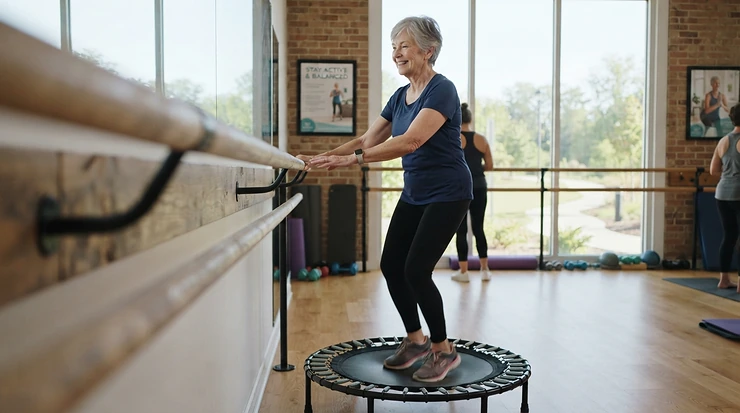
A stability bar for seniors rebounding is an adjustable handrail fixed to a rebounder (a mini trampoline) that gives older users something solid to hold while they bounce, march or shift their weight. It turns a wobbly-feeling workout into a supported, low-impact one. For many beginners, it is the difference between trying rebounding and quietly shoving the thing under the bed.
Why does this matter beyond gadgetry? An evidence review commissioned by Public Health England and the Centre for Ageing Better backed the UK Chief Medical Officers’ advice that adults should do strengthening and balance activity at least twice a week. It also noted that poor muscle strength raises an older adult’s risk of falling by 76%. Balance is a use-it-or-lose-it skill, and a supported rebounder is one gentle way to use it.
Here is how this guide works. It draws on published specifications, seller listings and the aggregated sentiment of real reviewers. It is not based on hands-on testing, and where UK-specific detail was thin, I say so rather than guess. Prices are indicative ranges only, so always check the current price and availability on Amazon UK before buying.
One caveat before the fun starts. If you have osteoporosis, a joint replacement, dizziness, a heart condition or you take medication that affects balance, speak to your GP or a physiotherapist first. A rebounder with the best handrail in Britain is still exercise equipment, not a medical device.
Quick Comparison: Which Setup Suits Which Senior?
The table below is your fast route to the shortlist. Each product is unpacked properly in the next section, including the awkward bits listings don’t mention.
| Product | Support type | Bounce system | Best For |
|---|---|---|---|
| FIT BOUNCE PRO II | Separate 10-height bar (bought on top) | Bungee | Premium, bar-first buyers who want a UK-based brand |
| bellicon | Removable stability bar (accessory) | Bungee, 5 cord strengths | Long-term, physio-style use |
| BCAN BT4 Soft Land Pro | Built-in T-handlebar | Bungee | Heavier users wanting a premium feel |
| BCAN BT2 | Built-in adjustable bar | Bungee | Best all-rounder on a mid-range budget |
| ANCHEER 50-inch | Built-in 3-level bar | Bungee, hexagonal | Big surface, tight budget |
| BCAN SP2 | Built-in foam handle | Spring | First-time buyers watching every pound |
| ACON Fit Hexagon | Extended adjustable balance handlebar | Not specified in listing | Style-conscious buyers wanting a roomy mat |
The split that matters is bungee versus spring, and built-in versus bolt-on. Bungee models are gentler and quieter, which suits sore joints. A separate bar, as with the FIT BOUNCE PRO II and bellicon, costs more but can be removed once your confidence grows. If you are on a budget, the BCAN SP2 and ANCHEER 50-inch include a handle in the box, so you start supported from day one.
💬 Just one click — help others make better buying decisions too!😊
Top 7 Stability Bar for Seniors Rebounding Options: Expert Analysis
Seven real products follow, spanning premium, mid-range and budget. Each is judged on what the handrail does in practice, not just what the box says.
1. FIT BOUNCE PRO II — best rebounder with a purpose-built bar
The headline here is the optional bar designed specifically for this rebounder. It is sold separately, with ten height settings, so it can match a tall user or a shorter one without awkward compromise.
The rebounder arrives already assembled with legs that click into place, folds in half for storage, and uses a bungee system rather than springs. That means a soft landing instead of a metallic twang. The weight rating needs care: listings variously quote 330 lb (about 150 kg) and 400 lb (about 181 kg), while UK retailer copy refers to testing up to 120 kg. Ask the seller to confirm the figure for the exact version you are buying.
On paper, this suits an older beginner who wants the bar from day one and expects to keep the rebounder for years. Reviewers with balance or joint concerns repeatedly say the bar gives them the confidence to bounce gently or march on the spot. One reviewer, however, reported that a leg tube was too narrow for the bar to fit properly, which is why checking the fit on arrival matters.
Pros:
- ✅ Ten-height bar suits many body sizes
- ✅ Arrives assembled, ready in minutes
- ✅ Quiet bungee bounce, kind to joints
Cons:
- ❌ Bar is an extra purchase
- ❌ Bar fits this model only
Price range: premium tier, so budget for the rebounder and the bar together (check current price). Value verdict: strong for long-term daily use, harder to justify for a “let’s see if I like it” trial.
2. bellicon — most flexible bar for long-term use
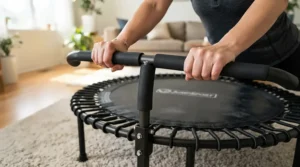
The standout is how easily the bar attaches and detaches. One long-term user describes using the rebounder bare most days and clipping the bar on for specific exercises. That is useful for seniors whose confidence grows over time.
The rebounder comes in 39″, 44″ and 49″ sizes with bungee cords in five strengths, so the bounce can be matched to your weight and comfort. Review sites commonly mention a lifetime frame warranty. One comparison lists a 330 lb (about 150 kg) rating, the lowest in this line-up, so heavier users should check carefully.
A reader on a senior-focused website calls the stability bar “essential” for her own use, and recommends a rebounder with six or more legs and a mat at least nine inches off the floor. That is one person’s guidance, not a standard, but it matches the logic: more legs and a stiffer frame mean less wobble when you lean on the bar.
Availability matters here. bellicon is mostly sold direct, so check whether it is currently listed on Amazon UK before relying on the link.
Pros:
- ✅ Bar attaches and removes quickly
- ✅ Five bungee strengths tailor the bounce
- ✅ Widely praised build and frame warranty
Cons:
- ❌ Premium price before adding the bar
- ❌ Stated weight rating is modest
Price range: well above £400 before the bar (check current price). Value verdict: expensive, but the most “grow into it” option here.
3. BCAN BT4 Soft Land Pro — premium bungee with built-in T-bar
The handle comes attached. A one-piece frame, rubber feet and a T-shaped bar combine to cut wobble, according to the review sites that recommend it.
It is a round bungee rebounder, and one review site pairs it with a 500 lb (about 227 kg) rating for heavier users. In practice, that headroom matters for seniors who want confidence rather than just a pass mark. Rubber feet also grip hard floors, which counts for more than it sounds when you are holding a bar and pushing off.
The T-bar is stable, but this design can limit lateral arm movement, so it suits upright marching and gentle bouncing better than wide arm-swinging routines. Independent UK-specific reviews are thin, and the bar’s exact height range was not clearly stated in the listings I found. Confirm it matches your height before you commit.
Reviewers consistently describe a soft, quiet bounce and stable feel, though the sources are mostly affiliate review sites. Treat enthusiastic wording with a pinch of salt.
Pros:
- ✅ Built-in T-bar, nothing extra to buy
- ✅ High stated weight rating
- ✅ Rubber feet grip hard floors
Cons:
- ❌ T-bar restricts wide arm movement
- ❌ Few independent UK reviews found
Price range: upper mid-range (check current price). Value verdict: sensible for heavier users who want a premium feel without bellicon money.
4. BCAN BT2 — best all-rounder for sturdy support
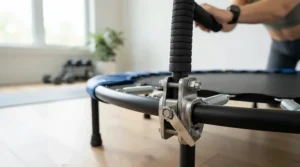
The rebounder’s selling point is a reinforced frame. Listing details describe 32 mm thickened alloy legs with ten thread turns and an M-shaped plate with locking screws at three points on the handlebar.
Translated: the legs resist twisting, and the bar is far less likely to rock or loosen under a leaning hand. The US listing gives bar heights from about 2 ft 7 in to 3 ft 2 in (roughly 79–97 cm). A UK listing I found describes a four-level handle and a 250 kg capacity, so specifications differ by region and size. Check the exact listing before buying.
For a senior who wants a sturdy rebounder support bar without premium prices, this is where the shortlist converges. Reviewers repeatedly praise the quiet bungee bounce and describe it as a best-seller. Common complaints are that bungee tension may need adjusting over time and that fitting the bungees can be fiddly. If you are not handy, ask a family member to help with assembly.
Pros:
- ✅ Reinforced legs and bar plates
- ✅ Quiet, joint-friendly bungee bounce
- ✅ Very high stated weight capacity
Cons:
- ❌ Bungee fitting can be fiddly
- ❌ Tension may need re-adjusting
Price range: roughly £130–£200 (check current price). Value verdict: the best balance of support, bounce quality and cost on this list.
5. ANCHEER 50-inch — biggest mat in the budget bar tier
The big hexagonal surface is the point. More mat means more room to step and wobble without panic.
The listing describes 48 bungees, a 560 lb (about 254 kg) rating and a three-level foam-gripped bar spanning roughly 33 to 46 inches. It folds to about 25 by 34 inches. A reviewer scored it 6.0/10 and flagged that handlebar height ranges vary between ANCHEER’s own listings. That is a practical warning: confirm the range for the exact version you order.
Based on the spec comparison, a large mat helps seniors who like to move their feet sideways or practise gentle weight shifts. Amazon-style listings show roughly 4.3–4.5 stars from a few hundred reviews, though those figures come from US pages and may differ on Amazon UK.
The 50 inches also takes real floor space. Measure your room first, including the clearance around the mat, because a bar is useless if you cannot step on and off safely.
Pros:
- ✅ Large hexagonal jumping surface
- ✅ Very high stated weight rating
- ✅ Bar included at a low price
Cons:
- ❌ Bar height range varies between listings
- ❌ Takes up significant floor space
Price range: under £150 (check current price). Value verdict: great for space-rich, budget-tight households, provided you verify the handlebar specification.
6. BCAN SP2 — cheapest way to start supported
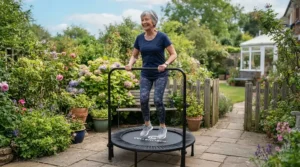
This spring-based model comes with a foam-padded handle and, according to review sites, one of the largest review bases of any rebounder (over 12,000 reviews on the US listing).
It is offered in 40″ and 48″ versions with 330 lb (about 150 kg) and 440 lb (about 200 kg) ratings. The handle has three height levels. A spring system is typically louder and a little harder on the landing than a bungee one, and reviewers note this. For seniors with arthritis or replacement joints, the gentler bungee models above are usually the better fit.
So why include it? Because many older beginners want to test the idea cheaply. Reviewers say assembly is simple, and the bar makes a decent first-week confidence booster. If rebounding becomes a habit, you can upgrade. If it doesn’t, you have not spent a fortune.
Reviewers’ sentiment is broadly positive for value, with the usual compromise on noise.
Pros:
- ✅ Handle included at a low price
- ✅ Very large review base
- ✅ Simple assembly, compact when folded
Cons:
- ❌ Springs are louder than bungees
- ❌ Harder landing on sensitive joints
Price range: roughly £80–£130 (check current price). Value verdict: sensible trial purchase, not necessarily a forever rebounder.
7. ACON Fit Hexagon — roomy hexagon with an extended balance handlebar
This is the lesser-known alternative here. It is a 1.41 m hexagon with an extended, adjustable balance handlebar, which the seller pitches at beginners and older adults.
The wide hexagonal frame gives you room to move your feet and the extended bar gives a longer grip area. The listing describes a smooth, quiet bounce and indoor-only use. It is stocked by Decathlon UK, and I could not verify Amazon UK availability, so check before relying on it. I also could not find a clear weight rating or a meaningful body of independent reviews, which I would treat as a reason for caution rather than something to wave through.
On balance, it appeals to buyers who value styling and a roomy mat, and who are prepared to confirm the weight rating directly with the seller. If you cannot get a clear number, move on to a model that states one.
Pros:
- ✅ Roomy hexagon for foot movement
- ✅ Extended adjustable balance handlebar
- ✅ Indoor-friendly, tidy styling
Cons:
- ❌ Weight rating not clearly stated
- ❌ Few independent reviews found
Price range: mid-range (check current price). Value verdict: promising on paper, but only buy it once the rating and return terms are clear.
Spec and Value Snapshot
| Product | Stated weight rating | Indicative price range | Review picture | Best For |
|---|---|---|---|---|
| FIT BOUNCE PRO II | Conflicting (330 lb / 400 lb; 120 kg tested) | Premium, plus bar | Confidence praised; one bar-fit complaint | Bar-first, long-term users |
| bellicon | About 330 lb in one comparison | Well above £400 | Strong reputation | Grow-into-it buyers |
| BCAN BT4 Soft Land Pro | About 500 lb (one review site) | Upper mid-range | Positive, few independent UK reviews | Heavier users |
| BCAN BT2 | 450/550 lb (US); 250 kg (UK listing) | £130–£200 | Best-seller, quiet | Best all-rounder |
| ANCHEER 50-inch | About 560 lb | Under £150 | Around 4.3–4.5 stars (US) | Big mat, small budget |
| BCAN SP2 | 330/440 lb | £80–£130 | Large review base | First-time buyers |
| ACON Fit Hexagon | Not clearly stated | Mid-range | Reviews not verified | Style-led buyers |
Reading across, the sweet spot is clear. The BCAN BT2 delivers most of the premium feel at a fraction of the cost, while the FIT BOUNCE PRO II and bellicon justify their prices only if you will use them daily for years. The ANCHEER 50-inch and BCAN SP2 are the budget plays, and the ACON Fit Hexagon needs homework before you buy.
How to Choose a Stability Bar for Seniors Rebounding
Choosing a stability bar for seniors rebounding comes down to six checks. Work through them in order and most of the confusion disappears.
- Check the bar fits the frame, not just the brand. Bars are usually model-specific, so a bar made for one rebounder may not fit another. Needak, for example, states its bar is designed for its own rebounders only.
- Confirm the height range matches you. Your hands should sit around hip-to-waist height with elbows slightly bent. Needak’s bar, for instance, spans 29 to 41 inches from mat to grip.
- Look at how the bar is anchored. Bolted plates and thick legs beat clip-on plastic, because the load goes through the frame rather than a thin joint.
- Prefer six legs or a wide, stable base. More contact points mean less rocking when you lean.
- Choose bungee over spring if joints are sore. The landing is softer and the noise lower.
- Check the weight rating and the returns policy. Pick a rating comfortably above your weight, and keep the receipt.
Each step filters out a different failure. Fit stops wasted money, height prevents shoulder strain, anchoring prevents wobble, and the rest protect your joints.
Is a Balance Bar Essential for Beginners?
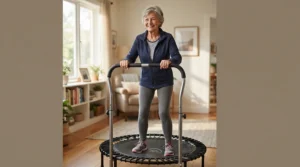
Is a balance bar essential for beginners? For older beginners or anyone with balance concerns, it is the single most useful add-on. For fit, confident adults, it is a handy extra rather than a necessity.
The case for “yes” is simple. A bar lets you practise at your pace and gives your hands somewhere to go if you wobble. One older reviewer who described herself as “not too steady on my feet some days” bought the bar separately precisely for this reason. A long-term user of a premium rebounder, by contrast, notes a bar is not just for the elderly and suits strength work too.
Here is a quick decision framework:
- If you have any history of falls or dizziness, choose a bar from day one, then speak to your GP or physio.
- If you are returning to exercise after illness or surgery, choose a bar and keep sessions short.
- If you are fit and steady, you can start without one, but a bar still helps with advanced moves.
- If you will use the rebounder next to a wall, treat that as a backup, not a replacement. Walls do not flex and handles do.
When in doubt, buy the bar. You can always remove it later, but you cannot undo a fall.
Weight-Bearing Rating: What the Number Really Means
A weight-bearing rating is the maximum user weight a manufacturer says the rebounder can handle. It sounds simple, but it hides a few traps.
First, there is no single universal figure for it. Ratings are manufacturers’ own claims, so compare like with like. Second, listings sometimes disagree, as with the FIT BOUNCE PRO II, where the quoted figure varies between 330 lb and 400 lb. When numbers conflict, ask the seller for the figure that applies to your exact version.
Third, a rebounder takes more than your static weight. Bouncing and leaning on a bar adds force. So pick a rating well above your body weight rather than just meeting it. Reviewers of heavier-duty models, such as the BCAN BT2 and ANCHEER 50-inch, point to reinforced legs and high ratings as the reassurance they wanted.
Finally, remember the bar. Leaning on it sends load through the legs, so thick, well-anchored legs matter. If your weight is near the limit, choose a higher-rated model instead of hoping for the best.
Balance and Falls Prevention: What Rebounding Can and Can’t Do
Balance and falls prevention is the reason most seniors consider a stability bar in the first place, so honesty matters here. Rebounding is a pleasant way to train balance and strength, but it is not a proven falls-prevention programme on its own.
A small university study of mini-trampolines and static balance in older adults found that balance scores rose after 16 weeks of training. However, the improvement was not statistically significant, and the authors called for more research on dynamic balance. In other words, promising but unproven.
What is well supported is the wider principle. The Centre for Ageing Better identifies muscle weakness and poor balance as the two most common modifiable risk factors for falls. The same body notes that strength and balance activity can lower the chance of a fall.
So treat a supported rebounder as one part of a routine, alongside walking, stair practice, chair rises and any programme your GP or physio recommends. If you have fallen before, ask about a local NHS falls service.
Rebounder Handrail for Older Adults: Fixed, Detachable or Freestanding?
A rebounder handrail for older adults comes in three flavours, and each suits a different person.
Fixed (built-in) bars are bolted on at the factory or in the box. The BCAN BT2, BCAN BT4 Soft Land Pro and ANCHEER 50-inch work this way. They are simple and cheap, but they can make folding fiddly because the handle often needs to come off first.
Detachable bars are accessories, like those for the FIT BOUNCE PRO II and bellicon. They cost more, but you can remove them as confidence grows.
Freestanding rails sit beside the rebounder instead of attaching to it. They are less common and I found no verified UK examples, so treat them with caution.
A sturdy rebounder support bar should feel solid when you lean on it before you ever bounce. If it flexes slightly, that can be by design, as Needak says its bar flexes with you. If it rattles or twists, send it back.
Stability Bar vs Alternatives: Which Support Works Best?
Not everyone needs a bar, and some people improvise. Here is how the options compare.
| Option | Stability | Adjustability | Risk | Best For |
|---|---|---|---|---|
| Fitted stability bar (e.g. BCAN BT2) | High | Several heights | Low if well anchored | Most older beginners |
| Detachable bar (e.g. FIT BOUNCE PRO II) | High | Up to ten heights | Low if it fits properly | Long-term growth |
| Wall or sturdy furniture | Medium | None | Furniture can slide | Backup only |
| No support | Low | N/A | Highest for unsteady users | Fit, steady adults |
The table shows why a bar beats improvised support for most seniors. A wall cannot be adjusted to your height, and furniture can move. Going without is fine for steady adults but is hard to recommend if you are wobbly.
If you are unsure, begin with a fitted bar. It costs little compared with a fall.
Low-Impact Rebounding with Support: Your First 30 Days
Low-impact rebounding with support works best when you start small and stay patient. Think of it as learning to walk on a gently moving floor.
Week 1: Stand and sway. Hold the bar with both hands, feet flat. Shift your weight side to side for two or three minutes. Do not leave the mat.
Week 2: March on the spot. Lift one foot at a time, keeping toes close to the mat. Aim for five minutes, with rest breaks.
Week 3: Gentle health bounce. Feet stay on the mat while your knees flex slightly. Keep your grip light, not clenched.
Week 4: Add variety. Try heel digs, side steps and slow turns, always with one hand on the bar.
According to NHS Inform, the aim is balance and strength exercises at least twice a week. Even short sessions help, and continuing for six months or more is what brings improvement.
Adjust the bar if your shoulders creep upward. Stop if you feel dizzy, chest pain or unusual joint pain, and speak to a professional.
Real-World Scenarios: Matching Seniors to the Right Setup
Three profiles show how the choice plays out.
Margaret, 72, recovering from a knee replacement, small flat. She needs a quiet bounce and a bar she can trust. The BCAN BT2 is a sensible fit, with its bungee system and reinforced bar, once her surgeon or physio has cleared her. Budget: mid-range. Frequency: five-minute sessions, three times a week.
Dennis, 68, heavier build, lives in a bungalow with space. He needs headroom on the weight rating and a large mat. The ANCHEER 50-inch or the BCAN BT4 Soft Land Pro suit him, subject to confirming the exact listed rating. Budget: low to upper mid-range.
Priya, 64, active, wants a long-term setup. She plans to start with the bar and drop it later. The FIT BOUNCE PRO II or bellicon makes sense because the bar is removable. Budget: premium. Frequency: daily short sessions.
The pattern is simple. Match the bar to your confidence, the weight rating to your frame and the budget to how often you will actually use it.
Common Problems and Solutions
Problem: the bar wobbles. Check every bolt and plate, then tighten evenly. If it still moves, contact the seller. Do not use a loose bar.
Problem: the rebounder slides on the floor. Place a non-slip mat underneath, or choose a model with rubber feet like the BCAN BT4 Soft Land Pro.
Problem: bungees feel uneven. Check each cord is seated properly. Reviewers of the BCAN BT2 note bungee tension may need adjusting over time.
Problem: the bounce is too noisy. Springs are louder than bungees. If this bothers you or your neighbours, bungee models are the better choice.
Problem: the bar is too low or high. Set it so your elbows are slightly bent. The FIT BOUNCE PRO II bar has ten settings for exactly this reason.
Safety Guide: Space, Surfaces and Standards
Safety starts with the room. Clear at least a couple of metres around the rebounder, use a non-slip floor, and keep pets and trailing cables away. Check ceiling height too, even if you only plan to stay low.
On standards, I could not verify a single universal safety mark that applies to every rebounder sold in the UK. Ask sellers whether the product has been tested to relevant standards, and look for any UKCA or CE marking they claim. If a seller will not answer, treat that as a flag.
Your consumer rights also help. Under the Consumer Rights Act 2015, you generally have a short-term right to reject faulty goods, so inspect the bar and frame as soon as the box arrives.
The Centre for Ageing Better’s broader message is that strength and balance activity should be accessible and evidence-based. Pair your rebounder with advice from your GP or physio rather than treating it as a stand-alone fix.
Long-Term Cost and Maintenance
A cheaper rebounder can cost more in the long run if you replace it. Budget models, like the BCAN SP2, are low-risk entry points. Mid-range options, like the BCAN BT2, spread cost over years. Premium units, such as bellicon and the FIT BOUNCE PRO II, ask for the biggest cheque but can deliver the lowest cost per use if you bounce regularly.
Maintenance is simple. Check bolts monthly, inspect bungees or springs for wear, wipe the mat, and fold or store the unit away from damp. Replace worn cords promptly.
Cost per use is the honest test. A rebounder used three times a week for three years is about 470 sessions. Even a premium price divides down to a modest figure. One used twice and abandoned is expensive at any price.
FAQs
❓ Can I fit a sturdy rebounder support bar to any rebounder?
❓ How high should a rebounder handrail for older adults be?
❓ Is a bungee or spring rebounder better for sore joints?
❓ Is it worth paying extra for a rebounder with a stability bar included?
❓ How long should a first session of low-impact rebounding with support last?
Conclusion
A stability bar for seniors rebounding is not a luxury accessory. For older beginners, it is the piece that makes the rest of the rebounder usable. The BCAN BT2 is the best all-rounder on this list, balancing reinforced support, a quiet bungee bounce and a reasonable price. The FIT BOUNCE PRO II and bellicon suit those who want a removable bar and plan to bounce for years. The ANCHEER 50-inch and BCAN SP2 are the budget starters, and the BCAN BT4 Soft Land Pro suits heavier users wanting extra headroom. The ACON Fit Hexagon is promising but needs its weight rating confirmed before you commit.
Whatever you choose, remember the basics. Check the fit, the height range and the weight-bearing rating, start with short supported sessions, and speak to your GP or physio if you have any health concerns. Rebounding can complement strength and balance work, but it is one tool among several.
✨ Ready to bounce with confidence?
🔍 Compare your shortlist, check current prices and availability on Amazon UK, and choose the setup that feels solid under your hands. Your future, steadier self will thank you!
Recommended for You
- Balance Bar For Fitness Trampoline: 7 Best Safe Picks (2026)
- Rebounder Accessories Bundle: 7 Essential Upgrades (2026 UK)
- Rebounder Under £150 For Low-Impact Cardio: 7 Smart Buys (2026)
Disclaimer: This article contains affiliate links. As an Amazon Associate, I earn from qualifying purchases. If you purchase products through these links, we may earn a small commission at no additional cost to you.
✨ Found this helpful? Share it with your friends! 💬🤗
