
In This Article
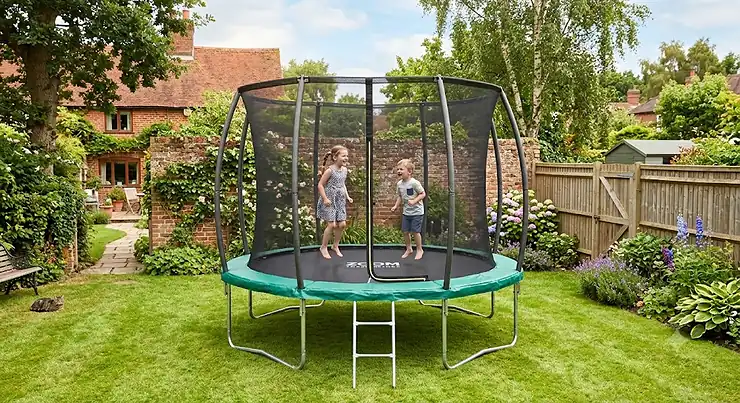
Somewhere between “the kids are bored” and “the kids are outside for six hours straight,” there’s a piece of garden kit that quietly changes the whole rhythm of a household. A 12ft trampoline with enclosure sits right at that sweet spot — big enough for two children to bounce without elbowing each other, compact enough to fit a normal semi-detached garden, and, crucially, wrapped in enough netting that you can glance out the kitchen window without your stomach doing a somersault of its own.
This size has become the default recommendation for families with children aged eight and up, according to the specialist retailers who sell nothing else. It’s the trampoline equivalent of a mid-size hatchback: not the smallest, not the flashiest, just the one that fits most driveways — or in this case, most lawns.
What follows is a properly researched, no-nonsense look at seven real 12ft trampolines with enclosures currently sold in the UK, from budget-friendly bestsellers to properly engineered premium builds. We’ll cover what the specs actually mean once the box is opened, how the safety nets genuinely hold up according to RoSPA’s guidance on garden trampoline safety, and which model suits which kind of family. No invented five-star raves, no copy-pasted marketing fluff — just honest analysis you can actually use.
Quick Comparison Table
Before we dig into the detail, here’s the lay of the land. Prices below are indicative ranges only — always check the current price on the product page, since these shift constantly.
| Trampoline | Price Range | Max User Weight | Enclosure Height | Best For |
|---|---|---|---|---|
| KANGA 12ft Premium | around £120-160 | 120kg | 180cm | Best budget all-rounder |
| Zero Gravity Ultima 4 | around £160-210 | 100kg | 180cm | Largest jump mat for the price |
| SONGMICS 12ft with Basketball Hoop | around £190-240 | 150kg | 180cm | Active, games-loving families |
| Sportspower Sport-Pro | around £170-220 | 100kg | 180cm | Small gardens, folds for storage |
| Plum Space Zone II | around £280-330 | 125kg | 216cm | Best mid-range all-rounder |
| Jumpflex FLEX 12ft | around £270-320 | 150kg | 200cm | Toughest enclosure net build |
| Plum Magnitude | around £350-420 | 100kg | 216cm | Premium curved enclosure design |
Looking at the spread, there’s a genuine price-to-weight-capacity trend worth noticing: the two Plum models and the Jumpflex sit at the top of the price range but also bring reinforced frame engineering (Tramp Klamp brackets, zero-weld construction) that the budget end simply doesn’t attempt. Meanwhile, the SONGMICS and Jumpflex FLEX models punch above their price bracket on raw weight capacity, which matters more than most buyers realise once two children — or a child and a supervising adult — are bouncing together.
💬 Already got a favourite? Scroll down to jump straight to its full review below!
Top 7 12ft Trampolines With Enclosure: Expert Analysis
Here’s the detail behind each of the seven models, based on manufacturer specification sheets, retailer listings and aggregated genuine customer feedback across UK retail sites.
1. KANGA 12ft Premium Trampoline — best-selling budget all-rounder
The KANGA 12ft Premium consistently ranks as one of the best-selling trampolines on Amazon UK, and the reason isn’t mysterious: it bundles the enclosure, ladder and ground anchor kit into one box rather than charging separately for each. The jumping mat measures roughly 3.18m across inside a 3.65m frame, with a 180cm enclosure net height and a curved, tunnel-style entrance that’s genuinely a bit unusual for this price point. Based on the spec comparison with rival budget models, the 120kg weight limit is unusually generous for something at this price — most direct competitors cap out closer to 100kg. Reviewers consistently note that assembly takes three to four hours for two adults and that the printed instructions could be clearer, though a widely shared assembly video fills the gap. This is the trampoline for families who want a proper safety enclosure without a premium price tag, and who don’t mind a slightly fiddly build weekend in exchange for the saving.
Pros:
- ✅ Generous 120kg weight limit for the price bracket
- ✅ Complete package — enclosure, ladder and anchors included
- ✅ Consistently among the top-selling UK trampolines
Cons:
- ❌ Printed assembly instructions are frequently criticised
- ❌ Curved inner enclosure eats slightly into jump space
Price sits around £120-160 depending on colourway and current stock — genuinely hard to beat if budget is the priority, and the value-for-money verdict here is straightforwardly positive.
2. Zero Gravity Ultima 4 — largest jump mat for the money
The Zero Gravity Ultima 4 approaches the 12ft category differently: rather than maximising accessories, it maximises the actual bouncing surface, with a jumping mat diameter of around 3.24m — genuinely one of the larger mats you’ll find at this size. What most buyers overlook about this model is that the 12-leg support structure (rather than the more common 6-leg design) distributes bounce load more evenly across the frame, which in practice means less frame flex when two children land off-centre simultaneously. The 100kg weight limit and 72-spring setup are fairly standard for the class, but the sheer size of the jump zone is the standout. Aggregated review sentiment points to solid stability once anchored, with occasional comments about the powder-coated finish showing wear faster than the galvanised-only alternatives after a couple of British winters left outdoors uncovered.
Pros:
- ✅ Above-average jump mat diameter for a 12ft frame
- ✅ 12-leg design spreads bounce load evenly
- ✅ Well-reviewed for stability once anchored
Cons:
- ❌ Powder coating shows weathering faster than galvanised-only frames
- ❌ 100kg limit is only average, not class-leading
At around £160-210, the Zero Gravity Ultima 4 earns its keep for families who prioritise space to bounce over accessory count.
3. SONGMICS 12ft with Basketball Hoop — best for active, games-loving families
The SONGMICS 12ft model differentiates itself immediately with a bundled basketball hoop and mini foam ball, plus a TÜV Rheinland certification against ASTM and GS standards — a third-party verification that’s genuinely worth something, since it means an independent lab tested the frame rather than the manufacturer simply self-declaring compliance. Specs-wise, the 150kg maximum static load capacity is one of the highest in this line-up, meaning it comfortably handles two heavier teenagers or a supervising adult alongside a child. Reviewers consistently report that the basketball netting itself is the weak point — several mention it degrading faster than the trampoline’s own safety enclosure, particularly in wet weather — so treat the hoop as a fun bonus rather than the main event. The core enclosure net and galvanised frame hold up well according to aggregated feedback, with SONGMICS customer service singled out repeatedly for responsiveness when replacement parts are needed.
Pros:
- ✅ 150kg load capacity, among the highest in this list
- ✅ Independent TÜV Rheinland safety certification
- ✅ Responsive customer service for replacement parts
Cons:
- ❌ Basketball hoop netting wears faster than the main enclosure
- ❌ Ships in multiple boxes that don’t always arrive together
Expect to pay in the £190-240 range — a fair value verdict for families who want the trampoline to double as an activity hub, not just a bounce zone.
4. Sportspower Sport-Pro — best for small gardens needing storage flexibility
The Sportspower Sport-Pro brings something genuinely useful to the 12ft category: a folding “Quad Lok” frame design that lets you break the trampoline down for winter storage far more easily than a fixed galvanised frame. On paper this means less “it’s taking up half the lawn every December” friction, which matters more than most marketing copy admits. The enclosure meets ASTM safety standards with padded poles and a zippered net entrance under resistance tension, and the frame carries a two-year metal warranty against one year for the rest of the unit. Aggregated reviews split fairly cleanly: buyers who received a well-packed unit report a smooth build and reasonable durability, while a vocal minority describe springs stretching unusually early — a common enough complaint with mass-market frames that it’s worth checking the return window rather than assuming a faulty batch. What the spec sheet won’t tell you, but reviewers note, is that the folding mechanism does add a small amount of flex versus a fully rigid frame — a fair trade for households genuinely tight on storage space.
Pros:
- ✅ Foldable frame genuinely eases seasonal storage
- ✅ Zippered enclosure with tension-based closure
- ✅ Reasonable two-year frame warranty
Cons:
- ❌ Some reviewers report springs stretching early
- ❌ Folding frame has marginally more flex than rigid designs
Priced around £170-220, this is the pick for gardens where “where do we even put this in winter” is a real question, not a hypothetical one.
5. Plum Space Zone II — best mid-range all-rounder
This is the model that comes up again and again in independent parent-tester reviews, including a detailed three-year ownership review from Mumsnet, where testers described the trampoline standing up to regular use in all weathers with minimal deterioration. Specs-wise, the Plum Space Zone II uses a galvanised steel frame with the brand’s Tramp Klamp joint brackets, a 125kg weight limit and a 216cm enclosure height — noticeably taller than most budget rivals, which genuinely reduces the chance of a bouncer’s hand brushing the top rim mid-jump. Based on the spec comparison, the extra enclosure height and reinforced joints are the two features that justify the mid-range price jump over models like the KANGA or Zero Gravity Ultima 4. Reviewers who’ve owned it for years consistently mention that the safety net holds its tension without sagging, though a small number note replacement washers can be hard to source once the original set wears. Suitable for both children and adults within the weight limit, this is genuinely a “grows with the family” purchase rather than a single-season toy.
Pros:
- ✅ Taller-than-average 216cm enclosure height
- ✅ Long-term owner reviews report minimal sagging over years
- ✅ Reinforced Tramp Klamp joint brackets resist rust
Cons:
- ❌ Small hardware (washers) can be tricky to source as spares
- ❌ Assembly recommended for two adults over roughly two hours
At around £280-330, the value verdict is strong for families planning to keep the trampoline for the long haul rather than a single summer.
6. Jumpflex FLEX 12ft — toughest enclosure net build
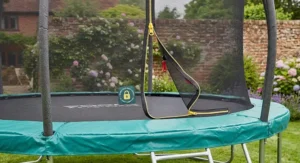
The Jumpflex FLEX 12ft takes a genuinely different engineering approach: a “zero-bolt, zero-weld” frame assembly method that the brand says roughly halves build time versus traditional bolted trampolines, paired with a 150kg weight capacity that ties it with the SONGMICS model for the highest in this round-up. What most buyers overlook is the net material itself — woven nylon rather than the more common polyethylene mesh, treated with a UV additive, and secured to the mat via a “SafeSeal” self-closing entrance system that removes the gap where fingers or toes can otherwise slip through during a bounce. Reviewers describe the build as noticeably quicker than expected, with one recent buyer reporting a full assembly in roughly ninety minutes with help from a family member. Certified to both ASTM and CE standards, this is a trampoline built with an eye on longevity in genuinely wet British gardens, not just a photogenic spec sheet.
Pros:
- ✅ Nylon net construction outlasts standard polyethylene mesh
- ✅ Zero-bolt build genuinely speeds up assembly
- ✅ 150kg capacity matches the highest in this list
Cons:
- ❌ Newer brand with a smaller UK review pool than Plum or Kanga
- ❌ Premium pricing versus similarly specced budget models
Expect around £270-320 — a reasonable value case if enclosure net durability is your priority over brand recognition.
7. Plum Magnitude — premium curved enclosure design
Sitting at the top of this line-up, the Plum Magnitude uses Plum’s “3G” curved enclosure design, which bows the netting outward from the frame rather than running it in a straight vertical line. Here’s what to weigh: that curve genuinely increases usable jumping space near the edges, since bouncers are physically further from the springs and poles even at the perimeter of the mat. The frame is double-galvanised inside and out, uses 72 zinc-coated springs, and the UK retail listing specifies a 100kg maximum user weight — worth noting this is lower than the mid-range Plum Space Zone II, so it’s built more around consistent long-term durability than raw weight capacity. Reviewers consistently single out the “SpringSafe” system, where the net is sewn directly to the safety pad, as the standout safety feature, since there’s no gap for a foot to slip through between mat edge and enclosure base. This is the trampoline for buyers who see it as a permanent garden fixture rather than a few years’ investment.
Pros:
- ✅ Curved 3G enclosure maximises usable edge space
- ✅ Net sewn directly to safety pad closes off gap risk
- ✅ Double-galvanised frame built for long-term outdoor use
Cons:
- ❌ 100kg weight limit is lower than the mid-range Plum Space Zone II
- ❌ Highest price point in this round-up
At around £350-420, this is a premium choice — the value verdict depends on whether you’re buying for years of daily use (in which case, yes) or occasional summer fun (in which case, the Plum Space Zone II likely makes more financial sense).
✨ Don’t Miss These Exclusive Deals!
🔍 Take your garden setup to the next level with these carefully selected 12ft trampolines. Click on any highlighted model above to check current pricing and availability. These picks will help you create years of safe, active fun your family will genuinely love!
Practical Usage Guide: Setting Up Your Complete 12ft Trampoline Set
Buying a 12ft trampoline complete set — frame, enclosure, ladder and anchor kit together — solves half the battle, but the other half is what happens on assembly day and the weeks after. Most complete sets arrive in two or three separate boxes, sometimes on different delivery days, so resist the urge to start building the moment the first box lands; check you have every parcel before you touch a spanner.
Ground preparation matters more than most instruction leaflets admit. A trampoline needs a genuinely flat, level surface — even a modest slope causes uneven frame stress over time, which shortens the lifespan of joints and welds. Grass or bark is preferable to hard-standing, since RoSPA recommends impact-absorbing surfaces beneath garden play equipment generally, and a paved patio simply doesn’t offer that cushioning if a fall does happen despite the net.
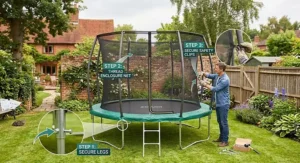
Assembly itself is a two-person job for anything at 12ft — trying to solo it is where most of the “took me six hours and I nearly gave up” reviews come from. Attach the legs to the frame ring first, then work the springs in evenly around the circle rather than completing one side before starting the next, which keeps tension balanced and reduces strain on any single point. The enclosure poles go up after the mat is fully sprung, never before, and the net should be tensioned enough to sit taut without pulling the poles inward.
In the first 30 days, the most common mistake is skipping the anchor kit because “it looks stable enough already.” British weather disagrees with that assumption more often than people expect — a gust strong enough to shift an unanchored 12ft frame doesn’t need to be a named storm. A monthly check of spring hooks, net stitching and pole caps keeps small wear from becoming a safety issue, and it takes about five minutes.
Real-World Scenarios: Which 12ft Trampoline Suits Your Family
If you’re a family with two children aged nine and eleven in a standard three-bed semi with a modest lawn, budget and simplicity probably matter more than premium engineering — the KANGA 12ft Premium or Zero Gravity Ultima 4 cover the basics without overspending, and both fit comfortably within a typical 20-by-15-foot garden once clearance is factored in.
If you’re a household where the trampoline needs to disappear every winter because the garden doubles as a patio party space in the warmer months, the Sportspower Sport-Pro‘s folding frame earns its slightly higher price simply by solving a storage headache that other models leave you to figure out yourself.
If you’re planning for this to be the trampoline your children still use as teenagers — and possibly the trampoline you occasionally bounce on too — the Plum Space Zone II or Plum Magnitude make more long-term financial sense than replacing a budget model every two or three years. Both carry weight limits and build quality that comfortably outlast a typical childhood’s worth of use, and the five-year frame warranties reduce the risk of an expensive early failure.
Problem → Solution: Common 12ft Trampoline With Enclosure Issues
Problem: The enclosure net is sagging after a year or two. This is almost always a tension issue rather than a material failure — check whether the net’s tie-points or elastic loops have loosened rather than assuming the mesh itself has stretched. Re-tensioning per the manufacturer’s manual usually resolves it; if it doesn’t, a replacement net compatible with your frame size (most 12ft frames use a standard fitting) is far cheaper than a whole new trampoline.
Problem: Springs are rusting despite a galvanised frame. Galvanising protects the tubular frame, but springs are often a separate zinc-coated component that wears faster, especially if left uncovered through winter. A £15-20 spring cover pad and a proper off-season tarp make a genuine difference here.
Problem: The trampoline shifted position after high winds. This points directly back to the anchor kit — if one wasn’t fitted, or the ground stakes were driven into soft or waterlogged soil, they simply won’t hold. Firmer, deeper anchoring or heavier sandbag-style weights solve this for gardens with looser soil.
Problem: Assembly instructions don’t match the parts in the box. This happens more often than manufacturers would like to admit, particularly with budget imports. Most UK brands, including Kanga and Sportspower, run active customer service lines specifically for this — contacting them directly is usually faster than trying to improvise with mismatched hardware.
Problem: Kids are bouncing off-centre and hitting the enclosure. This is frequently a size mismatch — younger, lighter children on a 12ft frame designed with older users in mind sometimes struggle to control their bounce trajectory, which is exactly why RoSPA notes that trampolining isn’t suitable for children under six, as they aren’t sufficiently physically developed to control their bouncing. One jumper at a time, with adult supervision, remains the single most effective fix.
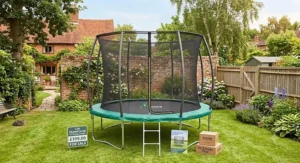
How to Choose a 12ft Trampoline With Enclosure
- Confirm your garden’s clear footprint first. A 12ft frame needs roughly 16ft of genuinely clear space in every direction once the enclosure and a safety fall-zone are factored in — measure before you fall in love with a specific model.
- Check the weight limit against your actual users, not just today’s. If a supervising adult will regularly join younger children on the mat, look toward the 125-150kg end of this list rather than the 100kg models.
- Prioritise enclosure height and closure method over colour or accessories. A taller net (200cm+) and a sewn-in or zip-sealed entrance reduce fall risk more meaningfully than a bundled basketball hoop ever will.
- Look for third-party certification, not just a manufacturer’s claim. TÜV, CE and compliance with EN71-14 are genuine independent markers, whereas “meets safety standards” printed on a listing with no certifying body named tells you very little.
- Factor in assembly realism. If you’re building solo or have limited weekend time, a folding or simplified frame system like the Sportspower Sport-Pro removes friction that a heavier premium frame doesn’t.
- Budget for the anchor kit and a spring cover pad even if they’re sold separately. These aren’t optional extras despite how some listings present them — they’re core to both safety and frame longevity.
- Read reviews for net durability specifically, not overall star ratings. A 4.5-star average can still hide a recurring complaint about the enclosure sagging within a year — search reviews for the words “net” and “enclosure” directly.
12ft Trampoline Safety Net Height Standards Explained
What is the correct enclosure net height for a 12ft trampoline? Most reputable UK models set their enclosure net height between 180cm and 216cm, tall enough that an average adult standing beside the trampoline can see over it, and tall enough to prevent a bouncing child from being propelled over the top during normal use…
There’s no single legally mandated net height in UK regulation, but new domestic trampolines are expected to meet EN71-14:2014, the European toy safety standard covering trampolines for home use, which addresses enclosure design alongside frame strength and spring cover requirements. Here’s how the seven models in this guide compare on that specific measurement:
| Model | Enclosure Net Height | Entry Method |
|---|---|---|
| KANGA 12ft Premium | 180cm | Curved zipped entrance |
| Plum Space Zone II | 216cm | Zipped, sewn to safety pad |
| Jumpflex FLEX 12ft | 200cm | SafeSeal self-closing entrance |
| Plum Magnitude | 216cm | 3G curved, sewn to pad |
The two Plum models and the Jumpflex FLEX sit meaningfully taller than the entry-level options, and that height difference is not just a marketing number — a shorter net genuinely reduces the margin between a confident jump and an accidental exit over the top rail. If your household includes older, taller children or teenagers, treating enclosure height as a priority spec rather than an afterthought is worth the modest price premium.
Enclosure Net Durability: What Our Research and Reviewer Reports Show
Durability claims are where marketing copy and lived reality diverge most sharply, so it’s worth being precise about what genuine review data actually shows rather than what spec sheets promise. Across the models reviewed here, nylon-based netting — as used on the Jumpflex FLEX — consistently outperforms standard polyethylene mesh in longer-term owner reports, largely because nylon resists UV degradation and knot-slip better over multiple British summers of direct sun exposure.
Sewn-to-mat designs, used by both Plum models, show a second durability advantage: because there’s no separate seam between the jumping mat and the enclosure base, there’s no gap for repeated stress to work loose over time. Reviewers who’ve owned Plum enclosures for three-plus years, as documented in independent parent-tester coverage, report minimal sagging when the frame is properly anchored and the trampoline isn’t left uncovered through the worst of winter.
Budget nets, by contrast, tend to show wear at the tie-points and stitched seams first — not because the mesh itself fails, but because the anchoring hardware (grommets, hooks, elastic loops) is a cheaper component built to a lower tolerance. The honest verdict: net material matters, but how the net attaches to the frame and mat matters just as much, if not more, for long-term durability.
12ft Trampoline vs Large Enclosed Trampoline Alternatives
If you’re weighing a 12ft model against a larger enclosed trampoline — 14ft or 15ft — the decision usually comes down to garden footprint versus long-term headroom for growing children. A 14ft trampoline typically needs an extra two feet of clearance on all sides compared with a 12ft frame, which sounds modest until you’re actually pacing it out on a suburban lawn.
| Factor | 12ft Trampoline | 14ft+ Trampoline |
|---|---|---|
| Typical garden footprint needed | ~16ft clearance | ~18-20ft clearance |
| Simultaneous jumpers (comfortable) | 2 children | 2-3 children |
| Typical weight limit | 100-150kg | 120-180kg |
| Price premium vs 12ft | — | Roughly 15-30% more |
For most UK gardens, the 12ft size hits the practical ceiling before space runs out — it’s large enough for genuine multi-child play without demanding a garden most semi-detached homes simply don’t have. A 14ft or larger enclosed trampoline earns its extra cost and footprint mainly for families with genuinely spacious gardens or older, taller teenagers who need more room to bounce safely without crowding the enclosure walls.
Buying a Large Trampoline Safety Set on Amazon: What to Check First
Shopping for a large trampoline safety set on Amazon specifically has its own quirks worth knowing before you click “add to basket.” First, check whether the listing title’s size claim matches the actual jumping mat diameter buried in the bullet points — a “12ft trampoline” almost always refers to the outer frame diameter, not the usable jump surface, which is typically 30-50cm smaller once the padding is accounted for.
Second, check whether the enclosure, ladder and anchor kit are genuinely bundled in the listed price or sold as “compatible accessories” separately — a frustratingly common tactic among lesser-known third-party sellers on the marketplace. Third, cross-reference the seller name against the brand name; several of the models in this guide, including Kanga and SONGMICS, sell both directly and through third-party Amazon Marketplace sellers, and stock consistency (and warranty support) is generally stronger when buying from the brand’s own listing or an Amazon-fulfilled offer.
Finally, always check the Q&A section on the listing itself before purchasing — as seen repeatedly across the Sportspower and Kanga listings referenced in this guide, genuine buyer questions about weight limits, box counts and delivery timing often surface details the main product description conveniently omits.
💬 Ready to compare live prices? One click on any model above helps you check today’s availability!
Long-Term Cost & Maintenance of Your 12ft Trampoline Enclosure
The sticker price is only the opening chapter of a 12ft trampoline’s total cost of ownership. Budget for a replacement spring cover pad roughly every two to three years (£20-40), an occasional spring replacement set if individual springs lose tension (£10-20), and — the big one — an eventual enclosure net replacement, typically needed somewhere between year three and year seven depending on weather exposure and net material quality.
On a pure cost-per-use basis, the maths tends to favour the mid-range and premium models surprisingly quickly. A £150 budget trampoline needing a full net replacement (£60-80) after three years, followed by a further replacement two years later, can end up costing more over a decade than a £350 Plum Magnitude with a longer-lasting sewn enclosure and a stronger warranty covering component failure. Total cost of ownership, not just the upfront figure, is the more honest way to compare value across this list.
Maintenance-wise, a simple seasonal routine keeps most of these costs at bay for longer: cover or partially dismantle the trampoline before the worst of winter, check spring tension and net stitching each spring before the first bounce of the season, and keep the anchor kit taut year-round rather than only during storm warnings. If you’re ever unsure whether an ageing net or frame is still safe to use, Suffolk County Council’s trading standards guidance is a useful, plainly written reference for when to stop using a product and report a concern.
Features That Actually Matter (And Those That Don’t)
Genuinely worth prioritising: enclosure net height and attachment method, independent safety certification (TÜV, CE, EN71-14 compliance), weight limit relative to your actual users, and frame warranty length as a proxy for manufacturer confidence in their own build quality.
Genuinely overrated for most families: bundled basketball hoops (fun, but consistently the first accessory to wear out per reviewer reports), spring count as a standalone number (72 springs on a poorly tensioned frame bounces worse than 60 on a well-engineered one), and colour options, which affect nothing except how the trampoline looks against your fence.
Reasonably useful but not essential: a folding frame for storage-tight gardens, a zipped versus tied entrance (zips are simply more convenient day-to-day), and branded accessory ecosystems like tents or shade covers, which are genuinely nice additions but shouldn’t influence the core purchase decision.
12ft Trampolines for Different Ages and Family Sizes
For households with children aged six to nine, weight limit matters less than enclosure height and jump-control — a taller net like the Plum Space Zone II‘s 216cm design offers more margin for less experienced, less controlled bouncing.
For families with a mix of children and occasional adult participation — a parent joining in, or older cousins visiting — the 150kg-capacity models, SONGMICS and Jumpflex FLEX, make more practical sense than the 100kg options, since combined jumper weight adds up faster than people expect.
For households where this will be a shared, near-daily fixture across several years and multiple children growing into their teens, the durability-first argument for Plum Magnitude or Plum Space Zone II becomes stronger the longer the intended ownership period.
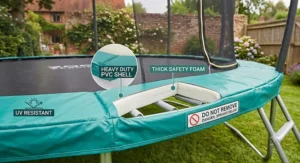
Frequently Asked Questions
❓ How much space do I need for a 12ft trampoline with enclosure?
❓ What weight limit should I look for on a 12ft trampoline?
❓ Do I need to buy a ladder and anchor kit separately?
❓ How long does a 12ft trampoline enclosure net typically last?
❓ Is a 12ft trampoline safe for a six-year-old?
Conclusion
A 12ft trampoline with enclosure is one of those purchases where the “best” option genuinely depends on which family is buying it. Budget-conscious households will get years of solid use from the KANGA 12ft Premium or Zero Gravity Ultima 4. Families wanting active, games-oriented fun should look at the SONGMICS with its basketball hoop, while smaller gardens or storage-tight households benefit specifically from the Sportspower Sport-Pro‘s folding frame.
For anyone planning years of daily use across a growing family, the case for investing in the Plum Space Zone II, Jumpflex FLEX, or the premium Plum Magnitude is straightforward once total cost of ownership — not just the sticker price — enters the calculation. Whichever model you land on, the enclosure net height, attachment method and genuine third-party safety certification matter more than accessory count or colour choice. Get those fundamentals right, and the rest is just bounce.
Recommended for You
- 12ft Family Trampoline: 7 Brilliant UK Picks for 2026
- Best 12ft Trampoline 2026: 7 Top Picks Ranked
- 12ft Trampoline: 7 Best Picks for UK Gardens in 2026
Disclaimer: This article contains affiliate links. As an Amazon Associate, I earn from qualifying purchases. If you purchase products through these links, we may earn a small commission at no additional cost to you.
✨ Found this helpful? Share it with your friends! 💬🤗
