
In This Article
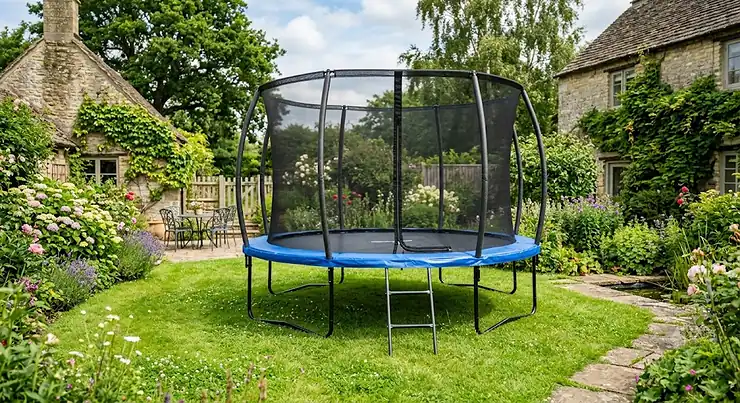
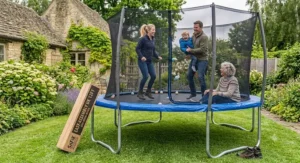
A 12ft trampoline is the size most British gardens settle on, and once you start looking, you’ll understand why. It’s roomy enough for two children to take turns without feeling cramped, compact enough to survive a standard suburban plot, and priced sensibly compared with the 14ft and 16ft giants that dominate showroom photos but rarely fit real gardens. What is a 12ft trampoline, exactly? It’s a round, oval or octagonal trampoline with a frame diameter of roughly 3.6-3.7 metres, typically fitted with a safety enclosure net, supporting one jumper at a time up to somewhere between 100kg and 250kg depending on the model. That range matters more than most shoppers realise, because two trampolines advertised as “12ft” can behave very differently once someone’s actually bouncing on them.
This top 12ft trampoline review exists because the market is stuffed with near-identical looking boxes, and the differences that actually matter (spring gauge, enclosure design, frame galvanising) rarely show up in a glance at the product photo. Rather than parrot manufacturer copy, we’ve dug into real specs, real aggregated review sentiment and the safety guidance that governs domestic trampolines in the UK, so you can make a properly informed 12 foot trampoline buy rather than a gamble. We’ll walk through seven genuine models spanning budget to premium, explain what the spring counts and weight ratings actually mean for your family, and flag the mistakes that trip up first-time buyers. By the end, you’ll know exactly which one suits your garden, your budget and your kids’ ages — and which pitfalls to sidestep entirely.
Quick Comparison Table
| Trampoline | Weight Limit | Springs | Enclosure Type | Price Range | Best For |
|---|---|---|---|---|---|
| Plum Space Zone II 12ft | 125kg | Standard coil | Springsafe 3G (net sewn to mat) | £250-£350 range | Best all-round family value |
| TP Genius 12ft Round | 130kg | Standard coil | SurroundSafe wraparound | £300-£400 range | Best for cautious first-timers |
| TP Infinity Octagonal 12ft | 130kg | Long-throw premium | YOYO fold-down net | £350-£450 range | Best bounce feel in its class |
| SONGMICS 12ft | 150kg | Standard coil | TÜV-tested PE net | Under £250 | Best budget large trampoline |
| Zero Gravity Ultima 4 12ft | 100-150kg (see analysis) | 72 conical | Quick-release enclosure | £250-£350 range | Best weldless frame design |
| Rebo Base Jump 12ft Halo II | 150kg | Standard coil | Halo II enclosure | £250-£350 range | Best value with basketball hoop bundles |
| Jumpflex HERO 12ft | 250kg total rating | 80 galvanised | SafeSeal 360° net | £450-£600 range | Best 12ft trampoline brand for premium build |
Looking at the spread above, the gap between the cheapest and most expensive models here isn’t really about “bounce” in the way most buyers assume — it’s about how much abuse the frame and springs can absorb over several British winters. The SONGMICS and Rebo models both undercut £300 while still hitting genuinely useful weight limits, which is why they dominate first-purchase searches. Meanwhile, the Jumpflex HERO’s 250kg total rating and dual-ring frame put it in a different durability bracket entirely, justifying its premium price for families who want this to be a ten-year purchase rather than a three-year one.
💬 Found a favourite already? Check current pricing and availability before the good sizes sell out this season.
Top 7 12ft Trampolines: Expert Analysis
1. Plum Space Zone II 12ft Trampoline — best all-round family value
The standout here is the Springsafe 3G enclosure, which sews the net directly to the jump mat so there’s no gap where fingers or toes could reach the springs — a genuinely useful design touch rather than a marketing flourish. Specs-wise, you’re looking at a galvanised steel frame (inside and out, which matters for rust resistance), a UV-treated jumping mat, and Plum’s signature “Tramp Klamp” brackets reinforcing the leg-to-frame joints. In practice, that galvanising is what lets this trampoline sit outside all year without a cover and still look presentable after several seasons, which is exactly what independent parent testing found. The maximum user weight sits at 125kg, on the lower side of this lineup, so it’s best suited to households where the trampoline is mainly for children rather than adults joining in regularly.
Based on the spec comparison, this model earns its “best all-round” tag less through any single standout feature and more through consistency: nothing here is class-leading, but nothing is a weak point either. Reviewers consistently report that assembly, while officially recommended for two people, is manageable solo in two to three hours, and that the trampoline holds up well through multiple years of heavy daily use with minimal maintenance beyond occasional washer replacement. A recurring minor gripe is that small black washers on the frame joints can work loose over time and can be tricky to source as spares, though this doesn’t affect core safety or function.
Pros:
- ✅ Springsafe 3G enclosure removes the spring-contact gap
- ✅ Galvanised steel frame withstands year-round UK weather
- ✅ Straightforward one-person assembly in 2-3 hours
Cons:
- ❌ 125kg limit is lower than several competitors here
- ❌ Small frame washers can be fiddly to replace
At around £250-£350 depending on retailer promotions, the Plum Space Zone II represents strong value for a mid-tier trampoline that’s built to last rather than to impress on spec sheets alone — check current pricing on Amazon before you commit, as Plum’s pricing does fluctuate with seasonal demand.
2. TP Genius 12ft Round Trampoline — best for cautious first-timers
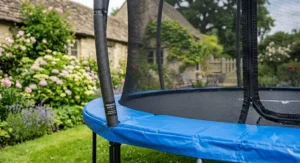
What immediately stands out is the patented SurroundSafe enclosure, which wraps the springs completely so that children both inside and outside the enclosure are protected — most competitors only shield jumpers on the inside. The frame is galvanised steel backed by a 5-10 year rust guarantee (TP’s exact figure varies slightly by retailer listing), and the zip-free IGLOO door entry means there’s no zip to snag clothing or get left undone by an excitable six-year-old. The maximum single-user weight sits around 130kg, and TP explicitly limits use to one jumper at a time, a rule the brand enforces harder in its marketing than most rivals.
What most buyers overlook about this model is that the “wraparound” design isn’t just about the jumper — it’s aimed at siblings or pets who might wander near the trampoline while someone else is bouncing, which is a genuinely distinct safety angle from most 12ft trampolines on this list. TP Toys has also had its range tested and endorsed by Olympic trampolining gold medallist Bryony Page, and while celebrity endorsement isn’t evidence of engineering quality on its own, the brand’s 65-plus years designing UK garden equipment does carry some weight. Customer feedback frequently praises the zip-free door specifically, with several reviewers noting it removed their biggest safety worry compared with older zipped trampolines they’d previously owned.
Pros:
- ✅ SurroundSafe wraparound shields jumpers and bystanders alike
- ✅ Zip-free IGLOO door removes a common failure point
- ✅ Long-standing UK brand with 65+ years in outdoor play
Cons:
- ❌ Ladder and weather cover often sold separately
- ❌ One-jumper-at-a-time rule limits sibling play
In the £300-£400 range, the TP Genius suits parents whose top priority is minimising avoidable safety gaps rather than chasing the springiest possible bounce.
3. TP Infinity Octagonal 12ft Trampoline — best bounce feel in its class
The octagonal shape is the standout feature here, and it’s not just cosmetic — TP’s Infinity range uses longer springs than most trampolines on the market, which translates into a noticeably higher, smoother bounce across more of the jumping surface than a standard round frame typically manages. The “Intelligent Feet System” adjusts to uneven ground, a detail that matters more than it sounds in gardens that aren’t perfectly flat (which, in the UK, is most of them). Add the YOYO enclosure system, which one adult can fold down in under a minute without tools, and you’ve got a trampoline designed as much for practical daily use as for the jump itself.
Here’s what the spec sheet won’t tell you, but the octagonal design implies: because the springs move more independently of one another than on a fully round frame, the bounce feels closer to a rectangular trampoline’s consistent edge-to-edge response while still fitting the same footprint as a standard round 12-footer. That’s a meaningful upgrade for slightly older children who’ve outgrown a basic bouncer and want a livelier, more responsive surface without needing a bigger garden. The extra-thick Safeguard pads, covered in tough PVC, also age noticeably better than thinner PE alternatives when left outdoors through a full British winter.
Pros:
- ✅ Octagonal frame and longer springs deliver livelier bounce
- ✅ Intelligent Feet System stabilises on uneven gardens
- ✅ YOYO enclosure folds down solo in under a minute
Cons:
- ❌ Pricier than TP’s standard round Genius model
- ❌ Octagonal shape takes marginally more assembly patience
Priced in the £350-£450 range, this is the pick for families who’ve already had a basic trampoline and are upgrading for genuinely better bounce quality rather than just size.
4. SONGMICS 12ft Trampoline — best budget large trampoline
The standout feature is straightforward: a 150kg maximum static load capacity at a price that regularly undercuts £250, which is a genuinely strong ratio for this size category. The frame uses galvanised steel tubes joined by T-shaped connectors and W-shaped legs, a stability-focused design that doesn’t require perfectly level ground to sit securely. The 180cm-high enclosure net is backed by TÜV Rheinland GS certification, a recognised German testing mark that adds a layer of third-party verification beyond the manufacturer’s own claims.
Based on the spec comparison, SONGMICS has clearly prioritised weight capacity and certification over premium finishing touches — the spring cover padding is 30mm wide with 15mm EPE foam, respectable but not class-leading. Reviewers consistently note that assembly is manageable with the included tools and instructions, though a meaningful minority found the process more time-consuming than expected, particularly the net attachment stage. Customers also frequently highlight that the trampoline suits a wide range of children’s ages and that it’s proven sturdy enough to handle boisterous multi-year use, with several reviewers specifically calling out the value-for-money as the deciding factor in their purchase.
Pros:
- ✅ 150kg limit is high for this price bracket
- ✅ TÜV Rheinland GS certification adds verified safety testing
- ✅ W-shaped legs stay stable without perfectly flat ground
Cons:
- ❌ Spring cover padding is thinner than premium rivals
- ❌ Some buyers report longer-than-expected assembly time
At under £250, the SONGMICS is the trampoline to consider first if budget is the primary constraint and you don’t want to compromise heavily on weight capacity to get there.
5. Zero Gravity Ultima 4 12ft Trampoline — best weldless frame design
The patented weldless frame is the genuine standout here — rather than welding joints, which is where trampoline frames traditionally crack first, Zero Gravity’s design has reportedly survived over 2.5 million test cycles versus roughly 1 million for a typical welded frame. The 12ft model runs 72 conically shaped galvanised springs, a jump mat made from tear-resistant “Permatron” material rated for UV exposure, and six curved double legs for added stability. It’s worth flagging that published weight limits vary by retailer for this model, with the manufacturer’s own site listing 150kg while some third-party sellers list 100kg, so always verify the current figure on the specific listing before you buy.
What most buyers overlook about the Ultima 4 is the quick-release enclosure: unlike trampolines where the safety poles bolt directly to the frame, this design allows the entire upper enclosure to collapse in around five minutes without tools, which genuinely helps during storms (folding it down reduces wind-catch risk considerably) and makes off-season storage far less of a chore. The PVC-topped safety padding is also worth noting — Zero Gravity specifically contrasts this with cheaper PE padding, which tends to degrade and flake under prolonged UV exposure, a common complaint about budget trampolines after a couple of summers.
Pros:
- ✅ Weldless frame tested to 2.5 million cycles
- ✅ Enclosure collapses in about five minutes, tool-free
- ✅ PVC-topped padding resists UV degradation better than PE
Cons:
- ❌ Weight limit listings are inconsistent across retailers
- ❌ Support line reliance suggests instructions aren’t foolproof
In the £250-£350 range, the Ultima 4 rewards buyers who value a genuinely different (and well-tested) frame engineering approach over the more conventional welded designs used elsewhere on this list.
6. Rebo Base Jump 12ft Trampoline with Halo II Enclosure — best value with basketball hoop bundles
The Halo II enclosure is the headline feature, offering a 150kg weight limit that matches the SONGMICS at the budget end while adding Rebo’s more structured pole-and-net system for extra rigidity around the enclosure’s perimeter. The 3.66m diameter delivers genuinely generous jumping space for the money, and Rebo frequently bundles the Base Jump with accessories like a basketball hoop set, which adds practical play value without the buyer having to source a compatible add-on separately.
Here’s what the spec sheet won’t tell you: a 150kg weight limit on a budget-tier trampoline like this one means it comfortably accommodates a parent joining in briefly for a photo or a supervised bounce, not just the children it’s primarily designed for — a detail that matters for households where “family trampoline” genuinely means the whole family. Reviewer sentiment for the Base Jump range consistently praises the balance of safety features against price, positioning it as a sensible middle ground between the cheapest unbranded imports and the premium end of this list.
Pros:
- ✅ 150kg limit matches pricier rivals at a lower cost
- ✅ Halo II enclosure adds structural rigidity around the net
- ✅ Frequently bundled with basketball hoop accessories
Cons:
- ❌ Fewer standalone safety certifications listed than SONGMICS
- ❌ Basketball hoop bundle availability varies by retailer
At £250-£350 depending on bundle choice, the Rebo Base Jump is worth comparing directly against the SONGMICS if a basketball hoop or extra accessories would tip your decision.
7. Jumpflex HERO 12ft Trampoline — best 12ft trampoline brand for premium build
The DualRing frame is the clear standout: a 42mm high-tensile steel upper ring paired with a 38mm lower ring, combined with a zero-bolt, zero-weld assembly method that Jumpflex says roughly halves build time compared with traditional bolted frames. The 80 galvanised springs give this model a notably deep, smooth bounce, and the total weight rating of 250kg — while intended for jumpers individually weighing 20-100kg — reflects a considerably more robust structural build than the budget and mid-tier options above.
What most buyers overlook about the HERO is that its six-layer rust-proofing process (galvanising plus a UV-resistant black powder coating on visible sections) is specifically engineered for outdoor exposure rather than adapted from an indoor product line, which shows in how the frame holds its finish season after season. Reviewers consistently highlight the assembly speed as a standout, with several noting two adults completed the build in around two hours despite the trampoline’s larger, more substantial components. The 10-year frame warranty (extendable to a lifetime option) also signals a brand confident enough in its own durability testing to back it commercially, something budget brands rarely offer at this length.
Pros:
- ✅ DualRing 42mm/38mm frame with bolt-free assembly
- ✅ 250kg total weight rating well above the budget tier
- ✅ 10-year frame warranty, upgradeable to lifetime cover
Cons:
- ❌ Priced meaningfully higher than every other model here
- ❌ Overkill for households only needing light occasional use
At £450-£600, the Jumpflex HERO is the trampoline to choose if you want this purchase to be the last 12ft trampoline you ever buy for this garden.
Practical Usage Guide: Setup, Maintenance and Optimisation
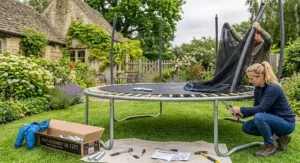
Getting a 12ft trampoline right starts before the first spring goes on. Choose a flat patch of lawn rather than patio or decking — soft ground genuinely absorbs impact better if anything goes wrong, and most manufacturers explicitly warn against hard surfaces. Budget two adults and two to four hours for assembly; trying to do it solo is possible on lighter models like the Plum Space Zone II, but larger premium frames like the Jumpflex HERO go noticeably faster with a second pair of hands feeding springs. Use the supplied spring-loading tool rather than fingers alone — it’s not just about comfort, it dramatically reduces the risk of a snapped-back spring catching skin during assembly.
Once it’s up, a genuinely useful first-30-days habit is a quick monthly check of spring hooks, net stitching and frame joints, since early wear is far easier to fix than a failure mid-bounce. Common early mistakes include leaving the ladder attached permanently (RoSPA and most manufacturers recommend removing it between sessions so younger children can’t access the trampoline unsupervised) and skipping an anchor kit in exposed gardens, which leaves even a well-built frame vulnerable to being lifted by strong wind. For optimisation, rotating which quadrant of the mat gets the most use evens out spring wear over time, and a breathable weather cover — rather than a fully sealed tarpaulin — prevents moisture pooling on the mat, which is a common cause of premature UV mat degradation even on models with strong factory UV treatment.
Real-World Scenarios: Which 12ft Trampoline Suits Your Family
Picture the Hendersons: two children aged seven and nine, a mid-sized suburban garden, and a budget capped around £280. The SONGMICS 12ft or Rebo Base Jump both fit comfortably here — the 150kg limits comfortably cover both children with room to spare as they grow, and neither model demands premium-tier spending for what is, realistically, several years of standard family bouncing rather than daily gymnastics training.
Now consider the Okafor family: one gymnastics-keen 11-year-old practising moves most evenings, plus occasional supervised use by an adult sibling visiting at weekends. Here the extra bounce quality of the TP Infinity Octagonal, or the higher weight rating and structural robustness of the Jumpflex HERO, earns its higher price — frequent, more athletic use puts genuinely more cyclical stress on springs and frame than casual bouncing, and cheaper models simply aren’t built for that duty cycle long-term.
Finally, take a young family with a five-year-old not quite ready for solo trampoline use and budget firmly capped under £300. The Plum Space Zone II’s Springsafe enclosure and TP Genius’s wraparound SurroundSafe design both prioritise the kind of layered protection that matters most when a nervous parent is watching a first-timer bounce, making either a sensible starting point before upgrading later if the interest sticks.
How to Choose a 12ft Trampoline
- Confirm your garden actually fits it. Manufacturers typically recommend at least 2-2.5 metres of clear space on all sides plus overhead clearance, so measure before you fall in love with a listing.
- Match the weight limit to who’s actually jumping. If an adult will ever join in, even occasionally, aim for 130kg-plus rather than the lowest-rated budget options.
- Check the enclosure design, not just its presence. A net sewn to the mat (Springsafe-style) or a fully wraparound design (SurroundSafe-style) closes more injury pathways than a basic bolt-on net.
- Look past spring count to spring gauge and length. More springs on a bigger frame doesn’t automatically mean springier — thickness and length matter as much as quantity.
- Verify a recognised safety standard. In the UK, that means EN71-14:2014 compliance at minimum, ideally alongside GS, TÜV or ASTM certification.
- Factor in realistic assembly time and manpower. Solo assembly is possible on lighter frames but budget two people and half a day for anything premium-tier.
- Decide your maintenance appetite honestly. A galvanised frame and UV-treated mat need less babying than budget alternatives, which can matter more than the sticker price over five years.
Common Mistakes When Buying a 12ft Trampoline
The single most common error is buying purely on price and only checking the weight limit after the trampoline arrives — by then, returning a large, part-assembled item is far more hassle than checking specs upfront. A close second is assuming “12ft” means an identical jumping surface across brands; frame diameter and actual mat diameter can differ by several inches once you account for enclosure padding thickness, which matters if you’re trying to fit a trampoline into a tight garden corner. Buyers also frequently skip an anchor kit, assuming the trampoline’s own weight is enough — it usually isn’t in genuinely exposed, windy gardens, and a lifted trampoline is both a safety hazard and an expensive repair. Finally, many people underestimate how much a permanently attached ladder undermines the “one jumper at a time, supervised” safety model that every major manufacturer and RoSPA itself recommends.
12ft Trampoline vs 10ft and 14ft: Which Size Wins
A 10ft trampoline suits smaller gardens and younger, lighter jumpers well, offering a tighter, often bouncier feel for a single child, but it starts to feel cramped once two children want to use it in quick succession or a child grows into their early teens. A 14ft model, by contrast, offers genuinely more room for multiple simultaneous bounce sessions (even though one-at-a-time remains the safety-recommended approach) and tends to suit larger, more athletic teenagers better, but it demands considerably more garden space and typically costs £100-£200 more for a comparable safety spec. The 12ft size sits deliberately in the middle: enough room to feel spacious for most children through to their early teens, without dominating an average UK garden or pricing out budget-conscious families. If your garden is genuinely large and your children are already confident, older jumpers, a 14ft is worth the upgrade; for the vast majority of UK households, the 12ft remains the best large trampoline that doesn’t force a compromise on space or spend.
12ft Trampoline Spring Count Quality: What Actually Matters
Spring count gets quoted on every listing, but on its own it’s a fairly weak signal of quality. The Zero Gravity Ultima 4 runs 72 springs, the Jumpflex HERO runs 80, and most standard 12ft trampolines from TP Toys and Plum sit somewhere in a similar range — yet the actual bounce feel and durability differ noticeably between them because gauge (thickness), length and the quality of the galvanising matter just as much as raw quantity. A trampoline with fewer, longer, higher-tensile springs (as seen on TP’s Infinity range) can out-bounce a model with more but shorter, thinner springs. What genuinely predicts long-term quality is galvanising (rust resistance inside and out, not just a surface coating) and whether springs are conically shaped, which several premium models use specifically to reduce metal fatigue over repeated stretching. When comparing spec sheets, treat spring count as a starting point for research rather than a final verdict, and weight it against the frame material and enclosure design covered elsewhere in this guide.
UV Protection Mat 12ft Trampoline: Why It’s Non-Negotiable
Every trampoline on this list advertises a UV-treated or UV-resistant jumping mat, and that’s not marketing filler — untreated PP or PE mats genuinely degrade under prolonged sun exposure, becoming brittle and losing tensile strength years before a properly treated mat would. What most buyers overlook is that UV protection matters as much for the enclosure net and spring padding as for the mat itself; a trampoline with a treated mat but a cheap, untreated PE net cover can still end up with a sagging, sun-damaged enclosure well before the jumping surface itself fails. Reviewers across several of the budget models above specifically flag padding and net degradation as the first visible sign of ageing, generally appearing before any structural frame issue. Practically, this means a breathable weather cover during off-peak months and periodic checks of the net (not just the mat) will meaningfully extend the working life of even a mid-tier trampoline, regardless of how strong the manufacturer’s original UV claims were.
12ft Trampoline Which Brand Should You Trust
TP Toys carries the weight of being a UK-founded manufacturer with over six decades in outdoor play equipment, which shows in details like the zip-free IGLOO door and wraparound SurroundSafe enclosure that few rivals have matched. Plum Products similarly has a long UK track record and backs its Space Zone II with genuinely long warranties on the frame specifically. SONGMICS and Rebo sit at the more accessible end, prioritising weight capacity and price over premium finishing, which suits buyers who want a solid trampoline without paying for extras they won’t use. Zero Gravity has built a specific reputation around its weldless frame engineering rather than brand heritage, appealing to buyers who care more about a documented technical advantage than a household name. Jumpflex, meanwhile, has positioned itself firmly at the premium end with warranty terms and structural ratings that outpace every other brand here, which is precisely why it holds the “best 12ft trampoline brand” position for buyers prioritising longevity over upfront cost. There’s no single objectively “best” brand across every use case — the right one depends entirely on whether your priority is heritage, price, engineering novelty, or premium durability.
Features That Actually Matter (And Those That Don’t)
Genuinely worth paying for: galvanised (not just painted) steel frames, an enclosure design that eliminates spring-contact gaps rather than merely covering them, and a documented, verifiable weight rating rather than a vague marketing figure. Largely marketing hype: exact spring count as a standalone metric (as covered above), cosmetic colour options, and bundled accessories like sprinkler attachments that add little practical value for most families. A middle-ground feature worth weighing case by case is a basketball hoop bundle — genuinely useful if your children want it, irrelevant if they don’t, and rarely worth paying extra for on its own. The bottom line: prioritise the structural and safety fundamentals covered in the “How to Choose” section above, and treat everything else as a tie-breaker rather than a deciding factor.
Safety, Regulations and Compliance Guide
UK domestic trampolines should meet EN71-14:2014, the European safety standard covering materials, construction and performance testing for trampolines intended for home use, and it’s worth checking this explicitly on a listing rather than assuming it as standard. According to the Royal Society for the Prevention of Accidents, roughly 13,000 trampoline-related injuries are treated in English A&E departments annually, with the majority involving children under 15, and more than half of recorded accidents happen even while an adult is supervising — which is why RoSPA specifically recommends a trained “spotter” rather than passive supervision alone. Guidance consistently advises against children under six using a full-size trampoline, since younger children haven’t developed the physical control to manage their own bounce safely, a point echoed by general trampoline safety literature covering the sport’s origins and modern safety evolution. A detailed NHS trust safety leaflet reinforces the core rules that apply regardless of which model you buy: one jumper at a time, remove the ladder between sessions, keep the surrounding safety zone clear of hard objects, and never allow somersaults without proper trampolining instruction, since these account for a disproportionate share of serious injuries.
FAQ
❓ What size garden do I need for a 12ft trampoline?
❓ How many springs does a good 12ft trampoline have?
❓ Can adults use a 12ft trampoline safely?
❓ How long does a 12ft trampoline typically last?
❓ Do I need to buy an anchor kit separately?
Conclusion
Choosing the best 12ft trampoline genuinely comes down to matching weight limit, enclosure design and frame durability to how your specific family will actually use it, rather than chasing the flashiest spec sheet. For most UK households, the Plum Space Zone II or SONGMICS 12ft strike the right balance of safety, price and durability without over-spending on features that won’t get used. Families with older, more athletic jumpers, or anyone treating this as a long-term investment, will get more genuine value from the TP Infinity Octagonal’s superior bounce or the Jumpflex HERO’s premium build and warranty terms. Whichever you choose, the fundamentals covered throughout this guide — a recognised safety standard, a properly rated weight limit, and an enclosure that actually closes the spring-contact gap — matter more than any single headline feature. Take the time to match the model to your garden and your children’s ages now, and you’ll avoid the regret of either overpaying for capacity you don’t need or under-buying for a family that’s about to outgrow a budget model within a year.
✨ Ready to get bouncing?
Compare current prices on your shortlisted model and check availability before this season’s stock sells through — your garden (and your kids) will thank you. 🛒
Recommended for You
- 12ft Trampoline: 7 Best Picks for UK Gardens in 2026
- 10ft Trampoline Under £200: 7 Best Value Picks for 2026
- 10ft Family Trampoline: 7 Best UK Garden Picks 2026
Disclaimer: This article contains affiliate links. As an Amazon Associate, I earn from qualifying purchases. If you purchase products through these links, we may earn a small commission at no additional cost to you.
✨ Found this helpful? Share it with your friends! 💬🤗
