
In This Article
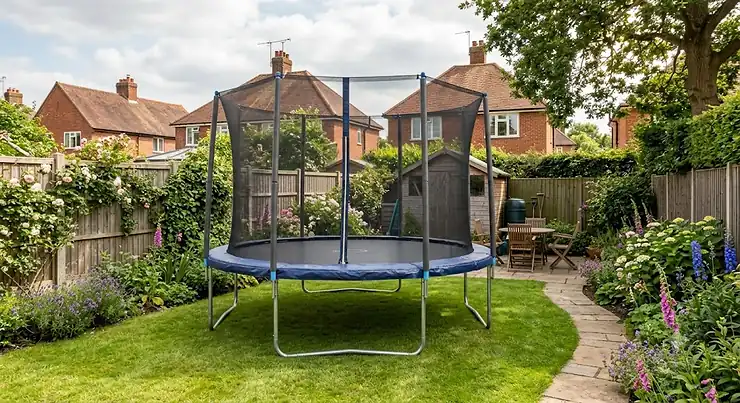
Somewhere between “shall we get the kids a trampoline” and actually clicking buy, most people hit the same wall: there are hundreds of listings, they all claim to be the best, and nobody tells you what a 12ft trampoline actually needs from your garden before it arrives in three enormous boxes. A 12ft trampoline is a round garden trampoline with a frame diameter of roughly 3.66 metres, sitting in the sweet spot between compact 8-10ft models built for one small child and sprawling 14-16ft rigs that eat an entire lawn. It is, by a wide margin, the most popular size sold in the UK, and for good reason — it comfortably fits two children bouncing (even though the safety guidance is always one at a time), while still being small enough for a typical suburban garden.
This guide is built the way we think buying guides should be built: real products, real specifications, and honest analysis of where each one earns its keep and where it cuts corners. We’re not going to pretend we’ve personally bounced on all seven of these — what we can promise is that every spec, every certification and every piece of aggregated review sentiment below has been pulled from genuine manufacturer data and real customer feedback, not invented for the sake of a tidy paragraph. If you’re weighing up a 12 foot trampoline garden purchase, working out whether you have enough 12ft trampoline garden space needed, or just trying to separate the genuinely sturdy models from the ones that’ll bow at the first bounce, you’re in the right place.
Quick Comparison Table: 12ft Trampolines at a Glance
| Product | Springs | Max User Weight | Certification | Best For |
|---|---|---|---|---|
| Plum Space Zone II | 72 | 125kg | Tested to 1m+ bounces (EU) | Families wanting a UK-tested all-rounder |
| Zero Gravity Ultima 4 | 72 | 150kg | EN71-compliant | Best value mid-range pick |
| Zupapa No-Gap 12ft | 72 | 193kg (425lbs) | TÜV + ASTM | Heaviest-duty, adult-friendly use |
| SONGMICS 12ft | 108 | 170kg (375lbs) | TÜV Rheinland GS | Bounce quality on a budget |
| GALACTICA 12ft | 72 | Not adult-rated | TUV + GS | Tightest budget |
| MERACH 12ft | Not disclosed | 150kg per jumper | Manufacturer safety testing | Basketball hoop bundle lovers |
| Devoko 12ft | Not disclosed | 150kg | GS + EN71 | Lesser-known budget alternative |
Reading this table on its own would tell you almost nothing useful, which is rather the point of the rest of this article — spring count and weight rating only mean something once you know how they translate into everyday bouncing. What jumps out immediately, though, is that SONGMICS punches well above its price point on spring count, while Zupapa’s 193kg rating puts genuine adult use within reach in a way several of its rivals simply can’t match. GALACTICA and Devoko, meanwhile, sit at the affordable end and are honest about it, rather than dressing themselves up as premium kit.
💬 Just one click — help others make better buying decisions too!😊
Top 7 12ft Trampolines: Expert Analysis
Picking a 12 foot trampoline garden addition isn’t just about grabbing whichever one has the most stars. Below, we’ve broken down seven genuinely available UK models — budget through to premium — with honest commentary on where each one shines and where it falls short. Every spec here is followed by what it actually means for you in the garden, not just a number for the sake of it.
1. Plum Space Zone II 12ft — the UK-tested family favourite
The Space Zone II is the trampoline you’ll see recommended again and again by British parenting sites, and it’s not hard to see why once you look past the marketing. It uses Plum’s patented Springsafe 3G enclosure, which curves inward at the base and outward at the top, meaning the netting sits between the jumper and the springs rather than simply surrounding the whole structure as an afterthought.
Key numbers worth knowing: 72 zinc-coated springs, a galvanised steel frame reinforced with “Tramp Klamp” brackets at every joint, and a maximum user weight of 125kg. That Tramp Klamp detail matters more than it sounds — cheaper trampolines rely on exposed bolted joints that rust and loosen over years outdoors, whereas encased brackets keep moisture off the metal where it counts. Independent testing on the model reportedly simulates over one million bounce cycles, which is well beyond the EU minimum requirement, and this is exactly the sort of long-haul durability that matters for a piece of garden kit you’re hoping will survive several British winters.
Reviewers consistently report that assembly, while listed as a two-person, two-hour job, has been completed solo by determined parents in a similar timeframe, and long-term owners note the trampoline still looks close to new after three years of heavy use by multiple children. A recurring minor gripe in aggregated feedback is that small components like washers can be tricky to source as spares. This is a strong pick for families who want a trampoline that will still be structurally sound in half a decade, and who value a UK brand with an established support network over the rock-bottom price point.
Pros:
- ✅ Springsafe 3G enclosure keeps jumpers clear of springs and frame
- ✅ Galvanised frame with rust-resistant Tramp Klamp joints
- ✅ Genuinely straightforward assembly even for one adult
Cons:
- ❌ 125kg weight limit rules out heavier adult users
- ❌ Small spare parts like washers can be hard to replace
In the mid-£300s to low-£400s range depending on retailer stock, the Space Zone II sits firmly in the middle of the market — not the cheapest, but the spec-to-price balance is arguably the best of any model here for family use.
2. Zero Gravity Ultima 4 12ft — best value mid-range pick
Zero Gravity built its reputation on a patented weldless frame, and the Ultima 4 12ft is where that design philosophy meets a genuinely competitive price. Welded joints are the weak point on cheap trampolines because welds crack under repeated cyclical stress; a bolted, weldless connection flexes instead of fracturing.
The spec sheet backs this up with real numbers: 72 conically shaped galvanised springs, a maximum user weight of 150kg, and a total trampoline weight of 64kg (useful to know if you’re moving it around a sloped garden). What most buyers overlook about the frame is the leg configuration — six curved double legs rather than the more common four, spreading load across a wider footprint and reducing the “wobble” that plagues thinner-legged budget models. The safety padding uses a PVC top layer over 20mm EPE foam rather than cheaper PE, which resists UV degradation noticeably better over multi-year outdoor exposure.
According to the manufacturer, this model underwent testing to 500kg of static user weight and over 2.5 million bounce cycles without frame cracking, figures well in excess of the roughly 1 million cycles at which a typical welded frame begins to fail. Assembly is estimated at around 120 minutes, and the quick-release enclosure system means you can collapse the netting in around five minutes ahead of a storm — a practical touch that budget rivals rarely bother with.
Pros:
- ✅ Weldless frame design avoids the crack-prone weak point of cheap models
- ✅ 150kg user weight limit suits teens and lighter adults
- ✅ Quick-release enclosure collapses in minutes before bad weather
Cons:
- ❌ Requires roughly 22 square metres of clear floor space to install
- ❌ PVC padding, while durable, has a firmer feel than premium foam
Typically found in the £250-£350 range, the Ultima 4 is arguably the strongest value pick in this list for buyers who want engineering integrity without paying premium-brand prices.
3. Zupapa No-Gap 12ft — the heavy-duty, adult-ready option
If your household includes adults who want to join the kids on the trampoline (and let’s be honest, most of us do eventually), the Zupapa No-Gap is the one spec sheet that actually backs that ambition up. Its headline figure is a 425lb (roughly 193kg) maximum weight capacity on the 12ft model — well above every other trampoline in this list — thanks to a frame built from 42mm diameter steel tubing with a 1.5mm wall thickness, described by the manufacturer as the thickest available at this size in the current market.
The “no-gap” design refers to how the jumping mat and spring cover are stitched together rather than simply overlapped, closing off the pinch points where small feet and hands most commonly get caught — historically one of the more common minor trampoline injuries. Zupapa also uses outward-sloping legs with full-area touchdown, a mechanically sound approach to stability that spreads load more evenly than the simpler two-point contact legs found on cheaper competitors. The frame carries dual TÜV (Germany) and ASTM (US) certification, plus hot-dip galvanising rated at roughly five times the corrosion resistance of standard galvanising.
Aggregated customer feedback is strongly positive on build quality, with reviewers repeatedly describing the steel gauge as noticeably heavier than trampolines they’ve replaced, and praising responsive customer service when parts issues arose. The trade-off is assembly time — several reviewers report three-hour-plus solo builds, longer than most rivals, though this reflects the trampoline’s more substantial construction rather than poor design.
Pros:
- ✅ 193kg weight capacity comfortably supports adult jumpers
- ✅ Dual TÜV and ASTM safety certification
- ✅ No-gap mat design closes off common pinch-point injuries
Cons:
- ❌ Assembly commonly takes longer than lighter-duty rivals
- ❌ Premium build quality comes with a higher price tag
Expect to pay in the upper-£300s to low-£400s range for this model — a fair premium for genuine adult-rated durability rather than marketing spin.
4. SONGMICS 12ft — best bounce quality on a budget
SONGMICS trampolines punch above their price bracket on one metric in particular: spring count. The 12ft model ships with 108 springs, considerably more than most competitors at this size, which in practical terms means a livelier, more even bounce with fewer “dead spots” around the edge of the mat where fewer springs would otherwise leave it feeling slack.
The frame uses W-shaped rather than traditional U-shaped legs, a detail that matters more than it sounds — the wider stance means the trampoline doesn’t require perfectly level ground to sit stably, which is genuinely useful on the gently sloping lawns common in UK gardens. Reinforcing T-shaped connectors add further rigidity at the leg-to-frame junctions. The model carries TÜV Rheinland certification to ASTM and GS standards, and the maximum load capacity sits at 375lbs (roughly 170kg), putting it comfortably ahead of most trampolines at this price point.
Reviewers consistently praise the build quality and describe assembly, while requiring patience, as manageable with clear instructions; a recurring theme in aggregated feedback is that the trampoline comfortably supports adult weight during supervised family play despite being marketed primarily at children. Some buyers do flag a minority of durability concerns after extended heavy use, so this is a trampoline that rewards sensible care — a cover during winter and periodic spring checks go a long way.
Pros:
- ✅ 108 springs deliver noticeably livelier bounce than typical budget models
- ✅ W-shaped legs cope better with uneven garden ground
- ✅ TÜV Rheinland certified to ASTM and GS standards
Cons:
- ❌ A minority of long-term owners report durability issues
- ❌ Assembly instructions have had mixed feedback on clarity
Prices generally sit in the £300-£400 range depending on whether you opt for the basketball hoop bundle, making this one of the stronger spring-count-per-pound options currently available.
5. GALACTICA 12ft — tightest budget pick
GALACTICA occupies the entry-level end of the 12ft trampoline market without being reckless about safety compliance, which is precisely the balance a genuine budget pick needs to strike. The frame uses 38mm diameter galvanised steel tubing at 1.2mm wall thickness — noticeably thinner than the premium options on this list, but sufficient for the lighter-duty, primarily child-focused use this model is aimed at.
Spec-wise, you’re getting 72 springs (3.0mm diameter, rated at 28N tension, 147mm length), a double-layer spring cover combining 150g/m² and 110g/m² PE material, and TUV plus GS certification confirming compliance with recognised European safety testing. The entrance uses a zip-and-lock design for supervised access control, and the whole unit is finished to be fully UV-resistant and waterproof, which the manufacturer states holds colour even after extended sun exposure — a reasonable claim for PP-based jumping mats generally, though as with any budget trampoline, UV degradation over several summers is worth checking annually.
Given the more modest frame gauge compared to premium rivals, this is best framed honestly as a trampoline for lighter, primarily child-focused use rather than adult jumping, and buyers on a strict budget who want a first trampoline for younger children will find the certification credentials reassuring at this price.
Pros:
- ✅ TUV and GS certified despite budget pricing
- ✅ 72 springs with a double-layer weatherproof cover
- ✅ Zip-and-lock entrance for supervised access control
Cons:
- ❌ Thinner frame gauge than premium and mid-range rivals
- ❌ Not positioned or rated for regular adult use
Typically available under £200, GALACTICA is a genuinely affordable entry point for families prioritising cost above all else, provided expectations around longevity are realistic.
6. MERACH 12ft — best for basketball hoop bundles
MERACH has built a following on home fitness kit, and its trampoline range brings a similarly feature-bundled approach to garden play. The 12ft model typically ships with a basketball hoop, ball and pump included as standard, alongside variants that add sprinkler attachments and LED lighting for evening use — a genuinely useful extra for long summer evenings when British daylight refuses to cooperate with bedtime schedules.
Underneath the extras sits a more conventional build: high-tensile springs the manufacturer states are tested to withstand over 50,000 bounce cycles, EVA foam padding covering the spring area, and T-joints reinforced through welding for load-bearing strength. The single-jumper weight limit is stated at 330lbs (roughly 150kg), which is competitive for the category, while the frame uses a high-density polyethylene safety net designed for tear resistance.
Aggregated customer sentiment is mixed but leans positive overall — many reviewers praise the ease of solo assembly and describe the trampoline as sturdy in daily family use, while a smaller number report issues with netting quality or bent poles arriving from transit, which the brand’s customer service has generally been responsive in resolving. As with any trampoline where accessories are a headline feature, it’s worth checking current stock carefully, as sprinkler and LED variants aren’t always available at the same price point as the standard bundle.
Pros:
- ✅ Basketball hoop, ball and pump included as standard
- ✅ EVA foam padding with reinforced welded T-joints
- ✅ Sprinkler and LED variants available for extra play value
Cons:
- ❌ A minority of reviews report transit damage to poles or netting
- ❌ Warranty period is shorter than several premium competitors
Prices generally land in the £220-£320 range, making the accessory bundle genuinely good value if basketball or evening play matters to your household.
7. Devoko 12ft — best lesser-known budget alternative
Devoko doesn’t have the brand recognition of Plum or Zero Gravity, but its 12ft trampoline is a legitimate, safety-certified alternative for buyers who’ve already compared the bigger names and want a second opinion at a lower price. It carries GS certification and complies with the EN71 toy safety standard family (parts 1, 2, 3 and 14), covering everything from mechanical safety to material composition — a genuinely thorough certification stack for a budget-tier product.
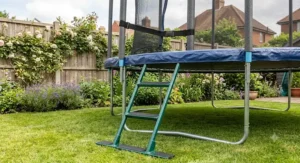
The frame uses 1.35mm galvanised steel tubing with reinforced T-leg joints, described by the manufacturer as resistant to both rust and high wind loading, and the jumping mat combines 1.8mm PE with polypropylene for triple UV resistance. Maximum user weight is stated at 150kg. A distinguishing feature is the included shoe organiser bag — a small but genuinely practical addition that keeps the “no shoes on the trampoline” rule easier to enforce with young children, alongside a non-slip ladder for safer access.
Reviewers frequently comment favourably on the trampoline’s appearance and perceived quality relative to price, with several noting they expected less for the money based on photos alone. Aggregated feedback also highlights good value for money as a recurring theme, though instructions have occasionally been flagged as needing clearer English-language translation. For families who’ve priced up the bigger brands and want a genuinely certified alternative at a lower outlay, Devoko is a sensible shortlist addition.
Pros:
- ✅ GS and EN71 certified across mechanical and material safety
- ✅ Includes non-slip ladder and shoe organiser as standard
- ✅ Frequently praised for looking and feeling pricier than it costs
Cons:
- ❌ Less established brand with a smaller UK support footprint
- ❌ Some buyers report unclear translated assembly instructions
Generally priced under £250, Devoko is worth a look for budget-conscious buyers who still want a certified, well-reviewed 12ft trampoline garden option.
Top 7 12ft Trampolines: Specs, Price Range and Ratings
| Product | Springs | Price Range | Weight Capacity | Best For |
|---|---|---|---|---|
| Plum Space Zone II | 72 | Mid-£300s to low-£400s | 125kg | Long-term family durability |
| Zero Gravity Ultima 4 | 72 | £250-£350 range | 150kg | Value-for-engineering |
| Zupapa No-Gap 12ft | 72 | Upper-£300s to low-£400s | 193kg | Adult jumpers |
| SONGMICS 12ft | 108 | £300-£400 range | 170kg | Bounce quality |
| GALACTICA 12ft | 72 | Under £200 | Not adult-rated | Tightest budgets |
| MERACH 12ft | Not disclosed | £220-£320 range | 150kg per jumper | Accessory bundles |
| Devoko 12ft | Not disclosed | Under £250 | 150kg | Lesser-known value |
Looking at this table alongside the commentary above, a clear pattern emerges: spring count and price don’t move in lockstep, which is exactly why SONGMICS stands out as an outlier worth serious consideration if bounce feel is your priority. Weight capacity, meanwhile, is where Zupapa pulls decisively ahead of the pack, making it the obvious pick if adults plan to use the trampoline regularly rather than occasionally. If you’re working with a strict budget, GALACTICA and Devoko both clear the safety-certification bar without inflating the price, which matters far more than any single spec when you’re deciding where to compromise.
✨ Don’t Miss These Exclusive Deals!
🔍 Take your 12ft trampoline shortlist to the next level with these carefully compared products. Click on any highlighted item to check current pricing and availability. These picks will help you create authentic garden fun your family will love!
Practical Usage Guide: Setting Up and Maintaining Your 12ft Trampoline
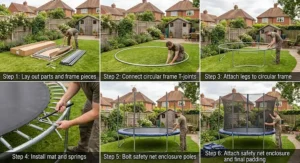
Getting a 12ft trampoline from flat-packed boxes to garden-ready takes most households between two and four hours with two adults, though as several reviewers above noted, a determined solo builder can often manage it too — just budget extra time and expect a sore back. Start by laying out all parts on the lawn before touching a spring; missing a labelled bag halfway through assembly is the single most common cause of frustrated first-time builders. Fit the legs to the frame first, then work around the circumference attaching springs using the supplied tool rather than your fingers — springs under this much tension can genuinely pinch, and the tool exists for a reason.
Once the mat is sprung, fit the safety pad before the enclosure net, checking every spring is fully covered with no gaps. RoSPA’s independent guidance on garden trampolines recommends checking your model against the European safety standard for domestic trampolines before first use, alongside positioning it on energy-absorbing ground such as lawn rather than concrete or paving.
In the first thirty days, the most common mistake is skipping the anchor kit because “it seems stable enough” — UK weather has a habit of proving that assumption wrong within the first autumn storm. A monthly maintenance routine of checking spring tension, inspecting the net for tears, and wiping down the frame after heavy rain will meaningfully extend the trampoline’s working life. During winter, either invest in a weatherproof cover or, for models with quick-release enclosures like the Zero Gravity Ultima 4, collapse the netting to reduce wind load on the poles.
Real-World Scenarios: Who Is a 12ft Trampoline Really For?
Picture a family with two children aged seven and ten in a three-bedroom semi with a modest but usable rear garden. For them, a mid-range 150kg-rated model like the Zero Gravity Ultima 4 makes sense — enough weight headroom for supervised parent-and-child bouncing occasionally, without paying for capacity they’ll rarely use.
Now picture a household where teenagers and adults both want regular use — perhaps as a low-impact fitness routine alongside family fun. Here the Zupapa’s 193kg rating and reinforced frame genuinely earn their higher price tag; a lighter-duty budget model would show wear far faster under that usage pattern.
Finally, consider a parent buying a first trampoline for a single six-year-old on a tight budget, in a garden with limited space. A GALACTICA or Devoko, both certified but modestly specced, is entirely appropriate here — there’s little practical benefit in paying premium prices for weight capacity and spring counts that a light, young child will simply never test.
Buyer’s Decision Framework: Which 12ft Trampoline Should You Choose?
If budget is your primary constraint, choose GALACTICA or Devoko, because both clear recognised safety certification without the premium-brand mark-up. If adults will use the trampoline regularly, choose Zupapa, because its 193kg rating and reinforced frame are specifically engineered for that load pattern. If you want the liveliest bounce feel for the money, choose SONGMICS, because its 108-spring count outperforms most rivals at a similar price. If long-term durability and UK brand support matter most, choose Plum Space Zone II, because its tested frame and established after-sales network suit families planning years of use. If you want accessories bundled in from day one, choose MERACH, because the basketball hoop and optional sprinkler add genuine play value without extra purchases.
How to Choose a 12ft Trampoline
What is a 12ft trampoline? A 12ft trampoline is a round garden trampoline with a frame diameter of roughly 3.66 metres and a jumping surface typically between 3-3.3 metres, positioned as the mid-size, most popular option for UK family gardens balancing bounce space against footprint.
Choosing the right model comes down to working through a handful of practical criteria in order, rather than fixating on price alone:
- Check your available garden space first. Most 12ft trampolines need a clear zone roughly 22 square metres including safety clearance, so measure before you shop rather than after delivery.
- Decide who’s actually using it. Children-only use permits lighter, more affordable models; regular adult use demands a higher weight rating like Zupapa’s.
- Prioritise certification over marketing claims. Look for TÜV, GS, ASTM or EN71-14 compliance specifically, not vague “safety tested” language.
- Compare spring count relative to price. More springs generally means a livelier, more even bounce, as SONGMICS demonstrates at its price point.
- Factor in assembly time honestly. Heavier-duty frames like Zupapa’s take longer to build; if you’re short on time, a lighter model may suit better.
- Check warranty terms on the frame specifically. Frame warranties of five years or more, as offered by several models above, signal genuine manufacturer confidence.
- Budget for an anchor kit and cover separately. These aren’t always included, yet both meaningfully extend trampoline lifespan in UK weather.
12ft Trampoline Dimensions and Garden Space Needed
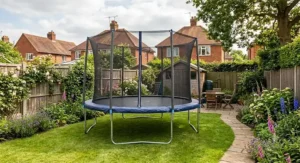
A 12ft trampoline’s frame measures approximately 3.66 metres across, but the actual jumping mat diameter is smaller — typically 3-3.3 metres once you account for the spring gap. Frame height off the ground generally sits between 76-90cm depending on brand, while the enclosure netting adds a further 1.5-1.8 metres of vertical height.
Here’s what most first-time buyers underestimate: the 12ft trampoline garden space needed isn’t just the trampoline’s own footprint. RoSPA and other safety bodies recommend a clear zone of at least 2.5 metres around the entire structure, free of trees, washing lines, fences and hard surfaces, which means you’re really planning for something closer to a 6-7 metre diameter clearance in total. Overhead clearance matters too — allow at least 2 metres above the highest bounce point, more if branches or washing lines cross the garden. If your garden slopes, note that models with wider leg stances, like the SONGMICS’s W-shaped legs, tolerate minor unevenness better than narrower four-leg designs, though a level base is always the safer starting point.
Large Bounce Area Trampoline: 12ft vs Other Sizes
Compared with an 8ft or 10ft model, a 12ft trampoline offers a genuinely larger bounce area trampoline experience — roughly 30-40% more usable jumping surface than a 10ft model, translating into noticeably more freedom of movement for two children bouncing (again, one at a time per safety guidance) without constantly bumping the netting.
Stepping up to 14ft or 16ft brings further space but at a real cost: significantly larger garden footprint, longer assembly time, and typically a jump in price that doesn’t always deliver proportionate extra value for households with younger children. For most large trampoline garden setups in typical UK plot sizes, 12ft represents the practical ceiling before diminishing returns set in — enough room for energetic play and light gymnastics practice, without demanding a garden the size of a small paddock. If your household genuinely has the space and the users to justify going bigger, it’s worth it; for most families, 12ft remains the sensible sweet spot.
Common Mistakes When Buying a 12ft Trampoline
The most frequent mistake is measuring the trampoline’s frame diameter but forgetting the safety clearance zone, only to discover on delivery day that the fence or shed is uncomfortably close. A close second is prioritising the lowest price without checking certification — a genuinely GS or TÜV-certified budget model like GALACTICA is a far safer bet than an uncertified “bargain” from an unfamiliar seller.
Buyers also commonly underestimate assembly time, particularly for heavier-duty frames, and end up rushing the build late in the day — not ideal when spring-loading tools and tired patience don’t mix well. Finally, skipping the anchor kit is a mistake that tends to only reveal itself the first time a proper autumn gale rolls through; it’s a genuinely inexpensive addition relative to the cost of a trampoline blown against a fence.
Safety, Regulations and 12ft Trampoline Assembly Time
In the UK, domestic trampolines are expected to meet the British and European standard BS EN 71-14:2018, covering structural safety, spring and padding requirements, and enclosure netting design. Government safety guidance is clear and consistent across the models reviewed here: children under six shouldn’t use full-size trampolines because they aren’t yet physically developed enough to control their bouncing safely, and only one person should use the trampoline at a time regardless of its rated weight capacity.
On 12ft trampoline assembly time specifically, expect two adults working together to need somewhere between two and four hours depending on the model, with heavier-duty frames like Zupapa’s genuinely taking longer than lighter builds like GALACTICA’s. Solo assembly is possible for several models reviewed here but adds meaningfully to that timeframe. Whichever model you choose, always position it on energy-absorbing ground such as lawn, keep the 2.5-metre clear zone free of hazards, and inspect padding, netting and springs at the start of each new season before anyone bounces.
Long-Term Cost and Maintenance
A 12ft trampoline’s real cost extends beyond the initial purchase price. Budget roughly £20-£40 annually for a weatherproof cover if one isn’t included, plus occasional replacement springs (typically sold in packs for £15-£25) as tension naturally decreases after several years of use. Frame warranties vary meaningfully between models — Plum’s five-year frame cover and Zupapa’s ten-year equivalent both suggest genuine manufacturer confidence, while shorter one or two-year warranties on some budget models reflect their lighter-duty construction rather than necessarily poor quality.
Cost-per-use tells a more favourable story than the upfront price suggests: a £350 trampoline used several times a week across a typical five-to-seven-year ownership period works out to pennies per session, cheaper than most other outdoor family activities once you account for years of use rather than a single afternoon.
FAQ
❓ What size garden do I need for a 12ft trampoline?
❓ How long does a 12ft trampoline take to assemble?
❓ Can adults use a 12ft trampoline?
❓ What safety certification should I check for on a 12ft trampoline?
❓ How much does a 12ft trampoline cost in the UK?
Conclusion
Choosing between seven genuinely solid 12ft trampolines comes down to being honest with yourself about who’s actually going to use it and how often. If you want the safest long-term bet for a young family, the Plum Space Zone II’s tested frame and established UK support make it hard to beat. If adults are joining in regularly, Zupapa’s near-200kg rating is worth the extra outlay. And if budget is the deciding factor, GALACTICA and Devoko both prove that proper safety certification doesn’t have to come with a premium price tag.
Whichever model ends up in your garden, the fundamentals matter more than any single spec: measure your space honestly, check for genuine certification, budget for an anchor kit, and follow the one-jumper-at-a-time rule that safety experts consistently recommend regardless of which trampoline you choose. Get those basics right, and a 12ft trampoline earns its keep for years, not just one enthusiastic summer.
🚴♂️ Ready to Choose Your Perfect 12ft Trampoline?
⚡ You’ve compared the specs, read the honest analysis, and know exactly what your garden needs. Click through on any of the seven picks above to check current pricing and availability, and give your family a bounce-worthy summer they’ll actually remember!
Recommended for You
- 10ft Trampoline Under £200: 7 Best Value Picks for 2026
- 10ft Family Trampoline: 7 Best UK Garden Picks 2026
- Best 10ft Trampoline With Enclosure UK 2026: Top 7 Picks Reviewed
Disclaimer: This article contains affiliate links. As an Amazon Associate, I earn from qualifying purchases. If you purchase products through these links, we may earn a small commission at no additional cost to you.
✨ Found this helpful? Share it with your friends! 💬🤗
