In This Article
Stairs complain. Pavements complain. Your knees have opinions about both. Yet doctors keep saying “move more”, and nobody wants to be told to take up jogging.
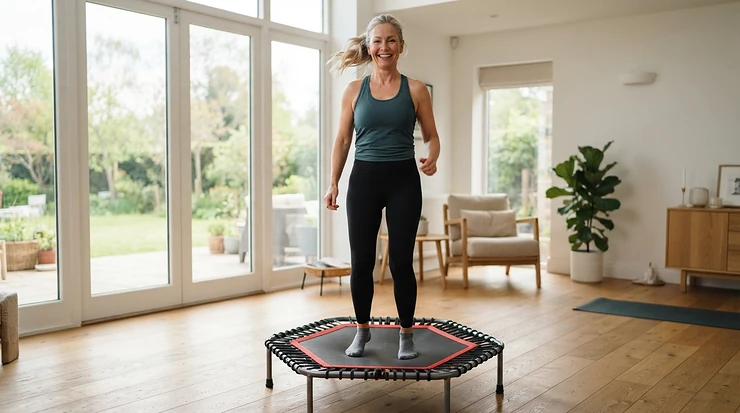
That’s the gap a low-impact rebounder for bad knees tries to fill. A mini trampoline with the right suspension, a stable frame and a proper handlebar lets you stay active without the jarring, thudding landings that make arthritic or injured joints flare up.
Does it work for everyone? No. Is it a miracle cure? Also no. NICE’s osteoarthritis guideline says tailored therapeutic exercise should be offered to everyone with osteoarthritis. It also warns that joint pain may increase when you start, so getting the kit right matters.
I haven’t bounced on any of these models, and I won’t pretend otherwise. What I’ve done is compare real specifications, read through genuine buyer feedback and published buying guides, and work out which designs make sense for sensitive knees. Treat this guide as analysis, not medical advice. Check with your GP or physiotherapist before starting.
Quick Comparison: 7 Rebounders at a Glance
| Product | Suspension | Handlebar | Max user weight | Best For |
|---|---|---|---|---|
| BCAN BT2 | Bungee | Included, adjustable | Up to 250kg (48in) | Best all-rounder |
| FIT BOUNCE PRO II | Bungee | Sold separately | Around 150kg | UK-based support, quiet use |
| bellicon Classic 44 | Bungee (5 strengths) | T-bar available | Up to 200kg by cord choice | Fine-tuned premium bounce |
| BCAN BT4 Soft Land Pro | Bungee (6 tension levels) | Adjustable | Around 227kg | Customisable softness |
| SportPlus Fitness Trampoline | Bungee | Adjustable, 85–119cm | 130kg | Compact, tested budget pick |
| ACON Fit 44in Round Rebounder | Check listing | Two-leg balance bar | Check listing | Maximum wobble control |
| BCAN SP2 Foldable | Spring | Foam, adjustable | Check listing | Tight budgets, easy storage |
Look at the suspension column first. Six of these seven lean on bungee-style suspension, and that is no accident. If knees are your priority, the BCAN BT2 and BCAN BT4 Soft Land Pro offer the strongest mix of softness and stability under premium-brand pricing. The bellicon Classic 44 is the connoisseur’s choice. The BCAN SP2 Foldable is the only spring model here, included so you can see the trade-off for yourself.
💬 Just one click — help others make better buying decisions too!😊
What Is a Low-Impact Rebounder for Bad Knees?
A low-impact rebounder for bad knees is a mini trampoline with a soft suspension, usually bungee cords rather than steel springs, a stable frame and ideally an adjustable handlebar. The suspension cushions each landing, so your knees take gentler, more even loads than on pavements or hard floors.
Three features separate a genuinely joint-friendly machine from a toy:
- Suspension feel: how gradually it slows your descent.
- Frame rigidity: whether it wobbles when you step on or off.
- Support: whether you have something to grab when a knee gives way.
Skip any one of them and the “low-impact” label becomes marketing.
Top 7 Low-Impact Rebounders for Bad Knees: Expert Analysis
1. BCAN BT2 — best all-round bungee with the handlebar included
The handlebar ships in the box, sparing you the “sold separately” shuffle that catches out buyers of rivals.
The legs use 32mm alloy tubing with deeper 10-turn threads. That means less wobble when you step on and off, which is exactly when sore knees feel most exposed. The 8mm bungees pair a woven outer with a natural latex core, so the stretch absorbs your landing rather than pinging it back up your legs. Listings quote 450/550lb capacity for the 40/48in sizes. The handlebar locks at three reinforcement points.
Based on the spec comparison, this is the model I’d shortlist first for anyone wanting stability without premium-brand pricing. The 48in version gives more room to step side to side, though it takes more floor space.
Review roundups consistently praise the quiet, soft bounce. Recurring gripes are that fitting the bungees can be fiddly and the foam handlebar cover can fade or tear after heavy use.
Pros:
- ✅ Handlebar included, adjustable and locked at three points
- ✅ Thick alloy legs for a steadier frame
- ✅ Quiet, soft latex-core bungee bounce
Cons:
- ❌ Fitting the bungees can be fiddly
- ❌ Foam handle cover may wear with heavy use
Price: broadly under £200 (indicative; check current price). Strong value for what you get.
2. FIT BOUNCE PRO II — best for quiet use and UK-based support
It arrives already assembled, with legs that click into place, and it half-folds into a storage bag.
The bungee suspension is silent, and the listing quotes a 330lb limit (around 150kg). The frame is a 40in design, but sellers describe a larger-than-standard bounce area. For bad knees, “ready assembled” matters more than it sounds. Wrestling with bolts is the sort of awkward twisting that aggravates sore joints before you’ve even started.
Here is what the spec sheet won’t tell you: the handlebar isn’t included. The matching stability bar is a separate purchase, with ten height settings in high-grade steel. Factor it in, because the stability bar is what turns this into a rebounder with handlebar for stability.
Buyers describe the bungee feel as much softer than spring models, and several mention joint conditions as their reason for choosing it. One reviewer reported cords coming loose after folding it away. Another had a bar-fitting problem. A third praised the small UK-based company’s customer service.
Pros:
- ✅ Arrives assembled, legs click into place
- ✅ Silent bungee suspension, no metal-spring clang
- ✅ Free online workouts included
Cons:
- ❌ Stability bar costs extra
- ❌ Some reports of loose cords after folding
Price: mid-range, broadly £150–£300 once the bar is added (indicative; check current price). Good value if you want a UK-based brand.
3. bellicon Classic 44 — best premium bounce you can tune to your body
The bounce can be tuned to your weight, which no budget model really matches.
bellicon offers five bungee strengths, colour-coded by user weight. Soft cords suit users under around 60kg. Medium covers roughly 60–90kg, strong roughly 90–120kg, extra strong roughly 120–150kg, and ultra strong up to about 200kg. For arthritic knees, choosing the right strength is the whole game. Too stiff and the landing jars. Too soft and you bottom out. The brand’s own guidance says people with specific health issues, such as osteoporosis, can contact them for advice on strength.
The legs fold for storage, and a T-bar handle is sold separately. Treat it as the model for people who’ll rebound for years.
Owners on a Cathe forum thread described it as extremely soft on joints, one saying they could no longer tolerate any impact. They also called it very quiet. The common complaints are price, and that worn bungees eventually need replacing.
Pros:
- ✅ Five bungee strengths matched to body weight
- ✅ Very soft, quiet, joint-friendly bounce
- ✅ Foldable legs, T-bar available
Cons:
- ❌ Expensive compared with most rivals
- ❌ T-bar is extra, bungees need replacing eventually
Price: premium bracket, broadly £400+ (indicative; check current price). Worth it only if you’ll use it daily for years.
4. BCAN BT4 Soft Land Pro — best for dialling the softness up or down
Six tension levels let you change how firm or gentle it feels.
The BCAN BT4 Soft Land Pro uses natural latex cords. Buying guides describe a smoother, more linear bounce than standard bungees. It comes with two sets of cords you can swap between lighter and firmer, and a 500lb (around 227kg) capacity. Sizes run 38, 40 and 48in. The handlebar is adjustable, though for some configurations it’s sold separately, so check before you buy.
“Linear” is the key word. A bounce that responds predictably to your weight means your knees aren’t constantly micro-correcting. That’s the stability argument for the extra spend over the BCAN BT2.
Roundups name it the best premium bungee option. I couldn’t find enough independent reviews to quote a reliable satisfaction trend, so I’d treat that as a gap in the evidence.
Pros:
- ✅ Six adjustable tension levels
- ✅ Natural latex cords for a smoother bounce
- ✅ High 500lb capacity, three sizes
Cons:
- ❌ Handlebar may cost extra on some configurations
- ❌ Fewer independent reviews than the BCAN BT2
Price: upper-mid, broadly £150–£300 (indicative; check current price). Good value if your knees need fine-tuning.
5. SportPlus Fitness Trampoline — best compact, safety-tested budget pick
A German-designed model with 36 bungee ropes and certification you can actually point to.
The adjustable handle runs from 85 to 119cm, the diameter is around 43in, and the maximum user weight is 130kg. Listings cite TÜV SÜD safety testing. Certification isn’t a guarantee of knee-friendliness, but it signals the frame has been loaded and checked, which is reassuring on a budget.
The 130kg ceiling is the catch. Heavier users should look at the BCAN BT2 or BCAN BT4 Soft Land Pro. The smaller mat also suits shorter, gentler bounces, which is arguably what bad knees want anyway.
On Amazon’s French storefront, the listing shows a rating in the low 4s across several thousand reviews. That tells you it’s widely used, though the figure comes from a different market. Check the UK listing and confirm whether you’re buying the folding version.
Pros:
- ✅ Tested to a recognised safety standard
- ✅ Handlebar height range suits most users
- ✅ Soft bungee suspension, quiet in use
Cons:
- ❌ 130kg limit rules out heavier users
- ❌ Smaller bounce area than larger models
Price: broadly £100–£170 (indicative; check current price). Strong budget value.
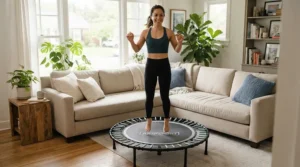
6. ACON Fit 44in Round Rebounder — best for maximum wobble control
Its extended two-leg balance handlebar is built to minimise sway.
The bar adjusts from 105 to 126cm on the UK listing and the legs are non-foldable. That rigidity is the point. Marketing positions it for beginners, older adults and recovery workouts, which fits a bad-knee buyer. One important line sits in the small print: the handlebar isn’t designed to support your entire body weight. It’s a steadying aid, not a crutch.
Analytically, a two-leg bar is more stable than a single central post because it triangulates your grip. If you’ve ever grabbed a wobbly rail on a bus, you’ll understand why that matters at 7am.
I couldn’t verify enough independent customer reviews to summarise genuine sentiment, so I’m not going to invent any. Read recent buyer feedback on the retailer page before committing.
Pros:
- ✅ Extended two-leg handlebar for stability
- ✅ Round 44in mat suits gentle, controlled bouncing
- ✅ Two-year handlebar warranty
Cons:
- ❌ Legs don’t fold, so storage needs space
- ❌ Independent review evidence is thin
Price: upper-mid bracket (indicative; confirm on the listing). Choose it for stability above all else.
7. BCAN SP2 Foldable — best budget option, with a spring-feel trade-off
A foldable frame and a three-position foam handlebar make it the easy-storage entry point.
BCAN SP2 uses springs, so the bounce is livelier and firmer than the bungee models. Roundups call it beginner-friendly, praise its easy setup and note the largest review base of any rebounder in one test, over 12,000 reviews on the US listing.
Honest take: that review volume speaks to popularity, not to knee-friendliness. A firmer rebound can be fine for mildly sore knees, but for arthritic joints I’d lean towards the bungee models above. Buying guides generally describe springs as higher-bouncing and slightly harder on joints.
Pros:
- ✅ Folds away easily, quick setup
- ✅ Adjustable three-position foam handlebar
- ✅ Huge review base for reassurance
Cons:
- ❌ Spring bounce is firmer than bungee models
- ❌ Likely noisier than bungee rivals
Price: budget bracket, broadly under £120 (indicative; check current price). Fine as a trial if your knees are only mildly sensitive.
Specs, Prices and Value: The Top 7 Side by Side
| Product | Price bracket | Standout feature | Review theme | Best For |
|---|---|---|---|---|
| BCAN BT2 | Under £200 | 32mm alloy legs | Quiet, soft, fiddly cords | Value-seekers |
| FIT BOUNCE PRO II | £150–£300 | Pre-assembled | Soft, silent, bar extra | UK support fans |
| bellicon Classic 44 | £400+ | Five cord strengths | Very soft, pricey | Long-term users |
| BCAN BT4 Soft Land Pro | £150–£300 | Six tension levels | Few independent reviews | Fine-tuners |
| SportPlus Fitness Trampoline | £100–£170 | Safety-tested | Widely used | Compact budgets |
| ACON Fit 44in Round Rebounder | Check listing | Two-leg bar | Limited evidence | Stability first |
| BCAN SP2 Foldable | Under £120 | Folds easily | Firm spring feel | Mild sensitivity |
If your knees really hurt, the bellicon Classic 44 and BCAN BT4 Soft Land Pro justify their extra cost through tuneable softness. The BCAN BT2 is the best compromise for most people, and the SportPlus Fitness Trampoline is the pick if budget and weight allow. The BCAN SP2 Foldable wins on price but loses on feel.
Low-Impact Rebounder vs Other Low-Impact Exercise
| Option | Knee impact | Space needed | Typical cost | Best For |
|---|---|---|---|---|
| Rebounder (bungee) | Cushioned landings | Small | £100–£500+ | BCAN BT2 buyers wanting variety |
| Exercise bike | Very low, no landing | Medium | Varies widely | Strength rebuilding |
| Swimming | Minimal, supported | Pool access | Pool fees | Severe joint pain |
| Walking | Low but repetitive | None | Free | Beginners, daily habit |
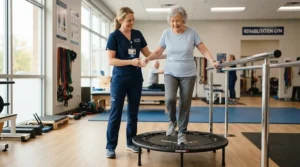
NHS leaflets typically list cycling, swimming and walking as the standard low-impact choices, and they steer arthritic knees away from running and jumping. A rebounder isn’t on those lists, which is why I’d position it as a complement rather than a replacement. Its edge is convenience and fun. If you’ll actually use it on a dreary Tuesday, that beats a gym membership you ignore.
Spring vs Bungee Cord System: Which Is Kinder to Your Knees?
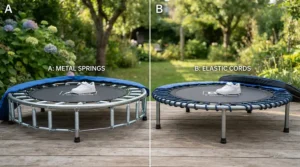
Springs create a sharper, more energetic rebound. Bungee cords stretch progressively, so your descent slows more gently. Buying guides consistently say spring models offer higher bounce but are slightly harder on joints, and that bungees run quieter.
Think of the spring vs bungee cord system as a car’s suspension. Steel springs are the sports setup: lively, but you feel every bump. Bungees are the limousine setup: soft and forgiving, less thrilling.
For bad knees, the progressive stretch matters because it shortens the sudden “stop” at the bottom of each bounce. One buyer in the reviews I read said they’d tried metal springs and found they didn’t suit their knees, so they chose a bungee model as gentler on ageing joints. That’s one voice, not proof, but it echoes the general pattern.
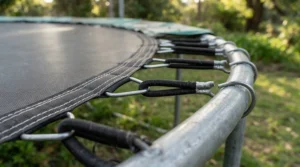
The trade-off is maintenance. Bungees stretch and eventually need replacing, whereas springs can rust or lose tension. Budget for either.
Rebounder Mat Thickness for Safety: What Actually Matters
Here’s a myth worth busting. Rebounder mats are thin woven fabric, not cushioned pads, and manufacturers rarely publish mat thickness in millimetres. So rebounder mat thickness for safety is the wrong number to hunt for.
What counts instead is:
- Weave tightness. A loose mat bottoms out against the frame. An overly tight mat removes the stretch that protects knees.
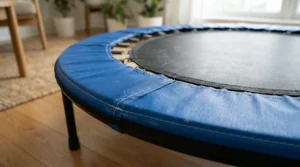
- Edge padding. Check the frame cover covers every hard edge and spring or bungee hook.
- Frame diameter. Thicker legs, like the 32mm alloy ones on the BCAN BT2, resist wobble.
- Surface underneath. On hard floors, add a thick exercise mat beneath to stop sliding.
If a seller can’t tell you how the mat is built, treat that as a red flag. Rebounder mat thickness for safety isn’t a spec to chase. Suspension quality is the real cushion.
Rebounder With Handlebar for Stability: Why It Matters
Getting on and off is where many falls happen. A rebounder with handlebar for stability gives you a fixed reference point when a knee twinges or your balance wobbles.
Check these points before buying:
- Height range. Ideally waist-to-chest height. The SportPlus Fitness Trampoline offers 85–119cm.
- Mounting. Three-point fixings, as on the BCAN BT2, resist flex better than a single clamp.
- Legs. A two-leg design like the ACON Fit 44in Round Rebounder triangulates your grip.
- Fit. Ensure the bar actually matches the rebounder. One FIT BOUNCE PRO II buyer reported a fitting problem with the separate bar.
One caution: bars are for steadying, not hanging your whole weight on them. The ACON Fit 44in Round Rebounder listing says as much.
How to Choose a Low-Impact Rebounder for Bad Knees
- Pick bungee over spring. Gentler progressive stretch. It’s the single biggest comfort lever.
- Match capacity to your weight. Stay well under the limit so the cords perform as designed.
- Demand a handlebar. Choose a rebounder with handlebar for stability, and confirm it’s included.
- Check frame build. Thick legs and secure threads mean less wobble.
- Choose size sensibly. Bigger mats (44–48in) allow stepping and gentle shifting.
- Look for safety testing. Evidence like TÜV SÜD testing is reassuring.
- Confirm UK support. Spare cords and warranty cover matter after a year.
Rebounder for Joint Pain: What to Realistically Expect
A rebounder for joint pain isn’t a miracle. The famous 1980 NASA study you’ll see quoted had just eight participants, and as Fit&Well’s physical therapist explainer notes, it’s over 40 years old. Treat it as a curiosity, not a prescription.
What you can reasonably expect is a gentler way to get your heart rate up, a prompt for better balance, and a convenient way to move daily. Your first sessions may feel odd, and some discomfort can appear as muscles adapt. If pain sharpens, stop.
A rebounder for joint pain works best at “health bounce” level: feet barely leaving the mat, short sessions, handlebar in reach. Chasing intensity defeats the purpose.
Joint Pain Relief: Where Rebounding Fits in a Wider Plan
Let’s be careful with the phrase joint pain relief. A rebounder can support the habits that help, but it’s not a treatment in itself. The NHS overview of osteoarthritis points to regular exercise and managing weight as cornerstones, alongside pain relief when needed.
Think of the rebounder as one tool in a kit that might include walking, strengthening exercises, sleep, pacing and weight management. For joint pain relief to be real, consistency beats heroics.
Track how your knees feel the next morning. If you wake stiffer than usual after a session, shorten it. Slow, steady progress is the point.

Physiotherapist-Recommended Exercise: Using Your Rebounder Wisely
I couldn’t find a UK physiotherapy body explicitly endorsing rebounders as a treatment, so I won’t claim they’re physiotherapist-recommended exercise in any official sense. What physios do widely advise is tailored strengthening and aerobic work, and supervised sessions can improve adherence. That aligns with NICE’s position.
A UK trial protocol from Keele researchers, the BEEP trial, highlights that older adults and even physiotherapists have worried about exercise safety. It also notes that better adherence improves pain relief. In other words, choose something you’ll actually keep doing.
Ask your physio three things:
- Is bouncing suitable for my diagnosis and stage?
- What duration and intensity should I start with?
- Should I add seated or standing strengthening alongside?
Their answer is worth more than any buying guide, including this one.
Practical Setup and First-30-Days Guide
Setting up.
- Place it on a level, non-slip surface with at least a metre clear all round.
- Check ceiling height; you need clearance even for small bounces.
- Tighten every fixing, then recheck after the first week.
Week 1. Just stand and shift your weight. Practise stepping on and off with the handlebar. Wear grippy socks or follow the manufacturer’s footwear advice. bellicon recommends barefoot or grippy socks.
Weeks 2–3. Try gentle health bounces for two to five minutes, rest, repeat. Keep your knees soft, never locked.
Week 4. Build to ten minutes if your knees allow, noting how they feel the next day.
Common first-month mistakes: bouncing too high, skipping the handlebar, ignoring creaks, and doing too much on day three because it felt fun.
Real-World Scenarios: Which Rebounder Suits Which Knee?
Scenario 1: The cautious beginner on a budget. A retiree with mild knee stiffness, a small flat and a modest budget. The SportPlus Fitness Trampoline offers tested construction and a handlebar at a friendly price, provided weight is under 130kg.
Scenario 2: The daily user with moderate osteoarthritis. Someone planning ten minutes every morning for years. The BCAN BT4 Soft Land Pro lets you tune firmness as strength improves, while the bellicon Classic 44 is the splurge version.
Scenario 3: The balance-nervous returner. Someone recovering confidence after a fall or a knee op, with physio clearance. The ACON Fit 44in Round Rebounder prioritises wobble control, and the FIT BOUNCE PRO II with its stability bar is a UK-supported alternative.
Scenario 4: The heavier user wanting capacity. The BCAN BT2 at 48in, with its high capacity rating, is the sensible starting point.
Common Mistakes When Buying a Low-Impact Rebounder for Bad Knees
- Assuming “low-impact” on the box means knee-friendly. Not every label earns it. Check suspension and frame.
- Buying springs to save money. If knees are your priority, the saving often costs comfort.
- Forgetting the handlebar is extra. Several rebounders sell the bar separately.
- Ignoring weight limits. Stay comfortably inside them.
- Chasing mat thickness numbers. As explained above, it’s the wrong metric.
- Skipping the physio chat. A five-minute conversation can save months of aggravation.
Another mistake: buying the biggest model without checking floor space. A 48in rebounder in a cramped lounge becomes a trip hazard.
Long-Term Cost and Maintenance
| Product | Upfront bracket | Running-cost note | Value verdict | Best For |
|---|---|---|---|---|
| BCAN SP2 Foldable | Under £120 | Spring wear over time | Cheap entry | Trial users |
| SportPlus Fitness Trampoline | £100–£170 | Spare cords available | Solid budget | Light daily use |
| BCAN BT2 | Under £200 | Bungees will stretch | Best all-round | Most buyers |
| bellicon Classic 44 | £400+ | Replacement bungees | Long-term investment | Committed users |
Cost per use tells the real story. A premium model used daily for five years costs pennies per session, while a cheap one abandoned in a cupboard costs far more. Check bungees every few months for fraying, retighten fixings, and wipe the frame down. Budget for replacement cords every few years on any bungee model.
The bellicon Classic 44 costs most upfront but offers tuneable cords and brand support. The BCAN BT2 delivers the most value per pound for most households.
FAQs
❓ Are rebounders safe for knee osteoarthritis?
❓ How long should I rebound each day with sore knees?
❓ Can I use a rebounder after knee replacement surgery?
❓ How much space and ceiling height does a rebounder need?
❓ Should I wear shoes on a rebounder?
Conclusion: Bounce Back Sensibly
A low-impact rebounder for bad knees can make daily movement feel less like a chore and more like a treat. The recipe is simple: bungee suspension, a rigid frame, a handlebar you trust, and a gentle, patient approach.
For most people the BCAN BT2 is the sensible starting point. If you want customisable softness, the BCAN BT4 Soft Land Pro and bellicon Classic 44 are worth the stretch. Choose the SportPlus Fitness Trampoline when budget and weight allow, the ACON Fit 44in Round Rebounder when stability is the priority, and the FIT BOUNCE PRO II if UK-based support matters to you. Keep the BCAN SP2 Foldable for mild sensitivity only.
Whatever you choose, run it past your GP or physio first.
✨ Ready to give your knees a gentler workout?
🔍 Click any highlighted product above to check current pricing and availability, and pick the rebounder that fits your knees, your space and your budget. Your future self will thank you! 🤸♀️
Recommended for You
- Rebounder Vs Skipping Rope For Fitness: 7 Best Buys (2026)
- Rebounder Vs Treadmill For Cardio: 7 Best Picks For UK Homes (2026)
- Rebounder For Over 50s: 7 Best Joint-Friendly Picks (2026)
Disclaimer: This article contains affiliate links. As an Amazon Associate, I earn from qualifying purchases. If you purchase products through these links, we may earn a small commission at no additional cost to you.
✨ Found this helpful? Share it with your friends! 💬🤗
