In This Article
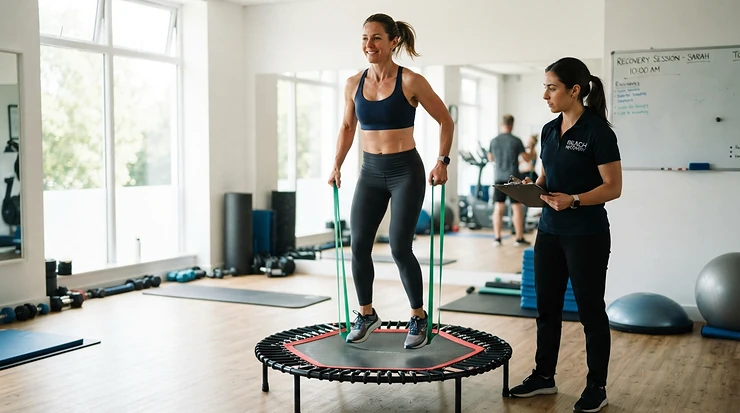
A rebounder for bone density support is a fitness mini trampoline used for low-to-moderate-impact, weight-bearing exercise. Each bounce loads your feet, legs, hips and spine against gravity, the kind of mechanical signal bone responds to. It complements, rather than replaces, medical advice, resistance training and good nutrition.
Your skeleton is not a statue. It is a living, constantly remodelling tissue that builds itself up when you load it and quietly dismantles itself when you don’t. According to the Royal Osteoporosis Society, roughly half of women and one in five men over 50 will break a bone because of osteoporosis. That is why the UK consensus statement on exercise for osteoporosis recommends a mix of resistance and impact exercise, plus balance work, to maximise bone strength and reduce falls.
So where does a bouncy circle of fabric fit in? Honestly, somewhere in the middle. It is gentler than jogging on pavements and more engaging than a daily shuffle round the block. The evidence that it directly raises bone mineral density is promising but thin, and this guide won’t pretend otherwise.
What follows is a research-led buying guide. I haven’t tested these products myself, so everything here comes from specifications, retailer listings, aggregated reviewer sentiment and published research. You’ll find seven real rebounders, a candid look at the science, and practical advice on osteoporosis prevention, weight-bearing exercise, bone health and rebounder for rehab and physio use. Prices are ranges only, so check current prices before you buy.
Quick Comparison: Best Rebounders for Bone Density Support at a Glance
| Product | Suspension | Size | Price range (check current) | Best For |
|---|---|---|---|---|
| Bellicon Classic | Latex bungee, multiple strengths | 39″, 44″ or 49″ | Premium: roughly £600-£900 | Daily users and shared households |
| JumpSport 350 PRO | Bungee | 39″ | Roughly £350-£450 | Stability-minded mid-range buyers |
| JumpSport 250 | Bungee (30 cords) | 39″ | Roughly £220-£320 | Best all-round value |
| SportPlus Fitness Trampoline | Rubber rope | Folding, with support bar | Roughly £100-£150 | Cautious beginners |
| BCAN BT2 | Bungee | 40″ | Roughly £100-£170 (UK stock varies) | Budget bungee seekers |
| Maxmass Bungee Rebounder | Bungee | Foldable, adjustable handle | Roughly £50-£80 | Trying the habit cheaply |
| CLORIS Foldable Rebounder | Foldable frame | 40″ or 48″ | Roughly £80-£120 | Taller or heavier users |
The table shows a clear pattern. Paying more buys a softer, quieter, longer-lived bounce, while paying less buys convenience and a lower-risk trial. For a rebounder for bone density support, the JumpSport 250 sits at the sweet spot. It is a proper bungee build with a sensible frame, without the Bellicon price tag. If you need a handrail for confidence, the SportPlus Fitness Trampoline and CLORIS Foldable Rebounder both come with one.
💬 Just one click — help others make better buying decisions too!😊
Top 7 Rebounders for Bone Density Support: Expert Analysis
1. Bellicon Classic — the premium, whisper-quiet bungee benchmark
The Bellicon Classic is built around custom latex bungee cords that let you choose a firmer or softer rebound to suit your weight and goals.
It comes in 39″, 44″ and 49″ sizes, and the 44″ is the sweet spot because the wider mat gives your feet room to stagger, step and shift weight. That matters for balance training, which the UK consensus statement treats as a core part of bone-friendly exercise. Frame warranty terms vary between sources, so check the current terms before ordering.
On paper, the soft bungee bounce is kinder to joints, which makes it a natural fit for rebounder for rehab and physio use. The trade-off is that softer cords absorb more impact. If your goal is a stronger bone-loading signal, you would choose firmer cords, but only once your clinician is happy with it. Reviewers consistently praise the quiet bounce and build quality, and the main complaint is price. UK retailers also note that Amazon rarely stocks the full premium range, so you may end up buying direct.
Pros:
- ✅ Customisable cord strength to suit body weight
- ✅ Very quiet, smooth bounce for flats and shared spaces
- ✅ Wide 44″ size gives room for balance work
Cons:
- ❌ Costs several times more than budget alternatives
- ❌ Often sold direct rather than through Amazon
Expect a premium range of roughly £600-£900 at the time of research. It is worth it if the whole household will use it daily, and overkill if you’re still testing the habit.
2. JumpSport 350 PRO — stable mid-premium bungee for harder sessions
The JumpSport 350 PRO is the brand’s mid-premium pick, using its EnduroLast bungee cords for a bounce that comes close to premium models at a lower price.
It has a 39″ mat, which is a touch tighter than the Bellicon. That is fine for rhythmic bouncing and heel-drop work, though it is less forgiving if you like lateral movement. Handlebar versions exist, so you can add a rail while you build confidence.
The honest analytical take is that this model suits people who want a firmer, more athletic platform without Bellicon money. Reviewers on comparison sites say JumpSport models stay planted during high-intensity intervals, which is reassuring when you’re doing weight-bearing exercise at pace. Owner reports also commonly mention years of regular use. Those reviews come from editorial and retail sources rather than a single verified dataset, so treat them as a trend.
Pros:
- ✅ Stable platform even during energetic sessions
- ✅ Bungee suspension keeps noise low
- ✅ Handlebar versions available for added security
Cons:
- ❌ 39″ mat feels snug for lateral moves
- ❌ UK pricing and availability vary by seller
Expect roughly £350-£450 at the time of research. It is good value if you want near-premium bounce and plan to use it several times a week.
3. JumpSport 250 — best value for most adults
The JumpSport 250 gets the best-value tag for a simple reason: it is a properly engineered bungee rebounder at a mid-range price.
It uses 30 low-impact bungee cords on a 39″ mat, and reviewers highlight the lifetime frame warranty, though you should confirm current terms. A 60-day JumpSport Fitness TV trial is often bundled in, which gives you structured routines from day one.
For a rebounder for bone density support, the main appeal is pairing a forgiving bounce with a frame that doesn’t flex under stronger movement. Routines on a rebounder can mix gentle marching with firmer stepping and, if cleared, small jumps. The JumpSport 250 is flexible enough to cover that whole progression. It is also available with a handlebar, which suits anyone building balance and confidence.
Review sentiment is broadly positive on build quality, and the most common caveat is price compared with budget spring models. Compared with the Bellicon Classic, you give up customisation and some quietness, but you keep several hundred pounds.
Pros:
- ✅ Solid frame with long-warranty reputation
- ✅ Gentle bungee bounce for joints
- ✅ Handlebar version available for balance
Cons:
- ❌ Pricier than entry-level foldable options
- ❌ Smaller 39″ mat limits lateral moves
Expect roughly £220-£320 at the time of research. It is the safest all-round buy for most households.
4. SportPlus Fitness Trampoline — folding rebounder with a five-height support bar
The SportPlus Fitness Trampoline pairs a five-position adjustable support bar with a folding frame and a soft rubber-rope suspension.
That adjustable bar is the headline feature. Raise it to waist height and you have a rail you can lean on while you find your balance, then lower it as you gain confidence. The folding design means it can slide behind a sofa between sessions, which matters more than people admit, because a rebounder stuck in a cupboard is a rebounder that doesn’t get used.
The honest take is that this suits cautious beginners, people returning to exercise after a layoff, and anyone doing rebounder for rehab and physio use at home under professional guidance. The rope suspension is quiet but gives you no tension customisation, and folding hinges rarely feel quite as rigid as fixed frames. Check the maximum user weight on the listing before you buy.
In a snapshot at the time of research, it showed roughly 4.2 stars from over 3,000 ratings on Amazon UK. That is a sizeable pool, though ratings change, so check current numbers.
Pros:
- ✅ Five-position adjustable support bar
- ✅ Folds away for easy storage
- ✅ Large review base on Amazon UK
Cons:
- ❌ No adjustable bounce tension
- ❌ Folding hinges less rigid than fixed frames
Expect roughly £100-£150 at the time of research. It is strong value as a first rebounder.
5. BCAN BT2 — popular budget bungee with a bigger mat
The BCAN BT2 is a 40″ bungee rebounder with a reputation as a best-seller on Amazon, which means a lot of people have already tried it.
The 40″ mat gives you slightly more room than 39″ frames, and bungee cords keep the bounce softer and quieter than steel springs. Quiet matters for consistency, because you are far more likely to bounce for ten minutes before work if the neighbours below can’t hear every landing.
Reviewers in comparison guides repeatedly describe the bungee system as quiet and the overall package as strong value. Those guides are mostly US-based, so UK buyers should check stock, delivery, warranty and after-sales support before committing. The BCAN BT2 is best for someone who wants a bungee feel without paying for the premium brands, and who is happy to accept less certainty on spare parts.
Pros:
- ✅ Quiet bungee bounce at a modest price
- ✅ 40″ mat offers a little extra room
- ✅ Popular enough to find plenty of reviews
Cons:
- ❌ UK stock and warranty details less clear
- ❌ Support and spares may lag premium brands
Expect roughly £100-£170 at the time of research. It is good value if UK availability checks out.
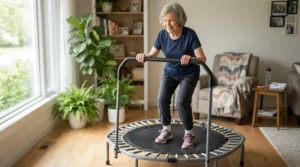
6. Maxmass Bungee Rebounder — lowest-risk way to try the habit
The Maxmass Bungee Rebounder is the budget entry point, with an adjustable handle, bungee suspension and a foldable frame.
At this price, you are not buying longevity. You are buying a trial. If you’ve never kept up an exercise routine, spending under £80 to find out whether you enjoy bouncing is a rational experiment, far better than a £700 mistake. The foldable frame keeps storage simple.
For a rebounder for bone density support, the main limitation is robustness under heavier or firmer use. A lightweight foldable frame is better suited to gentle bouncing, marching and balance work than intense sessions. Check the maximum weight rating carefully against your own.
At the time of research, the listing showed roughly 4.3 stars from only 56 ratings. That is a small sample, so it hints at satisfaction rather than proving it. The Maxmass Bungee Rebounder suits people who want to test the habit, and you can always upgrade later.
Pros:
- ✅ Very low cost of entry
- ✅ Adjustable handle for balance support
- ✅ Folds away between sessions
Cons:
- ❌ Small review pool, so reliability is unproven
- ❌ Lightweight frame suits gentler use only
Expect roughly £50-£80 at the time of research. It is a sensible starter if you accept a shorter lifespan.
7. CLORIS Foldable Rebounder — bigger sizes and higher weight ratings
The CLORIS Foldable Rebounder stands out by offering 40″ and 48″ versions with listed maximum loads of about 400 lb and 450 lb (roughly 181 kg and 204 kg), plus an adjustable foam handle.
That higher stated capacity makes it one of the few budget-priced options aimed at taller or heavier users. The 48″ mat is generous, giving more room for wider stances and gentle stepping patterns, both useful for balance training. Foldable convenience again helps with small UK homes.
The practical take is that this model suits people who find standard 39″ mats cramped or who need reassurance on weight rating. Treat stated capacities as a starting point, and check the listing’s current specifications. I couldn’t verify a robust pool of independent reviews for this exact listing, so there is no honest sentiment summary to offer. Read recent buyer feedback on assembly and stability before you decide.
Pros:
- ✅ Large 48″ size available
- ✅ Higher listed weight capacity
- ✅ Adjustable foam handle included
Cons:
- ❌ Independent review data hard to verify
- ❌ Budget build may feel less refined
Expect roughly £80-£120 at the time of research. It is good value for larger users, subject to checking recent reviews.
Product Feature Comparison
| Product | Handlebar | Foldable | Bounce feel | Best For |
|---|---|---|---|---|
| Bellicon Classic | Optional stability bar | Fixed or folding options | Soft, deep, customisable | Long-term daily use |
| JumpSport 350 PRO | Handlebar version available | Check model | Firm bungee, stable | Energetic sessions |
| JumpSport 250 | Handlebar version available | Check model | Gentle bungee | All-round value |
| SportPlus Fitness Trampoline | Five-height bar | Yes | Soft, quiet rope | Cautious beginners |
| BCAN BT2 | Check bundle | Check model | Quiet bungee | Budget bungee fans |
| Maxmass Bungee Rebounder | Adjustable handle | Yes | Light bungee | Low-risk trial |
| CLORIS Foldable Rebounder | Foam handle | Yes | Basic, roomy | Larger users |
Read across the rows and the real question becomes whether you want a rail. If balance confidence is a concern, the SportPlus Fitness Trampoline, Maxmass Bungee Rebounder and CLORIS Foldable Rebounder include one in the standard package. If you want a firmer platform for progression, the JumpSport 350 PRO and JumpSport 250 are the better engineered choices. The Bellicon Classic wins on feel but costs the most.
What the Evidence Really Says About Rebounding and Bone Health
Let’s be straight about the science. The evidence for a rebounder for bone density support is encouraging, but it is early and limited.
A Massey University thesis followed 37 postmenopausal women through a 12-week mini trampoline programme, with 29 in the intervention group and eight controls. Heel bone density, measured by ultrasound, rose by about 8%, then fell back to about 4% above baseline at three-month follow-up. That’s a nice signal. But the sample was small, the control group tiny, and the heel is not the hip or spine, which is where fractures matter most.
A second trial, summarised in secondary reporting, put women aged 56-83 with osteopenia through twice-weekly balance, strength and rebounding sessions for 12 weeks. Balance, strength, walking speed and fear of falling all improved, but changes in spine and hip bone density were not statistically significant. A registered randomised trial of three 60-minute trampoline sessions a week for 20 weeks has also been run in perimenopausal and postmenopausal women, and I haven’t verified its published results.
The balanced reading is that rebounding looks reliably good for balance, strength and confidence, and possibly useful for bone. It is not a proven treatment. That is still valuable, since fewer falls means fewer fractures, but it shouldn’t replace medication, resistance training or your clinician’s advice.
Weight-Bearing Exercise: Where a Rebounder Fits
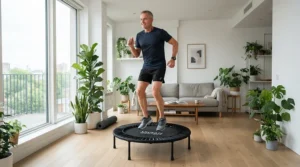
Weight-bearing exercise is any activity where you’re upright and supporting your own body weight. Walking counts. Swimming and cycling don’t, however good they are for your heart.
The Royal Osteoporosis Society sorts impact into low, moderate and high. Bone responds most strongly to higher forces, but many people can’t or shouldn’t jump from a box. That’s where a rebounder earns its place: it lets you add controlled loading in a form your joints can tolerate.
Here is the nuance most buying guides skip. A soft bungee absorbs part of every landing, so the peak force through your skeleton is lower than on a hard floor. A firmer cord, or a spring-style platform, gives a sharper signal. So the best rebounder for bone density support depends on your starting point. If you have joint pain or fracture history, softer is safer. If you’re fit and your clinician agrees, firmer may deliver more stimulus.
Think of it as a dial rather than a switch. The Bellicon Classic lets you turn it with cord choice. The JumpSport 350 PRO gives you a firm, stable platform. Cheaper rope or bungee options like the SportPlus Fitness Trampoline sit towards the gentle end.
Osteoporosis Prevention: Building a Realistic Rebounding Plan
Osteoporosis prevention is a long game. Bone mass peaks in early adulthood and gently declines afterwards, with a sharper drop around menopause. Anything that slows the slide counts.
A realistic plan combines three things: regular impact, progressive muscle work and balance practice. A rebounder helps with the first and third, and gives some muscular endurance work too. For muscle strength, you’ll still want resistance exercise such as bodyweight squats, resistance bands or weights.
Here is a sensible weekly shape for a healthy adult:
- Three to five short rebounding sessions of 10-20 minutes
- Two resistance sessions
- Daily walking
- Balance practice built into your warm-up
Consistency matters more than heroics. Ten minutes on four days beats an hour once a fortnight, because bone responds to regular loading. This is also where noise and storage matter. A quiet JumpSport 250 that lives in the lounge gets used, while a clanking spring model in the loft doesn’t.
If you’ve already been diagnosed with osteoporosis, ask your GP, specialist nurse or physiotherapist what impact level suits you before you begin.
Bone Health Beyond the Bounce
No rebounder can out-bounce a poor diet. Bone health depends on calcium, vitamin D, protein, not smoking, sensible alcohol intake and, for some people, medication. Exercise is one lever among several.
Calcium and vitamin D are the headline nutrients, and the UK public health advice on vitamin D is worth reading, particularly through the darker months. Protein matters too, since muscle protects bone by absorbing forces and helping you stay upright. Sleep, hormones and certain medicines also influence bone, which is why a conversation with your GP is worth having if you’re worried.
Where does the rebounder fit? Mostly as the part of the plan you’ll actually enjoy. People stick with activities that feel playful, and a few minutes of gentle bouncing to your favourite playlist can be the hook that keeps the rest of the routine going.
The practical takeaway is to treat your purchase as a habit-builder. Choose the model you’ll use, put it where you’ll see it, and pair it with food, sunlight and strength work.
Rebounder for Rehab and Physio Use: What to Know
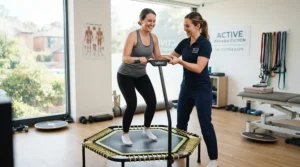
Rebounder for rehab and physio use is where soft bungee suspension really shines. A cushioned surface reduces peak joint loading, so people recovering from lower-limb problems, or returning to exercise after a layoff, often find it more tolerable than hard floors. Physiotherapists sometimes use rebounding for gentle balance, coordination and circulation work.
That said, rehab is individual. A rebounder that suits a stiff knee may not suit a recent vertebral fracture, a hip replacement or severe balance problems. The right model, the right surface firmness and the right exercises should come from your physiotherapist.
When you’re choosing equipment for this purpose, prioritise:
- A handrail that adjusts to the right height
- A stable, non-wobbly frame
- Soft, controllable bounce
- A low step-on height
The SportPlus Fitness Trampoline ticks the rail box with its five-height bar, and the Bellicon Classic offers premium softness with optional stability accessories. For a budget compromise, the Maxmass Bungee Rebounder has an adjustable handle. Always ask your physio before starting, and stop if you feel pain, dizziness or instability.
How to Choose a Rebounder for Bone Density Support
Here are the steps I’d work through, in order:
- Set your impact level with a professional. If you have osteoporosis, vertebral fractures or joint problems, get guidance first. This decides whether you need a soft or firm bounce.
- Choose bungee over steel springs for most home use. Bungee is quieter and gentler on joints. Springs give a firmer, more jarring landing that can be harsh on knees.
- Match mat size to your movements. 39″ is fine for bouncing on the spot, while 44″ or larger suits stepping and balance drills.
- Check the weight rating. Choose a model that handles your weight comfortably with a safety margin.
- Decide whether you need a handrail. If balance is a worry, buy a model with one, such as the SportPlus Fitness Trampoline or JumpSport 250 handlebar version.
- Think about storage. A foldable frame like the CLORIS Foldable Rebounder gets used more often if your home is small.
- Check warranty and spares. Premium brands tend to offer better parts support, though terms change, so verify them.
“The best rebounder is the one you’ll still be using in six months.”
That line is a rule of thumb rather than a quotation, but it holds up. A mid-range JumpSport 250 used four times a week beats a premium frame gathering dust.
✨ Ready to compare current prices?
🔍 Look through the models above and click any highlighted product name to check current pricing and availability on Amazon. Choose the one that fits your space, your budget and your confidence on the mat, then start gently!
Features That Actually Matter (And Those That Don’t)
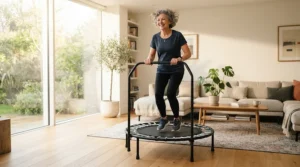
Marketing around rebounders can be noisy, so let’s separate signal from sparkle.
Features that matter:
- Suspension type. This decides how the bounce feels on your joints.
- Frame stability. A wobbling frame is a falls risk, not a feature.
- Handrail height adjustability. It is invaluable for balance work.
- Weight rating. It tells you about build strength.
- Noise level. Quiet models get used.
Features that matter less:
- Bundled DVDs and apps. Useful, but you can follow free routines. The 60-day JumpSport Fitness TV trial offered with some models is a nice extra, not a reason to buy.
- Colour choices. Pretty, irrelevant to bone.
- Huge “calories burned” claims. Ignore these.
- Bonus resistance bands. Handy, but they’re cheap to buy separately.
What does that mean in practice? Spend your budget on the bounce and the frame. A Bellicon Classic is expensive mostly because of bounce feel, durability and customisation, not accessories. A Maxmass Bungee Rebounder shows you what you give up when those priorities are trimmed.
Rebounder vs Traditional Alternatives for Bone Health
| Option | Impact level | Joint-friendliness | Weather/space needs | Best For |
|---|---|---|---|---|
| Rebounder (JumpSport 250) | Low to moderate, adjustable | High | Indoor, small footprint | Joint-sensitive, year-round exercisers |
| Brisk walking | Low to moderate | High | Outdoors, any weather | Everyone starting out |
| Jogging | Higher | Moderate | Outdoors or treadmill | Healthy, joint-sound adults |
| Resistance training | Muscle loading | High when technique is good | Gym or home | Everyone, ideally twice weekly |
| Swimming/cycling | None for bone | Very high | Pool or road | Heart health, joint-friendly cardio |
The comparison tells an honest story. Walking and resistance training remain the evidence-backed foundations, while rebounding adds an enjoyable, joint-friendly option when weather, time or pain get in the way. Swimming and cycling are brilliant for your heart but contribute little bone loading, so they shouldn’t be your only exercise if bone health is a priority.
If you’re choosing one purchase, a JumpSport 250 gives you a rainy-day workout you can do in ten minutes. For a smaller budget, the BCAN BT2 or CLORIS Foldable Rebounder do a similar job with fewer frills.
Safety Guide: Bouncing Sensibly
The Royal Osteoporosis Society’s exercise guidance is the best starting point for anyone with a diagnosis. Its UK consensus statement says people with vertebral fractures or multiple low-trauma fractures should usually exercise only up to an impact equivalent to brisk walking, and should avoid high degrees of spinal flexion.
Practical rules:
- Start with the health bounce. Feet stay on the mat and you gently flex your knees. It is the lowest-impact option.
- Use a rail until you trust your balance.
- Wear supportive trainers or grippy socks if the manufacturer allows it.
- Clear the area. Allow generous headroom and space around the frame.
- Stop at pain, dizziness or breathlessness.
- Avoid forward-curling movements such as crunches on the mat if you have vertebral concerns.
- Check the equipment monthly. Look at bungees, legs and bolts.
Note that UK safety markings and product standards vary between sellers, so look for clear manufacturer information and warranty details. If you’ve got any doubt, ask a physiotherapist to watch you try a few movements before you start.
Practical Usage Guide: Your First 30 Days on a Rebounder
Here is a gentle onboarding plan for a healthy adult. Adjust it with your clinician if you have a bone condition.
Setup: Place the frame on a level floor with at least a metre clear around it. Tighten every leg and bolt, and re-check after the first week.
Week 1: Health bounce. Five minutes a day, feet stay on the mat. Hold the rail if you have one.
Week 2: Add walking. Ten minutes, marching on the spot and gentle side steps.
Week 3: Add rhythm. Twelve to fifteen minutes with heel lifts, gentle jogging and arm swings, building to the full session over the week.
Week 4: Progress, if cleared. Add small, controlled impacts only if your clinician has confirmed they suit you. Otherwise keep varying tempo and balance challenges.
Maintenance: Every month, check bungee wear, frame bolts and mat seams. Keep the frame out of damp conditions and direct sunlight. Follow manufacturer guidance for replacing bungee cords.
Mistakes to avoid in the first 30 days:
- Going too hard too soon
- Skipping the rail when balance is shaky
- Bouncing with bare, sweaty feet
- Ignoring strength work
The result is a steady habit, not a short burst of enthusiasm.
Real-World Scenarios: Matching the Rebounder to the Person
These are illustrative profiles, not real testimonials, designed to show the reasoning.
Scenario 1: A 58-year-old starting osteoporosis prevention on a tight budget. She lives in a flat, wants quiet exercise and worries about balance. A SportPlus Fitness Trampoline with its adjustable bar and fold-away frame is a sensible first purchase. She bounces 10-15 minutes four times a week, adds resistance bands twice weekly, and walks daily.
Scenario 2: A 45-year-old desk worker and runner wanting cross-training. He wants a stable frame that tolerates energetic sessions and a household that will share it. A JumpSport 250, or the JumpSport 350 PRO if the budget stretches, offers a firmer platform without premium pricing. He uses it for warm-ups, intervals and recovery days.
Scenario 3: A 71-year-old with osteopenia under physio supervision. The priority is a soft, stable platform with a reliable rail and long-term durability. A Bellicon Classic with optional stability accessories fits the brief, though a JumpSport 250 handlebar version is a cheaper alternative. The physiotherapist sets the intensity, and sessions are short and frequent.
The common thread is that the right choice follows the person, not the product ranking.
Frequently Asked Questions
❓ Can a rebounder for bone density support replace osteoporosis medication?
❓ How long should I rebound each day for bone health?
❓ Is a bungee or spring rebounder better for rebounder for rehab and physio use?
❓ Is a rebounder safe if I have osteoporosis?
❓ Is a rebounder worth buying instead of just walking?
Conclusion
A rebounder for bone density support is not a miracle. The research so far suggests it can improve balance, strength and confidence, and might nudge bone density in the right direction, but it hasn’t been proven to replace established treatments or exercise. Used sensibly alongside resistance training, walking, good nutrition and medical advice, it can make weight-bearing exercise more enjoyable and more consistent.
If you want the best all-round buy, the JumpSport 250 offers sensible engineering at a fair price. If you want premium bounce for daily or shared use, the Bellicon Classic is the benchmark. For cautious beginners and anyone doing rebounder for rehab and physio use at home, the SportPlus Fitness Trampoline offers an adjustable rail and folding convenience. On a tighter budget, the BCAN BT2, Maxmass Bungee Rebounder and CLORIS Foldable Rebounder let you try the habit with less risk, provided you check current reviews and specifications.
Whatever you choose, start gently, build gradually and get professional advice if you have a bone condition. Your skeleton will thank you for the small, steady effort, long before the next birthday candles.
Recommended for You
- Low-Impact Rebounder For Bad Knees: 7 Best Picks For UK Homes (2026)
- Rebounder Vs Skipping Rope For Fitness: 7 Best Buys (2026)
- Rebounder Vs Treadmill For Cardio: 7 Best Picks For UK Homes (2026)
Disclaimer: This article contains affiliate links. As an Amazon Associate, I earn from qualifying purchases. If you purchase products through these links, we may earn a small commission at no additional cost to you.
✨ Found this helpful? Share it with your friends! 💬🤗
