In This Article
A rebounder for over 50s is a stable, joint-friendly mini trampoline, usually around 40 inches across. It is sprung with bungee cords or steel springs and ideally fitted with a stability bar. It delivers gentle cardio, leg strength and balance training without the pounding of running or high-impact aerobics.
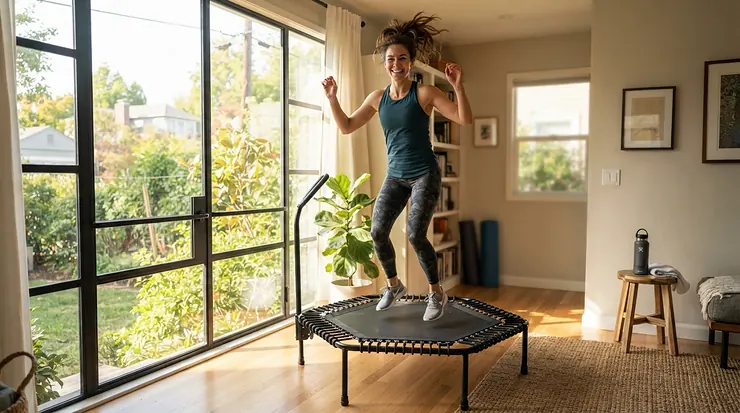
Right, the pitch. Picture a piece of kit that fits behind the sofa, works your heart, legs and core, and asks your knees for a fraction of the punishment a brisk jog would. That is the promise of a good rebounder for over 50s. The catch is that the market is a jungle of wobbly bargains, flimsy frames and marketing that reads like it was written by a caffeinated hamster.
The stakes are real. NHS guidance for older adults says strength, balance and flexibility work should sit alongside your weekly aerobic activity. It also notes that if you have fallen, or worry about falling, those exercises help you feel stronger and more confident on your feet. A well-chosen rebounder can tick several of those boxes in one compact package.
This guide does the homework for you. It compares seven real, UK-available options across budget, mid-range and premium. It explains what each specification means in practice, and it shows you how to start safely. Everything below is based on published specifications, retailer and manufacturer information, and aggregated review commentary. I haven’t tested any of these products myself, and where evidence is thin, I say so.
Quick Comparison: Rebounder for Over 50s at a Glance
| Product | Bounce type | Approx. price range* | Best for |
|---|---|---|---|
| BERG Fitness Trampoline 110 | Elastic bands | £300-£350 | Smooth, quiet bounce for sensitive joints |
| Fit Bounce Pro II | Bungee | £300-£375 | Flat or terrace living where silence matters |
| bellicon Classic | Bungee (choose your strength) | £500+ | Long-term investment, tailored resistance |
| MaXimus Pro Rebounder | Steel springs | £150-£250 | An all-in-one kit with bar, bands and weights |
| MaXimus Bounce & Burn | Large springs | Around £150 | Mid-range value with a high weight limit |
| HOMCOM Rebounder | Spring | Around £50 | Trying rebounding on a tight budget |
| Costway 101 cm Mini Trampoline | Spring-type | Under £100 | Budget rebounder with resistance bands |
*Ranges reflect the time of research and retailer/review-site information. Prices move often, so check current price before buying.
Looking at the comparison above, the Bounce & Burn and HOMCOM Rebounder cover most of the affordable ground. The BERG Fitness Trampoline 110, Fit Bounce Pro II and bellicon Classic are the “soft landing” specialists, and you pay for that softness. If your priority is a ready-made rebounder with resistance bands and a handle, the MaXimus Pro Rebounder and Costway 101 cm Mini Trampoline are the cheapest routes.
💬 Just one click — help others make better buying decisions too!😊
The 7 Best Options for a Rebounder for Over 50s: Expert Analysis
Three picks below come from the same UK maker. That reflects how few specialist rebounder firms serve the UK market, not brand loyalty. Each product is judged on what matters after 50: joint comfort, stability, support options and honest value.
1. BERG Fitness Trampoline 110 — elastic bounce, whisper-quiet feel
The BERG Fitness Trampoline 110 trades metal springs for elastic bands, and that choice defines its whole personality. It is a Dutch-engineered 110 cm model that folds flat for storage. On paper, the elastic suspension means the mat decelerates you more gradually than tight steel springs do. In practice, that translates to a gentler landing through the ankles, knees and hips.
Based on the spec comparison, it suits people who find conventional springs jarring. Be aware that much of the available praise, including the claim that cheaper spring models can feel harsh on joints, comes from a specialist retailer’s own content. Independent long-term reviews are thinner than for the Maximus range. Check whether a stability bar can be fitted, because the base model’s support options weren’t clear from the material I found.
Pros:
- ✅ Elastic bounce is softer than steel springs
- ✅ Quiet enough for shared walls
- ✅ Folds flat for easy storage
Cons:
- ❌ Costs several times more than budget springs models
- ❌ Independent long-term reviews are hard to find
Price and value: Expect the £300-£350 range, so check current price. It’s fair value if joint comfort is your main criterion, but hard to justify if you’re merely curious.
2. Fit Bounce Pro II — the bungee benchmark for quiet, cushioned bouncing
The Fit Bounce Pro II is the model most UK review sites reach for when the brief is “quiet and kind to joints”. It’s a 40-inch half-folding rebounder from Windsor-based Maximus Life, and it arrives pre-assembled. The bungee suspension absorbs more of each landing than metal springs, and it makes very little noise. That’s a genuine plus for early-morning bouncing in a flat.
The listed weight limit varies by source, at roughly 140-150 kg, so verify it on the listing. Bungee-cord counts are also reported inconsistently, with 60 connectors claimed by the brand and 30 loops in one independent review. The bungees are a consumable, guaranteed for around six months by one review’s account, so budget for replacements over the years.
Reviewer commentary on the maker’s Trustpilot page includes first-time users in their 60s and people with health conditions who say they simply keep their feet on the mat. That’s a sensible way to use it.
Pros:
- ✅ Near-silent bungee bounce
- ✅ Arrives pre-assembled and half-folds
- ✅ Bundled workouts and a carry bag
Cons:
- ❌ Bungee cords are a recurring cost
- ❌ Connector count is described inconsistently
Price and value: Expect roughly £300-£375. It’s a strong mid-to-upper pick if noise and comfort matter more than cost.
3. bellicon Classic — premium build, bounce tuned to your weight
The bellicon Classic is the “buy it once” option, and its trick is customisation. It comes in 100 cm, 112 cm and 125 cm frame sizes, with six foldable legs and a powder-coated steel frame. You choose the bungee strength by body weight, from soft (under 60 kg) to ultra strong (151-200 kg). That matters because a mismatched bungee makes the bounce either boneshakingly firm or unhelpfully mushy.
The brand also notes its rebounders are used in physiotherapy and rehabilitation settings. I’d treat that as a manufacturer claim rather than clinical endorsement. It also lists a T-bar option for supported balance, which is valuable for cautious beginners. The catch is cost and complexity, since configuring size, bungee strength and legs takes some thought.
I couldn’t verify a large body of independent UK reviews for the current model, so this verdict rests mainly on specifications and brand information.
Pros:
- ✅ Bungee strength matched to your weight
- ✅ Three frame sizes, up to 200 kg capacity
- ✅ T-bar option for supported balance work
Cons:
- ❌ Priciest option on this list by a distance
- ❌ Configuration choices can confuse first-timers
Price and value: Expect £500 or more depending on configuration, so check current price. It’s the best long-term value here if you’ll bounce daily for years, and overkill if you might abandon it in March.
4. MaXimus Pro Rebounder — the all-in-one kit with bar, bands and weights
The MaXimus Pro Rebounder is the one to consider if you want a rebounder with resistance bands and a handle right out of the box. The package includes a stability bar, resistance bands, small sand weights, two workout DVDs, a bounce counter and a carry bag. It uses 32 calibrated steel springs and weighs around 14 kg, and that weight matters. One UK maker’s buying guide suggests rebounders under about 10 kg can feel unstable for workouts.
On paper, the kit approach saves you hunting for accessories. The steel springs give a livelier, more responsive bounce than bungees, which some people love and some find harsher. Review-site commentary lists a top user weight of around 140 kg and rates it as a higher-end spring model.
Springs are noisier than bungees, and a touch of lubricant is a common suggestion for squeaks. If quiet matters, look at the Fit Bounce Pro II.
Pros:
- ✅ Stability bar, bands and weights included
- ✅ Weighty frame feels planted underfoot
- ✅ Online workout access adds variety
Cons:
- ❌ Springs are livelier and noisier than bungees
- ❌ Bounce can feel firmer than elastic systems
Price and value: Expect roughly £150-£250. It’s excellent value for a starter package if you’ll actually use the extras.
5. MaXimus Bounce & Burn — mid-range value with a high weight limit
The MaXimus Bounce & Burn aims squarely at the sensible middle. It’s a 40-inch foldable model with a steel frame that reviewers describe as robust yet fairly light. It uses a large spring system designed to soften the bounce, and it has a weight limit of around 140 kg, which is generous at this price.
What does that mean for you? You get a stable platform without paying bungee-tier money. Review-site commentary singles it out as strong value at around £150, and one reviewer describes its design as suitable for arthritic knees. That’s a marketing-adjacent claim rather than a clinical one, so use judgement.
Sources disagree on whether online workout access is included, with one noting it would be welcome. Check the current listing. Independent commentary also points out that some budget-tier models lack a bar, so verify that you can add one.
Pros:
- ✅ High weight limit at a mid-range cost
- ✅ Sturdy steel frame stays reasonably light
- ✅ Folds and comes with a carry bag
Cons:
- ❌ Spring bounce is noisier than bungee
- ❌ Included extras vary between listings
Price and value: Around £150, so check current price. It’s the best all-rounder here for most people who want quality without a premium price tag.
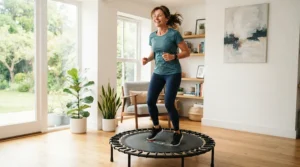
6. HOMCOM Rebounder — the budget starter with a handlebar
The HOMCOM Rebounder is the “let’s see if I actually like this” purchase. It’s lightweight and comes with handlebars, and it can often be picked up for around £50. A reviewer at one UK comparison site calls it a favourite and praises the handlebars, while noting the online content that comes with pricier options is missing.
What does light weight mean for you? It’s easy to move, but one buying guide suggests rebounders under 10 kg can feel less stable, so test the bar’s stability before trusting it with your weight. Look for rubber feet and check whether the bar locks solidly.
Reviewers positioning it as good value at a lower price point is honest but not rigorous evidence. Think of it as a low-risk trial. If you bounce three times a week for a month, you’ve learned something valuable before spending more.
Pros:
- ✅ Very affordable way to try rebounding
- ✅ Handlebars aid balance and confidence
- ✅ Lightweight and easy to store
Cons:
- ❌ Lighter frame may feel less planted
- ❌ Basic spring bounce is firmer than premium models
Price and value: Around £50, so check current price. It’s superb for testing the water, though you may outgrow it.
7. Costway 101 cm Mini Trampoline — budget rebounder with resistance bands
The Costway 101 cm Mini Trampoline is the cheapest way to get a rebounder with resistance bands included. It has a 101 cm diameter, an adjustable foam handlebar and two detachable resistance bands. Per its product page, it arrives pre-assembled and folds in half, then again for storage.
The adjustable handlebar suits different heights, and the bands open up gentle upper-body work. The brand suggests it suits body shaping, balance and stretching. I couldn’t verify weight limits or independent long-term reviews, so check those on the listing before you commit, particularly the maximum user weight.
The product page doesn’t advertise premium suspension, so treat bounce softness as an unknown. If you have sensitive joints, a softer bungee model may be worth the extra outlay.
Pros:
- ✅ Bands and adjustable handlebar included
- ✅ Folds compactly for storage
- ✅ Pre-assembled for a quick start
Cons:
- ❌ Weight limit and suspension details are unclear
- ❌ Limited independent review evidence
Price and value: Typically under £100, so check current price. It’s a decent low-cost experiment, provided the weight limit suits you.
How to Choose a Rebounder for Over 50s
Choosing well comes down to seven questions, answered in order:
- Set your joint-comfort priority. If knees or hips complain easily, bungee or elastic systems such as the BERG Fitness Trampoline 110, Fit Bounce Pro II or bellicon Classic cushion landings more than tight springs.
- Check the weight limit. Choose a rebounder rated comfortably above your weight. The bellicon Classic goes up to 200 kg on its largest frame, while most others sit around 140-150 kg.
- Insist on a stability bar. A handle significantly improves balance and confidence, especially for beginners and older users, according to JumpSport. Many people use one permanently, and there’s no shame in it.
- Look at frame weight. Heavier frames (over roughly 10 kg) stay planted. The MaXimus Pro Rebounder at around 14 kg fits this.
- Consider noise. Bungees are near-silent, which matters in flats. Springs can squeak, though a touch of silicone lubricant can help.
- Check for UK/EU test certificates. Reputable makers publish them, so look for this before you buy.
- Weigh service and spares. Bungees wear out, so buy from a supplier that stocks replacements.
Use the list as a filter, not a checklist to win. The best rebounder for over 50s is the one whose limitations you can live with.
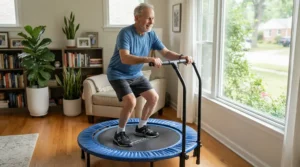
Rebounder With Resistance Bands: Worth the Extra?
A rebounder with resistance bands adds upper-body and core work to your bounce. Bands come in two forms. Some attach to the frame or legs, and others are loose handheld bands you use while standing on the mat.
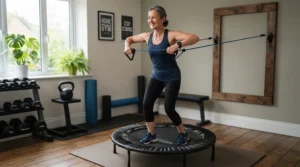
Is it worth it? Based on the spec comparison, it depends on your goals. The MaXimus Pro Rebounder includes bands, weights and a bar in one package. The Costway 101 cm Mini Trampoline offers detachable bands at a budget price. For pure convenience, that combination reduces the number of things you need to buy separately.
Resistance work also lines up with general guidance. One UK private-hospital guide suggests adding resistance with exercise bands, and keeping weights very light with high, slow repetitions if you have arthritis. If you already own bands, a rebounder with resistance bands built in adds little. Then a well-sprung model without extras, such as the Fit Bounce Pro II, may be the smarter spend.
Start light and let the bounce stay gentle. Resistance should challenge your muscles, not your joints.
Balance Training on a Rebounder
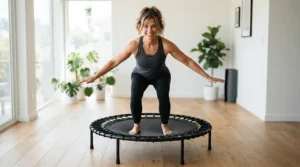
Balance training on a rebounder works because the surface moves. Your ankles, hips and core constantly correct tiny wobbles, and that’s exactly the kind of reactive stability you need on a slippery kerb.
There’s real research behind the idea. In a study in PubMed, 22 older adults completed 14 weeks of mini-trampoline training while 12 acted as controls. The trained group improved their ability to regain balance during sudden forward falls by around 35%, and their calf muscle strength rose by roughly 10%. It’s a small study, so don’t treat it as a promise, but it points in an encouraging direction.
Try this progression:
- Week one: Hold the bar and simply shift your weight from foot to foot.
- Week two: March gently on the spot with the bar in reach.
- Week three: Let go with one hand for a few seconds at a time.
If you’ve fallen before or feel unsteady, keep the bar and get advice from a GP or physiotherapist first. Balance training should feel challenging but never scary.
Low-Impact Exercise: How a Rebounder Compares With Walking, Swimming and Cycling
Low-impact exercise doesn’t mean low reward. It means your joints aren’t absorbing repeated jolts. A rebounder’s mat and suspension take much of that force, which is why so many people see it as gentler than running or aerobics.
| Option | Joint load | Balance benefit | Space and cost | Best for |
|---|---|---|---|---|
| Rebounder | Low (mat absorbs shock) | High if you use bar-free drills gradually | Compact; £50-£500+ | Home workouts with balance challenge |
| Walking | Low to moderate | Modest | Free; needs safe routes | Beginners and daily habit-building |
| Swimming/water aerobics | Very low | Modest | Pool access and fees | Painful or heavily affected joints |
| Exercise bike | Low | Little | Larger footprint; varying cost | Steady cardio, weather-proof |
Look at that table honestly. Nothing beats swimming for sheer joint protection, and walking wins on cost. A rebounder shines when you want compact, all-weather low-impact exercise that also trains balance.
The rebounder isn’t a replacement for everything. It’s one useful tool in a varied routine, and Versus Arthritis suggests mixing strengthening, stretching, fitness and balance activities.
Arthritis-Friendly Fitness: Can You Rebound With Sore Joints?
Arthritis-friendly fitness starts from a simple fact. Staying active tends to ease symptoms and support independence, whereas rest tends to stiffen joints. Versus Arthritis says it can be hard to keep moving with arthritis, but staying as active as possible can reduce pain and help you stay independent.
A rebounder can fit into arthritis-friendly fitness because the mat spreads the load. Some makers describe their models as suited to arthritic knees. Treat that as a marketing claim, not medical advice. Everyone’s joints are different, and inflammatory arthritis such as rheumatoid arthritis calls for particular care.
Sensible rules:
- Begin with the “health bounce”, keeping your feet on the mat and simply moving your knees.
- Warm your joints first, as Mayo Clinic suggests using heat before exercise, and use ice afterwards if joints ache.
- Favour consistency over intensity, because gentle regular sessions beat heroic weekends.
- Stop if you feel sharp or joint-specific pain.
Ask your GP or physiotherapist before starting if you have a joint replacement, a flare-up, or osteoporosis. Bouncing gently is not the same as jumping.
Your First 30 Days: A Practical Usage Guide
Amazon listings sell you the rebounder, but they rarely tell you how to start. Here’s a month-long plan for a rebounder for over 50s that keeps things sensible.
Days 1-7: Learn the surface. Position the rebounder on a flat, non-slip floor with clear space around it, and keep the bar within reach. Stand, shift your weight and walk gently on the spot for two to three minutes. Wear supportive trainers or grip socks.
Days 8-14: Build a rhythm. Aim for five to eight minutes, three or four times a week. Try the health bounce, gentle marching and small side-to-side steps.
Days 15-21: Add gentle variety. Lengthen sessions to ten to twelve minutes and introduce arm movements. NHS advice describes moderate intensity as a level where you can still talk but not sing, so use that as your guide.
Days 22-30: Explore balance and bands. Add short single-leg holds near the bar. If your model includes bands, try light upper-body moves.
Common first-month mistakes include overdoing it, skipping warm-ups, using a wobbly floor surface and never checking the frame bolts. Check fixings monthly, and inspect bungees or springs for wear.

Real-World Scenarios: Which Rebounder Suits Which Over-50?
Three quick profiles show how the analysis plays out.
The cautious returner (58, sore knees, flat with shared walls). Their priorities are joint comfort and quiet. Based on the specs, the Fit Bounce Pro II or BERG Fitness Trampoline 110 fit well. They should attach a stability bar and bounce for short, frequent sessions.
The budget experimenter (63, healthy, unsure). They want to test rebounding before investing. The HOMCOM Rebounder or Costway 101 cm Mini Trampoline cost the least, and the handlebar gives balance confidence. If they stick with it after a couple of months, an upgrade is easy to justify.
The committed regular (70, recovering strength, three sessions a week). They plan to bounce for years and want tailored resistance. The bellicon Classic with a T-bar suits, with bungee strength chosen for their weight. The MaXimus Bounce & Burn is a cheaper, sturdy alternative.
Notice that none of these profiles chooses on price alone. They choose on comfort, support and how long the person expects to keep going.
Problem → Solution: Fixing Common Rebounder Frustrations
Most rebounder complaints have straightforward fixes.
Problem: Squeaking. Spring models can squeak over time, and a little silicone lubricant on the springs often helps. Bungee models such as the Fit Bounce Pro II avoid the issue.
Problem: The rebounder creeps across the floor. A light frame slides. Use a non-slip mat beneath it, or choose a heavier model like the MaXimus Pro Rebounder.
Problem: Feeling wobbly. Keep the stability bar attached and shorten your sessions. If you feel unsteady on flat ground, speak to your GP before continuing.
Problem: Knee or hip twinges. Return to the health bounce, reduce range, and check your footwear. Persistent pain deserves a professional opinion.
Problem: Boredom. Many packages, including the MaXimus Pro Rebounder, include workout access, and free online sessions are widely available. Music helps.
Problem: Bungees losing bounce. Cords wear with time. Budget for replacements, and pick a supplier that stocks them.
Features That Actually Matter (And Those That Don’t)
Marketing loves a big number. Here’s what deserves your attention and what doesn’t.
Features that matter:
- Stability bar compatibility. Confidence and safety come first.
- Suspension type. Bungee or elastic cushions landings, and springs are livelier.
- Weight limit and frame weight. These affect stability and longevity.
- Mat surface diameter. The bellicon Classic in 100 cm has a 67 cm mat, and the difference between mat and frame size is what you actually bounce on.
- Spare-parts availability. Bungees and mats wear.
Features that matter less:
- Bounce counters and apps. Nice, but not essential.
- Glossy DVD packages. Free online workouts are plentiful.
- “Detox” and lymphatic claims. Marketing copy sometimes leans on these, but the evidence I found for them was weak, so don’t buy on that basis.
- Colour options. Pleasant, irrelevant.
If a claim sounds too good, it probably is. Spend on stability and suspension, not slogans.
Long-Term Cost and Maintenance
The cheapest rebounder isn’t always the cheapest to own. Consider running costs, replacement parts and how long you’ll actually keep using it.
| Tier | Price range | Examples | What you gain | What you give up | Best for |
|---|---|---|---|---|---|
| Budget | Under £100 | HOMCOM Rebounder, Costway 101 cm Mini Trampoline | Low-risk trial, handle and bands | Softness, long-term durability | First-timers |
| Mid-range | £150-£250 | MaXimus Bounce & Burn, MaXimus Pro Rebounder | Sturdy frame, extras | Bungee-level quiet | Regular users |
| Upper-mid | £300-£375 | Fit Bounce Pro II, BERG Fitness Trampoline 110 | Soft, quiet bounce | Lower price | Sensitive joints |
| Premium | £500+ | bellicon Classic | Customisation, longevity | Low cost | Daily long-term use |
The table shows a clear pattern. Paying more buys softness and tailoring, but it only pays off if you keep bouncing. A £50 model used twice weekly for years beats a £500 one gathering dust.
Maintenance is modest. Bungee cords wear, with one review noting roughly a six-month guarantee, so plan for replacements. Springs may need occasional lubrication. Wipe the mat, check bolts and inspect legs monthly.
Safety Guide: Who Should Speak to a GP First
A rebounder for over 50s is generally gentle, but “gentle” isn’t “risk-free”. Speak to your GP or a physiotherapist before starting if any of these apply to you:
- Osteoporosis or a recent fracture
- A joint replacement or recent surgery
- Balance disorders, dizziness or previous falls
- Uncontrolled high blood pressure or heart conditions
- Pelvic floor problems, since some people leak when bouncing
bellicon’s own guidance says that severe balance disorders, acute injuries and uncontrolled cardiovascular conditions warrant medical advice first. That is sensible for any rebounder.
Practical safeguards:
- Keep the stability bar in place until you’re confident.
- Never exceed the weight limit.
- Clear the space around you, including low ceilings and furniture.
- Avoid bouncing when tired or unwell.
- Stop if you feel chest pain, dizziness or sharp joint pain.
Use the “talk but not sing” rule for intensity. The aim is a steady, sustainable routine, not a hero moment.
FAQ
❓ How long should a beginner over 50 bounce each day?
❓ Do I need a stability bar on a rebounder for over 50s?
❓ How much space does a rebounder need at home?
❓ Can I use a rebounder after a knee or hip replacement?
❓ How often do bungee cords need replacing?
Conclusion
Choosing a rebounder for over 50s isn’t about chasing the springiest bounce. It’s about matching a stable, comfortable platform to your joints, your space and your confidence. The BERG Fitness Trampoline 110, Fit Bounce Pro II and bellicon Classic offer the softest landings, at a price. The MaXimus Bounce & Burn and MaXimus Pro Rebounder deliver strong mid-range value, and the HOMCOM Rebounder and Costway 101 cm Mini Trampoline keep the entry cost low.
Whatever you pick, use a stability bar until you feel steady, start small, and lean on balance training and low-impact exercise habits rather than intensity. National data shows the need. In England in 2021, only 19% of adults aged 65 and over met the balance-exercise guideline, so a few minutes a day puts you ahead of most.
Rebounding won’t fix everything, and it isn’t for everyone. But for many people it’s an enjoyable, compact form of arthritis-friendly fitness that keeps them moving.
Recommended for You
- Mini Trampoline For Weight Loss: 7 Best Picks For UK Homes (2026)
- Rebounder For Beginner Workouts: 7 Best Picks UK (2026)
- JumpSport vs Bellicon Rebounder: 7 Best Picks Compared (2026)
Disclaimer: This article contains affiliate links. As an Amazon Associate, I earn from qualifying purchases. If you purchase products through these links, we may earn a small commission at no additional cost to you.
✨ Found this helpful? Share it with your friends! 💬🤗
