In This Article
Picture a piece of kit that raises your heart rate, spares your knees, folds under the bed and costs less than a few months of gym membership. That is the pitch for a rebounder under £150 for low-impact cardio, and for once the pitch holds up better than most.
Not everything on Amazon lives up to the hype, though. Rebounders range from wobbly toys to properly engineered fitness tools, and the price tag alone won’t tell you which is which. Spring or bungee, 36 inches or 48, handlebar or none: each choice changes how the thing feels and how long it lasts.
The research is encouraging but modest. Work sponsored by the American Council on Exercise tested a mini-trampoline routine against standard cardiorespiratory fitness guidelines and found participants enjoyed it and could stick with it. That staying power is half the battle with home exercise.
This guide covers seven real models and what their specifications mean in practice. It also covers who each one suits, with a dedicated look at the top rebounders recommended for seniors. Along the way you’ll get honest advice on budget fitness equipment, low-impact training and home workout value.
One note on method. I haven’t personally tested these products, so everything below comes from published specifications, retailer listings and aggregated review themes. Price brackets are indicative at the time of research, so check current price before you buy.
Quick Comparison: 7 Budget Rebounders at a Glance
Here is the whole field on one screen. Use it to shortlist, then read the detailed entries below.
| Product | Mat size | Bounce type | Weight limit | Price range | Best For |
|---|---|---|---|---|---|
| Body Sculpture 36in Foldable Mini Trampoline | 36in (92cm) | Spring | 100kg | Around £50-£70 | Tiny budgets, light users |
| Gr8 Home 40″ Silent Mini Fitness Trampoline | 40in | Bungee | 150kg | Roughly £50-£90 | Flats and quiet floors |
| BCAN SP2 40″ Foldable Mini Rebounder | 40in | Spring | Check UK listing | £70-£110 range | Beginners, easy setup |
| Newan 40″ Silent Mini Trampoline | 40in | Bungee | About 150kg | £70-£110 range | Joint-friendly bounce |
| SONGMICS 40″ Mini Fitness Trampoline | 40in | Bungee | 120kg | £80-£120 range | Taller users, handrail |
| ONETWOFIT 48″ Silent Mini Trampoline | 48in | Bungee | Check UK listing | £80-£130 range | Confidence, extra space |
| BCAN BT2 40″ Bungee Rebounder | 40in or 48in | Bungee | 450-550lb rated | £90-£150 range | Heavier use, longevity |
The table shows a clear split. Spring models such as the BCAN SP2 and Body Sculpture cost less and bounce firmer, while bungee models cost a little more and feel softer and quieter.
If a handlebar matters to you, as it does for most older users, check each listing carefully, because bundles vary. The Body Sculpture has the lowest weight limit here, so heavier users should look further up the table.
💬 Just one click — help others make better buying decisions too!😊
Top 7 Rebounders Under £150: Expert Analysis
1. Body Sculpture 36in Foldable Mini Trampoline — cheapest way to start
The standout here is the entry price. Retailer listings put the Body Sculpture in the £50-£70 range, which makes it the lowest-risk way to find out whether rebounding suits you.
It measures 92cm across and 19.5cm high, with six rubber-mounted feet and an integral foam edge. In practice the small mat suits gentle bouncing, marching and basic balance work, but it won’t forgive wide-legged movements. The 100kg limit is the lowest in this guide, and jumping loads the frame well beyond your standing weight, so treat that figure as a ceiling rather than a target.
On paper this suits lighter adults, teenagers and anyone dipping a toe into low-impact training. Delivery is folded, with a small amount of assembly.
Review evidence is thin. One UK retailer page shows 3.9 out of 5 from about a dozen reviews, too small a pool to draw firm conclusions.
Pros:
- ✅ Lowest entry price in this guide
- ✅ Foam edge and six rubber-mounted feet
- ✅ Folds away easily for storage
Cons:
- ❌ 100kg weight limit excludes many users
- ❌ Small review base and no handlebar listed
Price verdict: around £50-£70 makes it fair value as a trial purchase, but not a long-term bet for frequent heavy use.
2. Gr8 Home 40″ Silent Mini Fitness Trampoline — bungee quiet for flats
The headline is the bungee design. Instead of metal springs that can creak, the Gr8 Home uses a bungee rope system, which matters if you live above someone or exercise early.
The listing gives 101 x 101 x 28cm dimensions, a 6.7kg frame and a 150kg limit. That limit is a big step up from the Body Sculpture. The elliptical steel tube frame and arched legs are meant to spread load, and the non-slip rubber pads protect floors and cut noise.
Based on the spec comparison, this is a sensible pick for flat-dwellers who want softer landings without spending over £100. The listing admits assembly “requires some physical labour”, so expect to put your back into attaching the bungees.
I couldn’t verify a meaningful pool of independent reviews, so treat the spec sheet with a healthy pinch of salt and read current buyer feedback before ordering.
Pros:
- ✅ Bungee system for quieter bounce
- ✅ 150kg limit at a budget price
- ✅ Non-slip pads protect flooring
Cons:
- ❌ Assembly takes real effort
- ❌ Independent review evidence hard to verify
Price verdict: likely £50-£90, so strong value on paper, provided current reviews hold up.
3. BCAN SP2 40″ Foldable Mini Rebounder — easiest setup, padded handlebar
The hook is simplicity. Roundup testers single out the BCAN SP2 for easy setup, and spring models in the BCAN family arrive with springs pre-installed.
Aggregated data for the 40-inch foldable BCAN line suggests assembly in roughly 7-20 minutes and a 330lb (about 150kg) rating. Confirm the figure on the UK listing for the SP2 itself. The foam-padded handlebar and gentle spring action are what make it attractive for older beginners.
Here is what to weigh. Reviewers consistently note that folding is cumbersome, since you must remove the handlebar and all six legs. That makes it an “occasional fold” machine rather than a daily slide-under-the-sofa one. If it will live in the corner of a room, that hardly matters.
Another common theme in user reviews is a solid, stable feel, with the bounce praised as fun and effective. Review counts are large on the US listing, which at least means the design has been widely tried.
Pros:
- ✅ Quick setup with pre-installed springs
- ✅ Padded handlebar aids balance
- ✅ Large body of owner feedback
Cons:
- ❌ Folding means dismantling legs and bar
- ❌ Springs can be noisier than bungees
Price verdict: £70-£110 range, and arguably the safest all-round buy here.
4. Newan 40″ Silent Mini Trampoline — soft bungee bounce, joint-friendly feel
The pitch is a joint-friendly ride. The Newan is described as a silent bungee rebounder, available in 40- and 48-inch versions, with a listed maximum of 330lb (about 150kg).
Bungee construction generally gives a softer, more cushioned landing than steel springs, which is why it is the usual recommendation for anyone with sore knees or hips. The honest caveat is that “softer” can feel less stable for beginners, so a handlebar helps. The listing doesn’t make clear which bundle includes one, so check before ordering.
My read: this is a good fit for adults wanting a gentler feel, especially if noise is a worry. One roundup notes that installation is best done with two people, which is typical of bungee models, where stretching cords onto the frame takes some muscle.
Review themes are positive on quietness, though I’d read recent feedback on durability before committing.
Pros:
- ✅ Quiet bungee bounce
- ✅ About 150kg weight limit
- ✅ Choice of 40in and 48in mats
Cons:
- ❌ Installation is easier with two people
- ❌ Handlebar inclusion varies by bundle
Price verdict: £70-£110 range, which is fair for a bungee design at this level.
5. SONGMICS 40″ Mini Fitness Trampoline — handrail that suits taller users
The differentiator is the handrail. The SONGMICS has a removable rail adjustable from roughly 43 to 51 inches (about 110-130cm), which comfortably suits tall adults and gives a proper grip point.
Other specs: 40-inch diameter, 8kg weight, 120kg static load and bungees pre-installed, which removes the worst assembly chore. Thick rubber feet grip the floor. The manufacturer says children under 14 should not use it, and only one person at a time.
For tall or unsteady users, a handrail at the right height is arguably more valuable than any amount of extra bounce. It’s a solid choice for low-impact cardio sessions where you want something to hold during warm-ups.
I found no deep pool of UK review data, so judge it on the specification and current buyer feedback.
Pros:
- ✅ Pre-installed bungees save setup time
- ✅ Tall, adjustable removable handrail
- ✅ Thick rubber feet grip well
Cons:
- ❌ 120kg limit is lower than rivals
- ❌ Limited UK review evidence
Price verdict: £80-£120 range, reasonable for the handrail and pre-fitted bungees.
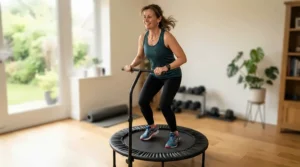
6. ONETWOFIT 48″ Silent Mini Trampoline — extra-wide mat for confident bouncing
Width is the story. At 48 inches, the ONETWOFIT gives you around 122cm of mat, enough room to step side to side, which makes your first sessions feel less like balancing on a dinner plate.
It comes with an adjustable handlebar and a silent bungee system, a combination that suits hesitant starters and anyone doing balance drills. The trade-off is floor space: a 48-inch frame needs a clear zone of at least a couple of metres each way, plus headroom.
Roundup writers advise reading the manual or watching the setup video before you begin, a reminder that bungee assembly isn’t quite flat-pack-simple. The model draws steady search interest from UK shoppers, though that isn’t the same as proven durability.
Check the weight limit on the live UK listing, as I couldn’t confirm it.
Pros:
- ✅ Generous 48in mat for stability
- ✅ Adjustable handlebar included
- ✅ Silent bungee bounce
Cons:
- ❌ Needs more floor space than 40in models
- ❌ Weight limit unverified here
Price verdict: £80-£130 range, decent value if you’ve space for it.
7. BCAN BT2 40″ Bungee Rebounder — longest-lasting feel at the budget ceiling
The point of this one is build quality at the top of the budget. The BCAN BT2 is a bungee rebounder in 40- and 48-inch sizes, rated in some variants at 450 or 550lb.
Roundup coverage describes the 2026 frame as an upgrade over earlier BCAN models, and one reviewer reported no frame flex at about 195lb with ankle weights. That’s one tester’s claim, not a certified result. The same coverage calls the bounce nearly silent but warns that bungee installation can be challenging.
Variants matter here: some listings are “no handle”, others “with bar”. For older users, the bar is the version to get. Larger sizes with handles may push past £150, so compare sizes before assuming it fits the cap.
Review sentiment points to a sturdy, quiet machine, with assembly as the main gripe.
Pros:
- ✅ Very quiet bungee operation
- ✅ Strong frame reported by reviewers
- ✅ High weight rating in some variants
Cons:
- ❌ Bungee installation can be fiddly
- ❌ Larger handled versions risk exceeding £150
Price verdict: £90-£150 range, best value if you plan to bounce several times weekly for years.
Setup, First 30 Days and Maintenance: A Practical Guide
Amazon listings rarely tell you what happens after the box is opened, so here is the practical bit.
Week one: place it right. Choose a flat, non-slip surface with at least a metre of clear space on every side and ample headroom. Check the room’s ceiling height with your arm raised, since jumping adds more than you’d think. Tighten every bolt after the first session, because fittings settle.
Weeks one to two: start small. Begin with a “health bounce”, feet barely leaving the mat, for five minutes. Add a minute every couple of sessions. The NHS Inform guidance on strength and balance exercises stresses regular practice, at least twice weekly, and sticking with it for six months or more to see real change.
Weeks three to four: add variety. Introduce marching, gentle twists and side steps. Keep a soft bend in the knees.
Maintenance schedule:
- ✅ Monthly: check legs, bolts and the handlebar clamp
- ✅ Every three months: inspect springs or bungees for fraying, rust or stretching
- ✅ Yearly: wipe the mat and flip or rotate position of the frame feet on the floor
Common mistakes in the first 30 days: overdoing session length, bouncing barefoot on a slippery mat, ignoring noise from springs that need attention, and jumping straight into high-impact moves. Honestly, the best optimisation trick is boring: a consistent 10-15 minutes beats an ambitious hour you quit after a week.
✨ Don’t Miss These Budget Bounce Picks!
🔍 Take your home workout to the next level with these carefully selected products. Click on any highlighted item to check current pricing and availability. These tools will help you build a gentle, joint-friendly routine your whole household can enjoy!
Real-World Scenarios: Matching a Rebounder to Your Life
Specs are abstract. Lives aren’t. Here are three profiles, with the reasoning behind each pick.
Scenario 1: The flat-dweller with thin floors. Imagine a 34-year-old renter on the second floor who wants early-morning cardio without upsetting the neighbours. A bungee model such as the Gr8 Home or Newan fits, because bungees tend to be quieter than springs. Budget around £50-£110, add a thick exercise mat underneath, and bounce three times a week for 15 minutes. If noise is the top priority, consider the BCAN BT2 and stretch toward the top of the range.
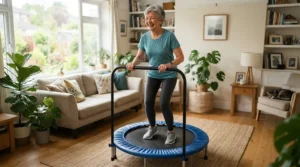
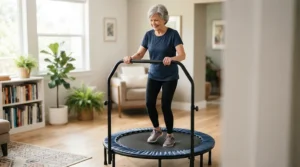
Scenario 2: The 68-year-old rebuilding confidence. Picture a retired teacher worried about balance who has been advised to stay active. The priority is a sturdy handlebar and a calm, predictable surface. The BCAN SP2 (padded bar) or the ONETWOFIT (adjustable bar, wide mat) match that brief. Aim for two or three short sessions weekly, ideally after speaking to a GP or physiotherapist, and place the unit beside a wall or heavy furniture.
Scenario 3: The tight-budget beginner. A student with £60 to spend and a small room could start with the Body Sculpture. It’s light, folds away and costs little, but its 100kg limit and small mat mean it’s a short-term solution. If the habit sticks, upgrading to a bungee model later is entirely sensible.
In each case, notice what drives the choice: environment, body, budget and frequency. Never the brand name alone.
Problem → Solution: Fixing Common Rebounder Headaches
Even good budget fitness equipment throws up the odd annoyance. Here are five, with fixes.
Problem 1: It squeaks. Springs rubbing at the hooks are the usual culprit. Check for loose bolts first, then consider moving to a bungee design like the Newan or SONGMICS if the noise persists.
Problem 2: It slides across laminate. Rubber feet help, but a non-slip mat or rubber furniture pads underneath improve grip further. Always test with gentle bouncing before building intensity.
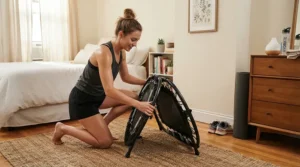
Problem 3: It’s a nightmare to store. Foldable frames save space, but as the BCAN SP2 shows, “foldable” can still mean removing legs and handlebar. If you need quick storage, choose a model with easily detachable legs and keep it by the wall for convenience.
Problem 4: The bungees feel tight or fiddly to fit. This is the reported weak spot of bungee designs, including the BCAN BT2. Fit them with a helper, follow the manual’s sequence, and don’t force damaged cords.
Problem 5: Calves ache after the first week. That’s normal. Reduce session length, keep a soft knee bend and make sure your trainers (or non-slip socks) offer good grip. If you feel sharp pain, stop and seek advice.
What Is a Rebounder Under £150 for Low-Impact Cardio?
A rebounder under £150 for low-impact cardio is a mini trampoline, usually 36 to 48 inches wide, designed for adult fitness rather than play. It uses springs or bungee cords to cushion each landing, spreading impact across your body. Most budget models cost between £50 and £150 and fold for storage.
The “low-impact” part deserves unpacking. Running on pavement delivers a sharp jolt through ankles, knees and hips with every stride. A rebounder’s flexible mat absorbs part of that force, so the same effort feels gentler on joints.
It isn’t magic, though. Rebounding is generally described as low-to-moderate intensity, with calorie burn comparable to brisk walking according to one exercise physiologist quoted in coverage of the trend. You can raise the effort by speeding up, adding arm movements or interval patterns. The advantage lies in comfort and consistency rather than in some secret metabolic trick.
Under £150 you will find a respectable range: spring-based entries from around £50, bungee models in the £70-£130 band, and larger or heavier-duty options close to the ceiling. Above that line, brands such as MaXimus (the MaXimus PRO Folding Rebounder appeared at well over £200 in one UK listing) start to charge for orthopaedic-style engineering and warranties.
How to Choose a Rebounder Under £150 for Low-Impact Cardio
Follow these steps and you’ll avoid most buyer’s remorse.
- Check the weight limit honestly. Pick a limit comfortably above your weight, ideally by a third or more. Jumping loads the frame beyond static weight, so margins matter.
- Choose spring or bungee. Springs are cheaper and firmer; bungees are softer and quieter. Joint-sensitive or flat-dwelling buyers should lean bungee.
- Decide on mat size. Forty inches suits most rooms. Forty-eight inches adds stability and room to move, but needs more space.
- Look at handlebar options. A padded, height-adjustable bar is the most important safety feature for beginners and older users. Check exactly what the bundle includes.
- Inspect the feet and frame. Six rubber-capped legs and a powder-coated steel frame resist wobble and rust.
- Weigh storage needs. “Foldable” varies from fold-in-seconds to dismantle-completely. Be realistic about how often you’ll move it.
- Read recent reviews and the warranty. Look for patterns on durability, assembly pain and noise rather than star ratings alone.
Top Rebounders Recommended for Seniors
If you’re searching for top rebounders recommended for seniors, start with the right question. It isn’t “which is cheapest?” but “which is most stable?”
The UK Chief Medical Officers’ guidelines advise older adults to do activities that improve strength and balance, and Public Health England’s strength and balance quality markers note that muscle weakness and impaired balance are significant fall risk factors. A rebounder can fit within an active routine, but it doesn’t replace a structured falls-prevention programme.
Features that matter most:
- ✅ A sturdy, padded handlebar with adjustable height
- ✅ A wide mat for secure foot placement
- ✅ Non-slip rubber feet and a stable six-leg frame
- ✅ A bungee system for gentler landings
On those criteria, the BCAN SP2 (padded bar), SONGMICS (tall adjustable rail) and ONETWOFIT (48-inch mat, adjustable bar) are the sensible shortlist, with the bar-equipped BCAN BT2 as a sturdier upgrade.
A balanced warning. One exercise physiologist cautioned that older adults can be poor candidates for bouncy surfaces if ankles are weak and balance is poor, and that ankle sprains are a known risk. Check with your GP or physiotherapist first, particularly with osteoporosis, vertigo, recent surgery or heart conditions. Start by marching on the spot beside a wall, always hold the bar, and keep sessions short.
Low-Impact Training: What the Evidence Really Says
Low-impact training has become a catch-all label, so let’s be precise. It means exercise where at least one foot, or part of the body, stays in contact or landings are cushioned, reducing peak joint stress. Walking, swimming, cycling and rebounding all qualify.
The evidence for rebounding is promising but modest. A small conference study from Western Kentucky University put older adults on mini-trampolines twice weekly for 16 weeks. Static balance scores rose in the rebounder group, but the increase wasn’t statistically significant, and the authors called for more research on dynamic balance. A separate 2011 study, reported in several health outlets, found a 14-week programme improved older participants’ ability to recover balance when falling forward.
Read together, that’s encouraging, not conclusive. Writers surveying the field note there are few large, high-quality trials. The trustworthy takeaway is that rebounding is a pleasant, joint-friendly way to stay active, with plausible balance benefits, rather than a proven cure for anything.
Practically, treat rebounding as one ingredient in a varied routine. Add walking, a couple of strength sessions each week and some stretching. That mix ticks the boxes the UK guidelines actually recommend.
Rebounder vs Traditional Cardio: Budget Fitness Equipment Compared
Budget fitness equipment tends to promise the earth. So how does a rebounder stack up against the usual suspects?
| Option | Joint impact | Space needed | Upfront cost | Best For |
|---|---|---|---|---|
| Rebounder | Low | Small, foldable | Under £150 | Flats, beginners, joint-conscious users |
| Walking outdoors | Low-medium | None | Free (shoes) | Weather-proof, outdoorsy people |
| Treadmill | Medium | Large | Higher | Runners with garage space |
| Exercise bike | Low | Medium | Mid | Seated cardio fans |
A rebounder wins on storage and variety. You can march, twist, jog, do light intervals and even balance work in the same footprint as a yoga mat. Walking wins on cost and fresh air, while bikes win for seated comfort and steady, controllable effort.
The real gain is behavioural. If a machine sits in the living room and takes thirty seconds to start, you’ll use it. If it requires a trip to the gym, you may not. That’s why even the cheapest Body Sculpture can punch above its price for the right user, and why a quieter Gr8 Home or Newan can suit someone who needs frictionless daily habits. Choose the piece of budget fitness equipment you’ll actually use.
Home Workout Value: Long-Term Cost and Maintenance
Home workout value comes down to cost per session, not sticker price. Here is the maths, assuming three sessions a week for two years (about 312 sessions) and using the midpoint of each indicative range.
| Product | Price range | Approx. cost per session | Best For |
|---|---|---|---|
| Body Sculpture | Around £50-£70 | About 19p | Trial or occasional use |
| Gr8 Home | Roughly £50-£90 | About 22p | Quiet floors on a budget |
| BCAN SP2 | £70-£110 range | About 29p | Beginners wanting simple setup |
| Newan | £70-£110 range | About 29p | Gentle bungee feel |
| SONGMICS | £80-£120 range | About 32p | Taller users, handrail |
| ONETWOFIT | £80-£130 range | About 34p | Wide mat, confidence |
| BCAN BT2 | £90-£150 range | About 38p | Heavy, frequent use |
Even the priciest option here costs less per session than a single coffee. The nuance is lifespan: a model that fails at month eight quickly erases its savings, which is why a sturdier BCAN BT2 may beat a cheaper alternative if you plan on years of use.
Running costs are almost nil. Set aside a little for replacement bungees or springs after a couple of years, and factor in a non-slip mat if your floor is smooth. Compare that with gym memberships and the long-term value of a rebounder under £150 for low-impact cardio is hard to argue with, provided you actually bounce.
Features That Actually Matter (And Those That Don’t)
Marketing copy loves big numbers. Here’s how to filter the useful from the decorative.
Worth paying for:
- Weight limit with headroom. A frame that flexes under you feels unsafe and wears quickly.
- A secure handlebar. For seniors, nervous beginners and balance drills, it’s the single most useful accessory.
- Bungee over springs (if noise or joints matter). Softer and quieter, though it may cost slightly more.
- Six sturdy legs with rubber caps. Stability beats gimmicks every time.
Nice, but not essential:
- Bounce counters and apps. Useful for motivation, but a phone timer does the same job.
- Workout DVDs. Free online videos cover similar ground.
- Carry bags. Handy for moving house, less so for daily life.
Mostly marketing:
- Inflated weight claims such as 450lb or 550lb without credible detail. Be sceptical and read reviews.
- “Silent” claims. No rebounder is truly silent. Bungee designs are quieter, not soundless.
The golden rule? Buy for stability and honest specifications first, extras last.
FAQ
❓ How long should beginners bounce on a budget rebounder each session?
❓ Are bungee rebounders worth paying extra over spring models?
❓ Can I use a rebounder in a flat without upsetting the neighbours?
❓ What should I check before buying a cheap rebounder online in the UK?
❓ Is it safe for older adults to use a mini trampoline at home?
Conclusion
A decent rebounder under £150 for low-impact cardio is one of the few fitness purchases that rewards modest spending. Seven options, one rule: match the machine to your body and your room, not to the loudest marketing.
For most beginners, the BCAN SP2 offers the simplest path, with easy setup and a padded bar. If quiet matters, the Gr8 Home, Newan and SONGMICS bring bungee cushioning at friendly prices. The ONETWOFIT earns its place for people who want a wider mat, the BCAN BT2 is the pick for heavy, frequent use, and the Body Sculpture is the no-pressure starter.
For top rebounders recommended for seniors, put the handlebar first and discuss your plans with a health professional. Keep expectations realistic as well: the evidence is encouraging rather than conclusive, and rebounding works best alongside walking, strength work and stretching.
Think of this as home workout value in its simplest form: a small, folding piece of kit that makes daily movement easier to start. Check current prices and availability, pick the model that fits your space, and give yourself a gentle first month. Your knees will thank you, and so might your sofa.
✨ Ready to bounce?
🔍 Compare the listings above, check current price and availability, and choose the rebounder that fits your space, budget and balance. Your first gentle session could be tonight! 🏃♀️
Recommended for You
- Rebounder For Mental Health & Stress Relief: 7 Calming Picks 2026
- Rebounder For Bone Density Support: 7 Smart Picks (2026)
- Low-Impact Rebounder For Bad Knees: 7 Best Picks For UK Homes (2026)
Disclaimer: This article contains affiliate links. As an Amazon Associate, I earn from qualifying purchases. If you purchase products through these links, we may earn a small commission at no additional cost to you.
✨ Found this helpful? Share it with your friends! 💬🤗
