
In This Article
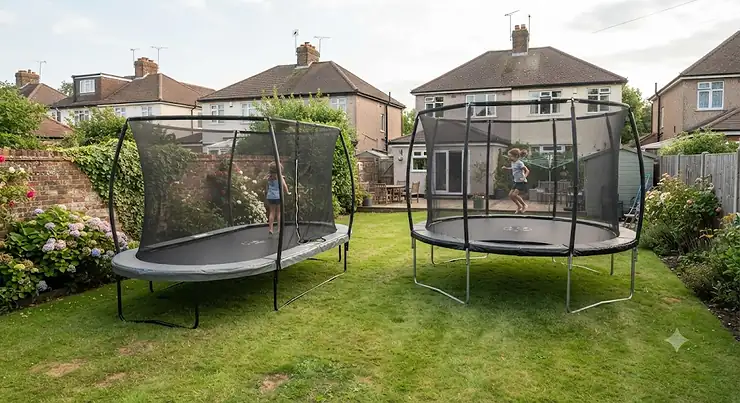
Stand in most UK garden centres for five minutes and you’ll hear the same argument on a loop: oval vs round trampoline, which one actually deserves the space in your garden? It’s not a trivial question. Get it wrong and you’re either wrestling a trampoline that swallows half your lawn, or watching your kids queue up for turns on a mat that’s really only built for one bouncer at a time. What is an oval vs round trampoline debate really about? In short — an oval trampoline has an elongated frame that creates two separate bounce zones and a slimmer footprint for narrow gardens, while a round trampoline concentrates all the bounce energy into one central sweet spot, which makes it simpler, cheaper, and often safer for younger solo jumpers.
Both shapes have loyal fans, and honestly, both have genuine drawbacks nobody puts on the box. Round trampolines have been the default in British back gardens for decades because the physics is forgiving — springs pull equally from every direction, so bouncers naturally drift back to the middle. Oval trampolines are the newer challenger, borrowing some of the multi-directional bounce of a rectangular competition trampoline while keeping a shape that’s easier to squeeze against a fence line.
This guide walks through seven real trampolines currently sold in the UK — a mix of budget round models, mid-range ovals, and a couple of proper premium picks — with honest analysis of specs, aggregated review sentiment where it’s verifiable, and practical buying advice. No invented five-star quotes, no fictional products, just what the research actually shows. By the end you’ll know exactly which shape suits your garden, your family, and your budget.
What Is the Difference? Oval vs Round Trampoline at a Glance
Here’s the quick version before we go deep: a round trampoline has springs of equal length running symmetrically around the frame, which funnels bounce energy straight to the centre. An oval trampoline stretches that frame lengthways, creating two distinct “sweet spots” rather than one, and typically offering more total jumping surface for the same footprint width.
| Feature | Oval Trampoline | Round Trampoline |
|---|---|---|
| Bounce pattern | Two separate jump zones, less centring pull | Strong pull to one central sweet spot |
| Best footprint fit | Narrow, rectangular gardens | Square or open garden spaces |
| Typical price range (UK) | £450–£1,400+ | £150–£600 |
| Multi-user friendliness | Better — two zones reduce collisions | Weaker — everyone drifts to the middle |
| Common user | Families with 2+ children, older kids/teens | Younger children, budget-first buyers |
Reading across that table, the story is really about trade-offs rather than one shape being objectively “better.” JumpPRO, BERG, and North Trampoline ovals win on usable space and multi-jumper comfort but cost noticeably more to buy new. Plum, SONGMICS, Rebo, and Telstar round models are cheaper to enter the market with and, because the bounce is more predictable, tend to suit younger or first-time jumpers better. If your garden is a long, narrow strip behind a terraced house, the oval’s shape alone might decide this for you before price even enters the conversation.
Physical activity on a trampoline isn’t just fun — it’s genuinely useful exercise, and the NHS’s physical activity guidelines for children and young people recommend at least 60 minutes of moderate-to-vigorous activity daily, something a garden trampoline can meaningfully contribute to regardless of which shape you land on.
💬 Found this comparison useful already? Bookmark this page — you’ll want to check back before you buy!
Top 7 Oval and Round Trampolines: Expert Analysis
We’ve deliberately mixed budget, mid-range, and premium options across both shapes so you can compare like-for-like within your price bracket, not just oval against round in the abstract.
1. Plum Play 8ft Springsafe Round Trampoline — safest budget entry point
The standout here is the Springsafe design, which tucks the netting inside the springs rather than around the outside frame, so there’s no exposed spring gap for little fingers or ankles to catch on.
Specced with a galvanised steel frame and thick foam-covered springs, the Plum Play 8ft Springsafe Round Trampoline carries a max user weight around 100kg, which tells you immediately this is built for younger children rather than teenagers or adults bouncing together. The 8ft diameter also means a genuinely compact footprint — useful if you’re trying to fit a trampoline into a small suburban garden without swallowing the whole lawn.
Based on the spec comparison with rival budget rounds, this is squarely a first-trampoline pick: EN71 safety certified, straightforward to assemble, and priced to make the decision low-stakes for parents unsure if trampolining will even stick as a hobby. Reviewers on the Amazon UK listing consistently mention assembly taking a couple of hours solo and note it suits younger children better than older, heavier kids, which lines up with the stated weight limit.
Pros:
- ✅ Springsafe design covers spring gaps others leave exposed
- ✅ Compact 8ft footprint fits small gardens easily
- ✅ EN71 certified and among the cheapest entry points
Cons:
- ❌ 100kg weight limit rules out older children and adults
- ❌ Smaller mat means less room as kids grow
Typically priced in the £150–£220 range depending on the exact size variant chosen, this represents strong value if you genuinely only need a starter trampoline for primary-school-aged children.
2. SONGMICS Round Trampoline (305cm) — best straightforward assembly
What stands out immediately is how few tools this needs — the poles simply slot into the frame with numbered, illustrated instructions.
The SONGMICS Round Trampoline range spans several diameters from 183cm right up to 427cm, but the 305cm (10ft) size hits the sweet spot for most family gardens. Its galvanised steel frame resists rust in typical British weather, and the external protection mesh sits outside the springs, covering the whole perimeter rather than leaving gaps at the ladder or door zip.
For a family wanting a mid-sized round trampoline without oval-level spending, this is a sensible, unfussy option — what most buyers overlook is that the T-connectors reinforcing the frame joints matter more for long-term stability than the headline weight rating, since loose joints are usually what fails first on cheaper rivals. Aggregated feedback on SONGMICS’s wider trampoline range points to consistently easy self-assembly as the most repeated positive theme, alongside general satisfaction with frame sturdiness for the price bracket.
Pros:
- ✅ Numbered parts make solo assembly genuinely manageable
- ✅ Rust-resistant galvanised frame suits UK weather
- ✅ Multiple diameters let you match garden size exactly
Cons:
- ❌ Jump mat sits noticeably smaller than the outer frame size
- ❌ Basic ladder and cover feel like the cheapest included accessories
Expect a price somewhere in the £150–£280 range depending on the diameter you choose, making this one of the more flexible round options on this list.
3. JumpPRO 15ft x 10ft Xcite Oval Trampoline with Enclosure — best large-family oval
This is the model that best demonstrates the oval’s core selling point: a genuinely huge jumping surface without the frame sprawling in every direction like an equivalent-capacity round would.
At 15ft by 10ft, the JumpPRO Xcite Oval Trampoline offers noticeably more usable mat than a same-width round trampoline, because the elongated shape adds length rather than diameter. The included enclosure net runs the full perimeter, and the frame uses a galvanised steel build designed to handle multiple simultaneous jumpers — genuinely the point of going oval in the first place.
Honestly, for larger families with two or three children who all want to jump together, this is one of the more compelling arguments for paying oval prices: the dual-zone bounce pattern (more on that below) means siblings aren’t fighting over one central sweet spot. Independent testers at MadeForMums specifically flagged this model in their round-up of trampolines tested with real families as a strong pick for larger households, which lines up with what the spec sheet suggests.
Pros:
- ✅ Large 15ft x 10ft mat comfortably fits 2–3 jumpers
- ✅ Independently tested and recommended for bigger families
- ✅ Full enclosure net included as standard
Cons:
- ❌ Needs a genuinely large, rectangular garden footprint
- ❌ Setup with two people takes considerably longer than budget rounds
Priced around the £500 mark at the time of research (check current price, as trampoline pricing fluctuates with steel costs), it sits firmly in the mid-range oval bracket — a reasonable ask given the mat size you’re getting.
4. Rebo Base Jump 12ft Round Trampoline with Halo II Enclosure — best pole-free safety design
The Halo II enclosure is the headline feature — it suspends the safety net from a curved top ring rather than upright poles poking through the jumping mat, removing a common trip and collision hazard.
With a 366cm (12ft) diameter and a stated weight limit around 150kg, the Rebo Base Jump 12ft Trampoline sits comfortably above entry-level rounds in both capacity and build quality. Reviewers at ProTrampolines note the brand states three years of development went into this particular enclosure system, and on paper the absence of internal poles genuinely does reduce one of the more common minor-injury causes on cheaper round trampolines — kids clattering into the support poles mid-bounce.
Here’s what to weigh: the halo design adds cost over a standard pole enclosure, but if you’ve got several children using the trampoline unsupervised for periods, removing the pole hazard is a meaningful safety upgrade rather than a marketing gimmick. This is a round trampoline built specifically to answer one of round trampolines’ most common complaints.
Pros:
- ✅ Halo II design removes internal trip-hazard poles
- ✅ Generous 150kg weight limit suits mixed-age families
- ✅ 12ft mat gives real room to move within the round format
Cons:
- ❌ Costs more than standard-enclosure round trampolines
- ❌ Verified individual review threads were limited during this research pass
The £300–£400 range is typical for this model, positioning it as a genuine mid-tier round option for families who’ve outgrown budget entry points.
5. Telstar Round Trampoline 14ft (4.26m) — best UK-heritage round brand
What stands out about Telstar isn’t a single flashy feature — it’s that the brand has been supplying UK trampoline retailers for years, which shows up in parts availability and warranty support most budget imports simply don’t offer.
The Telstar Round Trampoline at 4.26m (roughly 14ft) is one of the largest true round mats on this list, giving genuinely competitive jumping space compared with mid-range ovals, just arranged in a circle rather than an elongated shape. Frame construction follows the standard galvanised steel approach seen across this category, but Telstar’s longer UK retail track record means replacement mats, springs, and nets are easier to source years down the line — a practical consideration that never shows up on a spec sheet.
Based on the spec comparison against similarly sized ovals, this model makes a strong case for buyers who want oval-level jumping space but prefer the simpler, more predictable centre-focused bounce of a round mat, and who value long-term parts support over the multi-zone novelty an oval offers.
Pros:
- ✅ Large 14ft mat rivals mid-range oval jumping space
- ✅ UK retail heritage supports long-term parts availability
- ✅ Simple, predictable centre-bounce pattern
Cons:
- ❌ Loses the dual-zone benefit multi-child households often want
- ❌ Large diameter still needs a genuinely open garden
Expect to pay in the £450–£600 range, putting it in direct competition with entry-level ovals like the JumpPRO — a genuinely useful comparison point if you’re torn on shape.
6. BERG Grand Champion Grey 520 Oval — best premium oval performance
The AirFlow jumping mat is the feature worth dwelling on — BERG states it allows around 50% more airflow through the weave than a standard mat, and in practice that translates to a noticeably softer, more responsive bounce rather than the slightly “dead” feel cheaper mats develop after a season outdoors.
At 520cm x 345cm (roughly 17ft x 11ft 4in), the BERG Grand Champion Grey 520 is a serious piece of garden equipment. It combines the AirFlow mat with TwinSpring Gold springs — a dual-spring design intended to extend spring lifespan and improve bounce consistency across the mat, not just at dead centre — plus a Deluxe safety enclosure. The stated dynamic weight capacity sits around 120kg with a considerably higher static/structural load rating, reflecting BERG’s positioning as a premium engineering brand rather than a budget importer.
What most buyers overlook about premium mats like this is that the “feel” difference genuinely compounds over years of use — cheaper mats stretch and lose bounce consistency within a couple of seasons, while a AirFlow-style weave with quality springs tends to hold its performance for considerably longer, which matters if you’re trying to justify the higher upfront spend through longevity rather than day-one excitement.
Pros:
- ✅ AirFlow mat delivers a noticeably softer, more responsive bounce
- ✅ TwinSpring Gold design supports longer-term bounce consistency
- ✅ Large 17ft oval footprint suits serious multi-user families
Cons:
- ❌ Sits firmly in premium pricing territory
- ❌ Overkill for casual, occasional trampoline use
This is a genuinely premium purchase, typically landing in the £1,100–£1,400 range at the time of research — a significant step up, but one that’s arguably justified if the trampoline is going to see years of near-daily use from multiple children.
7. North Trampoline Legend Oval — best adjustable-bounce premium oval
The adjustable bounce feature is what sets this apart — included spring extenders let you tune the tension and, by extension, the bounce height, something most trampolines simply don’t offer as standard.
The North Trampoline Legend has been part of the brand’s line-up since 2012, when oval trampolines were still a rarity in UK gardens, and it’s built around a self-closing, zip-free safety entrance — a genuinely clever detail that removes the “did anyone actually zip that up properly” risk common with traditional enclosure doors. It’s available across three sizes (12ft x 8ft, 14ft x 10ft, and 16ft x 11ft), so it scales to different garden shapes without switching product lines entirely.
On paper this means buyers get to choose their footprint precisely rather than jumping between wildly different models, and the shared Swedish-engineered safety features — thick padding, industrial-grade net zippers — carry across every size. Customer feedback shared by the brand consistently praises the guided sizing advice offered before purchase, though as with any single-retailer feedback, it’s worth weighing alongside independent reviews rather than taking at face value.
Pros:
- ✅ Adjustable bounce via included spring extenders
- ✅ Zip-free, self-closing entrance reduces user error
- ✅ Three sizes scale to different garden shapes
Cons:
- ❌ Premium pricing typical of the top oval tier
- ❌ Independently verified review data was limited during research
Pricing sits at the top end of the oval market — check current price directly, as size and included accessories shift the figure considerably; this isn’t a model where a single number tells the full story.
Top 7 Trampolines: Specs & Value Comparison
| Product | Shape | Size | Best For |
|---|---|---|---|
| Plum Play 8ft Springsafe | Round | 8ft | Younger children, first trampoline |
| SONGMICS Round Trampoline | Round | Up to 305cm | Easy solo assembly |
| JumpPRO Xcite Oval | Oval | 15ft x 10ft | Large families, multiple jumpers |
| Rebo Base Jump 12ft | Round | 12ft (366cm) | Pole-free safety priority |
| Telstar Round 14ft | Round | 4.26m | Long-term parts support |
| BERG Grand Champion 520 | Oval | 520 x 345cm | Premium daily-use families |
| North Trampoline Legend | Oval | 12–16ft (3 sizes) | Adjustable bounce, garden flexibility |
Scanning across this table, the pattern is clear: round trampolines dominate the budget-to-mid bracket, while ovals only really start earning their keep once you’re spending £450 or more. If your budget caps out under £300, a round model like the Plum Play or SONGMICS genuinely outperforms any oval you’d find at that price, simply because ovals need more steel and a larger safety net to build properly.
✨ Ready to compare live prices and availability? Check today’s listings before stock or pricing shifts.
Trampoline Shape and Bounce Difference Explained
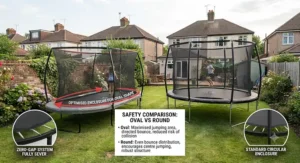
The physics behind trampoline shape and bounce difference comes down to spring geometry, and it genuinely changes how the mat feels underfoot, not just how it looks in the garden. On a round trampoline, every spring is the same length and pulls toward the centre with equal force from every angle — bounce off-centre and you’ll feel yourself gently corrected back toward the middle almost automatically.
An oval mat breaks that symmetry deliberately. The springs along the two straighter side edges pull differently than the ones wrapped around the curved ends, which is what creates two semi-independent bounce zones rather than one dominant centre point. Reviewers consistently note that oval mats feel slightly “flatter” or less bouncy directly in the middle compared with a round mat’s peak sweet spot, but more usable and consistent toward each end — a trade worth understanding before you buy, because it changes expectations rather than being a flaw.
For competitive gymnasts training specific skills, this distinction actually matters practically — dedicated trampolining clubs typically use long rectangular competition trampolines precisely because the elongated shape supports controlled, directional bouncing rather than the more chaotic energy of a round mat, and oval garden trampolines borrow a diluted version of that same principle.
Oval Trampoline Dual Jump Zone vs Round Trampoline Centre Bounce Focus
The Oval Trampoline Dual Jump Zone
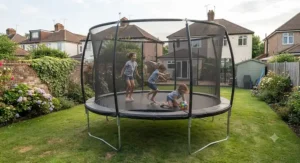
The oval trampoline dual jump zone is arguably the single biggest practical reason families upgrade from round to oval. Rather than one central sweet spot everyone gravitates toward — and inevitably queues for — an oval mat creates two usable bounce areas, roughly one toward each rounded end. In practice this means two children can jump simultaneously with meaningfully less risk of colliding mid-air, because they’re naturally drawn to different zones rather than converging on the same central point.
Round Trampoline Centre Bounce Focus
Round trampoline centre bounce focus works differently, and it’s not automatically worse — for a single younger jumper, that strong central pull is genuinely reassuring. It means less drifting toward the enclosure net edges, less risk of an off-balance landing near the frame, and a more predictable, controllable bounce for a child who’s still learning basic trampoline coordination. What most buyers overlook is that this “limitation” is actually a safety feature for solo under-8s use, even though it becomes a genuine constraint once you’ve got two or three children wanting to jump at once.
The honest takeaway: households with one young child lean round; households with multiple children of similar age, or teenagers wanting more room to move, lean oval. Neither pattern is objectively superior — they’re solving different problems.
Oval Trampoline Benefits Over Round
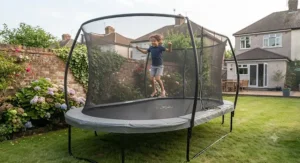
Beyond the dual-zone bounce already covered, there are a handful of oval trampoline benefits over round that consistently show up once you dig into the spec sheets and garden-fit realities:
- Narrower footprint for the same mat length. An oval trampoline can deliver more total jumping surface than a round trampoline while occupying a slimmer width, which matters enormously for narrow, fenced UK gardens where a wide circular frame simply won’t fit.
- Better multi-user comfort. As covered above, the two-zone bounce pattern reduces mid-air collisions when siblings jump together, which is the most commonly cited reason parents upgrade.
- More natural fit against boundary lines. The elongated rectangular-ish footprint tends to sit more comfortably parallel to a fence or hedge line than a circle does, often leaving usable garden space on either side that a round trampoline’s diameter would otherwise consume.
- Scope for larger overall size without dominating a square garden. Because length and width can differ, an oval can be sized generously in one direction while staying modest in the other.
None of this makes oval an automatic upgrade, though — you’re paying a genuine premium for these benefits, typically £150–£300 more than an equivalent-quality round model, and smaller gardens under roughly 4 metres wide often can’t accommodate an oval’s minimum practical length anyway.
Round vs Oval Trampoline: Pros and Cons Breakdown
Rather than repeating individual product pros and cons, here’s the round vs oval trampoline pros cons picture at the shape level:
Round Trampoline — Pros:
- ✅ Lower price point across nearly every size bracket
- ✅ Predictable centre-bounce suits younger, less experienced jumpers
- ✅ Simpler frame geometry means easier, faster assembly
Round Trampoline — Cons:
- ❌ One sweet spot creates queuing and collision risk with multiple jumpers
- ❌ Circular footprint wastes corner space in rectangular gardens
Oval Trampoline — Pros:
- ✅ Dual jump zones suit multiple simultaneous users
- ✅ Slimmer footprint fits narrow garden shapes better
- ✅ Often includes premium build features at the higher end of the range
Oval Trampoline — Cons:
- ❌ Meaningfully higher price across every comparable size
- ❌ Larger, heavier frame typically takes longer to assemble
How to Choose an Oval or Round Trampoline
Working through the oval or round trampoline which is better question properly means running through the same criteria a genuinely informed buyer would, in order:
- Measure your garden first, not the trampoline. Walk out with a tape measure before you shop — an oval needs meaningful clearance at both rounded ends, not just along its length.
- Count your regular jumpers. One or two young children genuinely suits a round trampoline fine; three or more, or a mix of younger and teenage siblings, tips the case toward oval’s dual zones.
- Set a realistic budget band. Round trampolines start considerably cheaper; decide whether the oval premium (roughly £150–£300+ over a comparable round) is worth it for your household before falling in love with a specific model.
- Check the weight rating against your family, not just the youngest child. Trampolines get used by visiting cousins, older siblings, and sometimes adults — buy for the heaviest realistic user, not the lightest.
- Prioritise enclosure quality over headline size. A smaller trampoline with a genuinely secure, gap-free net beats a larger one with a flimsy enclosure every time — this is where RoSPA’s guidance is unambiguous.
- Factor in assembly help. Larger ovals in particular are a two-person job; if you’re assembling solo, weigh that realistically against a simpler round frame.
- Think five years ahead, not just this summer. A round trampoline your child outgrows in two seasons isn’t necessarily cheaper long-term than a larger oval bought once.
Oval Trampoline Comparison: Matching Models to Garden Shapes
Not every oval suits every garden, so a quick oval trampoline comparison by footprint helps narrow things down fast. The JumpPRO Xcite Oval (15ft x 10ft) needs a genuinely large, open rectangular space — think a proper family-sized back garden rather than a compact townhouse plot. The BERG Grand Champion 520 is even larger at roughly 17ft x 11ft 4in, and really only makes sense where garden space was never the limiting factor to begin with. The North Trampoline Legend, by contrast, starts at a far more modest 12ft x 8ft, making it the most realistic oval option for medium suburban gardens that still want the dual-zone bounce benefit without needing a paddock.
| Model | Minimum Practical Garden Width | Best Garden Type |
|---|---|---|
| North Trampoline Legend (12ft x 8ft) | Around 4m | Medium suburban garden |
| JumpPRO Xcite Oval (15ft x 10ft) | Around 5m | Large family garden |
| BERG Grand Champion 520 (17ft x 11ft 4in) | Around 6m | Very large or rural garden |
The clear analysis here is that garden width, not enthusiasm for the oval shape, should be the deciding factor — squeezing the BERG Grand Champion into a space really suited to the North Trampoline Legend‘s smaller footprint is a recipe for a trampoline that dominates the entire garden and leaves no safe clearance zone around it.
Practical Usage Guide: Setup, Maintenance and the First 30 Days
Getting the shape decision right is only half the job — how you set up and maintain either trampoline type genuinely affects both safety and lifespan. Start with siting: RoSPA recommends at least 2.5 metres of clear space around a trampoline with no enclosure, though with a proper safety net fitted (as all seven products above include) this clearance requirement relaxes somewhat, provided the net itself is intact and correctly tensioned.
During the first 30 days, check spring tension and frame bolts weekly rather than assuming factory assembly holds indefinitely — vibration from regular bouncing genuinely does work fasteners loose, particularly on larger oval frames with more joints. Ground siting matters more than most buyers expect: a level base is essential, and placing the trampoline on grass or bark rather than paving reduces impact injury risk if anyone does come off the mat unexpectedly.
Common first-month mistakes include leaving the enclosure door unzipped “just for a quick jump,” letting more users on than the weight rating suggests is sensible even when the total is technically under the limit, and skipping the settling-in period where springs need a few sessions to reach their proper working tension. Seasonal maintenance — checking for rust on the frame, UV damage on the mat weave, and net tears — should happen at minimum each spring and autumn, regardless of whether you’ve bought a budget round or premium oval model.
Real-World Scenarios: Matching Families to the Right Shape
Scenario one — a family of four in a three-bedroom semi with a 4-metre-wide garden, two children aged 5 and 8. Here, garden width alone rules out the larger ovals, but the smaller North Trampoline Legend (12ft x 8ft) or a mid-sized round like the Rebo Base Jump 12ft would both fit. Given the age gap and only two regular jumpers, the round Rebo’s pole-free Halo enclosure and lower price point make it the more sensible pick here.
Scenario two — a family of five with a wide, open half-acre garden, three children aged 7, 10, and 13. This is precisely the profile ovals were designed for: multiple simultaneous jumpers spanning a wide age and size range benefit hugely from the dual-zone bounce, and the garden space comfortably accommodates the JumpPRO Xcite Oval or even the premium BERG Grand Champion 520 if budget allows.
Scenario three — grandparents buying a first trampoline for occasional weekend visits from grandchildren, budget-conscious and uncertain how much use it’ll actually get. The Plum Play 8ft Springsafe or SONGMICS Round Trampoline make far more sense than committing to an oval — low investment, straightforward assembly, and sized appropriately for younger visiting children rather than daily heavy use.
Buyer’s Decision Framework
If you want a genuinely simple rule rather than working back through every section above, here’s the condensed version: if your garden is narrower than about 4 metres, choose round — an oval simply won’t fit safely regardless of how appealing the dual-zone bounce sounds on paper. If you regularly have three or more children jumping together, choose oval, because the collision-reduction benefit of separate bounce zones outweighs the extra cost. If budget is genuinely tight and this is a “let’s see if trampolining sticks” purchase, choose round, because entry prices are dramatically lower and the risk of an unused purchase is smaller. If you’re buying once for the next decade with a growing family, lean oval, because the extra jumping surface and multi-user capacity age better with your children than a fixed-size round mat.
Common Mistakes When Buying an Oval or Round Trampoline
The single most common mistake is buying by budget or shape preference before measuring the garden — plenty of buyers fall for a large oval’s dual-zone appeal only to discover it barely clears the fence on either end. A close second is underestimating total user weight: parents often size for their children today rather than the heaviest realistic combination of users, including visiting friends or family, over the trampoline’s lifespan. Skipping enclosure quality in favour of headline mat size is another frequent error — RoSPA’s trampoline safety guidance is explicit that safety netting design matters as much as, if not more than, sheer jumping area. Finally, many buyers overlook long-term parts availability entirely, only to discover years later that a cheap imported frame has no replacement mat or spring kit available anywhere — a problem brands with established UK retail history, like Telstar, are specifically built to avoid.
Long-Term Cost & Maintenance: Oval vs Round
Upfront price is only part of the total cost of ownership picture. Round trampolines typically need replacement mats and spring kits every few years depending on usage intensity, and because parts are commodity-standard for common diameters (8ft, 10ft, 12ft), these replacements tend to be cheap and widely available. Oval trampolines, by contrast, often use size-specific mats and springs that aren’t interchangeable between brands, meaning replacement parts can cost more and take longer to source — something worth factoring in before committing to a premium oval purely on day-one specs.
Where premium ovals like the BERG Grand Champion 520 claw back value is longevity: the AirFlow mat and TwinSpring Gold system are engineered specifically to resist the bounce degradation that forces earlier replacement on budget mats. Run the numbers over five years rather than one, and a £1,200 premium oval replaced once might genuinely cost less per year of use than a £180 budget round replaced three times over the same period — though this only holds if the trampoline actually gets heavy, regular use that justifies the premium build in the first place.
Safety, Regulations & Compliance Guide
Every trampoline sold new in the UK should meet EN71-14:2014, the European safety standard specifically covering domestic trampolines, and all seven products featured in this guide are marketed as meeting this requirement. Beyond the standard itself, RoSPA reports that roughly 13,000 trampoline-related injuries occur annually in England, with wrist and ankle fractures from awkward landings among the most common — a statistic worth taking seriously regardless of which shape you choose.
Practical safety steps that apply equally to oval and round models: enforce a strict one-jumper-at-a-time rule wherever possible (RoSPA’s primary recommendation), maintain active adult supervision rather than passive presence, and never allow somersaults or advanced moves without proper training, since head and neck injuries — while less common than limb fractures — are the most serious category recorded. RoSPA and NHS guidance also both note that trampolining generally isn’t suitable for children under six, who lack the physical control to manage their own bounce safely, which is worth bearing in mind regardless of how tempting a smaller trampoline looks for a toddler.
Research published in Sports Medicine – Open backs up the exercise case while reinforcing the safety framing: a peer-reviewed study on trampolining as a training modality for children found cardiopulmonary benefits genuinely comparable to treadmill running, supporting trampolining’s value as structured exercise rather than just idle play — provided the safety fundamentals above are actually followed.
Frequently Asked Questions
❓ Is an oval trampoline better than a round one?
❓ Do oval trampolines bounce differently to round trampolines?
❓ What size garden do I need for an oval trampoline?
❓ Are round trampolines safer than oval trampolines?
❓ How much does an oval trampoline cost compared to a round one in the UK?
Conclusion
The oval vs round trampoline decision genuinely comes down to three honest questions: how wide is your garden, how many children will realistically jump at once, and how much are you comfortable spending upfront versus over the trampoline’s lifespan. Round trampolines like the Plum Play 8ft Springsafe and SONGMICS Round Trampoline remain the sensible default for younger, solo jumpers on a tighter budget, while the Rebo Base Jump 12ft and Telstar Round 14ft prove round doesn’t have to mean small once you move up a tier. On the oval side, the JumpPRO Xcite Oval earns its keep for larger families needing genuine multi-user space, while the BERG Grand Champion 520 and North Trampoline Legend represent the premium end where build quality and bounce longevity justify a considerably higher spend.
There’s no single correct answer here — only the shape that correctly matches your garden, your family size, and your budget. Measure first, count your regular jumpers second, and let the spec sheets above do the rest of the deciding for you.
✨ Ready to pick your trampoline? Compare current prices and availability on the models above before making your final call! 🏡🤸
Recommended for You
- Best Oval Trampoline UK 2026: 7 Top-Rated Models Reviewed
- Large Garden Trampoline: 7 Brilliant Big-Garden Picks (2026)
- Best 16ft Trampoline UK 2026: 7 Top Picks Reviewed
Disclaimer: This article contains affiliate links. As an Amazon Associate, I earn from qualifying purchases. If you purchase products through these links, we may earn a small commission at no additional cost to you.
✨ Found this helpful? Share it with your friends! 💬🤗
