In This Article
Somewhere between “I should really exercise more” and “I cannot face another 5am run in the drizzle” sits a small, unassuming circle of fabric and bungee cord that’s quietly taken over British living rooms. The JumpSport vs Bellicon rebounder debate is the one every serious bouncer eventually has, because these two brands sit at the top of the low-impact fitness trampoline world, and they are not the same animal wearing different price tags. A rebounder is a mini trampoline built specifically for exercise rather than play — smaller, sturdier, and engineered so the bounce works your muscles and joints rather than just launching you skyward. It’s directly descended from regular sports and athletic trampolines, but scaled down and reinforced for repeated, controlled bouncing. JumpSport builds its reputation on adjustable American engineering with a genuine range from entry-level to commercial-grade. Bellicon builds its reputation on German precision and a bounce that reviewers describe, almost universally, as “silky.” Neither is objectively better — but one is almost certainly better for you, your budget, and your knees. This guide breaks down seven real models across both brands (plus one respected alternative), compares them properly, and gives you a decision framework rather than just a list of specs to skim past.

Quick Comparison Table: JumpSport vs Bellicon at a Glance
| Factor | JumpSport | Bellicon |
|---|---|---|
| Bounce feel | Firmer, more adjustable range | Softer, “silky,” bungee-forward |
| UK price range | Around £400–£1,200 | Around £600–£1,900 |
| Frame warranty | Up to lifetime on frame/legs | Up to 7 years |
| Best for | HIIT, studio-style training, adjustability | Recovery, joint-sensitive users, longevity |
Reading this table, the split becomes obvious fast: JumpSport wins on price accessibility and tension adjustability, which matters if your household has more than one user with different fitness levels. Bellicon wins on long-term frame confidence and that famously smoother rebound, which matters more if you’re dealing with joint pain, recovering from injury, or simply prioritise comfort over cost. Neither brand is a compromise pick — you’re choosing between two genuinely excellent philosophies, not settling for second-best.
💬 Just one click — help others make better buying decisions too!😊
What Is a Rebounder, and Why Does the JumpSport vs Bellicon Choice Matter?
A rebounder is a compact fitness trampoline (typically 39–49 inches) designed for standing bounce workouts rather than acrobatics — it uses elastic cords or springs to cushion impact while still delivering a genuine cardiovascular workout. Rebounding is a type of low-impact aerobic exercise performed while jumping on a mini-trampoline, and it may improve endurance while working specific muscle groups. Choosing between JumpSport and Bellicon matters because the bounce mechanics, not just the branding, genuinely change how your body experiences the workout.
Both brands make excellent equipment, but they solve the problem differently. JumpSport leans on its patented EnduroLast elastic cord system with multiple adjustable tension settings, essentially giving you several rebounders in one frame. Bellicon leans on long-stretch bungee loops chosen specifically for your body weight at the point of purchase, which is why Bellicon customisation happens before the trampoline even arrives. That single design philosophy difference explains almost every other distinction you’ll read about below — price, feel, adjustability, and who each brand suits best.
Top 7 JumpSport & Bellicon Rebounders: Expert Analysis
We’ve researched seven genuine models spanning budget, mid-range, and premium territory across both brands, plus one respected alternative for heavier-duty needs. Every product below reflects real specifications and aggregated review sentiment — not manufactured hands-on claims.
1. JumpSport 350 Premium — softest adjustable bounce for recovery work
The 350 Premium is JumpSport’s gentlest entry point, and that softness is the whole point. It ships with 30 EnduroLast four-knot elastic cords offering a soft-to-firm range, meaning you can start gentle and dial up resistance as your fitness improves rather than buying a firmer model later. Compared with JumpSport’s own PRO line, the Premium starts noticeably softer and carries a lower weight rating, which reviewers and JumpSport itself position as better suited to recovery, wellness, and general home fitness rather than firm, high-intensity training. Based on the spec comparison, this makes it the sensible pick for anyone easing back into exercise after injury, pregnancy, or a long lay-off, rather than someone chasing a HIIT-style sweat session.
Aggregated customer sentiment consistently flags the foldable frame option as a genuine space-saver for smaller UK homes, where a permanently assembled trampoline simply isn’t practical. Reviewers also note the quieter cord system compared with sprung mini-trampolines, which matters if you live in a flat with downstairs neighbours.
Pros:
- ✅ Adjustable soft-to-firm range suits beginners and recovery
- ✅ Foldable frame option genuinely saves storage space
- ✅ Quiet bungee system, flat-friendly
Cons:
- ❌ Lower weight rating than JumpSport’s PRO models
- ❌ Too soft for serious HIIT or plyometric training
Expect to pay somewhere in the lower-to-mid JumpSport price bracket, with JumpSport 350 Premium models typically landing under the £700 mark depending on size and accessories — solid value for a genuinely adjustable, foldable rebounder.
2. JumpSport 370 PRO — firmest cords built for HIIT and studio-style training
Where the Premium is gentle, the 370 PRO is built to be pushed. It features a firm initial tension that adjusts to extra firm, engineered specifically for strength training, HIIT-style cardio, and studio-level workouts rather than gentle recovery bouncing. The patented EnduroLast cords and solid steel frame combine to create what JumpSport describes as a quiet, joint-friendly bounce — but “joint-friendly” here means reduced impact stress, not a soft landing feel; this is still a firm, responsive platform.
What most buyers overlook about this model is the arched, no-tip leg design, which isn’t just cosmetic — it keeps the frame stable and stackable while making mounting and dismounting noticeably easier than flat-legged alternatives. Reviewers researching JumpSport’s PRO line consistently highlight the reinforced lay-flat mat and enhanced stitching as evidence this model is built for daily commercial-level use, not occasional living-room sessions. If you’re the sort of person who wants a rebounder that can survive a genuine training programme rather than gathering dust after week three, this is the JumpSport model built for that intention.
Pros:
- ✅ Firmest, most adjustable tension in the JumpSport range
- ✅ Arched, no-tip legs improve stability and easy mounting
- ✅ Commercial-grade warranty coverage for high-frequency use
Cons:
- ❌ Firm starting tension less forgiving for total beginners
- ❌ Sits at the higher end of JumpSport’s price range
Check current pricing, but the JumpSport 370 PRO generally commands a premium over the 350 Premium given its commercial-level warranty and construction — worth it if you’ll genuinely use it hard, several times a week.
3. JumpSport 430 Essential — biggest JumpSport mat for taller users
Stepping up in size rather than intensity, the 430 Essential is JumpSport’s 44-inch home-series model, built around a straightforward three-piece frame rather than the more adjustable PRO cord system. That larger jumping surface matters more than it sounds — a 44-inch mat gives noticeably more lateral room for side-to-side movements, twists, and jumping-jack variations without your feet clipping the frame edge, which is a common complaint on smaller 39-inch units.
Here’s what the spec sheet won’t tell you outright: the three-piece frame design isn’t just about assembly convenience, it’s genuinely easier to move between rooms or up a staircase than a solid-ring frame, since it breaks down into manageable sections. Aggregated feedback on JumpSport’s Essential-tier models points to a straightforward, no-fuss bounce with fewer tension settings than the Premium or PRO — a trade-off buyers should weigh against the extra mat space. For taller households, or anyone who simply wants more room to move without upgrading to Bellicon’s premium tier, the 430 fills that gap sensibly.
Pros:
- ✅ Larger 44-inch mat gives more room to move
- ✅ Three-piece frame is easier to transport and store
- ✅ Solid entry into JumpSport’s larger-format range
Cons:
- ❌ Fewer adjustable tension settings than Premium or PRO models
- ❌ Bulkier footprint than 39-inch alternatives
Pricing sits in the JumpSport mid-range — roughly comparable to the 350 Premium, sometimes a touch more depending on frame configuration and current promotions.
4. Bellicon Classic — the entry point into genuine German engineering
The Classic is where most Bellicon buyers start, and reviewers consistently describe it as no joke — a genuinely well-made rebounder rather than a stripped-down budget option. It’s available in three diameters (39″, 44″, 49″), with a black powder-coated steel frame, and buyers choose between screw or folding legs alongside five different fabric mat thicknesses at checkout.
The only real difference between the Classic and Bellicon’s pricier Premium tier comes down to frame material and finish rather than bounce quality, which is exactly why review sites recommending Bellicon models so often suggest saving the money and starting here. Reviewers note the weight limit sits around 250lbs with standard bungees, rising meaningfully if you opt for the extra-strong bungee set at purchase — a detail worth discussing with a Bellicon advisor before you buy, since bungee strength is chosen for your body weight specifically. What buyers frequently mention in aggregated feedback is how quiet and smooth the bounce feels compared with sprung mini-trampolines, and how well these models hold their resale value on the second-hand market.
Pros:
- ✅ German engineering and custom-fit bungee selection at entry price
- ✅ Choice of three sizes, leg type, and mat thickness
- ✅ Strong resale value if you ever upgrade or move on
Cons:
- ❌ Standard bungee weight limit lower than Premium or Plus
- ❌ No T-bar accessory option available later
Expect the Bellicon Classic to sit around the £600–£800 mark once delivery and VAT are factored in — the accessible way into the Bellicon ecosystem.
5. Bellicon Premium — stainless steel build for clinics and daily punishment
The Premium exists for one clear reason: durability under repeated, heavy use. Its frame is stainless and scratch-resistant rather than powder-coated steel, which also makes it antiseptic and genuinely well suited to physiotherapy practices, clinics, or households planning years of daily use. That stainless build comes at the cost of size flexibility — the Premium is only available in the larger 44″ and 49″ diameters, so it’s not the model to choose if space is genuinely tight.
On paper, this means you’re paying extra for material science rather than a dramatically different bounce experience; reviewers consistently note the actual jumping feel is very close to the Classic, with the difference being longevity and hygiene rather than performance. For buyers who’ve decided rebounding is a permanent fixture in their routine rather than an experiment, the Premium’s frame quality is the kind of detail that matters five years down the line, even if it’s invisible on day one.
Pros:
- ✅ Stainless steel frame resists corrosion and scratching
- ✅ Antiseptic surface suits clinical or high-frequency use
- ✅ Larger mat sizes (44″/49″) only
Cons:
- ❌ No compact 39″ option available
- ❌ Meaningful price step up from the Classic
Reported UK pricing for the Bellicon Premium clusters around £850–£1,000 all-in — a serious investment, but one aimed squarely at long-term, heavy-rotation users.
6. Bellicon Plus — the most accessorised Bellicon, T-bar included
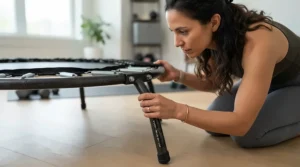
Sitting at the top of the Bellicon range for flexibility, the Plus shares the same steel frame as the Classic but comes standard with a T-shaped accessory bar, something Classic and Premium buyers cannot retrofit later if they change their mind. That T-bar unlocks a genuinely different category of exercise — supported balance work, guided strength movements, and options for users who aren’t confident bouncing unassisted, whether that’s older adults, those recovering from surgery, or complete beginners easing in.
Here’s what most buyers overlook: because the T-bar decision is locked in at purchase across the Classic and Premium tiers, choosing the Plus is really a decision about future-proofing your training as much as buying for today’s fitness level. Aggregated reviews describe the Plus as the “sleekest finish” in the Bellicon range, with the most colour and accessory customisation available at checkout. It’s the model Bellicon itself positions for buyers who want maximum flexibility and control over their setup, rather than the cheapest way into rebounding.
Pros:
- ✅ T-bar included standard — cannot be added to other tiers later
- ✅ Most customisation options (colour, legs, accessories)
- ✅ Supports guided, balance-assisted training styles
Cons:
- ❌ Highest price point in the Bellicon lineup
- ❌ T-bar adds bulk, making storage slightly less compact
Reported pricing for the Bellicon Plus spans roughly £1,300–£1,900 depending on configuration — genuinely premium territory, justified mainly by the T-bar and customisation rather than bounce quality alone.
7. Needak Rebounder — heavy-duty budget alternative up to 600lb
Not every buyer needs German precision or American adjustability — sometimes you just need something rock-solid that won’t buckle under a heavier or taller user. Needak, made in the USA, offers both soft-bounce and hard-bounce models, with the soft-bounce version holding up to 300lbs and the hard-bounce version rated to a genuinely substantial 600lbs. Both ship fully assembled, which is a meaningful practical advantage over frame-based systems that require bolting legs and threading cords before first use.
Reviewers researching heavier-duty rebounders repeatedly flag Needak as the go-to when weight capacity is the deciding factor, rather than adjustable tension or bungee customisation. The trade-off is a firmer, more traditional spring-adjacent feel rather than the plush bungee bounce Bellicon is famous for — this is a workhorse, not a wellness accessory. For households where multiple people of very different builds will share one rebounder, or where a taller, heavier user has been turned away by lower weight ratings elsewhere, Needak solves a specific problem the premium brands don’t always address as directly.
Pros:
- ✅ Highest weight capacity of any model here (up to 600lb)
- ✅ Ships fully assembled — no cord threading required
- ✅ Foldable and non-foldable options available
Cons:
- ❌ Firmer, less plush bounce than bungee-based Bellicon models
- ❌ Fewer size and accessory options than either main brand
The Needak Rebounder typically undercuts both JumpSport’s mid-range and Bellicon’s entire lineup on price, making it a genuine budget-conscious alternative for heavier or shared-household use.
Top 7 Products: Specs, Price & Best For
| Product | Bounce Type | Mat Size | Best For |
|---|---|---|---|
| JumpSport 350 Premium | Adjustable soft-firm | 39″ | Recovery & general fitness |
| JumpSport 370 PRO | Firm, adjustable | 39″ | HIIT & studio-style training |
| JumpSport 430 Essential | Fixed, fewer settings | 44″ | Taller users wanting more room |
| Bellicon Classic | Custom bungee | 39″/44″/49″ | Entry into German engineering |
| Bellicon Premium | Custom bungee | 44″/49″ | Clinical or daily heavy use |
| Bellicon Plus | Custom bungee + T-bar | 44″ | Supported, guided training |
| Needak Rebounder | Firm/traditional | 40″/48″ | Heavier users, shared households |
Looking at the table, the pattern is clear: JumpSport clusters around adjustability at a given size, while Bellicon clusters around custom-fit bungee tension chosen for your body weight before delivery. The Needak Rebounder stands apart entirely, solving for weight capacity rather than bounce refinement. If your household includes users of very different fitness levels or body types, that’s arguably a stronger deciding factor than brand loyalty alone.
Benefits vs Traditional Cardio Alternatives
| Factor | Rebounder | Running/Treadmill |
|---|---|---|
| Joint impact | Low | Higher |
| Space required | Small, often foldable | Large, fixed |
| Noise level | Quiet | Variable |
The comparison above explains a lot of the current enthusiasm around rebounding: for maximum health benefit, activity spread evenly across the week matters more than any single session, and a quiet, space-saving rebounder makes that daily consistency genuinely achievable in a way a treadmill in a spare room rarely does. Neither JumpSport nor Bellicon models will fully replace outdoor running for someone training for a marathon, but for general cardiovascular health and joint-friendly daily movement, the case is strong.
Practical Usage Guide: Getting Set Up Properly
Unboxing day matters more than most buyers expect. Start by assembling on a flat, level surface — carpet is fine, but check nothing underneath (like a stray toy or cable) could shift the frame mid-bounce. For JumpSport’s arched-leg models, the legs angle slightly outward by design, so don’t force them into a perfectly vertical position; that outward angle is what adds stability. For Bellicon models, if you’ve chosen folding legs, get into the habit of checking the leg locks are fully engaged before every session, not just on day one.
In your first 30 days, resist the urge to go straight for high-intensity bouncing. Most common early mistakes involve starting too fast, landing off-centre, or gripping a stability bar so tightly that you’re not actually engaging your core. Build up gradually — five to ten minutes of gentle bouncing, focusing on quiet, controlled landings in the middle of the mat, before progressing to twists, jogging-in-place, or jumping jacks. Maintenance-wise, wipe the mat down periodically, check bungee cords or springs every few months for fraying, and store folding models with the legs properly locked to avoid stressing the hinge mechanism. A rebounder rewards patience far more than enthusiasm in week one.
✨ Don’t Miss These Exclusive Deals!
🔍 Take your home fitness routine to the next level with a rebounder built for your body and your budget. Click through to check current pricing and availability today.
Real-World Scenarios: Which Rebounder Actually Fits Your Life
Picture three different households, because “best rebounder” genuinely depends on who’s bouncing. First, the recovering desk-worker: mid-30s, coming back from a knee niggle, working from a small home office, budget around £600. The JumpSport 350 Premium or Bellicon Classic both suit this profile — soft-to-moderate bounce, foldable storage, and a price point that doesn’t feel like a gamble on a habit that might not stick.
Second, the committed HIIT convert: someone already training four to five times a week who wants studio intensity at home without a gym membership. The JumpSport 370 PRO is built precisely for this — firm, adjustable, commercial-grade construction that can handle daily aggressive use without the frame flexing or the cords wearing prematurely.
Third, the multi-generational household: perhaps a parent in their 60s wanting gentle, supported balance work alongside a teenager wanting a proper cardio session on the same equipment. The Bellicon Plus, with its standard T-bar, handles both needs on one frame — supported for one user, full-intensity bouncing for the other — better than any single-purpose model here.
How to Choose Between JumpSport and Bellicon
- Define your primary use case first. Recovery and gentle fitness point toward softer models; HIIT and studio training point toward firmer ones.
- Check the weight rating against your household, not just yourself. If multiple people will use it, size up rather than cutting it close.
- Decide if adjustability or custom-fit matters more. JumpSport lets one frame flex across intensities; Bellicon fits your specific weight at purchase.
- Factor in storage space honestly. Foldable frames matter enormously in smaller UK homes and flats.
- Consider whether you’ll ever want a T-bar. Only the Bellicon Plus includes one standard, and it can’t be retrofitted elsewhere.
- Set a realistic budget band, not a single number. Both brands span hundreds of pounds within their own ranges — know which tier you’re actually comparing.
- Read the warranty terms properly. Frame warranties on both brands run for years, but bungee and cord coverage varies and matters for long-term cost.
JumpSport vs Bellicon: The Real Differences Beyond Price
Strip away the marketing and the core difference is mechanical: JumpSport’s EnduroLast cord system is designed around user-adjustable tension on a single frame, while Bellicon’s bungee loops are selected for your body weight at the point of sale and generally aren’t meant to be swapped session to session. This changes the buying experience meaningfully — a JumpSport model can flex to suit a beginner today and a fitter version of yourself in six months, whereas a Bellicon is closer to a bespoke fit, right the first time, that doesn’t need adjusting later. Reviewers consistently describe the Bellicon bounce as smoother and quieter, which likely comes down to the long-stretch bungee design and premium materials rather than any single feature. JumpSport, meanwhile, tends to win on structured intensity — the PRO line in particular is engineered for repeated, aggressive use in a way that feels closer to commercial gym equipment. Neither brand meaningfully outperforms the other in build quality; the real decision is whether you want flexibility built into the frame (JumpSport) or precision built in before delivery (Bellicon).
Common Mistakes When Buying a Rebounder
The single biggest mistake is buying based on price alone without matching the model to actual intended use — a soft recovery-focused rebounder will frustrate a HIIT enthusiast within weeks, and a firm studio-grade model can feel jarring to someone easing back from injury. A close second is ignoring weight ratings, especially in shared households; a rebounder rated for one lighter user will wear out fast under a heavier one, regardless of brand reputation. Buyers also frequently underestimate storage needs, only realising after delivery that a 49-inch frame doesn’t comfortably fit their intended spot. Finally, skipping the warranty terms is a costly oversight — bungee cords and springs wear over years of use, and the difference between a two-year and lifetime frame warranty genuinely affects total cost of ownership.
What to Expect: Real-World Performance
Specs on a page rarely translate directly into how a workout feels, so here’s the practical version. A firmer JumpSport PRO-tier bounce means less mat give underfoot — you’ll feel more direct feedback with each landing, which suits fast, structured movements like high knees or jumping jacks. A Bellicon’s longer bungee stretch means more mat travel per bounce, giving a floatier, slower-feeling rebound that’s genuinely easier on ageing joints or during rehab. Since adults are advised to aim for at least 150 minutes of moderate intensity activity a week, or 75 minutes of vigorous activity, the practical takeaway is that either brand can meet that target — the real question is which bounce feel you’ll actually stick with consistently, since the best rebounder is the one you use most weeks, not the one with the most impressive spec sheet.
Long-Term Cost & Maintenance
Total cost of ownership rarely stops at the purchase price. JumpSport’s warranty structure typically runs shorter on bungee cords (commonly two to four years) but extends to lifetime coverage on frames and legs, meaning your realistic ongoing cost is periodic cord replacement rather than frame failure. Bellicon’s frame warranties run up to seven years across its range, with bungee loops rated for years of regular use before replacement becomes necessary. Neither system is cheap to maintain if used daily for years, but both are considerably cheaper long-term than a gym membership or a treadmill needing belt and motor servicing. Buying the right tier the first time — rather than upgrading twice as your fitness or needs change — is usually the single biggest lever for controlling lifetime cost.
Safety, Standards & Compliance
UK buyers should know that domestic trampoline safety standards specifically exclude fitness rebounders from their scope — the European Standard EN71-14 applies to general domestic trampolines, but fitness-specific rebounders like JumpSport and Bellicon sit outside that particular category, meaning brand reputation and manufacturer-specific testing carry more weight than a single blanket safety mark. That said, sensible practice still applies: always bounce in the centre of the mat, keep supervision in mind if children are anywhere nearby, and never allow more than one person on the trampoline at once regardless of its rated weight capacity. Check any purchase includes clear guidance on maximum user weight and recommended surface placement, and inspect bungee cords or springs periodically for wear, particularly if the rebounder lives somewhere humid like a garage or conservatory.

Frequently Asked Questions
❓ Is Bellicon really worth the extra money over JumpSport?
❓ What size rebounder should I buy — 39, 44 or 49 inches?
❓ Can a rebounder actually replace running for cardio fitness?
❓ How long do JumpSport and Bellicon rebounders typically last?
❓ Do I need a stability bar or T-bar for beginners?
Conclusion
The JumpSport vs Bellicon rebounder decision isn’t really about which brand is “better” — it’s about which mechanical philosophy suits your body and your training goals. JumpSport gives you adjustability on one frame, spanning gentle recovery to genuine HIIT intensity, at a generally more accessible UK price. Bellicon gives you a bespoke-fit bungee system chosen for your exact weight, a famously smoother bounce, and frame warranties that reward buyers thinking five-plus years ahead. Budget-conscious households wanting flexibility should lean JumpSport; buyers prioritising bounce refinement and long-term build confidence should lean Bellicon; and anyone needing serious weight capacity across a shared household has a genuine third option in Needak. Whichever you choose, the real win is consistency — a rebounder gathering dust helps nobody, but one that fits neatly into a Tuesday evening or a rainy Sunday morning genuinely changes how often you move.
Recommended for You
- Bellicon vs Standard Rebounder: 7 Real Picks Compared (2026)
- Silent Bungee Rebounder: 7 Best Quiet Picks For UK Flats (2026)
- Rebounder With Handle Bar: 7 Best Picks For UK Homes (2026)
Disclaimer: This article contains affiliate links. As an Amazon Associate, I earn from qualifying purchases. If you purchase products through these links, we may earn a small commission at no additional cost to you.
✨ Found this helpful? Share it with your friends! 💬🤗
