
In This Article
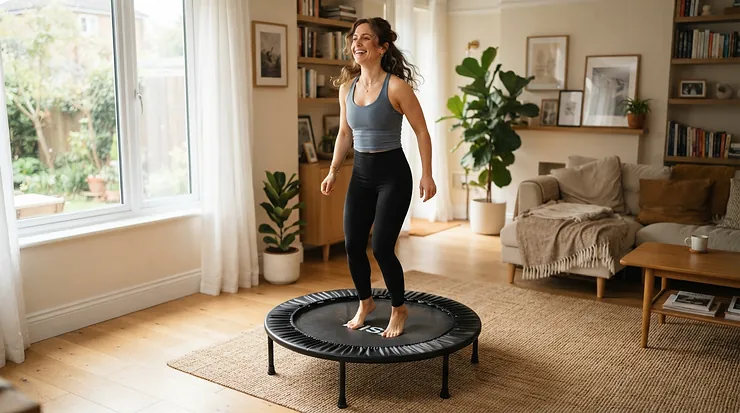
There’s a particular kind of tired that comes from a desk job, swollen ankles by 4pm, and a vague sense that your body just isn’t “moving” the way it should. If that sounds familiar, you’ve probably stumbled across the idea of a rebounder for lymphatic drainage somewhere between a wellness forum and a slightly too-enthusiastic Instagram reel. Strip away the hype, though, and there’s something genuinely sensible underneath it: gentle, rhythmic bouncing on a mini trampoline is one of the few forms of movement that combines cardiovascular effort with almost zero joint pounding.
Unlike running on tarmac, where every stride sends shock straight up through your ankles and knees, a rebounder absorbs the landing through bungee cords or springs before your joints ever feel it. That’s the whole appeal for people managing swelling, recovering from injury, or simply trying to find low-impact exercise that doesn’t leave them wincing on the stairs the next morning. It’s also why so many people search for a gentle rebounder for circulation rather than a standard fitness trampoline — the emphasis shifts from bounce height to bounce quality.
This guide digs into seven real rebounders currently available through Amazon UK, spanning everything from £50 entry-level bungee models to premium German-engineered options. We’ll compare bungee cord tension systems, weigh up genuine reported review sentiment, and walk through exactly how to choose, set up, and use one safely — grounded in real specifications, not marketing fluff.
What Is a Rebounder for Lymphatic Drainage?
A rebounder for lymphatic drainage is a mini trampoline, typically 90-125cm in diameter, designed for gentle vertical bouncing rather than acrobatics. Instead of steel springs, many models use flexible bungee cords that flex through their full range with every bounce, cushioning the landing and encouraging repeated, low-impact movement thought to support fluid movement through the lymphatic system.
Here’s the honest bit most product pages skip: the lymphatic system is a network of small channels and glands spread throughout the body, working as part of the immune system to help fight infection while draining excess fluid from your tissues. Unlike your circulatory system, it has no central pump — it relies on muscle contraction and movement to shift fluid along. That’s the biological logic behind rebounding for lymph flow. Whether the science is as conclusive as some sellers claim is a separate question, and we’ll come back to it honestly in a moment. For a clearer picture of how the lymphatic system works and what happens when it doesn’t, the NHS overview of lymphoedema is a useful, plain-English starting point.
Quick Comparison Table
Before the deep dive, here’s the shape of the market at a glance.
| Rebounder | Suspension | Diameter | Weight Capacity | Price Range | Best For |
|---|---|---|---|---|---|
| bellicon Classic | Latex bungee, 5 tension grades | 91-125cm | Up to ~200kg (strongest cord) | £500-£800 range | Customised bounce, therapy use |
| JumpSport 370 PRO | 36 EnduroLast elastic cords, 7 settings | 99cm frame / 90cm mat | ~136kg | £300-£450 range | Serious home cardio |
| BCAN BT4 Soft Land Pro | Dual latex bungee sets | 102-122cm | ~227kg | £100-£160 range | Adjustable tension on a budget |
The pattern here is fairly predictable once you see it laid out: price tracks tension customisation and build materials far more than it tracks diameter. A budget frame and a premium frame can both measure 100cm across, but only one lets you fine-tune the bungee stiffness to your own bodyweight. If you’re after gentle rebounding rather than an intense plyometric workout, that adjustability tends to matter more than raw size.
💬 Just one click — help others make better buying decisions too!😊
Top 7 Rebounders for Lymphatic Drainage: Expert Analysis
We’ve picked seven real, currently available models spanning budget, mid-range, and premium tiers, each assessed on suspension quality, stability, and what genuine owner feedback actually says — not what the listing promises.
1. bellicon Classic — customisable bungee tension by bodyweight
The standout feature of the bellicon Classic is that it doesn’t treat every bouncer the same. Instead of a fixed bounce feel, bellicon colour-codes its latex bungee cords by user weight — silver for under 60kg, blue for 61-90kg, yellow for 91-120kg, red for 121-150kg, and green up to roughly 200kg — so you order the tension that actually matches your body rather than adapting to whatever the factory bolted on.
Under the hood, this is a German-engineered frame using pure latex bungees rather than woven synthetic cords, which gives what the brand calls “Flow Motion”: upward and downward phases of the bounce last roughly the same length, so there’s no jarring snap-back at the bottom like you sometimes get with cheap springs. Based on the spec comparison with every other model in this list, the bellicon Classic is the only one offering true weight-matched tension out of the box rather than a generic multi-level adjustment.
This is the pick for people who’ve tried a budget rebounder, found the bounce either too stiff or too mushy, and want it engineered around their own weight from day one — physiotherapists and rehab clinics reportedly favour it for exactly this reason. Reviewers consistently note the near-silent bounce and the noticeably smoother “float” compared with spring or generic bungee models, though a recurring theme in owner feedback is that self-assembly of the legs and bungees takes real effort and, on some configurations, a second pair of hands.
Pros:
- ✅ Bungee tension matched to your exact bodyweight bracket
- ✅ Whisper-quiet latex suspension with a smooth “floating” bounce
- ✅ Comes with a free trial period of guided online workouts
Cons:
- ❌ Sits at the very top of the price range in this list
- ❌ Self-assembly of bungees is fiddly and time-consuming
At the premium end of the market — typically £500-£800 depending on diameter and cord strength — the bellicon Classic only makes sense if you’ll genuinely use it several times a week; for occasional bouncing, the cost-per-session math favours a cheaper model.

2. JumpSport 370 PRO — best adjustable tension for serious home cardio
The JumpSport 370 PRO leads with a 35.5-inch Permatron petal mat and 36 EnduroLast elastic cords offering seven distinct firmness settings, which is a lot of range packed into a 39-inch frame.
What that means in practice: instead of buying a rebounder tuned for “average” bounce, you can dial the cords from a soft recovery bounce up to a firmer, more responsive setting for interval work, all on the same unit. The tip-resistant arched-leg design also does something most budget frames don’t bother with — it keeps the trampoline stable even when your bounce drifts slightly off-centre, which matters more than it sounds like it should once you’re mid-workout and not watching your feet.
Based on the spec sheet, this rebounder is built for people who want one machine to cover both gentle lymphatic bouncing on stiff-joint days and higher-intensity cardio on good days, rather than owning two separate trampolines. Reviewers consistently point to the tension adjustability as the headline feature, with aggregated feedback describing the bounce as noticeably firmer than typical bungee-only rebounders — worth knowing if silence and softness are your priority over responsiveness.
Pros:
- ✅ Seven adjustable tension settings on one frame
- ✅ Tip-resistant arched legs stay stable off-centre
- ✅ Commercial-grade cords rated for over a million bounce cycles
Cons:
- ❌ Firmer baseline bounce than pure bungee-latex rivals
- ❌ Premium pricing for a 39-inch frame
In the £300-£450 range, the value case rests on longevity and adjustability rather than upfront cost — it’s the rebounder for someone who’ll still be using it in five years and wants the settings to grow with their fitness, not just their first month of enthusiasm.
3. MXL FIT Bounce PRO — best connector density for a silent bounce
The MXL FIT Bounce PRO‘s standout feature is straightforward: 60 mat-to-bungee connectors, roughly double what most rivals at this price point offer, distributing load across far more contact points on every landing.
More connectors sounds like a spec-sheet gimmick until you think about what a single bounce actually does to a mat — each connector shares a fraction of your bodyweight, so doubling the count roughly halves the stress on any individual bungee, which is precisely what makes this model feel notably quieter and smoother underfoot than 30-32-connector competitors. The half-folding steel-leg design and included carry bag also target a genuinely practical problem: most rebounder buyers eventually need to move or store the thing, and MXL builds that in rather than treating it as an afterthought.
Who should care: anyone in a flat, a shared house, or with a partner working from home downstairs, where noise is a real deal-breaker rather than a footnote. Aggregated review sentiment around this model consistently highlights the quiet bounce and inclusion of an online workout library as strong points, with occasional notes about the T-bar handle feeling less sturdy than the frame itself under heavier use.
Pros:
- ✅ 60 bungee connectors for an unusually smooth, quiet bounce
- ✅ Half-folding frame with carry bag for easy storage
- ✅ Supports up to 400lb (roughly 181kg)
Cons:
- ❌ T-bar handle reported as less robust than the frame
- ❌ Mid-range price sits above several comparable bungee models
Priced in the £150-£250 range at the time of research, the MXL FIT Bounce PRO earns its place as the pick for buyers who rank quietness above almost everything else.
4. BCAN BT4 Soft Land Pro — best dual-tension bungee system for the price
The BCAN BT4 Soft Land Pro stands out for offering two separate bungee sets in one box: 32 cords of 8mm latex for lighter, cardio-focused bouncing, and 22 cords of 9mm for firmer resistance work, giving six adjustable tension combinations overall.
Each cord is built from over 160 individual latex filaments, which the brand states cuts impact transmission by up to 60% compared with a rigid landing — that’s a meaningful real-world difference for anyone whose knees start complaining after ten minutes on a cheap spring trampoline. The one-piece frame and pre-assembled bungees also address the single biggest complaint across this entire product category: setup time. Where several rivals ask you to hand-loop dozens of bungees onto hooks, the BT4 arrives largely ready to go, needing only the legs and handlebar attached.
This model suits buyers who want genuine tension flexibility — soft for lymphatic bouncing, firmer for interval sessions — without paying premium-brand prices for it. What most buyers overlook about a dual-cord system like this is that you can literally swap which set is installed depending on the day, rather than being locked into one feel for the trampoline’s entire lifespan. Aggregated owner feedback frequently praises the quick setup and cushioned landing, while a recurring theme in reviews flags that the handlebar height range, though adjustable, feels most comfortable for average-to-taller adults rather than shorter users.
Pros:
- ✅ Two bungee cord sets for six tension combinations
- ✅ Bungees arrive pre-assembled, cutting setup time significantly
- ✅ High 500lb (roughly 227kg) weight capacity
Cons:
- ❌ Handlebar range suits taller users better than petite ones
- ❌ Available in 40in or 48in, so measure your space carefully
Sitting in the £100-£160 range, this is arguably the strongest value-for-tension ratio in the entire line-up — you’re getting adjustable-cord flexibility that used to be a premium-only feature at a genuinely mid-market price.
5. ONETWOFIT 48″ Silent Mini Trampoline — best hexagonal stability on a budget
The ONETWOFIT 48″ Silent Mini Trampoline leads with its hexagonal alloy-steel frame rather than the usual circular design, paired with 42 bungee cords across a generous 48-inch surface.
The hexagon shape isn’t just cosmetic — a six-sided frame distributes leg-mounting points more evenly than a round one, which noticeably reduces the wobble that budget round-frame rebounders are prone to when your bounce drifts slightly off-centre. Combined with anti-slip rubber pads on each foot, this translates into a trampoline that feels considerably more planted than its price tag would suggest. The adjustable foam handlebar is a genuine bonus for anyone nervous about balance in their first few sessions, letting you build confidence before removing it entirely.
This model is well suited to first-time rebounder buyers who’ve read that gentle rebounding might help with circulation and swelling but aren’t ready to commit premium-brand money before knowing if the habit sticks. Reviewers consistently mention the sturdy, wobble-free feel as a standout given the price point, with some noting the bungee bounce is firmer than expected straight out of the box, softening slightly after the first few weeks of use.
Pros:
- ✅ Hexagonal frame noticeably reduces wobble versus round budget models
- ✅ Large 48-inch bounce surface for the price
- ✅ Includes a removable adjustable handlebar for balance support
Cons:
- ❌ Bounce feels firmer initially, before the cords bed in
- ❌ One-year warranty is shorter than premium-tier competitors
At roughly £70-£120, the ONETWOFIT 48″ Silent Mini Trampoline is a genuinely sensible mid-budget entry point, particularly for anyone who values a large jumping surface over ultra-premium bounce feel.
6. HOMCOM 40″ Bungee Rebounder — best low-cost entry point for first-time bouncers
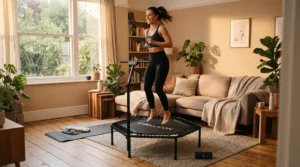
The HOMCOM 40″ Bungee Rebounder‘s standout feature is simply accessibility: a genuine bungee-cord suspension system, not steel springs, at one of the lowest price points in this entire round-up.
That distinction matters more than it might seem. Plenty of budget “rebounders” on general marketplace listings are actually spring-based trampolines with rebounder branding slapped on, which transmits far more shock through the ankles than true bungee suspension. HOMCOM’s U-shaped adjustable foam handle and anti-slip rubber feet round out a package clearly aimed at beginners rather than serious athletes, and the compact folded footprint makes it realistic for a box room or a corner of a living room.
Who this suits: someone testing the waters with gentle rebounding for the first time, perhaps on a lymphoedema nurse’s suggestion or after reading about low impact exercise for stiff joints, who doesn’t want to gamble £300+ before knowing whether the routine will stick. Aggregated feedback from UK buyers frequently mentions that assembling the bungee cords by hand takes real patience and often benefits from a second person, though once built, the finished unit is generally described as sturdy and surprisingly quiet for the price.
Pros:
- ✅ Genuine bungee suspension, not disguised metal springs
- ✅ Adjustable foam handle supports balance for beginners
- ✅ Among the most affordable true bungee models available
Cons:
- ❌ Bungee assembly is time-consuming and fiddly by hand
- ❌ 150kg weight capacity is lower than mid-range and premium rivals
At around £60-£100, the HOMCOM 40″ Bungee Rebounder is the pragmatic choice if your priority is trying gentle rebounding without a big financial commitment.
7. Fellie 48″ Rebounder Trampoline — best ultra-budget pick for casual bouncing
The Fellie 48″ Rebounder Trampoline rounds out this list as the most wallet-friendly genuine bungee model, using 8mm latex cords across a wide 48-inch PP mesh mat.
Six arched foot pipes provide the stability base, and a three-level T-bar handle offers height adjustment for different users in the same household — a practical touch if more than one family member plans to use it. The PP mesh mat is worth flagging on its own merits: it’s more breathable than solid vinyl mats used on some ultra-cheap alternatives, which reduces the sweaty, slippery feel that can develop over a longer session.
What most buyers overlook at this price tier is that a wider 48-inch surface, even on a budget frame, gives noticeably more room for side-to-side movement variations than a cramped 38-40in mat — useful once you move beyond simple vertical bouncing into gentle lateral shifts. This is squarely a casual-use, occasional-bouncer pick rather than a daily-training investment, and honest expectations matter here: build quality and cord longevity are reasonably assumed to trail the mid-range and premium options given the price gap, though we could not verify independent long-term durability testing for this specific model.
Pros:
- ✅ Genuine latex bungee cords at an entry-level price
- ✅ Wide 48-inch mat gives more room than typical budget 40in models
- ✅ Adjustable three-level T-bar handle included
Cons:
- ❌ Long-term cord durability is unverified at this price point
- ❌ Lighter-duty frame than mid-range and premium alternatives
Priced around £40-£60, the Fellie 48″ Rebounder Trampoline is best treated as a low-risk way to find out whether rebounding suits your routine before spending more.
Top 7 Products: Full Comparison
| Product | Suspension | Weight Capacity | Adjustable Tension | Price Range | Best For |
|---|---|---|---|---|---|
| bellicon Classic | Latex bungee | ~200kg (max cord) | Yes, 5 weight grades | £500-£800 | Weight-matched premium bounce |
| JumpSport 370 PRO | EnduroLast elastic cords | ~136kg | Yes, 7 settings | £300-£450 | Serious adjustable home cardio |
| MXL FIT Bounce PRO | 60 bungee connectors | ~181kg | No | £150-£250 | Silent, low-noise bouncing |
| ONETWOFIT 48″ Silent | 42 bungee cords | ~150kg | No | £70-£120 | Wobble-free budget stability |
| BCAN BT4 Soft Land Pro | Dual latex bungee sets | ~227kg | Yes, 6 combinations | £100-£160 | Budget-friendly tension flexibility |
| HOMCOM 40″ Bungee | Bungee cord | ~150kg | No | £60-£100 | First-time bouncer, small budget |
| Fellie 48″ Rebounder | 8mm latex bungee | Not independently verified | No | £40-£60 | Casual, low-commitment trying-out |
Looking at the comparison above, weight capacity and price move almost in lockstep with bungee complexity rather than frame size — the BCAN BT4 Soft Land Pro punches well above its price bracket on capacity thanks to its one-piece frame, while the bellicon Classic justifies its premium position through the sheer engineering behind weight-matched cords rather than raw numbers. If budget is tight but you still want genuine tension control, the BCAN BT4 Soft Land Pro is the standout compromise in this table.

Lymphatic Rebounding Benefits: What the Evidence Actually Shows
Here’s where honesty has to win over enthusiasm. The lymphatic rebounding benefits claimed across product listings — detoxification, immune stimulation, faster fluid clearance — sound compelling, and there’s a genuine physiological mechanism behind some of them: the alternating compression and release of gentle bouncing does encourage lymph movement, because, unlike blood, lymph fluid has no central pump and depends on muscle contraction to move at all.
That said, it’s worth being upfront about the limits of the research. According to Wikipedia’s overview of rebound exercise, rebounding is credited by advocates with helping dozens of specific medical conditions, but there is little systematic peer-reviewed scientific evidence backing most of those claims. One of the few controlled studies that does exist, run by researchers in the Department of Exercise and Sport Science, focused on cardiovascular output and calorie burn rather than lymphatic markers specifically — useful, but not the same thing as proof that a rebounder clears lymphoedema-related swelling.
What can honestly be said: gentle, rhythmic vertical movement is a recognised component of managing fluid-related swelling generally, alongside skin care, compression, and manual lymphatic drainage massage. It’s a plausible complementary habit, not a replacement for clinical treatment. If you’re managing a diagnosed condition, the sensible approach is treating a rebounder as one tool among several, discussed with whoever manages your care, rather than a standalone fix.
Gentle Rebounder for Circulation: Bungee vs Spring Suspension
The single biggest factor separating a genuinely gentle rebounder for circulation from a jarring budget trampoline isn’t diameter or brand — it’s whether the mat hangs from springs or bungee cords.
Metal springs compress and release with a sharper, more linear snap; that responsiveness is great for athletic training but sends more shock back up through the ankles, knees, and hips on every landing. Bungee cords, particularly latex ones, stretch and recoil more gradually, spreading the same landing force over a longer fraction of a second. Reviewers consistently note that this translates into a noticeably “softer” feel underfoot, and it’s also why bungee models tend to be dramatically quieter — springs squeak and click as they compress; bungees generally don’t.
For circulation-focused use specifically, gentler landings matter because the goal isn’t maximum bounce height, it’s sustained, comfortable, rhythmic movement you can keep up for 10-20 minutes without joint discomfort creeping in. A firmer JumpSport-style adjustable cord, dialled down to its softest setting, can achieve a similarly gentle feel — but out of the box, pure latex-bungee models like the bellicon Classic or HOMCOM 40″ Bungee Rebounder start softer by default.
Low Impact Rebounder vs Running, Walking and the Gym
Set a low impact rebounder against more familiar cardio options and the trade-offs become clear fairly quickly.
Running burns calories efficiently and needs zero equipment, but every stride delivers a full-bodyweight impact through the joints — a real problem for anyone with knee, hip, or lower-back sensitivity, or managing swelling that worsens with pounding. Walking is gentler again, genuinely excellent for general health, but as a standalone cardio stimulus it’s comparatively low-intensity unless you’re covering serious distance. Gym-based low-impact exercise machines — ellipticals, recumbent bikes — offer joint-friendly cardio too, but they’re bulky, expensive, and tied to a single location.
A rebounder splits the difference in a genuinely useful way: the elastic suspension absorbs the majority of landing shock the way a treadmill or pavement never will, while the vertical bounce still recruits stabilising muscles through the core, ankles, and legs in a way a stationary bike simply doesn’t. Rebounding studios have reported that participants consistently rate rebounding sessions as feeling less strenuous than their actual measured heart-rate and oxygen-consumption data suggest — in other words, the perceived effort undersells the real workout, which is part of why the format has stuck around as a home-fitness category rather than fading as a fad.
Bungee Cord Tension Explained: Getting the Bounce Right for Your Body
Bungee cord tension is the single most misunderstood spec on a rebounder listing, and it’s also the one that most determines whether you’ll actually enjoy using the thing.
Tension is generally driven by three variables: cord material (latex stretches more gradually than braided synthetic), cord thickness (thicker cords, like BCAN’s 9mm set, resist stretch more and feel firmer), and cord count (more cords sharing the load, as with the MXL’s 60-connector design, means each individual cord flexes less per bounce). None of these is objectively “better” — they’re trade-offs matched to bodyweight and goals. A 55kg user on a 9mm high-tension cord set will feel a stiff, unresponsive bounce; a 100kg user on soft 8mm cords may feel like they’re bottoming out.
Here’s what most listings won’t tell you plainly: if you’re heavier than a rebounder’s stated “comfortable” range, even a high weight-capacity rating doesn’t guarantee a good bounce feel — capacity is a safety ceiling, not a comfort guarantee. This is precisely why the bellicon Classic‘s weight-graded cord system and the BCAN BT4‘s dual-cord approach stand out structurally: they let tension track your actual body rather than a generic average.
How to Choose a Rebounder for Lymphatic Drainage
Working through these criteria in order will narrow the field quickly:
- Suspension type first. Prioritise bungee over springs if gentleness and quiet are the goal; springs suit those wanting firmer, more athletic bounce.
- Match tension to your bodyweight. Check whether the model offers weight-graded or adjustable cords, especially if you’re above or below the “average” 65-85kg range most budget models are tuned for.
- Measure your space before diameter. A 48-inch mat needs meaningfully more clearance than a 40-inch one — check ceiling height too, not just floor space.
- Check the weight capacity with headroom. Buy for at least 20-30kg above your bodyweight, since capacity ratings assume static load, not dynamic bounce force.
- Decide if you need a handlebar. Genuinely useful for balance-building beginners and anyone with stability concerns; unnecessary once confidence builds, though removable designs offer the best of both.
- Factor in noise tolerance. Higher connector-count bungee designs, like the MXL FIT Bounce PRO, are measurably quieter — worth prioritising in flats or shared housing.
- Budget for the whole lifecycle, not just the sticker price. Replacement bungee cords, shipping costs on bulky items, and warranty length all affect genuine long-term value.
Common Mistakes When Buying a Rebounder
A handful of buying mistakes show up again and again in aggregated owner feedback across this category.
The most frequent is buying based on diameter alone, assuming bigger automatically means better, then discovering the larger frame doesn’t fit the intended room once folded legs and clearance space are accounted for. Close behind is underestimating weight capacity margins — buying a model rated almost exactly at bodyweight rather than comfortably above it, which shortens the product’s realistic lifespan considerably. A third common error is ignoring suspension type entirely and choosing on price or colour, then being surprised that a spring-based “trampoline” feels far harsher underfoot than expected from lymphatic-drainage marketing copy. Finally, plenty of buyers skip reading the assembly requirements, only to discover — as reflected consistently in UK owner reviews of bungee models like HOMCOM’s — that hand-looping dozens of cords onto a frame is a genuinely physical, occasionally two-person task, not a five-minute unbox-and-go experience.
Safety, Regulations and When to Check with a Doctor First
Domestic trampolines and rebounders sold in the UK generally fall under safety standards covering structural integrity, stability, and entrapment risk, though it’s worth knowing that fitness and medical-use rebounders sit in a slightly different regulatory category from garden trampolines aimed at children. Sensible safety habits apply regardless: check the frame and legs are fully locked before each session, keep the area around the rebounder clear, and replace any bungee cord or spring showing visible wear rather than continuing to use it. For general household trampoline safety guidance relevant to UK buyers, nidirect’s trampoline safety advice is a useful practical reference, even though its detail is aimed primarily at garden models.
Medically, a low-impact rebounder is broadly considered a gentle activity, but it isn’t automatically appropriate for everyone. Anyone with diagnosed lymphoedema, a recent surgery, joint replacements, uncontrolled heart conditions, severe osteoporosis, or who is pregnant should speak with their GP, physiotherapist, or specialist lymphoedema nurse before starting — not because bouncing is inherently dangerous, but because individual conditions genuinely change what’s appropriate, and self-directed exercise decisions around a medical diagnosis are never a like-for-like substitute for guidance from whoever manages that care.
Which Rebounder Should You Choose? A Simple Decision Framework
If you’re still torn between models, this framework should settle it quickly:
- If budget is under £100 and you’re testing the concept → choose the HOMCOM 40″ Bungee Rebounder or Fellie 48″ Rebounder Trampoline, because genuine bungee suspension at low commitment beats an expensive gamble on an untested habit.
- If you want adjustable tension without premium pricing → choose the BCAN BT4 Soft Land Pro, because dual bungee sets deliver flexibility usually reserved for £300+ models.
- If noise is your main concern (flats, shared housing) → choose the MXL FIT Bounce PRO, because its 60-connector design is engineered specifically around quiet operation.
- If stability on a budget frame worries you → choose the ONETWOFIT 48″ Silent Mini Trampoline, because its hexagonal frame reduces wobble more than typical round budget designs.
- If you want serious, adjustable daily training → choose the JumpSport 370 PRO, because seven tension settings genuinely support both gentle and intense sessions on one frame.
- If money isn’t the deciding factor and you want it tuned to your exact bodyweight → choose the bellicon Classic, because weight-graded bungee cords are still its unmatched signature feature.
Your First 30 Days: Setup, Technique and Maintenance
Getting a rebounder into a genuine routine, rather than a guilt-inducing corner ornament, comes down to a handful of unglamorous habits.
Setup: Unfold or assemble on a flat, non-slip surface — carpet is generally fine, but check leg-tip pads are seated properly on hard floors to prevent sliding. If your model needs hand-looped bungees, budget genuine time (30-60 minutes isn’t unusual) and, honestly, a second pair of hands makes the last few cords considerably easier.
General UK guidance on building any new activity gradually — covered in the NHS’s overview of getting started with exercise — applies just as well to rebounding as it does to walking or swimming: short, frequent sessions beat one punishing effort that puts you off for a week.
First sessions: Start with 5-10 minutes of small, controlled bounces where your feet barely leave the mat — this “health bounce” style is where most of the gentle circulation benefit is thought to come from, not high jumps. Keep knees slightly bent throughout to protect joints, and use a nearby wall or the handlebar if balance feels uncertain at first.
Common early mistakes to avoid: Bouncing too hard, too soon (soreness in calves and shins is common in week one); jumping in bare socks on a slick mat surface; and placing the rebounder too close to furniture, since even gentle side-to-side drift needs a genuine safety margin.
Maintenance schedule: Check bungee cords or springs monthly for visible stretching, fraying, or cracking; wipe the mat surface periodically to remove dust and grip-reducing residue; and re-tighten any leg bolts every few months, since repeated bouncing gradually works fixings loose. A rebounder stored folded in a cupboard between uses will generally last longer than one left permanently assembled in a humid conservatory or garage.
Optimisation tricks: Adding gentle arm movement (light overhead reaches, arm circles) increases the cardiovascular demand without adding joint impact. Playing music at a steady 100-120bpm tends to naturally regulate bounce rhythm, which is genuinely more sustainable over a 20-minute session than watching the clock.
Who’s Actually Bouncing? Three Real-World Scenarios
The desk-bound commuter with puffy ankles. Picture someone spending eight hours seated, then a train home, arriving with visibly swollen feet by evening. A budget-to-mid bungee model like the ONETWOFIT 48″ Silent Mini Trampoline, used for 10-15 minutes after work at gentle “health bounce” intensity, fits into an existing routine without requiring a gym trip or extra travel time — the low £70-£120 outlay also makes it an easy habit to trial without financial pressure to “make it worth it.”
The post-surgery or lymphoedema-managing user following clinical advice. Here, the priority is the gentlest possible landing and maximum control over intensity, which points firmly toward the bellicon Classic‘s weight-graded cords or the BCAN BT4‘s softer 8mm bungee set, used only within guidance from a lymphoedema nurse or physiotherapist as part of a broader treatment plan, never as a standalone substitute for it.
The home-fitness enthusiast wanting one flexible machine. For someone who already trains regularly but wants a joint-friendly option for recovery days and higher-intensity intervals on good days, the JumpSport 370 PRO‘s seven-setting adjustable tension covers both ends of that spectrum on a single frame, avoiding the need to own two separate pieces of equipment.
Long-Term Cost and Maintenance
The upfront price tag is only part of the real cost picture. Bungee cords, regardless of brand, degrade gradually with UV exposure and repeated flexing — expect noticeably softer tension after a year or two of regular use, and budget for eventual replacement cord sets on models where that’s possible (premium brands like bellicon and JumpSport generally sell replacement cords directly; several budget models don’t offer this, meaning the whole unit effectively becomes disposable once cords fail).
Cost-per-use is a genuinely more useful metric than sticker price for anything used several times a week. A £600 bellicon Classic used four times weekly for three years works out to roughly £1.28 per session before accounting for resale value or replaceable parts; a £70 ONETWOFIT used at the same frequency for a shorter two-year lifespan before cords need replacing comes out around £0.45 per session. Neither is “wrong” — it depends entirely on whether you value the smoother bounce enough to pay the premium, or whether a functional, slightly firmer bounce meets your needs just as well at a fraction of the cost.
FAQ
❓ How much does a rebounder for lymphatic drainage cost in the UK?
❓ Is a bungee rebounder better than a spring-based mini trampoline for lymphatic drainage?
❓ How often should I use a rebounder for lymphatic drainage?
❓ Can I use a rebounder if I have lymphoedema or another health condition?
❓ What size rebounder should I buy for a small UK home?
Conclusion
A rebounder for lymphatic drainage isn’t a miracle appliance, and anyone promising otherwise is overselling it — the peer-reviewed evidence is genuinely thinner than the marketing suggests. What it is, honestly, is one of the more joint-friendly ways to get consistent, low-impact movement into a routine, with a plausible physiological reason to expect it supports fluid circulation alongside good habits like hydration, movement breaks, and, where relevant, guidance from a lymphoedema specialist.
Across the seven models covered here, the right choice comes down to matching suspension type and tension to your own body rather than chasing the biggest frame or the flashiest listing. Budget bungee models like the HOMCOM 40″ Bungee Rebounder and Fellie 48″ Rebounder Trampoline are sensible ways to test whether the habit sticks; the BCAN BT4 Soft Land Pro and ONETWOFIT 48″ Silent Mini Trampoline offer a genuinely strong middle ground; and the JumpSport 370 PRO and bellicon Classic reward buyers who know they’ll use the equipment often enough to justify tuning it precisely. Whichever tier you land on, gentle, low impact exercise done consistently will outperform an expensive rebounder gathering dust in a corner every single time.
Recommended for You
- Best Rebounder For Weight Loss: 7 Proven UK Picks (2026)
- Value Fitness Trampoline: 7 Best Rebounders for UK Homes (2026)
- Cheap Mini Trampoline: 7 Brilliant Budget Picks for 2026
Disclaimer: This article contains affiliate links. As an Amazon Associate, I earn from qualifying purchases. If you purchase products through these links, we may earn a small commission at no additional cost to you.
✨ Found this helpful? Share it with your friends! 💬🤗
