In This Article
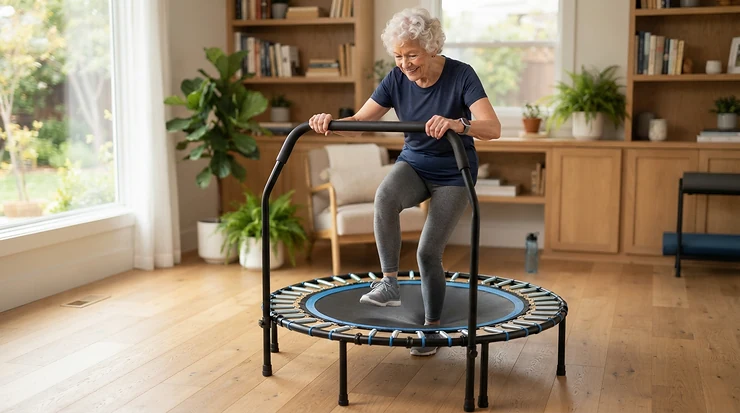
Somewhere between “I should probably move more” and “but walking hurts my knees” sits a small, unassuming circle of fabric and springs that’s quietly become one of the most talked-about pieces of home fitness kit for older adults. A rebounder is a mini trampoline built for controlled, low-impact bouncing rather than backflips — and finding the best rebounder for elderly users usually comes down to one non-negotiable feature: something sturdy to hold onto while you find your rhythm. Add a stability bar, a low deck height, and a cushioned bounce, and you’ve got a piece of equipment that can support balance training, protect ageing joints, and — crucially — not end up shoved under the bed after week two.
This guide digs into seven real, currently available rebounders, comparing how each one handles the specific demands of older bodies: entry and exit height, handle security, noise levels for flats and bungalows, and genuine review sentiment rather than marketing gloss. As the NHS notes in its balance exercise guidance, regular strength and balance work is one of the most effective ways older adults can reduce their risk of falling — and a well-chosen rebounder with a stability bar can make that kind of joint-friendly exercise genuinely achievable at home, rather than something reserved for a gym you’ll never quite get to.
Quick Comparison: Best Rebounders for Elderly at a Glance
Before the deep dive, here’s the short version — useful if you’re scanning on your lunch break or comparing options with a family member over the phone.
| Rebounder | Handle Type | Best For | Price Range |
|---|---|---|---|
| MaXimus Pro Gym Rebounder | Fixed stability bar (included) | All-round confidence and durability | £150-£220 |
| SportPlus Fitness Trampoline | 5-position adjustable handle | Quiet bouncing in flats/bungalows | £150-£250 |
| BCAN 51″ Octagonal Rebounder | T-bar adjustable handle | Larger jumping surface, roomier stance | £100-£160 |
| Fit Bounce Pro XL | 10-position adjustable bar | Changing mobility needs over time | £250-£350 |
| JumpSport 250 Rebounder | 6-position handle bar accessory | Clinically-minded, cushioned bounce | £300-£450 |
| Needak Soft Bounce Rebounder | Fixed stabilizer bar | Softest possible landing | £400-£600 |
| ACON Fit 44″ Rebounder | 4-height adjustable safety rail | Best value low height rebounder for balance | £150-£220 |
Look closely and a pattern emerges: every genuinely senior-friendly rebounder on this list pairs its bounce mechanism with some form of handle, because balance confidence — not raw bounce height — is what actually gets older adults exercising consistently. The BCAN 51″ Octagonal Rebounder wins on sheer surface area for anyone worried about foot placement, while the Needak Soft Bounce Rebounder sits at the premium end precisely because its cushioning is engineered for fragile joints rather than athletic performance. Price alone won’t tell you which is right for your knees, hips, or living room — so treat this table as a shortlist, not a verdict.
💬 Found a favourite already? Scroll down to see how it stacks up against the rest — knowledge is half the battle!
Top 7 Rebounders for Elderly: Expert Analysis
Choosing a rebounder isn’t like choosing a toaster — get it wrong and you’re either left with something too wobbly to trust or too stiff to enjoy. Below are seven real, currently sold options spanning budget to premium, each assessed on how it actually behaves for an older user rather than how it photographs on a product page.
1. MaXimus Pro Gym Rebounder — sturdiest all-round package with a built-in stability bar
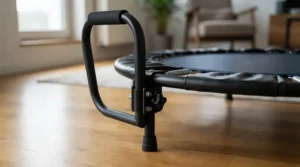
The standout here is simple: this British-designed rebounder ships with its stability bar already in the box, rather than as a pricey add-on you discover you need after the fact. Built from high-grade steel with a quarter-folding frame, it’s rated to a substantial 140-150kg user weight, and the whole unit tips the scales at a reassuring weight itself — light rebounders tend to walk across the floor mid-bounce, and this one largely doesn’t.
Based on the spec comparison, the fixed bar (rather than a loosely clipped-on accessory) is what separates this from cheaper “trampette” toys; it flexes slightly with your movement but doesn’t rock free, which matters enormously for anyone still building trust in their own balance. It’s a genuinely solid pick for beginners rebuilding confidence after an injury, and for anyone who wants one purchase that includes the bar rather than a second delivery to wait for.
Reviewers consistently report that it “doesn’t walk” during use and that the bar “steadies you if needed,” with more than one buyer specifically noting they were purchasing it as a senior user. A recurring theme in aggregated feedback is that assembly and folding take a little practice before they become quick — not a flaw exactly, but worth setting aside twenty unhurried minutes for on day one.
Pros:
- ✅ Stability bar included as standard, not sold separately
- ✅ Heavy-duty steel frame resists tipping and “walking”
- ✅ Comes with online workout access for structured balance training
Cons:
- ❌ Folding mechanism needs a bit of practice at first
- ❌ Bar is a balance aid, not designed to bear full body weight
Sitting in the mid-range around £150-£220 (check current price, as availability shifts), the MaXimus Pro Gym Rebounder earns its keep through sheer completeness — you’re not left sourcing a compatible handle after the fact, which for many older buyers is worth the extra outlay alone.
2. SportPlus Fitness Trampoline — quietest bungee bounce for shared walls
What most buyers overlook about bungee-corded rebounders is just how much quieter they are than the spring-based models many people picture when they hear “mini trampoline” — and the SportPlus Fitness Trampoline leans hard into that advantage. Its 36 elastic rubber cords replace metal coil springs entirely, which removes the rhythmic creak-and-ping that can otherwise travel straight through a downstairs neighbour’s ceiling.
The handle adjusts across five heights from 82cm up to 117cm, so it suits a genuinely wide range of statures without needing a different model altogether, and the whole unit is rated to 130kg. Safety testing by Intertek, a recognised European testing body, adds a layer of reassurance that isn’t just marketing language.
On paper this means a machine built for repeat, joint-conscious use rather than a garage-sale impulse buy, and the German manufacturer’s two-decade track record in home fitness backs that up. The trade-off reviewers flag most often is that the bungee cords are genuinely tough to tension during assembly — doable solo, but noticeably easier with a second pair of hands holding the frame steady.
Pros:
- ✅ Bungee cords give a near-silent, joint-friendly exercise bounce
- ✅ Five-position handle adjusts from 82cm to 117cm
- ✅ Independently safety-tested by Intertek
Cons:
- ❌ Cord tensioning during setup is stiff and fiddly
- ❌ Handle fully detaches rather than folding flat with the frame
At around £150-£250 depending on the exact configuration, the SportPlus Fitness Trampoline is the pick for anyone in a flat, bungalow, or house with light sleepers below — the quiet factor alone justifies its place on this list.
3. BCAN 51″ Octagonal Rebounder — best for a roomier, more forgiving stance
Here’s what the spec sheet won’t tell you outright: an octagonal 51-inch mat gives you noticeably more usable jumping surface at the corners than a standard round 40-inch rebounder, and for anyone whose foot placement drifts slightly during a session, that extra real estate is the difference between a confident bounce and a nervous, foot-watching one. The BCAN 51″ Octagonal Rebounder uses a silent bungee suspension system and carries a substantial 450lbs (roughly 204kg) weight rating, built around a T-shaped adjustable handle that offers a wide, secure two-handed grip rather than a single central pole.
Assembly reviewers describe as generally straightforward, and the rubber-tipped legs are reported to grip well on hardwood and laminate flooring without sliding — a genuine safety consideration for older users on wooden floors.
Aggregated review sentiment does flag two recurring caveats worth knowing before you buy: the folding mechanism can be a little stiff to engage compared with rival brands, and as a newer entrant to the market, BCAN doesn’t yet carry the decades-long brand history of names like JumpSport or Needak, which may matter if long-term customer support is a priority for you.
Pros:
- ✅ Large octagonal mat gives extra margin for foot placement
- ✅ Wide T-bar handle supports a secure two-handed grip
- ✅ High 450lbs weight capacity with a quiet bungee bounce
Cons:
- ❌ Folding mechanism can feel stiff on some units
- ❌ Newer brand with a shorter UK support track record
Priced attractively in the £100-£160 range, this is arguably the best value entry on the list for anyone who wants a genuinely safe mini trampoline for seniors without paying premium-brand prices for the privilege.
4. Fit Bounce Pro XL — most adjustable handle for changing mobility needs
The Fit Bounce Pro XL distinguishes itself with a stability bar offering ten separate height settings — noticeably more granular than the four-to-six-position bars found on most competitors — which matters more than it sounds. Mobility and confidence rarely stay static; someone recovering from a hip replacement in month one may need the bar higher and closer than they do by month six, and being able to fine-tune rather than jump between a handful of fixed notches keeps the equipment useful across that whole recovery arc.
Built on a bungee-sprung 48-inch frame with a half-folding design, it’s UK-designed and has reportedly been recommended by physiotherapists for its rigidity — the bar is described as “completely solid” with no perceptible wobble once locked in place, a detail that stands out given how many rival bars flex noticeably under load.
Reviewers consistently mention using it for rehabilitation after mobility-limiting health events, with one specifically describing it as helping them “health bounce” while managing multiple existing conditions. The honest caveat: the bar is sold as an optional accessory on some bundles rather than bundled by default, so it’s worth double-checking the exact listing includes it before you buy.
Pros:
- ✅ Ten-position bar adapts as mobility needs change over time
- ✅ Bar reported as rigid and wobble-free, unlike flexible alternatives
- ✅ 48-inch bungee-sprung mat gives a soft, quiet bounce
Cons:
- ❌ Stability bar sometimes sold separately from the trampoline
- ❌ Premium positioning pushes it above budget alternatives
Expect to pay in the £250-£350 range (again, always check current price rather than relying on any figure printed here), which places the Fit Bounce Pro XL firmly in the premium bracket — justified, based on the spec comparison, if you want one piece of equipment that can flex with you over years rather than months.
5. JumpSport 250 Fitness Rebounder — most clinically-minded cushioned bounce
American brand JumpSport built its reputation partly on independent claims of up to a 40% reduction in landing impact compared with traditional bouncing, achieved through arched-leg construction and EnduroLast elastic cords rather than standard bungees or springs. For elderly users specifically, that impact reduction is the entire point — it’s the difference between a bounce that jars an arthritic knee and one that doesn’t.
The JumpSport 250 ships with a 35.5-inch Permatron jumping surface inside a 39-inch frame, and pairs with a separately-available handle bar accessory offering six height settings from 30 to 40 inches, aimed specifically at physical therapy and upper-body-assisted low-impact workouts. What most buyers overlook is that the arched-leg design isn’t just aesthetic — it actively resists tipping in a way that straight-legged budget models sometimes don’t, which is a genuinely relevant safety feature rather than a marketing flourish.
The trade-off is largely one of geography and price: as a US-manufactured product, UK buyers often pay a premium over similarly-specced European alternatives, and the standard bundle doesn’t include the handle, meaning it’s effectively two separate purchases.
Pros:
- ✅ Independently claimed 40% impact reduction versus standard rebounders
- ✅ Arched-leg frame actively resists tipping
- ✅ Handle accessory purpose-built for physical therapy use
Cons:
- ❌ Handle bar sold as a separate accessory, adding to total cost
- ❌ Typically pricier in the UK than comparable European brands
Once you factor in the handle accessory, total cost tends to land around £300-£450, making the JumpSport 250 a premium pick best suited to buyers who specifically want a rehab-oriented, clinically-referenced design rather than a general fitness rebounder.
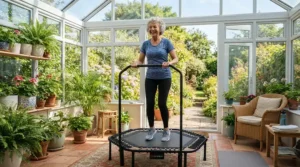
6. Needak Soft Bounce Rebounder — softest possible landing for fragile joints
Where most of this list leans on bungee cords for a gentle bounce, the Needak Soft Bounce Rebounder takes a different, spring-based approach — but engineers its spring tension specifically to produce what the brand calls a “soft bounce,” aimed at users who need the absolute gentlest possible impact rather than a springy, energetic one.
Here’s what the spec sheet won’t tell you outright: softer bounce mechanics generally mean less rebound height and a slower cadence, which sounds like a downside until you remember the goal for many elderly users isn’t athletic performance, it’s sustainable, joint-friendly exercise they can do daily without discomfort the next morning. It folds for storage and pairs with a dedicated stabilizer bar, continuing a design lineage the brand has refined for decades in the North American market.
Based on the spec comparison, this is the rebounder most likely to suit someone with existing joint replacements, significant arthritis, or a general nervousness about impact — the trade-off being a genuinely premium price point and, for UK buyers, potentially longer shipping and import considerations depending on the current retailer.
Pros:
- ✅ Spring tension specifically engineered for a gentle “soft” landing
- ✅ Foldable frame with a dedicated stabilizer bar included
- ✅ Long-established brand with decades of design refinement
Cons:
- ❌ Among the most expensive options on this list
- ❌ UK availability and import logistics can vary by retailer
At roughly £400-£600, the Needak Soft Bounce Rebounder sits at the top of the price ladder — but for buyers whose priority is minimising joint impact above all else, that premium reflects a genuinely different bounce mechanism rather than just a brand markup.
7. ACON Fit 44″ Rebounder — best value low height rebounder for balance with an adjustable safety rail
Rounding out the list is a genuinely underrated option: the ACON Fit 44″ Rebounder already includes a safety rail adjustable across four different heights, meaning you’re not hunting for a compatible accessory after the fact, and its 44-inch mat sits comfortably between the more compact 40-inch models and the larger 48-51 inch options — enough room to move without dominating a living room.
The safety rail’s four-position adjustment is specifically designed to accommodate seniors of varying heights within one household, which is a genuinely practical detail if a rebounder is being shared between, say, two grandparents of different statures. Built on a robust steel frame with a bungee suspension system, it carries a hefty 550lb (roughly 249kg) weight capacity, comfortably out-specifying several pricier competitors on this list.
Based on the spec comparison, the standout here is value: you’re getting an included, height-adjustable rail — usually a premium feature — at a price point that undercuts brands with decades more marketing spend. The trade-off is brand recognition; ACON isn’t yet a household name in UK fitness circles the way JumpSport or Needak are, so buyers occasionally report needing to search a little harder for UK-based spare parts.
Pros:
- ✅ Four-height adjustable safety rail included as standard
- ✅ Generous 550lb weight capacity, among the highest here
- ✅ 44-inch mat balances manoeuvring room with compact footprint
Cons:
- ❌ Less UK brand recognition than established rivals
- ❌ Spare parts and accessories can take longer to source
Priced around £150-£220, the ACON Fit 44″ Rebounder is arguably the smartest all-rounder on this list for anyone specifically prioritising an included, adjustable support handle without stretching into premium territory.
Looking across all seven, the products cluster into three clear tiers: budget-conscious but still handle-equipped (BCAN, ACON), well-rounded mid-range all-in-one packages (MaXimus Pro, SportPlus), and premium options engineered around a specific priority — adjustability for the Fit Bounce Pro XL, clinical impact reduction for the JumpSport 250, and maximum joint softness for the Needak Soft Bounce Rebounder. Match the tier to your actual priority rather than your budget alone, and you’ll end up using the thing rather than storing it.
| Rebounder | Weight Capacity | Handle Positions | Rating (aggregated) |
|---|---|---|---|
| MaXimus Pro Gym Rebounder | ~140-150kg | Fixed | 4.5-5/5 |
| SportPlus Fitness Trampoline | 130kg | 5 | 4-4.5/5 |
| BCAN 51″ Octagonal Rebounder | ~204kg | T-bar, adjustable | 4/5 |
| Fit Bounce Pro XL | Not always stated | 10 | 4.5-5/5 |
| JumpSport 250 Rebounder | ~113kg | 6 (accessory) | 4-4.5/5 |
| Needak Soft Bounce Rebounder | Premium-grade | Fixed | 4.5/5 |
| ACON Fit 44″ Rebounder | ~249kg | 4, adjustable | 4/5 |
The weight capacity spread here is genuinely wide, and it’s worth reading past the headline number: a higher capacity generally correlates with a heavier, more tip-resistant frame, which matters as much for stability as it does for accommodating a larger user. If in doubt, the ACON Fit 44″ and BCAN 51″ both offer meaningful headroom above an average adult bodyweight, giving a reassuring safety margin rather than a number you’re pushing right up against.
Getting Started Safely: A Practical Usage Guide
Buying the right rebounder is only half the job — how you use it in the first thirty days determines whether it becomes a daily habit or an expensive clothes horse. Start on a flat, non-slip surface; a rug or carpet underneath the legs can add useful grip on laminate or tiled floors, and it’s a five-minute precaution that meaningfully reduces wobble. For your very first sessions, keep both hands on the stability bar and simply transfer your weight from foot to foot without leaving the mat at all — this “health bounce” technique lets your inner ear and stabilising muscles adjust to the moving surface before you introduce any actual lift. Footwear matters more than people expect: supportive trainers or bare feet both work well, but socks alone are genuinely risky, since they can slide on the mat’s surface at exactly the wrong moment.
A sensible first-month structure looks like two to three sessions per week of five to eight minutes each, building gradually rather than aiming for a dramatic first workout. Common early mistakes include gripping the bar too tightly (which paradoxically makes balance harder by locking the upper body rigid), bouncing barefoot on a mat that’s still slightly damp from being wiped down, and skipping the manufacturer’s assembly video in favour of guesswork — stability bars in particular are engineered to flex a specific amount, and forcing them straight can strain the mounting brackets. For ongoing maintenance, a monthly check of leg bolts and bungee cord tension keeps the bounce consistent and catches wear before it becomes a safety issue, which matters more here than with most fitness equipment precisely because the whole point is trusting the surface beneath you.
Real-World Scenarios: Which Rebounder Suits Your Situation?
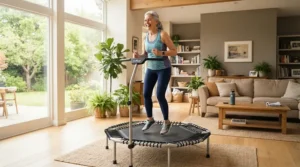
Picture Margaret, 74, recently discharged from physiotherapy after a knee replacement, living alone in a first-floor flat with understandably nervous neighbours below. Her priority list runs: quiet, gentle, and confidence-building above all else — which points straight at the SportPlus Fitness Trampoline for its near-silent bungee cords, paired with genuinely patient, seated-to-standing progression in her first few weeks.
Now consider Frank and Doreen, a couple in their early eighties sharing a bungalow, with Frank at 5’11” and Doreen at 5’2″. A single fixed-height handle would suit one of them and frustrate the other, so a genuinely adjustable option — the ACON Fit 44″ with its four-position rail, or the ten-position Fit Bounce Pro XL — solves the household mismatch that a cheaper, fixed-bar model simply can’t.
Finally, take Joan, 68, still fairly active but managing early-stage osteoporosis and keen to protect her bone density through appropriate weight-bearing movement, as recommended by exercise guidance from the Royal Osteoporosis Society. For her, a rebounder that combines gentle impact with genuine stability — the MaXimus Pro Gym Rebounder, with its included, non-negotiable bar — offers a sensible middle ground between staying sedentary and risking a harder-impact activity her consultant would rather she avoided.
Your Buyer’s Decision Framework: Choosing in 5 Questions
If you’re still torn between two or three options, run through these in order — the first “yes” often settles it.
- Do you live with, or below, people who’d notice noise? If yes, prioritise bungee-corded models like the SportPlus or BCAN over spring-based options.
- Will more than one person of different heights use it? If yes, an adjustable handle with multiple positions — the Fit Bounce Pro XL or ACON Fit 44″ — beats a fixed bar.
- Do you have an existing joint replacement or significant arthritis? If yes, weight impact reduction over bounce height; look to the Needak Soft Bounce or JumpSport 250.
- Is budget the primary constraint? If yes, the BCAN 51″ delivers a genuine handle and large mat without premium pricing.
- Do you want everything in one box with nothing extra to source? If yes, the MaXimus Pro Gym Rebounder bundles its bar as standard, removing that extra decision entirely.
Common Rebounding Problems (and How to Fix Them)
Problem: The mat feels unstable or “walks” across the floor. This is almost always a legs-and-surface mismatch rather than a faulty unit — add a thin rug underneath for grip, and double-check all leg bolts are fully tightened, since shipping vibration can loosen them slightly.
Problem: My hands ache gripping the stability bar. Over-gripping is common among nervous first-timers; try resting fingertips lightly on the bar rather than gripping with a full fist, and build confidence gradually so the bar becomes a light touchpoint rather than a lifeline.
Problem: I feel dizzy after a session. This typically settles within the first few sessions as your vestibular system adapts to the moving surface — but if dizziness persists, stop and speak to a GP before continuing, since it may be unrelated to the rebounder itself.
Problem: The bungee cords or springs feel looser than when new. Some settling is normal in the first month; if a cord snaps or a spring visibly deforms, stop using that section and contact the manufacturer rather than continuing on a compromised surface.
Problem: Getting on and off feels like the riskiest part. Position the rebounder next to a wall, sofa arm, or sturdy piece of furniture for the first few weeks, so you always have a secondary support point during mount and dismount — arguably the single most useful safety habit on this whole list.
How to Choose the Best Rebounder for Elderly Users
What is the best rebounder for elderly users? In short: it’s the one with a genuinely rigid support handle, a low, easy-to-clear deck height, a quiet bungee or cushioned-spring bounce, and a weight capacity comfortably above the user’s bodyweight — features matter more here than brand name or bounce height.
- Prioritise the handle over the mat. A slightly firmer bounce with a rock-solid bar beats a plush bounce with nothing to hold onto.
- Check the deck height off the floor. A low height rebounder for balance work should let you step on and off without a noticeable climb — anything requiring a real “step up” adds unnecessary fall risk.
- Confirm the weight rating with margin. Look for a capacity at least 20-30kg above the heaviest intended user, for genuine peace of mind rather than a tight squeeze.
- Test-read reviews for noise complaints. Anyone in a flat, terrace, or bungalow with shared walls should weight bungee-corded models over spring-based ones.
- Look for adjustability if more than one person will use it. A multi-position handle removes the need for separate equipment per household member.
- Factor in assembly difficulty honestly. Several genuinely good options require two people for setup — worth knowing before delivery day, not after.
- Decide whether the bar needs to be included or can be added later. Some premium mats sell the handle separately, which affects your real total cost.
Common Mistakes When Buying a Rebounder for Seniors
The single most common mistake is buying based on bounce height alone, borrowed from marketing language aimed at younger fitness users — for elderly buyers, a lower, more controlled bounce with better stability is almost always the better trade. A close second is assuming any handle will do; a loosely clipped-on accessory bar designed for occasional upper-body stretching is a very different product from a rigid, load-tested stability bar, and the two get conflated in product listings more often than they should. Buyers also frequently underestimate assembly difficulty, ordering a rebounder that arrives requiring two people and several tools when they live alone — worth checking delivery notes and reviews in advance rather than discovering it on the day. Finally, there’s a tendency to buy the cheapest available “mini trampoline” without checking whether it’s genuinely designed for adult fitness use at all — some budget listings are closer to children’s toys with a higher price tag, lacking the reinforced frame and tested weight capacity that adult rebounding genuinely requires.
Rebounder vs Traditional Low-Impact Exercise for Older Adults
| Factor | Rebounder | Walking | Swimming |
|---|---|---|---|
| Weather-dependent | No | Yes | Sometimes |
| Joint impact | Low | Moderate | Very low |
| Balance training benefit | High | Low | Low |
| Home accessibility | High | Moderate | Low |
| Weight-bearing bone benefit | Yes | Yes | No |
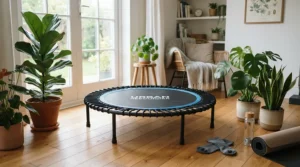
Rebounding earns its place on this list precisely where the other two fall short: it’s entirely weather-independent, doesn’t require transport to a pool, and — unlike swimming — still counts as weight-bearing exercise, which matters for bone density as people age. Walking remains excellent for cardiovascular health and costs nothing, but it does comparatively little for dynamic balance training, since the surface underfoot never actually moves. A joint-friendly exercise routine built around rebounding, topped up with regular walking for cardiovascular variety, arguably covers more bases than either activity alone — which is precisely the kind of combined approach that NHS Inform’s strength and balance guidance recommends rather than relying on a single activity type.
What to Expect: Real-World Performance for Older Joints
On paper, “low-impact” is just a spec; in practice, it means something specific for ageing joints. Reviewers consistently note that the first week involves a genuine adjustment period — not pain, but a novel sensation of the ground moving that takes several sessions to feel natural. What most buyers overlook is that a rebounder’s cushioning absorbs a significant portion of landing force that would otherwise travel straight through the knees and hips on a hard floor, which is precisely why physiotherapists frequently recommend rebounding during rehabilitation rather than resuming impact walking too early. The bounce itself is genuinely gentler than it looks in promotional videos, where younger, more experienced users demonstrate far more vigorous movement than any elderly buyer would realistically attempt. In day-to-day terms, a five-minute session tends to leave users pleasantly warmed up rather than breathless, and the balance-challenge element — constantly making tiny corrective adjustments — is often reported as more noticeably fatiguing to the legs than the cardio component itself, which is exactly the kind of stabilising-muscle engagement that supports long-term fall prevention.
Rebounders for Different Types of Senior Users
For the cautious beginner rebuilding confidence after a fall or long period of inactivity, a fixed, rigid bar like the one on the MaXimus Pro Gym Rebounder removes decision fatigue entirely — there’s nothing to adjust, just something solid to hold. For the actively mobile senior still gardening, walking regularly, and looking to add variety, the larger mat on the BCAN 51″ Octagonal Rebounder rewards a slightly more energetic bounce with extra room to move. For those managing a specific medical condition — a recent joint replacement, osteoporosis, or significant arthritis — the gentler mechanics of the Needak Soft Bounce Rebounder or the clinically-referenced JumpSport 250 are worth the extra investment. And for multi-generational or shared households, where a rebounder might see use from a grandparent one day and a returning adult child the next, the wide adjustability of the Fit Bounce Pro XL flexes to suit very different users without compromise.
Safety, Standards & Regulations for Home Rebounders in the UK
Look for products carrying CE or UKCA marking, which indicates the manufacturer has assessed the product against recognised European or UK safety standards before sale — several rebounders on this list, including the MaXimus Pro Gym Rebounder, explicitly reference full CE certification in their documentation. Independent safety testing by a recognised body, such as the Intertek testing referenced for the SportPlus Fitness Trampoline, adds a further layer of verification beyond the manufacturer’s own claims. Beyond the product itself, positioning matters: keep the rebounder well clear of furniture edges, radiators, and stairwells, and always have a GP or physiotherapist sign off before starting if you’re managing a cardiovascular condition, recent surgery, or significant balance impairment, in line with general guidance from NHS advice on staying active in later life. None of this is about being overly cautious for its own sake — it’s about making sure the equipment that’s meant to reduce your fall risk doesn’t inadvertently introduce a new one.
Long-Term Cost & Maintenance: Is a Rebounder Worth It?
A one-off purchase in the £150-£450 range, most rebounders on this list carry warranties running from one to three years, with replaceable parts — bungee cords, mat covers, leg bolts — generally available from the manufacturer rather than requiring a whole new unit when wear eventually shows. Compared against the ongoing cost of a gym membership, typically £30-£50 monthly in much of the UK, even a premium £450 rebounder pays for itself within a year of regular home use, without factoring in travel time or the inconvenience of a class schedule that doesn’t suit an unpredictable day. Maintenance costs stay low if you follow the manufacturer’s monthly bolt-check routine outlined earlier in this guide; the main long-term expense tends to be an eventual bungee cord or spring replacement set, generally available for £15-£30 depending on the brand. Viewed as a total cost of ownership rather than a single price tag, a well-chosen rebounder with a genuine stability bar represents one of the more cost-effective pieces of home fitness equipment specifically suited to older adults.
Frequently Asked Questions
❓ Is a rebounder safe for elderly people with balance problems?
❓ What is the best low height rebounder for balance training?
❓ How long should a senior bounce on a rebounder each day?
❓ Do all rebounders come with a support handle?
❓ Can rebounding help with joint pain in older adults?
Conclusion
There’s no single best rebounder for elderly users — only the best one for your specific mix of living situation, mobility, and budget. What every genuinely strong option on this list shares is a rigid, trustworthy handle and a bounce engineered for control rather than height, whether that’s the all-in-one completeness of the MaXimus Pro Gym Rebounder, the whisper-quiet cords of the SportPlus Fitness Trampoline, or the ten-position flexibility of the Fit Bounce Pro XL. Budget buyers shouldn’t feel short-changed either — the BCAN 51″ Octagonal Rebounder and ACON Fit 44″ Rebounder both prove that a genuine support handle doesn’t have to come with a premium price tag attached. Whichever you land on, the real value shows up weeks and months later, in steadier balance, stronger legs, and a joint-friendly habit you can actually keep doing on a rainy Tuesday in February when a walk to the shops feels like one hurdle too many. Start slow, keep a hand on the bar, and let consistency — not intensity — do the heavy lifting.
🔍 Take your home fitness routine to the next level with a rebounder built for real balance and confidence. Click through on any highlighted pick above to check current availability and pricing — a steadier, stronger you could be one small bounce away!
Recommended for You
- Rebounder for Lymphatic Drainage: 7 Gentle Picks (2026)
- Best Rebounder For Weight Loss: 7 Proven UK Picks (2026)
- Value Fitness Trampoline: 7 Best Rebounders for UK Homes (2026)
Disclaimer: This article contains affiliate links. As an Amazon Associate, I earn from qualifying purchases. If you purchase products through these links, we may earn a small commission at no additional cost to you.
✨ Found this helpful? Share it with your friends! 💬🤗
