
In This Article
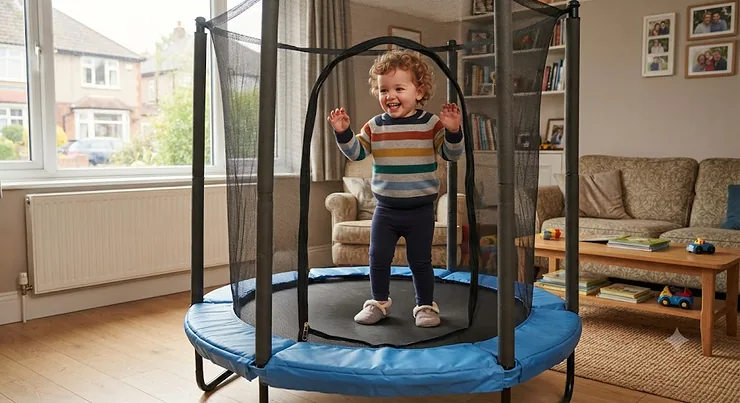
Watching a toddler discover bouncing for the first time is a bit like watching them discover their own legs all over again — wobbly, delighted, slightly chaotic, and somehow completely infectious. If you’re hunting for the best toddler trampolines, you’ve probably already noticed the market is a maze of handle bars, safety nets, and wildly different price tags, from a £20 Argos basic to a £130 enclosure-net model with a basketball hoop bolted on for good measure.
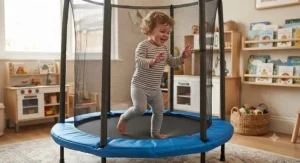
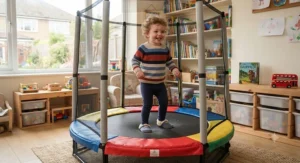
So what actually is a toddler trampoline? In short, it’s a low-height, low-bounce activity trampoline — typically 2 to 5.5 feet across, with a support handle or padded netting — designed specifically for children roughly 12 months to 6 years old to build balance, coordination and confidence, distinct from a full-size garden trampoline built for older kids.
That distinction matters. Toddlers under about three shouldn’t be anywhere near a full-size garden trampoline; their bodies simply aren’t developed enough to control an energetic bounce yet. A proper toddler-specific model, used one child at a time with adult supervision, sits in a very different risk category. It also ties neatly into wider guidance: the NHS recommends toddlers be physically active every day for at least 180 minutes, spread throughout the day and including active, outdoor-style play — read the full NHS activity guidance. A toddler trampoline, used sensibly, is one easy way to chip into that total on a rainy Tuesday.
This guide covers seven real, currently available toddler trampolines across budget, mid-range and premium price points, comparing handle bar designs against safety net enclosures, indoor practicality, and genuine long-term value — not just a rewritten spec sheet.
Quick Comparison Table
| Trampoline | Type | Weight Capacity | Best For |
|---|---|---|---|
| TP Toys Early Fun 4.5ft Junior Trampoline | Handle bar, frame pads | Toddler weight range | Best overall first trampoline |
| Happin 55″ Ultra Safe Trampoline | Full safety enclosure net | Up to roughly 45kg | Best with a safety net |
| Chad Valley Toddler Trampoline | Handle bar, low frame | 20kg | Best budget under £30 |
| Galt Nursery Trampoline | Detachable handle | 20kg | Best for balance-building |
| BCAN 36″ Mini Toddler Trampoline | Adjustable handle, foldable | Around 45kg | Best foldable under £50 |
| HLC 37″ Foldable Toddler Trampoline | Safety handle, foldable | Up to 60kg | Best for growing with your child |
| TP Toys UP 4.5ft Junior Trampoline | Full net enclosure | Higher family-friendly capacity | Best premium, grows-with-child pick |
Looking at the spread, there’s a clear split between compact handle-bar bouncers built for very early walkers and larger net-enclosed models that comfortably see a child through to preschool age. Budget doesn’t strictly track quality here — the Galt Nursery Trampoline and Chad Valley Toddler Trampoline punch well above their price simply by doing one job properly, while the enclosure-net models justify their higher cost with a longer useful lifespan. If you’re torn between a handle and a net, the honest answer is that it depends almost entirely on your child’s age and how confident they already are on their feet — more on that below.
💬 Just one click — help others make better buying decisions too!😊
Top 7 Best Toddler Trampolines: Expert Analysis
1. TP Toys Early Fun 4.5ft Junior Trampoline — best overall first trampoline
The soft-grip handle bar is the standout here, giving very new walkers something secure to hold while they figure out how bouncing actually works. TP Toys has been designing UK outdoor play equipment since 1959, and this compact 4.5ft model carries that pedigree through into protective frame padding, a springless-feeling compact bounce, and a genuinely toddler-appropriate low height that lets an 18-month-old climb on and off unassisted. Based on the spec comparison against rival handle-bar models, the frame padding is noticeably more generous than budget alternatives, which matters more than people expect — cheap padding compresses and thins within months of daily use.
This is the trampoline to buy if you want a no-fuss first bouncer that isn’t a toy your toddler outgrows in a season; TP Toys’ broader Junior range is specifically pitched at children under five. Aggregated customer feedback across TP Toys’ own listings consistently flags the assembly instructions as clear and the build as sturdy for the size, though a handful of buyers mention delivery timing niggles rather than product faults.
Pros:
- ✅ Purpose-built handle for confident, secure early bouncing
- ✅ Protective frame pads reduce impact risk from falls
- ✅ Compact footprint suits small rooms and flats
Cons:
- ❌ Bounce height is deliberately limited, so older toddlers outgrow it fast
- ❌ No safety net, so supervision remains essential throughout
In the £45-£55 range, this sits at the affordable end of “proper” toddler trampolines rather than budget novelty territory, and on value alone it’s hard to beat for a first purchase.
2. Happin 55″ Ultra Safe Trampoline — best with a safety net enclosure
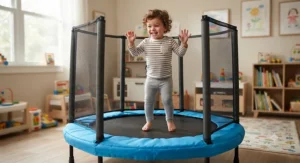
The uniquely curved enclosure poles are the standout feature, creating a gap between the netting and the metal frame specifically to stop little limbs colliding with anything solid mid-bounce. At 55 inches across, this is a genuine step up in jumping space from the handle-bar bouncers, with thick foam padding covering every potential impact point and a weight capacity that comfortably handles a single toddler with room to grow into it. What most buyers overlook about safety-net models like this one is that the net isn’t just a fall-catcher — it also stops a toddler wandering off the mat sideways mid-bounce, which is the single most common way small children come off a trampoline.
Reviewers consistently note the noise-free bounce (useful for flats and early mornings) and straightforward assembly, while a recurring theme in aggregated feedback is that the net zip needs checking periodically to make sure it hasn’t worked loose. Based on the spec sheet, the curved-pole design also means fewer pinch points than straight-pole rivals — a small but genuinely useful engineering detail.
Pros:
- ✅ Full enclosure net prevents sideways falls off the mat
- ✅ Curved poles create a gap away from hard frame parts
- ✅ Noise-free bounce, good for indoor use in flats
Cons:
- ❌ Bulkier footprint than simple handle-bar bouncers
- ❌ Net and zip need occasional inspection for wear
Priced in the £90-£120 range, it’s a mid-to-premium buy, but for parents specifically searching for toddler trampolines with a safety net, this is the clearest match on the market right now.
3. Chad Valley Toddler Trampoline — best budget pick under £30
The standout here is simply the price-to-purpose ratio: a genuinely toddler-scaled 58cm trampoline with foam handles and a weather-resistant safety mat for well under £30. Built for children from around 18 months with a 20kg maximum user weight, it’s a painted steel frame with non-slip feet, designed to be lightweight enough (2.7kg) that a parent can move it between rooms without a second thought. On paper this means it’s not trying to be everything — it’s a genuinely entry-level product, and that focus is exactly why it works so well for its narrow age bracket.
Argos customer Q&A responses repeatedly confirm the trampoline is suitable from 18 months, and feedback describes it as well-received for its build quality relative to its size, though it’s worth being upfront that only the handlebar folds — the base frame stays assembled, so storage-conscious buyers should measure their space first.
Pros:
- ✅ Genuinely low price point for a purpose-built toddler bouncer
- ✅ Lightweight at 2.7kg, easy to carry between rooms
- ✅ Weather-resistant padding suits indoor and outdoor use
Cons:
- ❌ 20kg weight limit means toddlers outgrow it quickly
- ❌ Frame doesn’t fully fold flat for storage
At around £20-£30, this is the trampoline to buy if you want to test whether your toddler even likes bouncing before committing to a bigger spend.
4. Galt Nursery Trampoline — best for building balance and coordination
The standout advantage is the fully detachable handle and legs, which turns this tortoise-themed trampoline into a genuinely flat-packable product rather than one that just claims to be. Aimed at children 12 months to 3 years with a 20kg weight limit, the tubular steel frame and padded cover are built by Galt, a long-established British toy manufacturer with a reputation for durable, developmentally-focused nursery products rather than trend-chasing novelty toys. Here’s what to weigh: the 70cm diameter is genuinely compact, so this suits flats and smaller playrooms better than families hoping for a bigger bounce.
Verifiable review volume for this specific model is lower than for the bigger Amazon sellers in this list, but where feedback does exist, parents consistently highlight how easily the handle and legs detach for storage, and how confidently very young toddlers use the grip handle to steady themselves.
Pros:
- ✅ Handle and legs both detach for genuinely easy storage
- ✅ Rubber feet keep it stable on hard indoor floors
- ✅ Backed by an established, trusted British toy brand
Cons:
- ❌ Fairly low 20kg weight ceiling for the price
- ❌ Assembly reportedly needs two adults, not one
In the £40-£50 range, it sits slightly above the cheapest Chad Valley option, but the storage-friendly design and brand reputation justify the difference for many parents.
5. BCAN 36″ Mini Toddler Trampoline — best foldable pick under £50
The adjustable handle is the headline feature, assembling in two configurations: a convex position that’s easier for 1-2 year olds to grip, and a concave setup that frees up more bounce space for confident 3-5 year olds. Built with anti-slip rubber feet, a thickened foam handle, and an elastic-band (springless) bounce system rather than metal springs, it’s specifically engineered around the fact that toddler fingers and springs are a bad combination. What most buyers overlook about elastic-band designs like this is that they’re quieter and gentler underfoot than sprung trampolines, which matters when a toddler is still learning to control their landings.
Aggregated Amazon feedback for compact folding toddler trampolines in this category tends to praise quick, tool-free assembly and genuine portability, while a recurring complaint across similar folding designs is that the handle can feel slightly less rigid than a fixed-frame alternative during more energetic bouncing.
Pros:
- ✅ Handle adjusts to suit two different age stages
- ✅ Elastic-band bounce avoids exposed metal springs entirely
- ✅ Folds down genuinely flat for cupboard storage
Cons:
- ❌ Handle rigidity can feel softer than fixed-frame rivals
- ❌ Compact size limits it to solo toddler use
At a typical £30-£45 range, this is a strong pick for parents short on permanent floor space who still want proper safety-conscious engineering.
6. HLC 37″ Foldable Toddler Trampoline with Safety Handle — best for growing with your child
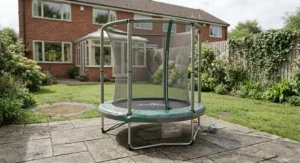
The standout feature is the generous 60kg maximum weight capacity for a trampoline this compact — noticeably higher than most 36-inch rivals, meaning it comfortably outlasts the toddler years into early school age. The 37-inch mat is paired with a sturdy safety handle and a fully foldable frame, aimed at indoor and outdoor use without demanding a dedicated storage spot. Based on the spec comparison, that weight ceiling is the genuine differentiator against similarly priced folding trampolines, most of which cap out closer to 45kg — a meaningful gap if you’re hoping one purchase covers a two- or three-year age span.
Reviewers of compact foldable trampolines in this size and price bracket typically flag straightforward assembly as a strength, while noting — fairly consistently across similar budget models — that the fabric mat surface can show wear faster than pricier alternatives after very frequent daily use.
Pros:
- ✅ 60kg weight limit gives real longevity as your child grows
- ✅ Fully foldable frame for genuine space-saving storage
- ✅ Sturdy handle adds confidence for less steady jumpers
Cons:
- ❌ Mat fabric wear reported with very heavy daily use
- ❌ No enclosure net, so active supervision still matters
Sitting under £40 for most buyers, it’s arguably the best value-for-weight-capacity pick on this list.
7. TP Toys UP 4.5ft Junior Trampoline — best premium, grows-with-child pick
The standout is the full SurroundSafe-style net enclosure combined with a zip-free IGLOO-style entrance, a design detail that removes the fiddly zip-catching-fingers problem entirely while keeping the net properly sealed during bouncing. As part of TP Toys’ core UP range, this 4.5ft model carries a higher weight capacity than the entry-level Junior line, effectively bridging toddlerhood into early primary school use rather than being retired after eighteen months. What the spec sheet won’t tell you, but user feedback does, is that assembly takes real time — TP Toys’ own guidance recommends allowing a proper block of time for the enclosure to go together correctly.
Across 95 reviews, the wider TP Toys UP Junior range holds an average rating of roughly 4.69 out of 5, with feedback consistently praising the size for small gardens and the overall sense of sturdy build quality, alongside occasional notes about delivery or assembly instruction clarity.
Pros:
- ✅ Zip-free enclosure entrance removes a common pinch-point
- ✅ Higher weight capacity means genuine multi-year use
- ✅ Strong, independently visible review track record
Cons:
- ❌ Noticeably pricier than compact toddler-only alternatives
- ❌ Assembly is a genuine two-person, unhurried job
In the £120-£140 range, this is the trampoline for parents who’d rather buy once and skip the “outgrown it already” upgrade cycle.
Practical Usage Guide: Setting Up and Introducing Your Toddler to Bouncing
Getting a toddler trampoline right starts well before the first bounce. Position it on a flat, carpeted or grassed surface — never directly on hard tile or concrete, even indoors, since a stumble onto bare floor is far harder than one cushioned by carpet pile. For enclosure-net models, check the zip or entrance mechanism every few weeks; nets loosen gradually with regular use, and a slack net defeats the point of having one.
In the first thirty days, resist the urge to let your toddler bounce unsupervised “just for a minute” — this is genuinely the window where most falls happen, simply because both of you are still learning the trampoline’s quirks. Introduce bouncing standing beside the trampoline rather than on it with your child; a 12kg toddler landing awkwardly against an adult’s far heavier bodyweight is a common and avoidable cause of injury. Once your toddler is confident holding the handle independently, start timing sessions in short bursts of five to ten minutes rather than long unstructured stretches, since fatigue is when control slips first.
Maintenance is minimal but not optional: wipe down padding after outdoor use, check foam handle grips for splitting, and retire any trampoline where the frame padding has thinned enough to expose metal.
Real-World Scenarios: Which Toddler Trampoline Suits Your Family
If you’re a parent in a two-bedroom flat with a wobbly 14-month-old just finding their feet, a compact handle-bar model like the Chad Valley Toddler Trampoline or Galt Nursery Trampoline makes far more sense than an enclosure-net design — you need low height, low weight, and easy storage far more than jumping space.
If you’ve got a confident three-year-old who’s already outgrown a first bouncer and you’re short on garden space for a full-size trampoline, the Happin 55″ Ultra Safe Trampoline or TP Toys UP 4.5ft Junior Trampoline buys real jumping room with a proper safety net, without the footprint or expense of a garden-sized model.
And if you’re simply not sure your toddler will take to bouncing at all — some don’t, at least not immediately — the BCAN 36″ Mini Toddler Trampoline or HLC 37″ Foldable Toddler Trampoline let you test the water for under £50 with genuine fold-away storage if it turns out not to be their thing.
Problem → Solution: Fixing Common Toddler Trampoline Headaches
Problem: My toddler keeps falling off the sides. Solution: switch to or add a full enclosure net model, such as the Happin 55″ Ultra Safe Trampoline, and position the trampoline at least a metre from furniture edges as an extra buffer.
Problem: The trampoline takes up too much floor space. Solution: a genuinely foldable design like the BCAN 36″ Mini Toddler Trampoline collapses flat for under-bed or cupboard storage between sessions.
Problem: My toddler has already outgrown their first trampoline. Solution: step up to a higher weight-capacity model such as the HLC 37″ Foldable Toddler Trampoline (60kg) or the TP Toys UP 4.5ft Junior Trampoline, which are built to last well beyond the toddler years.
Problem: It’s too noisy for our flat. Solution: elastic-band, springless designs like the BCAN 36″ Mini Toddler Trampoline and Happin 55″ Ultra Safe Trampoline are specifically engineered to be quieter than sprung alternatives — the Mumsnet trampoline safety guide is a useful read on noise and neighbour-friendly setup too.
Problem: I’m not sure my toddler is even ready. Solution: start with the cheapest genuinely age-appropriate option — the Chad Valley Toddler Trampoline — before investing in a premium model.
How to Choose the Best Toddler Trampoline
- Check the age and weight rating first. A trampoline rated for a 20kg toddler shouldn’t be shared with a parent demonstrating bounces — stand beside it instead.
- Decide between a handle bar and a safety net. Handles suit new walkers under two; nets suit more confident bouncers who move around the mat.
- Measure your actual storage space. Not every model folds flat — check this before, not after, delivery.
- Prioritise padding thickness over bounce height. A gentler bounce with thick padding beats an energetic one with thin cover for this age group.
- Look for a genuinely toddler-specific product, not a scaled-down adult fitness trampoline with a handle bolted on.
- Factor in noise if you’re in a flat. Elastic-band and springless designs are noticeably quieter than sprung mats.
- Read aggregated review themes, not star ratings alone. Recurring complaints (loose nets, thin padding) tell you more than a headline score.
Handle Bar Trampolines vs Safety Net Enclosures: Which Design Wins
There’s no single correct answer here — it genuinely depends on your toddler’s stage of development. Handle bar trampolines, like the TP Toys Early Fun 4.5ft Junior Trampoline, the Chad Valley Toddler Trampoline, and the Galt Nursery Trampoline, are built around a very early walker’s need for something to physically grip while their balance is still developing. The handle does the stabilising work that a net simply can’t for a child who hasn’t yet learned to bounce in place.
Safety net enclosures, by contrast — as seen on the Happin 55″ Ultra Safe Trampoline and TP Toys UP 4.5ft Junior Trampoline — become more valuable once a toddler is confident enough to move around the mat while bouncing, because that’s precisely when the risk shifts from “falling forward off a handle” to “wandering sideways off the edge.” Any toy sold in the UK, including trampolines marketed at children, is required to comply with the Toys (Safety) Regulations 2011, and it’s worth checking a product carries UKCA or CE marking regardless of which design you choose — see the official gov.uk toy safety guidance for the full detail. As a rough rule of thumb: under two, lean handle; two and up and steady on their feet, lean net.
Indoor Toddler Trampolines: Space, Noise and Floor Protection
Buying specifically for indoor use changes the priority order. Footprint matters more than outdoor durability — a compact 36-inch model like the BCAN 36″ Mini Toddler Trampoline fits a playroom corner far more sensibly than a 55-inch enclosure model. Noise matters too, especially in flats or houses with shared walls; elastic-band and springless designs consistently bounce quieter than metal-sprung alternatives, and several manufacturers now market this explicitly as a feature rather than an afterthought.
Floor protection is the detail people forget. Even a padded toddler trampoline transmits some vibration and occasional scuffing to laminate or wood flooring, so a thin rug or interlocking foam mat underneath is a cheap, sensible add-on. Ceiling height is the other easily-missed factor — even a low-bounce toddler trampoline needs roughly a metre of clear headroom above it, more if you’ve got a taller three- or four-year-old using it.
Toddler Trampolines Under £50: Best Budget Buys
Budget doesn’t have to mean a compromise on safety fundamentals, though it usually does mean a compromise on longevity or extra features. The Chad Valley Toddler Trampoline and BCAN 36″ Mini Toddler Trampoline both sit comfortably under £50 while still offering purpose-built padding, appropriate weight ratings, and either a folding or lightweight design. The Galt Nursery Trampoline and HLC 37″ Foldable Toddler Trampoline hover right around or just under that £50 line depending on retailer promotions, and both add genuine extras — detachable storage for the Galt, a higher weight ceiling for the HLC — that make them worth the small stretch.
What you generally lose at this price point is a full safety net enclosure; none of the sub-£50 options on this list include one. If a net is non-negotiable for your family, budget closer to £90 and look at the Happin 55″ Ultra Safe Trampoline instead. Otherwise, for a first trampoline bought to test the waters, any of the four budget picks here genuinely deliver on the basics.
Bouncing Safety for Toddlers: RoSPA-Backed Ground Rules
It’s worth being honest about where mainstream trampoline safety guidance draws its lines. RoSPA notes that trampolining generally isn’t suitable for children under the age of six, because they aren’t sufficiently physically developed to control their bouncing — but that guidance is specifically written about full-size, sprung garden trampolines, not the low-height, low-bounce toddler-specific products covered in this guide. The distinction matters: a 58cm Chad Valley bouncer with a 20kg limit and a handle is a fundamentally different risk profile to a 10ft sprung garden trampoline.
That said, the underlying principles still apply sensibly to toddler models. Never place a trampoline on a hard surface like concrete or tarmac without absorbent matting underneath, and one child at a time is the rule regardless of trampoline size — RoSPA data suggests 60% of trampoline injuries happen when more than one person is bouncing at once. Full guidance is available directly from RoSPA’s trampoline safety resource. Active adult supervision, checked padding and nets, and strict one-toddler-at-a-time rules remain the three fundamentals, whichever model you choose.
✨ Don’t Miss These Exclusive Deals!
🔍 Take active play to the next level with these carefully selected toddler trampolines. Click through to check current pricing and availability, and give your little one hours of safe, confidence-building bounce time!
Common Mistakes When Buying a Toddler Trampoline
The most frequent mistake is buying on bounce height rather than age-appropriateness — a trampoline that bounces higher isn’t better for a toddler, it’s riskier. Parents also regularly skip checking the actual weight limit, assuming any “kids” trampoline covers their toddler, when many budget models cap out at 18-20kg. Another common misstep is buying a net-enclosure model for a child who isn’t yet mobile enough to need one, paying a premium for a feature that won’t be genuinely useful for another year.
Storage is chronically underestimated too — several models marketed as “foldable” only fold the handle, not the base frame, which catches out flat-dwellers specifically. Finally, don’t assume outdoor durability claims mean indoor floor-safety; check separately for non-slip, non-marking feet if it’s going on laminate or wood.
Toddler Trampolines vs Traditional Garden Trampolines
The comparison isn’t really “which is better” — it’s “which is appropriate for the age.” Traditional garden trampolines are sprung, sit higher off the ground, and are built for children who can already control a bounce, typically from around six years old and up under RoSPA’s general guidance. Toddler trampolines sit low, bounce gently, and are engineered specifically around the balance limitations of a one- to five-year-old.
Cost-per-use tends to favour toddler models in the short term — a £30-£50 spend covers roughly two to three years of appropriate use before a child outgrows it, at which point a family garden trampoline becomes the sensible next step rather than a replacement toddler model. Trying to skip straight to a garden trampoline for a toddler isn’t a value shortcut; it’s a genuine step up in injury risk for very little practical gain, since a toddler can’t yet use the extra bounce height safely anyway.
Long-Term Cost & Maintenance
Total cost of ownership for a toddler trampoline is modest compared to most nursery equipment, but it’s not zero. Budget models under £50 typically need replacing within two to three years, either through outgrowing the weight limit or general wear to padding and fabric. Mid-range and premium net-enclosure models, priced from roughly £90 upward, tend to have a longer realistic lifespan — often stretching from toddlerhood into early primary school — which narrows the effective cost-per-year gap considerably once you do the maths.
Maintenance costs are minimal: replacement parts like handle grips or net sections are occasionally available from manufacturers directly, but a trampoline with structurally worn padding or a torn net is generally not worth repairing at this price tier — replacement is usually the more sensible route both financially and safety-wise.
Frequently Asked Questions
❓ What age can a toddler start using a trampoline?
❓ Do toddler trampolines need a safety net?
❓ Are toddler trampolines safe for 1 year olds?
❓ What is the best toddler trampoline under £50?
❓ Can toddler trampolines be used indoors on carpet?
Conclusion
Choosing between these seven toddler trampolines really comes down to two questions: how steady is your toddler on their feet right now, and how much space do you genuinely have to give it? For brand-new walkers, a compact handle-bar model like the TP Toys Early Fun 4.5ft Junior Trampoline or budget-friendly Chad Valley Toddler Trampoline covers the essentials without overspending. For confident bouncers who’ve outgrown a first model, the safety-net security of the Happin 55″ Ultra Safe Trampoline or the longer-lasting TP Toys UP 4.5ft Junior Trampoline earns its higher price tag through genuine extra years of use.
Whichever you choose, the fundamentals stay the same: check the weight rating properly, supervise every session, keep it to one toddler at a time, and inspect padding and nets regularly as they age. Bouncing is genuinely good for a toddler’s coordination and confidence — it’s worth getting the choice right so it stays that way.
Recommended for You
- Rectangular vs Round Trampoline: 7 Best Picks Ranked (2026)
- Rectangular Trampoline Gymnastics: 7 Best Picks for 2026
- Best Rectangular Trampoline UK 2026: 7 Top Picks Reviewed
Disclaimer: This article contains affiliate links. As an Amazon Associate, I earn from qualifying purchases. If you purchase products through these links, we may earn a small commission at no additional cost to you.
✨ Found this helpful? Share it with your friends! 💬🤗
