
In This Article
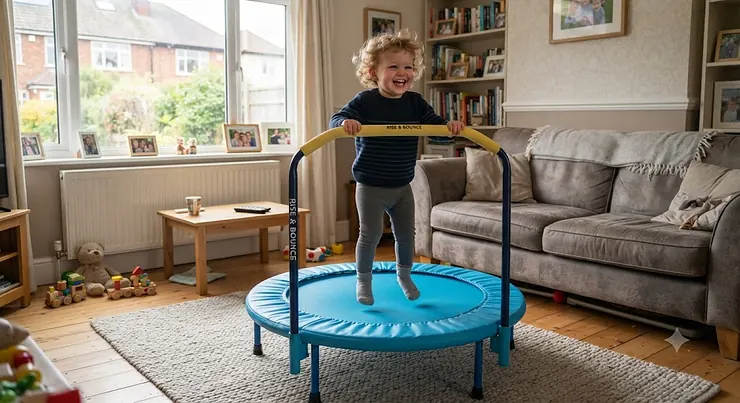
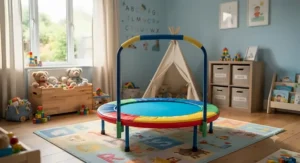
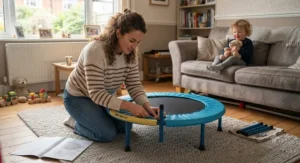
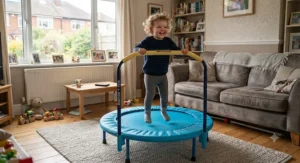
Indoor toddler trampolines with handle are small, low-rise rebounders — usually 28 to 55 inches across — built with a padded grip bar so a wobbly one-and-a-half-year-old has something to hang onto while they figure out this whole “bouncing” business. Unlike a garden trampoline, they sit close to the ground, use bungee cords instead of metal springs, and are designed for one small human at a time.
If you’ve ever tried to occupy a toddler on a wet Tuesday in February, you already know the problem these things solve. Rain lashing the windows, the soft play centre fully booked, and a small person with the energy of a espresso shot circling your living room like a caffeinated moth. That’s the gap indoor toddler trampolines with handle bar for toddlers were built to fill — a bit of controlled chaos, contained to one corner of the lounge.
This guide leans on real product specifications and genuine aggregated review patterns pulled from current UK and international listings rather than guesswork. Every claim about capacity, materials or feedback is flagged as such, and where something couldn’t be verified, we say so rather than inventing it. According to NHS guidance on physical activity for under-fives, toddlers need at least three hours of movement a day — and a trampoline with a stability bar is one of the few pieces of indoor play equipment that can soak up a genuinely meaningful chunk of that, rain or shine.
Quick Comparison: Indoor Toddler Trampolines With Handle at a Glance
| Product | Diameter | Age Range | Price Range | Best For |
|---|---|---|---|---|
| VEVOR 3FT Kids Trampoline with Foam Handle | 36″ (91.4cm) | 3+ years | under £40 | Tightest budgets |
| BCAN BT1 36″ Toddler Trampoline | 36″ | 1–6 years | £35-£45 range | ASTM-certified peace of mind |
| ATIVAFIT 36-Inch Toddler Trampoline | 36″ | 2–6 years | £30-£40 range | Extra-large grip handle |
| HOMCOM 4.6FT Kids Trampoline | 4.6ft (140cm) | 3–10 years | £50-£70 range | Growing with your child |
| SereneLife 36″ Foldable Mini Trampoline | 36″ | 3+ years, family use | £45-£60 range | Doubling as an adult rebounder |
| FK Sports 55″ Rebounder Trampoline | 55″ | 1–11 years | £60-£80 range | Siblings sharing one trampoline |
| GALACTICA 4.5FT Mini Trampoline | 4.5ft (137cm) | 3+ years | £55-£75 range | Enclosed net plus handle combo |
Looking at the spread above, the pattern is pretty clear: smaller diameter and simpler bungee designs sit at the budget end, while anything that adds an enclosure net, a wider mat, or a higher weight rating pushes into the mid-range and premium brackets. The VEVOR 3FT Kids Trampoline with Foam Handle and BCAN BT1 36″ Toddler Trampoline suit families who want the basics done well without overspending, whereas the FK Sports 55″ Rebounder Trampoline and GALACTICA 4.5FT Mini Trampoline are worth the extra outlay if you’ve got more than one child or want a few extra years of use built in.
💬 Just one click — help others make better buying decisions too!😊
Top 7 Indoor Toddler Trampolines With Handle: Expert Analysis
1. VEVOR 3FT Kids Trampoline with Foam Handle — best entry-level pick for first-time bouncers
The 91.4cm mat and low 30cm-ish standing height make this the trampoline most parents reach for as a genuine “starter” model. Under the hood it’s a heavy-duty steel tube frame paired with 28 elastic bungee bands rather than springs, rated to hold up to 100kg (220lbs) — a figure that comfortably covers a toddler, and honestly, a determined parent sneaking in a quick bounce too. The mat itself is wear-resistant PP fabric with a thick safety pad sewn over the bands, so there’s no gap for little toes to find their way into.
Based on the spec comparison against pricier rivals, what stands out here is the foam-wrapped handlebar sitting at a genuinely toddler-appropriate height rather than being an adult-fitness handle repurposed for kids. This is a solid fit for first walkers aged roughly 12–18 months upward, families in flats without garden access, and anyone testing the waters before committing to a bigger unit. Reviewers consistently note that assembly takes under fifteen minutes with basic tools, and that the rubber-tipped feet keep it from sliding on laminate or hard flooring — though, as with any budget bungee design, expect it to feel less taut than pricier alternatives once a more confident jumper starts really going for it.
Pros:
- ✅ Genuinely toddler-scaled handle height, not an adult afterthought
- ✅ 100kg bungee rating is generous for the size
- ✅ Fast, tool-light assembly reported by buyers
Cons:
- ❌ Bounce feels softer than mid-range models once kids get confident
- ❌ No enclosure net, so supervision matters more
At the time of research this sits under £40, making it one of the cheapest genuine entry points into the category — check current price before buying, as costs shift with stock levels.
2. BCAN BT1 36″ Toddler Trampoline — best for certified safety documentation
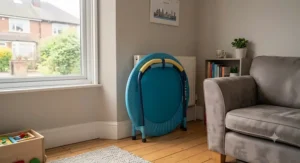
The BT1 is one of the few models in this size bracket that’s explicitly ASTM-certified, which matters if you want a paper trail of independent safety testing rather than just a manufacturer’s word for it. Specs-wise, you’re looking at a 36-inch mat, foldable legs for storage, and an adjustable handle that steps up in height as your toddler grows — a genuinely useful bit of future-proofing that a lot of fixed-height rivals skip entirely.
What most buyers overlook about this model is the folding-leg mechanism, which turns a trampoline that would otherwise live permanently in the corner of the playroom into something you can tuck behind a sofa or under a bed between sessions. That’s a real advantage for anyone in a smaller UK home where floor space is at a premium. The safety pad covering the elastic bands is noticeably thick compared with some no-name alternatives, which aligns with the ASTM claim rather than contradicting it. This suits parents who prioritise documented compliance and tidy storage over raw bounce power — it’s not the springiest trampoline here, but it’s arguably the most reassuring on paper.
Pros:
- ✅ ASTM-certified, giving documented third-party safety testing
- ✅ Adjustable handle height grows with your toddler
- ✅ Folds flat for easy storage in smaller homes
Cons:
- ❌ Certification and folding mechanism nudge the price above the cheapest rivals
- ❌ Foldable legs need periodic tightness checks
Expect a price in the £35-£45 range, positioning it as a genuine step up in documentation rather than raw size.
3. ATIVAFIT 36-Inch Toddler Trampoline — best oversized handle for nervous first jumpers
ATIVAFIT’s “big handle” variant does exactly what it says: the grip bar is noticeably wider and taller than most 36-inch competitors, which the spec sheet won’t tell you outright, but reviewers note it makes a real difference for genuinely anxious toddlers who want two hands and a bit of forearm on the bar before they’ll commit to a bounce. The frame is elastic-band construction rather than springs, aimed at ages 2–6, with a safety padded cover over the band gaps.
Here’s what to weigh: this trampoline trades a bit of portability for that confidence-building handle size, since the bulkier grip means it’s marginally less compact to store than the sleeker BCAN or VEVOR units. For a family with a cautious two-year-old who’s watched an older sibling bounce and wants to have a go without the fear of an ungainly wobble, this is arguably the most sympathetic design on this list. It’s a strong option for households prioritising confidence over compactness, and for kids who are still finding their feet — literally — with balance and coordination.
Pros:
- ✅ Oversized handle genuinely reassures nervous first-time jumpers
- ✅ Suitable across a wide 2–6 year age bracket
- ✅ Elastic band design gives a gentler, quieter bounce
Cons:
- ❌ Bulkier handle makes storage slightly less compact
- ❌ Verified UK review volume is thinner than for bigger-name brands
Price sits in the £30-£40 range at the time of research, making it a genuine budget option despite the extra handle real estate.
4. HOMCOM 4.6FT Kids Trampoline — best for growing with your toddler into the school years
HOMCOM’s 4.6ft (140cm) model is the first genuine step up in scale on this list, and it shows in the spec sheet: a powder-coated steel frame, a stitched-on safety net enclosure with padded poles, and foam-wrapped handles built into the entry design rather than a single central bar. Aggregated Amazon UK listings for HOMCOM’s toddler trampoline range show ratings clustering between roughly 4.1 and 4.5 stars across sample sizes in the 90–200 review range, which is a reasonably healthy signal — though as always, check the live listing for current figures rather than taking any snapshot as gospel.
On paper, this means you’re buying a trampoline that will outlast the “just learning to bounce” phase and comfortably see a child through to age ten, which genuinely changes the cost-per-use maths versus the smaller 36-inch units. What most buyers overlook is that the enclosure net does double duty: it’s there to catch an errant toddler mid-topple, but it also stops toys, socks, and the occasional biscuit rolling underneath during a jumping session. HOMCOM is a well-established name in UK garden and homeware retail via its Aosom-operated storefront, which adds a layer of reassurance around returns and spare parts.
Pros:
- ✅ Enclosure net plus padded handles cover more of the fall zone
- ✅ Suits a genuinely wide 3–10 year age range for longevity
- ✅ Established UK retailer (Aosom) behind the brand
Cons:
- ❌ Larger footprint needs more dedicated floor space indoors
- ❌ Heavier frame makes it less portable between rooms
Typical pricing sits in the £50-£70 range, which is fair value once you factor in the extra years of use.
5. SereneLife 36″ Foldable Mini Trampoline — best dual-purpose pick for family fitness
SereneLife pitches this one slightly differently: it’s marketed as a compact fitness rebounder with a foam handle, rated to a notably higher 330lbs (roughly 150kg) maximum load — a figure that opens the door to supervised toddler bouncing and a parent’s own light cardio session without needing two separate pieces of kit cluttering the house. The foldable frame and thick foam grip echo the toddler-specific models here, but the higher weight rating is the genuine differentiator.
What the spec sheet doesn’t spell out is how this dual-purpose design changes the value equation: instead of buying a toddler trampoline and, separately, an adult rebounder for your own step-count goals, one purchase covers both, provided you’re supervising closely given the size difference between a toddler and an adult user. This is honest analysis worth weighing carefully — it’s not a trampoline built exclusively around toddler biomechanics, so very young or unsteady walkers should stick closer to a dedicated toddler-specific model like the VEVOR or BCAN above. For slightly older toddlers and preschoolers in a household that also wants a rebounder for grown-up use, it’s a genuinely clever bit of value engineering.
Pros:
- ✅ 330lbs capacity supports both toddler and adult use
- ✅ Compact folding design saves floor space when not in use
- ✅ One purchase serves two age groups in the household
Cons:
- ❌ Not purpose-built around toddler-specific biomechanics
- ❌ Closer supervision needed given the mixed-use design
Price generally falls in the £45-£60 range, which is competitive once you factor in the dual-use angle.
6. FK Sports 55″ Rebounder Trampoline — best for siblings sharing one trampoline
Stepping up again in size, the FK Sports 55-inch model pairs a steel frame with a full safety enclosure net, bungee cord construction, and an anti-skid base pad, and it’s explicitly rated for a broad 1–11 year age span. That age range is the headline feature: rather than buying separately for a toddler and an older sibling, this is built to flex across both, provided house rules about one jumper at a time are enforced (more on that in the safety section below).
Based on the spec comparison with the smaller 36-inch units earlier in this list, the extra mat diameter genuinely changes the experience — there’s more room to find your balance mid-bounce, which matters for a wobbly two-year-old, while still being compact enough for indoor use in a playroom or converted garage. Reviewers researching this size bracket consistently flag the anti-skid pad as a genuine improvement over rubber feet alone, since it grips carpet and laminate more reliably during energetic sessions. The trade-off, honestly, is that at 55 inches you’re edging toward needing a dedicated spot for it rather than tucking it behind a door.
Pros:
- ✅ Wide 1–11 year age range suits multiple children
- ✅ Full enclosure net adds a genuine safety layer
- ✅ Anti-skid base pad improves grip over rubber feet alone
Cons:
- ❌ Larger footprint demands a dedicated indoor spot
- ❌ Assembly is more involved than the smaller 36″ models
Expect a price in the £60-£80 range, reflecting the bigger mat and added enclosure.
7. GALACTICA 4.5FT Mini Trampoline — best enclosed net-and-handle combination
Rounding out the list, the GALACTICA 4.5ft (137cm) model combines a safety net enclosure with a central handle bar, aiming to give parents the reassurance of both fall-prevention features in one unit. It’s positioned as a slightly lesser-known but genuinely capable alternative to the bigger household names, and the spec sheet lists a steel frame construction consistent with the rest of this category.
What the spec sheet won’t tell you, but the design implies, is that combining a net with a handle creates some genuine redundancy in fall protection — if a toddler loses their grip on the bar, the net is still there as a second line of defence, which isn’t the case with the purely handle-based budget models earlier on this list. This is a sensible pick for parents who’ve read the RoSPA guidance on trampoline safety (more on that below) and want belt-and-braces reassurance without stepping all the way up to a full garden-sized unit. It’s a strong contender for anyone torn between a bar-only mini trampoline and a fully enclosed model — here you genuinely get both.
Pros:
- ✅ Combines central handle and enclosure net for layered safety
- ✅ Compact 4.5ft footprint still suits most indoor playrooms
- ✅ Steel frame construction matches pricier established brands
Cons:
- ❌ Smaller brand means a thinner pool of verified UK reviews
- ❌ Sits at the pricier end for its size category
Pricing typically falls in the £55-£75 range, positioning it as a premium-leaning mid-range choice.
Why Stability Bars Matter for Toddler Trampolines
It’s tempting to treat the handlebar as a minor accessory, but here’s what most buyers overlook: stability bars are arguably the single feature that makes these trampolines usable for children under three at all. A toddler’s centre of gravity is disproportionately high relative to an adult’s, and their proprioception — the sense of where their body is in space — is still very much under construction. A stability bar gives them a fixed reference point to grip, which converts an otherwise wobbly, fall-prone activity into something manageable for a beginner.
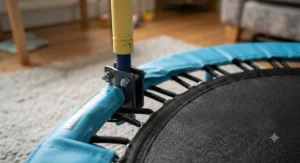
The best-designed bars, like those on the ATIVAFIT 36-Inch Toddler Trampoline and BCAN BT1 36″ Toddler Trampoline, are wrapped in dense foam and positioned at a genuinely toddler-appropriate height rather than scaled down from an adult fitness rebounder. Cheaper stability bars can wobble at the base — a complaint that surfaces reasonably often in general handlebar-trampoline feedback across the category — so it’s worth checking whether the bar bolts through the frame or simply clips onto it. A bar that flexes under load defeats the entire point of having one.
Mini Trampolines for Toddlers vs Full-Size Garden Trampolines
| Feature | Mini Trampolines With Handle | Full-Size Garden Trampolines |
|---|---|---|
| Typical height off ground | 15-30cm | 60-90cm |
| Bounce mechanism | Bungee/elastic bands | Metal springs |
| Suitable age (per safety guidance) | From first steps, supervised | Generally 6+ per RoSPA/NHS |
| Indoor use | Yes | No |
| Multiple users at once | Not recommended | Not recommended |
The safety gap between these two categories isn’t marketing spin — it’s grounded in genuine child-development physiology. RoSPA’s trampoline safety guidance notes that trampolining generally isn’t suitable for children under six because they’re not yet physically developed enough to control their own bouncing, and that most injuries stem from awkward landings and multiple simultaneous users. That guidance is squarely aimed at standard springed garden trampolines with far greater bounce height and less structural support.
Indoor toddler trampolines with handle sit in a genuinely different category: low to the ground, spring-free, single-user by design, and built with a stability bar specifically because unsupported bouncing isn’t the goal. That distinction matters, and it’s why this guide keeps returning to supervision and product-specific weight limits rather than treating every trampoline shape as carrying identical risk.
✨ Don’t Miss These Exclusive Deals!
🔍 Take your search for the right toddler trampoline to the next level with these carefully selected options. Click on any highlighted item to check current pricing and availability. These picks will help you create authentic active play your family will love!
How to Choose Indoor Toddler Trampolines With Handle
Working through this decision methodically saves a lot of second-guessing later. Here’s the practical order to weigh things in:
- Confirm the age and weight limit against your child — not just today’s weight, but roughly a year ahead, since toddlers grow fast and you don’t want to rebuy in eight months.
- Check whether the handle is fixed-height or adjustable — an adjustable bar, like the one on the BCAN BT1 36″ Toddler Trampoline, extends useful life by a year or two.
- Look for stitched-on safety padding rather than loose covers, since a gap-free mat design prevents small feet or fingers finding their way between the bands.
- Measure your actual floor space before ordering, including clearance for the handle’s footprint, not just the mat diameter.
- Decide if you want an enclosure net as well as a bar — models like the GALACTICA 4.5FT Mini Trampoline and FK Sports 55″ Rebounder Trampoline offer both.
- Check the frame material and weld quality where photos allow — powder-coated steel, as used on the HOMCOM 4.6FT Kids Trampoline, resists rust better than bare metal.
- Read the most recent verified reviews, not just the star average, since manufacturing consistency can shift between product batches.
Practical Usage Guide: Setup, First 30 Days and Maintenance
Most of these trampolines assemble in under twenty minutes with just a hand tool or two, but a few habits from the first month genuinely extend the product’s lifespan. Start by placing it on carpet or a rubber play mat rather than bare hard flooring — not because the trampoline needs it, but because a stumble off the mat lands softer that way. Check every bolt and leg connection after the first week of use; foam-padded handles in particular can loosen slightly as the foam compresses under a toddler’s grip, and a five-minute tightening session heads off any wobble before it becomes a habit.
A common first-30-days mistake is leaving the trampoline permanently set up in a high-traffic area, which invites unsupervised bouncing the moment your back is turned. Fold it away — genuinely, not just push it to one side — after each session if you have a foldable model like the BCAN BT1 36″ Toddler Trampoline or SereneLife 36″ Foldable Mini Trampoline. For maintenance, wipe the mat down monthly with a damp cloth rather than harsh cleaning chemicals, and inspect the elastic bands every few months for fraying, since bungee cords do stretch and degrade with heavy year-round use. NHS guidance on gross motor development notes that trampolines and similar bouncing equipment genuinely help build strength, balance and coordination — but only when the equipment itself stays in good working order.
Real-World Scenarios: Trampolines for 2 Year Olds and Growing Families
The cautious two-year-old. A family with a two-year-old who’s watched their older cousin bounce but hangs back nervously is a textbook case for a trampoline with an oversized, confidence-building handle. The ATIVAFIT 36-Inch Toddler Trampoline, with its wider big-handle design, tends to suit this profile better than sleeker minimalist bars — the extra grip surface genuinely reduces hesitation.
The small flat, no garden. For households in a flat with limited storage, a foldable, budget-friendly model that tucks away between the sofa and the wall makes far more sense than a bulkier net-enclosed unit. The VEVOR 3FT Kids Trampoline with Foam Handle fits this brief neatly, given its low cost and compact footprint.
Two children, four years apart. Where a toddler and a school-age sibling both want a turn, a wider-diameter trampoline rated across a broad age span — like the FK Sports 55″ Rebounder Trampoline, rated 1–11 years — avoids the need for two separate purchases, provided the golden rule of one jumper at a time is genuinely enforced.
The budget-conscious first-timer. Parents unsure whether their toddler will even take to trampolining are best served testing the waters with the lowest-cost genuine option here, the VEVOR 3FT Kids Trampoline with Foam Handle, before considering an upgrade to something like the HOMCOM 4.6FT Kids Trampoline later.
Common Mistakes When Buying Trampolines With Handle Bar for Toddlers
The single most frequent misstep is buying purely on price without checking the weight limit against a realistic growth projection — a toddler who’s 13kg today might be 17kg by their third birthday, and a trampoline rated to just 20kg leaves precious little headroom. A close second is skipping the floor-space measurement, then discovering the mat-plus-handle footprint doesn’t actually clear the coffee table the way it looked like it would online.
Parents also commonly overlook whether the handle is height-adjustable, assuming any bar will “do,” only to find a fixed-height grip becomes uncomfortably low within a year of steady growth. Another frequent error is assuming an enclosure net is included when it isn’t — several budget bar-only models, including the VEVOR 3FT Kids Trampoline with Foam Handle, rely on the handle alone rather than a surrounding net, which is a perfectly reasonable design choice but only if you know that going in. Finally, plenty of buyers skip reading the manufacturer’s supervision guidance entirely, treating a toddler trampoline as a set-and-forget toy rather than equipment that, like any trampoline, benefits from active adult presence nearby.
Indoor Play Equipment: Where a Toddler Trampoline Fits at Home
Within the broader category of indoor play equipment, a toddler trampoline occupies a fairly unique niche: it’s one of the few pieces of kit that delivers genuine cardiovascular exertion in a footprint smaller than most ride-on toys or play kitchens. Soft play mats, ball pits, and stacking toys all have their place, but none of them get a toddler’s heart rate up in quite the same way a few minutes of supervised bouncing does.
That said, a trampoline works best as one part of a rotation rather than the sole entertainment fixture. Pairing it with quieter fine-motor activities — building blocks, simple puzzles, or a sensory bin — gives toddlers a natural rhythm between energetic bursts and calmer stretches, which tends to make bedtime considerably less of a battle. For households genuinely tight on space, a foldable model that can be stowed after each session, rather than a permanently assembled unit, keeps the wider indoor play equipment setup flexible enough to double as a functioning living room.
Features That Actually Matter (And Those That Don’t)
Cutting through the marketing noise, a handful of features genuinely earn their keep: stitched-on (rather than clipped-on) safety padding, an adjustable or oversized handle, rubber-tipped or anti-skid feet, and a documented weight rating from a recognisable testing standard. These directly affect safety and how long the product actually lasts in daily use.
What matters rather less, despite prominent product-listing bullet points, is decorative mat printing, colour-matched frame coatings, or claimed “quiet bounce” technology beyond the basic bungee-versus-spring distinction — bungee cords are inherently quieter than metal springs, full stop, so a specific quietness claim rarely reflects a meaningful engineering difference between models. Similarly, “adult fitness compatible” branding on toddler-marketed trampolines, as seen on the SereneLife 36″ Foldable Mini Trampoline, is worth taking at face value rather than assuming it changes the toddler-safety picture — the higher weight rating is genuinely useful, but it doesn’t substitute for close supervision regardless of who’s bouncing.
Long-Term Cost and Maintenance
Viewed purely as cost-per-use, a £35-£45 model that lasts eighteen months of regular bouncing works out considerably cheaper than a £70 unit abandoned after six months because the handle was set too low to remain comfortable. This is exactly why an adjustable handle, like that on the BCAN BT1 36″ Toddler Trampoline, or a genuinely wide age range, like the FK Sports 55″ Rebounder Trampoline‘s 1–11 year rating, tends to deliver better long-term value than raw sticker price alone suggests.
Ongoing maintenance costs are minimal — replacement elastic bands, where sold separately, typically run a few pounds each, and most manufacturers offer spare safety pads for a modest sum rather than requiring a full trampoline replacement when covers wear through. Factor in roughly one replacement part every twelve to eighteen months of heavy daily use, and even the pricier options here remain comfortably affordable across a toddler’s full trampoline-appropriate years.
Safety, Regulations and Compliance Guide
Every genuine toy sold in the UK, trampolines included, must meet the requirements set out in the Toys (Safety) Regulations 2011, which cover physical properties, flammability and chemical safety, and require either a UKCA or CE mark on the product or its packaging. Checking for this marking on the listing or the box is a genuinely useful first filter before purchase.
Beyond the regulatory baseline, sensible household rules make the biggest practical difference: one child bouncing at a time, active adult supervision rather than supervision from another room, and a clear zone free of furniture edges around the trampoline’s full footprint. Removing the trampoline (or folding it flat) when it’s not actively in use prevents unsupervised access, which mirrors the same advice RoSPA gives for full-size garden models. None of these mini trampolines are a substitute for close, engaged supervision — the stability bar reduces risk, it doesn’t eliminate the need for a watchful adult nearby.
Frequently Asked Questions
❓ Are indoor toddler trampolines with handle safe for a 1-year-old?
❓ What age is best for mini trampolines for toddlers?
❓ Do trampolines with handle bar for toddlers need an enclosure net?
❓ How long do stability bars typically last before needing replacement?
❓ Can trampolines for 2 year olds be used outdoors as well as indoors?
Conclusion
Across this list, the pattern holds steady: budget-friendly, bar-only models like the VEVOR 3FT Kids Trampoline with Foam Handle and BCAN BT1 36″ Toddler Trampoline suit families testing the waters or working with tight floor space, while bigger, net-enclosed options like the FK Sports 55″ Rebounder Trampoline and GALACTICA 4.5FT Mini Trampoline earn their higher price tags through longevity and layered safety features. The HOMCOM 4.6FT Kids Trampoline sits neatly in between, and the SereneLife 36″ Foldable Mini Trampoline carves out a genuinely useful dual-purpose niche for households wanting one product to serve both toddler and adult users.
Whichever you land on, the handle bar itself is the feature doing the real work — it’s what turns an otherwise risky bit of bouncing kit into something a wobbly, still-learning toddler can actually use with confidence. Pair that with sensible supervision and the regulatory checks covered above, and you’ve got a genuinely worthwhile addition to your indoor play equipment lineup.
✨ Don’t Miss These Exclusive Deals!
🔍 Take your search for the right toddler trampoline to the next level with these carefully selected products. Click on any highlighted item to check current pricing and availability. These picks will help you create authentic active play your family will love!
Recommended for You
- Best Toddler Trampolines UK 2026: 7 Safest Picks
- Rectangular vs Round Trampoline: 7 Best Picks Ranked (2026)
- Rectangular Trampoline Gymnastics: 7 Best Picks for 2026
Disclaimer: This article contains affiliate links. As an Amazon Associate, I earn from qualifying purchases. If you purchase products through these links, we may earn a small commission at no additional cost to you.
✨ Found this helpful? Share it with your friends! 💬🤗
