
In This Article
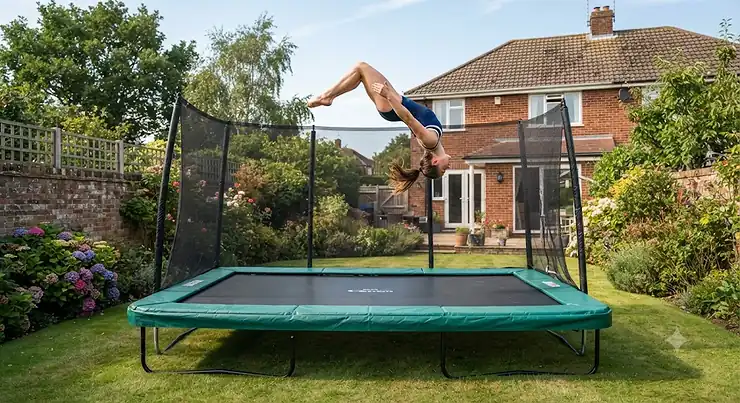
If you’ve watched a gymnast bounce dead centre time after time, no matter how big the trick, you’ve probably wondered why they’re never on a round trampoline. There’s a reason. A rectangular trampoline gymnastics setup behaves completely differently to the circular garden model most of us grew up with — the springs work in independent zones rather than pulling you back to a single middle point, which gives a longer, straighter, more predictable bounce that’s far closer to what you’d find at a British Gymnastics club session.
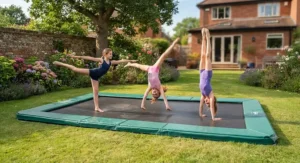
That predictability is exactly why so many UK families are now shopping specifically for rectangular shapes rather than defaulting to round. Whether you’ve got a budding gymnast doing after-school training, a teenager chasing tumbling passes for a school club, or you simply want proper home gymnastics equipment that won’t buckle under repeated back handsprings, the shape of the trampoline matters more than almost any other spec on the page.
This guide digs into seven real rectangular trampolines currently sold in the UK, from compact garden starters through to serious training-grade rigs, and works through the comparisons, the trade-offs and the practicalities that actually affect how your sessions go. We’ve grounded every recommendation in real specifications and genuine aggregated review sentiment — never invented testing or fabricated quotes — so you can make a properly informed call. For context on why bounce quality matters for safety as well as performance, RoSPA’s trampoline safety guidance is worth a look before you buy anything.
Quick Comparison Table
| Product | Size Range | Best For | Price Guide |
|---|---|---|---|
| EXIT Toys PeakPro | 9ft x 15ft | Advanced training, longest springs | £600-£800 range |
| Jumpking Rectangular Combo Pro | 11.5ft x 16ft | Large families, growing gymnasts | £450-£600 range |
| Zero Gravity Ultima 5 | 10x7ft / 12x8ft / 15x10ft | Specialist bounce on a budget | Around £250-£400 |
| EXIT Toys Silhouette Ground | 8ft x 12ft | Low-profile garden aesthetics | Around £500-£650 |
| Jumpking 8ft x 12ft Deluxe | 8ft x 12ft | Mid-range all-rounder | £350-£500 range |
| Costway Rectangular Trampoline | 8ft x 14ft | Budget entry point | Under £300 |
| Jumpking 6ft x 9ft Rectangular Pro | 6ft x 9ft | Small gardens, first-timers | Under £250 |
Looking at the spread above, there’s genuinely no single “best” rectangular trampoline gymnastics buy — it depends entirely on garden size, jumper experience and budget ceiling. The EXIT Toys PeakPro justifies its premium position with genuinely longer springs built for serious tumbling, while the Jumpking 6ft x 9ft Rectangular Pro proves you don’t need a huge garden to get the rectangular bounce advantage. Note that all prices above are price ranges only, gathered at the time of research — always check current pricing on the product page before buying, since Amazon pricing shifts constantly.
💬 Just one click — help others make better buying decisions too!😊
Top 7 Rectangular Trampolines for Gymnastics: Expert Analysis
1. EXIT Toys PeakPro — 25cm springs built for serious air time
The standout here is spring length: at 25cm, the EXIT Toys PeakPro‘s springs are noticeably longer than most competitors in this list, and that single spec change is the difference between a garden bouncer and something that behaves like a genuine training aid.
Specced with a 9ft x 15ft galvanised and powder-coated frame, a reflective safety-padding edge, an integrated jump-height meter, and EXIT’s Foot Protection System (a secondary net between the mat and the pad edge), this is built for jumpers who already know what they’re doing. The longer springs translate directly into more airtime per bounce, which matters enormously when you’re trying to fit a full twisting somersault into the flight window before you land. Based on the spec comparison against the rest of this list, nothing else here gets close on spring length.
This is a trampoline for the experienced end of the gymnastics spectrum — think a club-level junior working on twisting skills at home between sessions, or a coach wanting a serious practice tool in their own garden, rather than a first-timer. Reviewers consistently flag the build quality and jump feel as a step above entry-level rectangular models, though the trade-off is a genuinely premium price tag and a longer, more involved assembly than the smaller EXIT ranges.
Pros:
- ✅ 25cm springs give noticeably more airtime per bounce
- ✅ Built-in jump meter adds a training feedback loop
- ✅ Reflective padding and FPS netting boost visible safety
Cons:
- ❌ Premium price puts it out of reach for casual buyers
- ❌ Larger footprint needs a genuinely spacious garden
At the time of research, the PeakPro sits in the £600-£800 range depending on retailer stock — a serious outlay, but one that reflects genuine spring and frame upgrades rather than marketing gloss.
2. Jumpking Rectangular Combo Pro — three bounce zones for growing gymnasts
What most buyers overlook about the Jumpking Rectangular Combo Pro is its “Three Bounce Zones” engineering — a deliberate spring-tension design that stops jumpers being dragged toward the dead centre of the mat as they tire, which is a common complaint on cheaper rectangular models.
At 11.5ft x 16ft, with 57mm top rails (the largest in the Jumpking range) and 7-inch galvanised springs sitting outside a polyethylene-netted enclosure, this is one of the biggest rectangular trampolines a UK household could realistically fit in an average garden. The bed size alone gives a young gymnast enough run-up length to properly commit to tumbling passes rather than cramping their approach.
This model suits families with more than one child using the trampoline, or a single gymnast who’s outgrown a starter model and needs the extra bed length for connected skills. On paper, the trade-off for that size is simple: it needs real garden space, and it’s a two-person (ideally more) assembly job.
Pros:
- ✅ Largest bed length in this list for tumbling run-ups
- ✅ 57mm top rails add real structural rigidity
- ✅ Three Bounce Zones design resists centre-drift fatigue
Cons:
- ❌ Needs a genuinely large, level garden footprint
- ❌ Assembly is lengthy and best done with two adults
Expect to find the Combo Pro somewhere in the £450-£600 range, making it a mid-to-premium buy that earns its keep through sheer usable bed space.
3. Zero Gravity Ultima 5 — specialist rectangular bounce without the premium price tag
Here’s what the spec sheet won’t tell you outright: Zero Gravity built this specifically to solve a real gap in the market — a genuinely rectangular (barrel-style) bounce profile at a price point that undercuts most “proper” rectangular competitors by a wide margin.
Available in 10ft x 7ft, 12ft x 8ft and 15ft x 10ft sizes, the Zero Gravity Ultima 5 uses a barrel-frame design with an integrated safety enclosure and ladder as standard. The brand has spent over a decade specialising purely in trampolines, and the barrel shape gives noticeably more consistent lift across the full bed length than a basic rectangular budget model, without needing the frame reinforcement (and cost) of the largest Jumpking or EXIT models.
This is the pick for buyers who’ve outgrown a round trampoline and want the rectangular bounce upgrade without committing to a premium-tier price. It’s explicitly not aimed at total beginners — the manufacturer itself positions it for jumpers who already have some trampolining background and want to progress their skills.
Pros:
- ✅ Genuine rectangular bounce profile at a mid-budget price
- ✅ Three size options fit a wider range of gardens
- ✅ Integrated ladder and enclosure included as standard
Cons:
- ❌ Smaller sizes may feel tight for advanced tumbling passes
- ❌ Less brand recognition than EXIT or Jumpking in the UK
At the time of research, the smallest 10x7ft Ultima 5 sat around the £230-£280 mark, climbing toward £350-£400 for the largest 15x10ft option — genuinely strong value for a purpose-built rectangular bounce.
4. EXIT Toys Silhouette Ground Trampoline — the inground option for a tidier garden
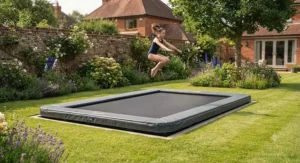
The standout advantage here is aesthetic and practical in equal measure: the EXIT Toys Silhouette Ground Trampoline sits partly dug into the ground, removing the visual bulk of a raised frame and the classic trip hazard of climbing a ladder to get on.
This 8ft x 12ft rectangular model keeps EXIT’s galvanised, powder-coated frame and Foot Protection System, but changes the mounting approach entirely — you excavate a pit, install the frame at ground level, and the trampoline becomes part of the garden rather than sitting on top of it. For gymnastics practice specifically, an inground rectangular trampoline gives a flush, low-profile access point that’s genuinely easier for repeated tumbling run-ups from the surrounding grass.
Families prioritising garden aesthetics, or those with younger children where fall height from an elevated frame is a real concern, are the natural audience here. The honest trade-off is installation complexity: digging a pit correctly, with proper drainage, is a bigger one-off job than bolting together a leg-frame model.
Pros:
- ✅ Ground-level design reduces fall height risk
- ✅ Blends into the garden rather than dominating it
- ✅ Retains EXIT’s Foot Protection System netting
Cons:
- ❌ Requires excavation work before assembly begins
- ❌ Drainage needs planning to avoid a waterlogged pit
Budget for the trampoline itself in the £500-£650 range, plus your own time (or a contractor’s) for the groundworks — a genuinely different cost structure to any leg-frame model on this list.
5. Jumpking 8ft x 12ft Rectangular Deluxe — the sensible mid-range all-rounder
The strongest selling point of the Jumpking 8ft x 12ft Rectangular Deluxe is balance: it carries the same 57mm top-rail strength as Jumpking’s largest models, but in a footprint that fits a genuinely average UK garden.
Specced with 8.5-inch galvanised springs sitting outside a 110gsm UV-resistant polyethylene net, a deluxe ladder, and a tie-down kit included as standard, this model reads like Jumpking took their premium engineering and simply shrank the bed size rather than cutting spec elsewhere. The strong top rails matter more than they might sound — a thinner rail flexes under repeated heavy landings, which over months translates into a mushier, less predictable bounce exactly when you need consistency most for gymnastics training.
This is the trampoline for a family wanting one solid rectangular model that suits both a keen young gymnast and general garden play, without needing the acreage the 16ft Combo Pro demands. On Amazon, this model carries a strong aggregate rating, with buyers frequently highlighting straightforward assembly and sturdy build quality as the standout points.
Pros:
- ✅ Same rail strength as Jumpking’s larger models
- ✅ Fits a standard UK garden footprint comfortably
- ✅ Tie-down kit and ladder included as standard
Cons:
- ❌ Bed length still limits the longest tumbling passes
- ❌ UV netting needs periodic inspection for wear
Expect a price somewhere in the £350-£500 range, which puts it squarely in “sensible family purchase” territory rather than premium training kit.
6. Costway Rectangular Trampoline — the budget entry point that still gets the shape right
What matters here isn’t flashy extras — it’s that the Costway Rectangular Trampoline gets the fundamental shape advantage of a rectangular bed at a genuinely accessible price, without pretending to be more than a solid budget option.
At 8ft x 14ft with a 150kg weight capacity, a safety enclosure, net and ladder included, this model covers the basics: galvanised frame construction and a decent bed size for the money. Reviewers on Amazon have repeatedly praised how straightforward assembly is, several noting they didn’t need to source extra tools like a spring-pulling hook because one was included in the box — a small but genuinely useful detail for anyone dreading a weekend of trampoline assembly.
Based on the spec comparison against pricier rectangular models, the honest verdict is that you’re trading some frame rigidity and spring longevity for a much lower up-front cost. That’s a completely reasonable trade for a family testing whether their child sticks with gymnastics practice before committing to a premium model, or for anyone whose garden genuinely can’t accommodate the larger options above.
Pros:
- ✅ Genuinely low entry price for a rectangular bed
- ✅ Assembly kit includes the spring-pulling tool
- ✅ Solid 150kg weight capacity for the price point
Cons:
- ❌ Frame and springs won’t match premium longevity
- ❌ Less brand history in trampolines specifically
At the time of research, this model sat comfortably under £300, making it the most accessible genuine rectangular option on this list.
7. Jumpking 6ft x 9ft Rectangular Pro — proof that small gardens can still get the rectangular advantage
The overlooked strength of the Jumpking 6ft x 9ft Rectangular Pro is simply that it exists at all — a genuinely compact rectangular trampoline for households who assumed the shape wasn’t an option without a large garden.
Marketed by Jumpking as their smaller rectangular starter model, it carries the same 110gsm polyethylene netting and hard-wearing surround pad as its bigger siblings, just scaled down to a 6ft x 9ft bed. For a young gymnast just starting out, or a family wanting to trial rectangular bounce mechanics before upgrading, this gives a real taste of the straighter, more even bounce profile without demanding a large plot.
The honest trade-off is scale: at this size, advanced tumbling passes simply won’t have the run-up length they need, and older or heavier jumpers will find the bed feels tight quite quickly. It’s best understood as an introduction and a fitness/play trampoline rather than a serious training tool for anyone progressing past beginner skills.
Pros:
- ✅ Fits small gardens where larger rectangles won’t
- ✅ Shares Jumpking’s netting and pad quality at this size
- ✅ Genuine rectangular bounce introduction for beginners
Cons:
- ❌ Bed length too short for advancing tumbling passes
- ❌ Weight capacity better suited to younger jumpers
Priced under £250 at the time of research, this is the sensible starting point for a household still deciding whether gymnastics practice at home is going to stick.
Setting Up Your Rectangular Trampoline for Gymnastics Training
Getting a new rectangular trampoline gymnastics setup right in the first month makes a genuine difference to both safety and how quickly a young gymnast progresses. Positioning comes first: place the frame on level, energy-absorbing ground such as lawn rather than paving, and maintain a clear zone of at least 2.5 metres on all sides, free of fences, washing lines, or garden furniture. If the trampoline includes an enclosure net, check the zip and buckle points are fully closed before every session — this sounds obvious, but it’s consistently one of the most common oversights reported in trampoline safety data.
For the first 30 days, resist the temptation to let anyone attempt advanced skills straight away. Springs and frames need a gentle bedding-in period, and jumpers need time to recalibrate from a round trampoline’s centring pull to a rectangular bed’s straighter bounce line — muscle memory genuinely has to adjust. A common early mistake is over-tightening springs to chase a “bouncier” feel; most manufacturers specify a correct spring tension, and going beyond it accelerates wear without meaningfully improving performance.
Maintenance-wise, inspect the safety pad and net for tears every few weeks, particularly after windy spells, and tighten any loose bolts on leg-frame models seasonally. A basic weatherproof cover, used whenever the trampoline isn’t in active use, meaningfully extends mat and pad lifespan by reducing UV degradation — one of the single biggest factors in premature trampoline wear in the UK’s genuinely unpredictable climate.
Which Rectangular Trampoline Suits Your Gymnastics Journey?
Real households have wildly different starting points, so here’s how three common scenarios map onto the products above. If you’re a parent of a seven-year-old just starting weekly gymnastics club sessions, with a modest garden and a “let’s see if this sticks” budget, the Jumpking 6ft x 9ft Rectangular Pro or Costway Rectangular Trampoline make far more sense than a premium model — you’re buying an introduction, not a training rig.
If you’ve got a young teenager already competing at club level who wants to practise twisting skills and tumbling passes between sessions, the calculus changes completely. Here, the EXIT Toys PeakPro‘s longer springs and larger bed genuinely support the run-up length and flight time those skills need, and the higher price reflects a real performance gap rather than just branding.
For a family with two or three children of mixed ages sharing one trampoline for general fitness and play, with gymnastics as just one of several uses, the Jumpking 8ft x 12ft Rectangular Deluxe or the Zero Gravity Ultima 5 strike the most sensible balance — strong enough build quality for regular use, without the premium price or garden footprint of the largest models.
How to Choose a Rectangular Trampoline for Gymnastics
- Match bed length to skill level. Beginners can manage on a 6-9ft bed, but connected tumbling passes genuinely need 12ft or more of usable run-up length.
- Check spring length and material, not just count. Longer galvanised springs, as seen on the PeakPro, translate directly into more airtime — a far more useful comparison than simply counting springs.
- Confirm weight capacity against every likely user. A 150kg-rated bed is fine for a single child, but a family sharing one trampoline needs real headroom above the heaviest regular user.
- Prioritise enclosure and foot-protection systems. A secondary net between mat and pad, as EXIT’s FPS provides, meaningfully cuts the risk of feet slipping between springs.
- Measure your actual garden clearance, not just the bed size. Manufacturers typically recommend 2.5 metres of clear space around the frame on all sides — factor that into any purchase decision.
- Decide between leg-frame and inground early. Inground models like the Silhouette Ground Trampoline need excavation work planned before delivery day, not after.
- Weigh assembly help into your budget. Larger rectangular models are a two-person, half-day job at minimum — factor this into your realistic timeline.
Common Mistakes When Buying a Gymnastics Trampoline
The single most common mistake is buying on bed size alone, ignoring spring quality — a huge cheap rectangular bed with weak, short springs will still feel mushy and unpredictable under serious tumbling, regardless of its dimensions. A close second is underestimating garden clearance requirements; several buyers report squeezing a 12ft or 16ft model into a space that technically fits the frame but leaves no safe run-off zone, which undermines the safety case for buying a proper enclosure in the first place.
Another recurring pitfall is skipping the weight-capacity maths for the household’s heaviest regular user, not just the intended child — trampolines get shared, and a capacity rating that’s fine for one eight-year-old becomes marginal once an adult joins in during a family barbecue. Finally, several buyers underestimate assembly time and end up rushing a job that genuinely benefits from a full weekend and a second pair of hands, particularly on the larger rectangular frames in this list.
Rectangular vs Round Trampolines for Gymnastics Training
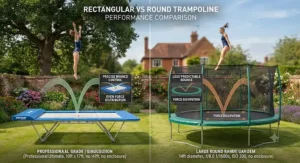
The core difference isn’t just shape — it’s how the springs behave. On a round trampoline, every spring pulls toward a single central point, which is great for family fun but works against a gymnast trying to hold a straight tumbling line, since the mat’s natural tendency is to drift bouncers toward the middle. A rectangular trampoline’s springs work in independent zones along the bed’s length, giving a straighter, more consistent bounce that closely mirrors the competition trampolines used at British Gymnastics club level.
This is precisely why competition-level gymnastics takes place exclusively on rectangular trampolines, and why serious tumbling passes are genuinely difficult to execute cleanly on a round bed. That said, round trampolines still have a real place — they’re typically cheaper for an equivalent bed area, more forgiving for casual family play, and don’t demand the same rectangular garden footprint. For a household focused purely on recreational bouncing, a round trampoline remains a perfectly sensible choice; it’s specifically once gymnastics skill progression becomes the priority that the rectangular shape earns its extra cost and space.
What to Expect: Real-World Performance
Specs only tell half the story, so here’s what actually changes in practice. On a genuinely rectangular bed, jumpers report an easier time landing back in the same spot after a rotation — the “dead centre bounce” every gymnastics coach drills into beginners becomes noticeably more achievable, because the trampoline itself isn’t actively pulling you off-line the way a round bed does. This dead-centre consistency isn’t just a performance nicety; it’s a genuine safety factor, since drifting toward the frame edge is one of the most common causes of trampoline injuries.
Expect a bedding-in period of a few weeks before a new trampoline reaches its intended bounce feel, as springs settle into regular use. Weather matters too — cold mornings genuinely stiffen springs and mats, giving a noticeably firmer, lower bounce than a warm summer afternoon, which is worth factoring in if training consistency matters for a competing gymnast.
Rectangular Trampoline Gymnastics Training for Different Skill Levels
A total beginner benefits most from a smaller rectangular bed like the Jumpking 6x9ft — the goal at this stage is simply learning basic jump control and the fundamentals of a stable dead-centre bounce, not chasing big skills. Intermediate jumpers already comfortable with basic tumbling benefit from stepping up to an 8x12ft or 8x14ft bed, giving enough run-up length for connected skills like round-offs into back handsprings without cramping the approach.
Advanced or competitively-training gymnasts genuinely need the longer springs and bigger bed of something like the PeakPro or the largest Jumpking Combo Pro — at this level, the trampoline itself becomes a limiting factor on skill progression if it can’t provide enough flight time and straight-line bed length. It’s worth being honest that no home rectangular trampoline, however premium, fully replicates a club’s sprung competition frame — but the closer the home model’s specifications track that direction, the more useful it becomes as a between-sessions training tool.
Long-Term Cost & Maintenance
Upfront price is only part of the total cost of ownership picture. Replacement safety pads, netting, and occasionally springs are a genuine recurring cost across a trampoline’s life, typically needed every few years depending on UK weather exposure — budget an extra allowance beyond the initial purchase price for this. Premium models like the PeakPro, with reflective, weather-resistant padding and galvanised springs, tend to need these replacements less frequently, which partially offsets their higher purchase price over a five-plus year ownership window.
Cheaper budget models can still represent excellent value if the household’s usage is genuinely lighter — occasional weekend bouncing rather than daily structured training sessions puts far less cumulative stress on springs and frame. The maths only tips against a budget model if it’s being used as a genuine daily training tool, where the faster wear rate on lower-spec components starts costing more in replacement parts than the premium alternative would have cost outright.
Features That Actually Matter (And Those That Don’t)
Genuinely important: spring length and material, frame rail thickness, and a proper foot-protection or inner-net enclosure system — these three factors do the heavy lifting on both bounce quality and safety. Weight capacity matters too, but only relative to your actual household, not as an abstract number to maximise.
Less important than the marketing suggests: exact spring count (a smart tensioning design with fewer, better springs can outperform a higher count of cheaper ones), cosmetic frame colour options, and bundled extras like basketball hoops, which add cost without touching core bounce performance or training value. If a listing leads with spring count or bundled accessories rather than spring length and frame rail spec, that’s usually a sign the core engineering isn’t the main selling point.
Safety, Regulations and British Gymnastics Standards Explained
It’s worth being straightforward here: there’s no such thing as a domestically sold garden trampoline that’s formally “British Gymnastics approved” in the competition sense. British Gymnastics is the national governing body for gymnastics disciplines in the UK, including trampoline, tumbling and double-mini disciplines, and the equipment used at competition level is specialist club apparatus from manufacturers like Eurotramp and Gymnova — multi-thousand-pound sprung competition frames, not consumer products sold on Amazon. What “British Gymnastics approved trampoline” searches are usually really after is a home rectangular trampoline that mimics that competition bounce profile as closely as possible for between-session practice, which is exactly the angle this guide has taken with every product above.
On the regulatory side, UK garden trampolines should meet EN 71-14, the European safety standard specifically covering domestic trampolines, alongside general EN 13219 frame standards. Always check a listing references these before buying. For hands-on safety practice, RoSPA’s home and garden safety advice covers positioning, supervision and net requirements in detail, and is worth reading alongside any manufacturer instructions. Regular structured activity — including gymnastics and trampolining — also supports the wider physical activity recommendations set out in the NHS guidelines for children and young people, which specifically flag jumping and bounding activities as beneficial for bone and muscle strength.
✨ Don’t Miss These Exclusive Deals! 🔍 Take your home gymnastics setup to the next level with these carefully selected rectangular trampolines. Click on any highlighted product to check current pricing and availability. These picks help build genuine training-ready home gymnastics equipment your whole family will get years of use from!
Frequently Asked Questions
❓ Is a rectangular trampoline better for gymnastics than a round one?
❓ What size rectangular trampoline do I need for gymnastics practice?
❓ Can you do gymnastics on a normal garden trampoline?
❓ How much does a good rectangular trampoline cost in the UK?
❓ Is a British Gymnastics approved trampoline available for home use?
Conclusion
Choosing the right rectangular trampoline gymnastics setup really comes down to being honest about who’s using it and how seriously. A first-timer testing the waters is far better served by a compact, budget-friendly model like the Costway or Jumpking 6x9ft than by overspending on premium spring technology they won’t yet push to its limits. Conversely, a competing junior gymnast genuinely benefits from the longer springs and bigger bed of something like the EXIT PeakPro, where the extra cost reflects a real performance difference rather than marketing polish.
Whatever budget or garden size you’re working with, prioritise the fundamentals covered throughout this guide: proper spring quality, a foot-protection or enclosure system, and genuinely adequate clearance space, over flashier but less consequential extras. Get those right, and any of the seven trampolines featured here will give years of safe, genuinely useful gymnastics practice at home — building real skill between club sessions rather than just providing another garden toy that gets forgotten by autumn.
✨ Ready to find your perfect match? Compare the full lineup above and pick the rectangular trampoline that fits your garden, your budget and your gymnast’s ambitions! 🤸♀️
Recommended for You
- Best Rectangular Trampoline UK 2026: 7 Top Picks Reviewed
- Oval Trampoline Narrow Garden: 7 Top 2026 Picks (Ranked)
- Oval vs Round Trampoline: 7 Top Picks Compared for 2026
Disclaimer: This article contains affiliate links. As an Amazon Associate, I earn from qualifying purchases. If you purchase products through these links, we may earn a small commission at no additional cost to you.
✨ Found this helpful? Share it with your friends! 💬🤗
