In This Article
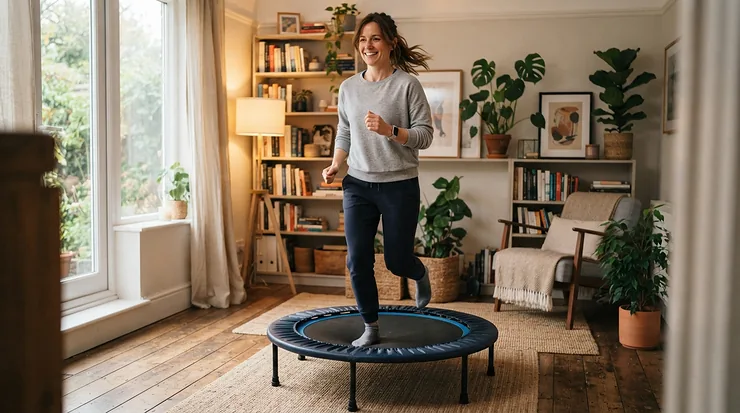
Somewhere between “I want to get fitter” and “I actually did something about it” sits a very small, very springy piece of furniture that most people underestimate until they’ve tried it. A rebounder for beginner workouts isn’t a gimmick from a late-night infomercial — it’s a genuinely sensible entry point into cardio for anyone whose knees have started sending polite complaints after a run, or whose living room simply doesn’t have space for a treadmill.
The appeal is obvious once you think about it properly. You’re not learning choreography, you’re not queuing for equipment at a gym, and you’re not committing to a monthly membership you’ll quietly resent by March. You step on, you bounce, and within about ninety seconds you understand why NASA researchers once flagged rebound exercise as unusually efficient for the effort involved — a claim explored in detail on the topic’s own Wikipedia entry, which traces the physiology back to decades of aerospace and physiotherapy research.
This guide exists because “just buy a mini trampoline” is bad advice — the market ranges from £30 wobble-prone frames that creak like a haunted house to £300 studio-grade units with bungee suspension systems. We’ve researched seven real, currently available rebounders spanning budget, mid-range, and premium tiers, with a specific focus on what actually matters for someone starting out: stability, quiet operation, a manageable footprint, and a non-slip mat that won’t send you sliding into the coffee table. Whether you’re squeezed into a one-bedroom flat or have a spare corner of the garage, there’s a sensible option below — and a fair bit of honest analysis about which one earns its keep.
Quick Comparison Table
| Product | Bounce Surface | Weight Capacity | Folding | Best For |
|---|---|---|---|---|
| Fit Bounce Pro II | 63cm | 135kg | Half-fold | Quietest option for flats |
| MaXimus PRO | 69cm | 130kg | Quarter-fold | Handle rail for balance |
| Rebound UK Pro Gym | 70cm | 150kg | Collapsible legs | Non-slip mat priority |
| SereneLife 40″ | 74cm | 100kg | Foldable | Adjustable handlebar |
| JumpSport 230 | 39″ (99cm) | 136kg | Arched legs, compact | Genuine beginners |
| Tunturi Fitness | 70cm | 140kg | Foldable | Elevation/incline training |
| Kanchimi | 38-45″ range | 150kg | Double-fold | Tightest budgets |
Looking at the spread here, weight capacity and folding mechanism tell you almost everything about who a rebounder is designed for. The Rebound UK Pro Gym and Kanchimi both claim a 150kg capacity, which matters less for the number itself and more as a proxy for frame rigidity — a rebounder rated that high typically uses thicker steel tubing that won’t flex and creak under repeated impact. Meanwhile, the half-fold and quarter-fold designs on the Fit Bounce Pro II and MaXimus PRO exist specifically for people who don’t have a dedicated home gym and need the thing to disappear behind a sofa by Sunday evening.
💬 Just one click — help others make better buying decisions too!😊
What Is a Rebounder for Beginner Workouts?
A rebounder for beginner workouts is a small, spring- or bungee-suspended trampoline — typically 90-105cm in diameter — designed for low-impact cardio and balance training at home, using controlled vertical bouncing rather than the high-arc jumping of a garden trampoline. Beginners specifically benefit from models with lower bounce tension, stability handlebars, and non-slip surfaces that reduce the learning curve.
Top 7 Rebounders: Expert Analysis
Choosing between seven rebounders that all claim to be “the best” is exhausting when every listing sounds identical. So we pulled apart the actual mechanics — bungee versus spring suspension, frame diameter versus usable bounce area, and what aggregated reviewer sentiment says once the marketing copy is stripped away. Below is where the honest differences actually live.
1. Fit Bounce Pro II — quietest bounce for shared walls
The standout here is genuinely the noise level, which matters more than most first-time buyers expect until their downstairs neighbour knocks on the door. Instead of steel coil springs, this model uses 30 bungee elastic cords rated to support up to 135kg, and the difference in sound is not subtle — no metallic pinging, no rhythmic creak that carries through a wooden floor.
Bungee cords also change the feel of the bounce itself: they compress more evenly across the mat rather than concentrating rebound force at fixed spring points, which in practice means a softer landing on the knees and ankles. Based on the spec comparison against the spring-based models further down this list, that’s a meaningful advantage for anyone easing into exercise after a knee injury or simply out of shape. The 63cm bounce surface is on the smaller side, which suits a beginner learning basic bounce patterns before attempting anything more dynamic like jogging-in-place or side-to-side shuffles.
Reviewers consistently report that the half-fold mechanism is the unit’s best feature for flat-dwellers — it collapses to roughly half its footprint and slides under a bed frame with room to spare. A recurring complaint in aggregated feedback concerns the included bounce meter, which some users find inaccurate compared to a proper heart-rate monitor.
Pros:
- ✅ Bungee cords produce a noticeably quieter bounce
- ✅ Half-fold design suits small flats and shared housing
- ✅ Includes a storage bag and two workout videos
Cons:
- ❌ Bounce meter accuracy is inconsistent per reviewer reports
- ❌ 63cm surface feels tight for taller users (over 6ft)
Priced in the £120-£160 range at the time of research, the Fit Bounce Pro II represents solid value for anyone prioritising quiet operation over sheer bounce surface size — check current price and availability before buying.
2. MaXimus PRO — best handle rail for wobbly beginners
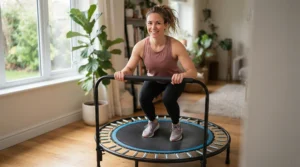
What sets the MaXimus PRO apart on paper is the optional handle rail, a genuinely underrated feature for anyone who hasn’t stood on a springy surface since primary school PE lessons. The rail bolts onto the frame and gives first-timers something solid to grip while their inner ear recalibrates to unstable footing — a real consideration that most budget rebounders skip entirely.
The 32 jumbo coil springs deliver a firmer, more responsive bounce than bungee alternatives, translating to more energy return per jump — useful once confidence builds and you want a bit more spring in your step, literally. The 69cm bounce area and 130kg capacity put it comfortably in the mid-range tier, and the quarter-fold mechanism, while less compact than a half-fold, still shrinks the unit enough to lean against a wall.
What most buyers overlook about this model is that it ships with sand weights for the base — a detail that dramatically improves stability on hard flooring, since an unweighted rebounder frame can shift slightly with vigorous lateral movement. Aggregated reviewer sentiment is largely positive on build quality, though a minority of users note the workout DVD content feels dated compared to the accompanying online access option.
Pros:
- ✅ Optional handle rail genuinely helps balance-anxious beginners
- ✅ Sand weights noticeably reduce frame shift during use
- ✅ Springs give firmer, more responsive energy return
Cons:
- ❌ Quarter-fold is bulkier to store than half-fold rivals
- ❌ Bundled DVD content feels dated versus the online library
At around £150-£190, the MaXimus PRO justifies its premium over pure budget models specifically through the handle rail and stability package — a fair trade if balance is your main hesitation about starting.
3. Rebound UK Pro Gym — best non-slip mat for confident footing
If a non-slip mat is your top priority — and for beginners still finding their bounce rhythm, it arguably should be — the Rebound UK Pro Gym leads with a purpose-textured jumping surface designed to grip trainers even when feet are damp from a proper sweat session. This isn’t a marketing footnote; a mat with genuine grip texture materially reduces the risk of a foot sliding mid-bounce, which is one of the more common ways beginners lose confidence early on.
Underneath that mat sit 36 steel springs rated for a 150kg capacity, among the highest in this roundup, which speaks to a genuinely robust frame rather than a lightweight budget build. The trade-off is that this model doesn’t fold flat — only the legs collapse — so it demands more permanent floor space than the half-fold options above. Based on the spec sheet, the 102cm base with a 70cm usable bounce area sits comfortably mid-pack for surface size.
What the spec sheet won’t tell you, but user reports suggest, is that the steel spring design does produce more audible bounce noise than bungee alternatives — worth weighing carefully if you live in a flat with wooden floors and downstairs neighbours. Two included exercise DVDs add a modest amount of guided-workout value for people who prefer structure over freestyle bouncing.
Pros:
- ✅ Genuinely textured non-slip mat improves footing confidence
- ✅ 150kg capacity signals a robust, non-flexing frame
- ✅ Two DVDs provide structured beginner routines
Cons:
- ❌ Legs-only collapse means a larger permanent footprint
- ❌ Steel springs are noticeably louder than bungee designs
Expect a price in the £130-£170 range; the Rebound UK Pro Gym earns its spot for anyone who values grip and frame rigidity over ultimate portability.
4. SereneLife 40″ — best adjustable handlebar for varying heights
The SereneLife 40″ distinguishes itself with a padded handlebar that adjusts between roughly 35 and 46 inches, which matters enormously in households where more than one person — different heights, different confidence levels — will actually use the thing. A fixed-height rail forces compromise; an adjustable one means a 5’2″ beginner and a 6’1″ partner can both use it properly without hunching or overreaching.
The frame itself uses coil springs across a 101.6cm frame with a 74.42cm bounce mat, on the larger end of the surface sizes here, giving slightly more room for lateral movement exercises once basic bouncing feels natural. PVC padding wraps the frame and spring area, a genuinely practical touch that reduces the chance of catching an ankle on exposed metal during an enthusiastic session — a small detail that speaks to sensible design rather than corner-cutting.
Reviewers consistently flag the six support legs as adding real stability on uneven flooring, a common complaint category for cheaper four-legged rebounders that rock slightly on anything less than a perfectly flat surface. The 100kg weight capacity is the lowest of the seven products here, so it’s worth checking this figure carefully against your own needs before purchasing.
Pros:
- ✅ Height-adjustable handlebar suits multi-user households
- ✅ Six-leg base adds stability on uneven flooring
- ✅ PVC frame padding reduces ankle-catch risk
Cons:
- ❌ 100kg capacity is the lowest of this roundup
- ❌ Larger footprint doesn’t fold as compactly as rivals
Typically priced in the £90-£130 range, the SereneLife 40″ is a sensible mid-tier pick where the weight limit fits your household.
5. JumpSport 230 — best genuine beginner design
JumpSport built its reputation on rebounders used in physiotherapy and rehab settings, and the JumpSport 230 reflects that pedigree directly. Its arched-leg design is the standout feature — rather than straight legs, the arched configuration widens the base for lateral stability without widening the actual footprint much, a clever bit of engineering that pays off the moment a beginner shifts weight unevenly mid-bounce.
The 39-inch bounce mat runs on 30 low-impact bungee cords, echoing the quieter, gentler landing profile of the Fit Bounce Pro II above, and the 136kg capacity comfortably covers most adult users. Based on the spec comparison, what genuinely sets this apart isn’t a single headline number but the overall engineering philosophy — this is a company that designs specifically around joint safety and controlled deceleration, not maximum bounce height.
Aggregated customer sentiment consistently praises the smoothness of the bounce compared with cheaper bungee units, where cord quality varies enormously between brands. A recurring theme in reviews is that the compact 39-inch size, while excellent for storage, does feel restrictive for anyone attempting wider lateral shuffle exercises.
Pros:
- ✅ Arched-leg design adds lateral stability without bulk
- ✅ Bungee cords give a genuinely gentle, low-impact landing
- ✅ Widely praised bounce smoothness versus cheaper bungee rivals
Cons:
- ❌ 39-inch surface feels tight for wide lateral movements
- ❌ Sits at the higher end of this roundup’s price range
At roughly £200-£260, the JumpSport 230 commands a premium, but for anyone who wants a rebounder that feels engineered rather than assembled, it’s arguably the most defensible splurge here — check current price before deciding.
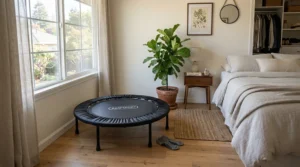
6. Tunturi Fitness Trampoline — best for incline training progression
Tunturi has built genuine credibility across the wider fitness-equipment market, and its rebounder brings something the others in this list largely skip: an elevation kit with four extra legs, letting you tilt the unit for angled bounce training once basic flat bouncing becomes too easy. That’s a legitimate progression path for beginners who don’t want to outgrow their equipment within a few months.
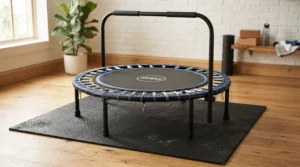
The 70cm bounce area sits on heavy-duty springs rated for a 140kg capacity, and the included stability handlebar mirrors the balance-assist approach seen on the MaXimus PRO, though Tunturi’s rail attaches slightly more rigidly according to aggregated build-quality feedback. A one-year parts warranty — a detail worth flagging, since many budget rebounders offer no meaningful warranty coverage at all — adds a layer of purchase confidence that’s genuinely rare at this price point.
What most buyers overlook about elevation training is that it isn’t about intensity for intensity’s sake — tilting the rebounder changes the muscle-engagement pattern in the calves and stabiliser muscles, giving a beginner a natural way to progress without needing an entirely new piece of equipment. Reviewers do note the foldable frame, while functional, is heavier to manoeuvre solo than the half-fold competitors.
Pros:
- ✅ Elevation kit offers a genuine progression path for beginners
- ✅ One-year parts warranty is unusually generous at this tier
- ✅ Heavy-duty springs handle a 140kg capacity comfortably
Cons:
- ❌ Foldable frame is heavier to move than half-fold rivals
- ❌ Elevation kit adds noticeable assembly complexity
Priced around £140-£180, the Tunturi Fitness Trampoline is the pick for beginners who specifically want room to grow into more advanced training without replacing the whole unit.
7. Kanchimi — best value for tight budgets
Rounding out the list, the Kanchimi leads on adjustability-per-pound: five handlebar height settings between 68 and 90cm, letting it flex across a genuinely wide range of user heights, paired with a double-fold mechanism that shrinks it down about as far as any rebounder in this roundup. For a household on a tight budget who still wants proper adjustability, that combination is hard to beat.
The polypropylene mat and springs deliver a serviceable, if unremarkable, bounce — not in the same league as JumpSport’s engineered bungee system, but perfectly adequate for beginner cardio sessions of 15-20 minutes. The claimed 150kg capacity matches the premium Rebound UK Pro Gym, though based on the overall build weight and materials used, it’s worth treating that headline figure with a degree of healthy scepticism rather than taking it at face value.
Aggregated reviews are mixed but generally favourable for the price bracket, with common praise centred on the handlebar adjustability and common criticism aimed at the mat’s grip texture wearing down faster than pricier alternatives after several months of regular use.
Pros:
- ✅ Five handlebar heights suit a genuinely wide range of users
- ✅ Double-fold mechanism maximises storage efficiency
- ✅ Lowest price point across this entire roundup
Cons:
- ❌ Mat grip reportedly wears faster than pricier alternatives
- ❌ 150kg capacity claim warrants a degree of scepticism
At under £80 in most listings, the Kanchimi is the entry point for beginners who want to trial rebounding before committing to a bigger spend.
Full Product Comparison: Specs, Price Range & Verdict
| Product | Suspension | Capacity | Price Range | Best For |
|---|---|---|---|---|
| Fit Bounce Pro II | Bungee | 135kg | £120-£160 | Quiet flats |
| MaXimus PRO | Coil springs | 130kg | £150-£190 | Balance support |
| Rebound UK Pro Gym | Steel springs | 150kg | £130-£170 | Grip priority |
| SereneLife 40″ | Coil springs | 100kg | £90-£130 | Multi-user homes |
| JumpSport 230 | Bungee | 136kg | £200-£260 | Engineered feel |
| Tunturi Fitness | Heavy-duty springs | 140kg | £140-£180 | Progression training |
| Kanchimi | Springs | 150kg (claimed) | under £80 | Tight budgets |
Stepping back from the individual entries, the clearest pattern is that bungee suspension consistently correlates with quieter, gentler bounces, while steel spring designs trend toward higher stated weight capacities and firmer energy return. For beginners specifically, that trade-off usually tips toward bungee models unless frame rigidity or budget constraints point elsewhere — the JumpSport 230 and Fit Bounce Pro II both illustrate this well, sitting at opposite price points but sharing the same underlying suspension philosophy.
✨ Don’t Miss These Exclusive Deals!
🔍 Take your home fitness routine to the next level with these carefully selected rebounders. Click on any highlighted item to check current pricing and availability. These picks will help you build an authentic, sustainable cardio habit your body will actually thank you for!
Practical Usage Guide: Your First 30 Days on a Rebounder
Setting up a rebounder properly takes about ten minutes but gets skipped constantly, usually with mildly painful consequences. Unfold the frame fully, check every leg clicks into its locked position, and place it on a flat, hard surface rather than carpet — carpet fibres can hide an uneven leg and create a subtle wobble you won’t notice until you’re mid-bounce.
For your first week, resist the urge to jump high. A proper beginner session involves a gentle “health bounce” — feet barely leaving the mat, knees soft, arms relaxed — for five to eight minutes, building tolerance in the stabiliser muscles around your ankles and knees that most people haven’t used this way before. Trying to replicate a gym class routine on day one is the single most common mistake beginners make, and it’s usually what leads to a rebounder gathering dust in a cupboard by week three.
By week two, most users can comfortably extend to 12-15 minutes and introduce basic variations — light jogging in place, gentle side-to-side steps — while maintaining the same soft-knee landing technique. Maintenance is minimal but not optional: check spring or bungee cord tension monthly, wipe the mat down after sweaty sessions to prevent grip degradation, and store the unit somewhere dry if it folds flat, since damp storage accelerates frame rust on cheaper models. According to the American Council on Exercise’s coverage of mini trampoline workouts, consistency over the first month matters more than intensity for building the habit long-term.
Real-World Scenarios: Who Should Buy Which Rebounder
Picture three quite different people, because “beginner” covers a lot of ground. First, a 34-year-old working from a one-bedroom flat in Manchester, wanting a 15-minute cardio break between video calls without disturbing the downstairs neighbour — the Fit Bounce Pro II or JumpSport 230 fit perfectly here, both prioritising quiet bungee bounce and compact storage.
Second, consider a 58-year-old recovering from a knee replacement, cleared for low-impact exercise but understandably nervous about balance — the MaXimus PRO‘s handle rail or the JumpSport 230‘s arched-leg stability design directly address that anxiety, giving something solid to hold while confidence rebuilds. Third, imagine a family of four in a semi-detached house with a spare garage corner, wanting one rebounder that works for a 5’4″ parent and a 6’2″ teenager alike — the SereneLife 40″ or Kanchimi, both with adjustable handlebars, solve that shared-use problem without needing two separate units.
The throughline across all three scenarios: match the rebounder’s specific strength — quiet suspension, balance support, or adjustability — to the actual obstacle standing between you and a consistent routine, rather than simply buying whichever model has the most five-star reviews.
How to Choose a Rebounder for Beginner Workouts
- Check the weight capacity against your own bodyweight with headroom. A rebounder rated close to your exact weight will feel less stable and wear out faster; aim for at least 20-30% above your bodyweight.
- Decide between bungee and spring suspension based on your flooring and neighbours. Bungee cords are quieter and gentler on joints; springs offer firmer, more responsive bounce but carry more noise.
- Measure your available floor space, folded and unfolded. A half-fold or quarter-fold design matters enormously in a flat; a permanent garage or spare room makes this less critical.
- Prioritise a genuinely textured non-slip mat if you sweat heavily or exercise in socks. Grip quality varies wildly between budget and premium models.
- Consider whether a stability handlebar suits your confidence level. Genuine beginners, older adults, or anyone recovering from injury benefit disproportionately from this feature.
- Factor in warranty length as a proxy for build confidence. A manufacturer offering a full year on parts, like Tunturi, is signalling something about expected component lifespan.
- Match adjustability to your household, not just yourself. If multiple people of different heights will use it, an adjustable handlebar earns its price premium quickly.
The NHS’s own physical activity guidelines for adults recommend at least 150 minutes of moderate activity weekly, and a rebounder’s low barrier to entry — no changing rooms, no commute, no weather dependency — makes hitting that target considerably more realistic for genuine beginners than most gym-based alternatives.
Rebounder for Small Spaces: What Beginners Actually Need to Know
A rebounder for small spaces isn’t just “the smallest one you can find” — that’s a common and costly misunderstanding. Folding mechanism matters more than diameter for anyone in a flat or studio: a 102cm rebounder that folds flat to lean behind a door genuinely beats a 90cm model with legs-only collapse that still occupies floor space permanently.
Half-fold and quarter-fold designs, seen on the Fit Bounce Pro II and MaXimus PRO respectively, exist specifically for this constraint. What most buyers overlook is that a folding mechanism also affects long-term durability — cheaper hinges can loosen with repeated folding, so it’s worth checking aggregated reviews specifically for complaints about hinge wear before committing, rather than assuming all folding designs are equal. For genuinely tight spaces — a box room, a narrow hallway cupboard — the double-fold Kanchimi compresses to roughly the size of a large suitcase, making it the most realistic option when storage space is measured in centimetres rather than metres.
Non-Slip Mats and Safety: What Actually Matters
A non-slip mat sounds like a minor spec until you’re mid-bounce in socks on a humid summer evening. What separates a genuinely effective non-slip mat from marketing language is surface texture — a properly ridged or dimpled polypropylene weave, as featured on the Rebound UK Pro Gym, grips trainers even when damp, whereas a smooth PVC-coated mat can become genuinely slick with sweat.
Reviewers consistently note that non-slip performance degrades over time regardless of brand, typically after 12-18 months of regular use, as the surface texture wears smooth. Based on the spec comparison across this roundup, it’s sensible to treat mat grip as a consumable rather than a permanent feature, and to check replacement mat availability before buying — a detail Amazon listings rarely surface prominently. A supporting PubMed-indexed study on mini-trampoline training found measurable improvements in balance and functional mobility among older adults using rebounders regularly, underlining why a secure, grippy surface genuinely matters for injury prevention rather than being a cosmetic add-on.
Mini Trampoline vs Traditional Home Cardio Equipment
Comparing a mini trampoline against a treadmill or stationary bike reveals genuinely different trade-offs rather than one being objectively superior. A treadmill demands significantly more floor space — typically 1.5 to 2 square metres permanently, even folded — and carries a far higher price tag, usually starting around £300 for anything durable enough for daily beginner use.
A rebounder, by contrast, occupies roughly a third of that footprint and costs meaningfully less at every tier in this roundup. Where treadmills win is in tracking metrics precisely — distance, incline, pace — which some beginners find motivating; rebounders generally lack built-in tracking, though the Fit Bounce Pro II‘s bounce meter is a partial exception. On impact forces, the honest analysis favours rebounders decisively: the elastic suspension absorbs a meaningful proportion of ground-reaction force before it reaches your joints, compared with a treadmill belt’s comparatively rigid surface, which matters considerably for beginners easing back into exercise after time off.
Home Cardio Equipment: Where Rebounders Genuinely Fit
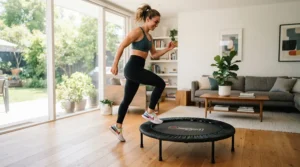
Within the broader category of home cardio equipment, rebounders occupy a specific niche: low-impact, low-footprint, low-cost entry-level cardio that doesn’t require dedicated technique training the way, say, a rowing machine does. Resistance bands and skipping ropes sit below rebounders in price and space but offer less structured cardio benefit for genuine beginners; exercise bikes and treadmills sit above in both price and footprint but offer more precise workout tracking.
What most home-cardio buying guides overlook is that equipment abandonment — buying something and quietly stopping after a month — correlates strongly with initial friction: assembly complexity, storage hassle, and noise complaints from neighbours. Rebounders score well on all three fronts specifically because they’re near-instant to set up, fold away in seconds on the right models, and — with a bungee suspension choice — genuinely quiet enough for early-morning or late-evening sessions without disturbing a household.
What to Expect: Real-World Performance for Beginners
The spec sheet numbers translate into everyday experience in fairly predictable ways once you know what to look for. A 130-150kg weight capacity in practice means a stable, non-flexing bounce rather than the wobbly, slightly alarming sensation of a cheap unrated rebounder flexing under your weight — that flex, beyond feeling unstable, also wastes energy that should be returning to your legs.
A genuine beginner session on a well-built rebounder feels noticeably different from running: your heart rate climbs steadily rather than spiking, and the soreness the next day tends to concentrate in stabiliser muscles — ankles, calves, deep core — rather than the knees and shins that often ache after a first run in months. Reviewers across every product in this roundup consistently mention this same pattern: initial wobbliness in the first few sessions, followed by a noticeably quick improvement in balance confidence within one to two weeks, which tracks closely with what the balance-focused research referenced earlier in this guide would predict.
Common Mistakes When Buying a Rebounder
The single most common beginner mistake is buying based on diameter alone without checking suspension type — a wider mat with harsh steel springs can feel worse for a genuine beginner than a smaller bungee model, despite looking like the “bigger, better” option on a listing page. A second frequent error is ignoring folding mechanism entirely, then discovering three weeks in that the unit permanently occupies the one spare corner of a small flat.
A third mistake, particularly common with the lowest-priced options, is trusting a stated weight capacity without cross-referencing aggregated reviews — as noted with the Kanchimi above, some claimed figures deserve healthy scepticism. Finally, many beginners skip checking for a stability handlebar entirely, then find themselves gripping a doorframe for the first week anyway; if balance anxiety is even a mild concern, that handlebar is worth paying for upfront rather than retrofitting later, since most budget frames aren’t designed to accept one after the fact.
Long-Term Cost & Maintenance
Thinking in cost-per-use terms changes the calculus considerably. A £150 rebounder used four times weekly for two years works out to roughly 35p per session — genuinely competitive against even a modest monthly gym membership, before factoring in travel time and cost. Maintenance costs are minimal but not zero: replacement mats typically run £15-£25 when grip wears down, and bungee cords or springs occasionally need individual replacement after a few years of heavy use, usually costing under £20 for a full set.
Where total cost of ownership diverges meaningfully between products is warranty coverage — the Tunturi Fitness Trampoline‘s one-year parts warranty could offset a genuine manufacturing fault that would otherwise cost the full replacement-part price on a warranty-free budget model. Over a multi-year horizon, that warranty difference can matter more to total value than the initial purchase price gap between products.
Safety, Regulations & Compliance for Rebounders in the UK
Rebounders sold in the UK fall under general consumer product safety regulations rather than a dedicated trampoline-specific British Standard, though reputable manufacturers typically test frames against relevant load-bearing and stability benchmarks voluntarily. Practically, this means checking for CE or UKCA marking on the product listing is a reasonable baseline safety check before buying, alongside genuine aggregated reviews mentioning frame stability over time rather than just initial impressions.
For anyone with pre-existing joint conditions, pregnancy, or a recent injury, consulting a GP or physiotherapist before starting a rebounding routine is sensible — low-impact doesn’t automatically mean risk-free, particularly around balance-related falls for older beginners. Positioning the rebounder away from furniture edges, ensuring adequate ceiling height, and never allowing children to use an adult-rated rebounder unsupervised are all straightforward precautions that meaningfully reduce injury risk without complicating the setup process.
Frequently Asked Questions
❓ Is a rebounder good for beginners with no fitness background?
❓ What size rebounder should a beginner buy for a small UK flat?
❓ Do rebounders work on carpet or only hard flooring?
❓ How much should I spend on a rebounder for beginner workouts?
❓ Can a mini trampoline replace a gym membership entirely?
Conclusion
Choosing the right rebounder for beginner workouts really comes down to three honest questions: how much noise can your living situation tolerate, how much floor space can you realistically spare, and how much balance confidence do you need built in from day one. The Fit Bounce Pro II and JumpSport 230 answer the first question best with their bungee suspension; the MaXimus PRO and Tunturi Fitness Trampoline answer the third with genuine handlebar support; and the Kanchimi answers the budget question about as directly as any product on the market right now.
None of these seven is a wrong choice, exactly — they’re each built for a slightly different version of “beginner,” and the analysis above should make it considerably easier to spot which version matches your actual living room, actual joints, and actual budget. What matters most now isn’t which model you eventually pick, but that you start bouncing consistently rather than letting the decision paralysis run out the clock on a habit that genuinely could stick.
Recommended for You
- JumpSport vs Bellicon Rebounder: 7 Best Picks Compared (2026)
- Bellicon vs Standard Rebounder: 7 Real Picks Compared (2026)
- Silent Bungee Rebounder: 7 Best Quiet Picks For UK Flats (2026)
Disclaimer: This article contains affiliate links. As an Amazon Associate, I earn from qualifying purchases. If you purchase products through these links, we may earn a small commission at no additional cost to you.
✨ Found this helpful? Share it with your friends! 💬🤗
