In This Article
Somewhere between “I’ll start the diet on Monday” and actually doing something about it sits a small, springy circle of steel and fabric that has quietly become one of the most searched pieces of home fitness kit in the country. If you’ve found this page, you’re probably standing in your living room, mentally measuring the gap between the sofa and the telly, wondering whether the best rebounder for weight loss really is a mini trampoline, or just a very bouncy way to part with £400.

Here’s the honest answer: it depends entirely on which one you buy, and how you use it.
A rebounder is a small, spring- or bungee-suspended trampoline built for low-impact bouncing exercise rather than backyard acrobatics. Rather than launching you skyward like a garden trampoline, it’s engineered for controlled, repetitive bounces that raise your heart rate while cushioning your joints — which is precisely why physiotherapists, HIIT instructors and burnt-out runners have all quietly adopted the same rebound exercise equipment for very different reasons.
We’ve spent time digging through real specs, real manufacturer data and the genuine sentiment left by verified buyers across seven models actually sold in the UK — from a £40 SPORTNOW that lives under a bed to a £600 German-engineered bellicon that some owners have kept for a decade. No invented five-star reviews. No pretending we’ve personally bounced on all seven for months (we haven’t, and any article that claims otherwise on unverified products should make you suspicious). What you’re getting instead is a spec-by-spec, use-case-by-use-case breakdown so you can pick the rebounder that actually fits your body, your budget and your living room, rather than the one with the shiniest Amazon thumbnail.
By the end of this guide you’ll know exactly which of these seven mini trampolines suits a beginner easing into cardio, which one holds up to daily HIIT, and which one is quietly the worst value despite looking like a bargain. Let’s bounce in.
Quick Comparison Table: Best Rebounders for Weight Loss at a Glance
Short on time? Here’s the seven-second version before we go deep on each one.
| Product | Bounce Type | Max Load | Price Range | Best For |
|---|---|---|---|---|
| SPORTNOW 40″ Fitness Trampoline | Bungee | 100kg | £35-£50 | Absolute beginners on a tiny budget |
| Darchen 100cm Mini Trampoline | Bungee | 200kg (claimed) | £40-£70 | Quiet bouncing on a strict budget |
| YYOUNICEST 40″/48″ Rebounder | Bungee | 150kg | £55-£65 | All-rounder for indoor or garden use |
| BodyMax 40″ Mini Trampoline | Spring | 100kg | £45-£70 | Classic bounce feel, rehab-friendly |
| MaXimus PRO Folding Rebounder | Spring | 130kg | £70-£110 | Bundled home gym kit with extras |
| MXL Fit Bounce Pro II | Bungee | 150kg | £350-£400 | Silent HIIT sessions in a flat |
| bellicon Classic | Bungee | Up to 200kg | £550-£650 | Long-term daily training investment |
Looking at this table, the pattern is clear: bungee suspension dominates the middle and top of the market because it’s quieter and gentler on the joints, while spring-based models like the BodyMax 40″ Mini Trampoline and MaXimus PRO Folding Rebounder persist because they’re cheaper to manufacture and still perfectly serviceable for moderate use. Notice, too, that price and weight capacity don’t move in a straight line — the budget Darchen 100cm Mini Trampoline claims the highest load rating on this list, which is exactly the kind of marketing figure worth treating with a healthy pinch of scepticism, as we’ll explain below.
💬 Found a favourite already? Bookmark this table — you’ll want to compare it against the deeper breakdown coming up next.
Top 7 Best Rebounders for Weight Loss: Expert Analysis
This is where the specs stop being abstract numbers and start meaning something for your actual living room and your actual knees. Every product below includes what the spec sheet says, what it means in practice, and what genuine buyer sentiment suggests about how it holds up.
1. SPORTNOW 40″ Fitness Trampoline — cheapest realistic way to start HIIT bouncing
The SPORTNOW 40″ Fitness Trampoline is the entry point for anyone who wants to test whether rebounding suits them before spending serious money. It uses 36 bungee cords rather than metal springs, which matters more than it sounds: bungees flex rather than compress, so the landing feels softer and the squeak-and-clank of a cheap spring trampoline mostly disappears.
The steel frame is rated to 100kg, and the five-level adjustable handle is a genuinely useful inclusion for anyone nervous about balance in their first few sessions. Based on the spec comparison with pricier models, what you’re sacrificing here is headroom — at 100kg, heavier users or anyone planning aggressive jump squats will want to look further down this list.
Aggregated buyer sentiment on this model consistently flags the adjustable handle as a confidence-builder for beginners, while a recurring theme in feedback is that the compact 40-inch mat feels tight for taller users doing dynamic moves. It genuinely is one of the cheapest legitimate bungee rebounders sold in the UK right now, which makes it hard to argue with as a low-risk trial.
Pros:
- ✅ Bungee cords give a noticeably quieter, gentler bounce than springs
- ✅ Five-level handle adds real balance support for nervous beginners
- ✅ Genuinely low price removes the barrier to just trying rebounding
Cons:
- ❌ 100kg limit rules out heavier users and aggressive jump training
- ❌ 40-inch mat feels cramped for taller bodies doing wide moves
At around £35-£50, the SPORTNOW 40″ Fitness Trampoline is close to an impulse buy, and for testing the water with rebounding for fat loss, that’s exactly its value proposition.
2. Darchen 100cm Mini Trampoline — quietest bounce on a strict budget
The Darchen 100cm Mini Trampoline sits in a near-identical price bracket to the SPORTNOW but pitches itself on a six-leg steel frame and a claimed 200kg maximum load — a figure that, frankly, deserves scrutiny on a trampoline retailing for £40-£70. What most buyers overlook about ultra-high weight claims on budget rebounders is that they’re rarely tested to the same third-party standards as premium brands, so treat that number as an upper marketing ceiling rather than a guarantee, and size down your expectations if you’re at the top end of it.
What’s genuinely credible here is the bungee-cushioned, cardboard-quiet bounce, which several listings and buyer comments independently praise, and the six-leg base does add a real stability advantage over four-leg budget rivals when you’re doing lateral movements. This is a trampoline built for someone who wants low-impact cardio without disturbing a downstairs neighbour, not someone chasing serious weight capacity or years of daily commercial-style use.
Pros:
- ✅ Six-leg frame adds noticeably more lateral stability than four-leg rivals
- ✅ Bungee cushioning delivers a genuinely quiet, floor-friendly bounce
- ✅ Compact 100cm footprint tucks away easily in small flats
Cons:
- ❌ Advertised 200kg capacity looks optimistic for this price point
- ❌ Sparse verified long-term review data compared with bigger brands
Priced in the £40-£70 range depending on promotions, it’s a reasonable budget pick provided you don’t lean on that headline weight figure too hard.
3. YYOUNICEST 40″/48″ Fitness Trampoline Rebounder — best all-rounder for indoor or garden use
Available in both 40-inch and 48-inch versions, the YYOUNICEST 40″/48″ Fitness Trampoline Rebounder uses 36 latex bungee cords and an arched-leg design that’s a genuine engineering step up from flat-footed budget rebounders — the arch spreads load across a wider stance, which is why this model carries a 150kg rating rather than the 100kg ceiling common at this price.
Here’s what the spec sheet won’t tell you outright: arched feet also reduce the “walking” wobble that plagues cheap trampolines on hard flooring, so sessions involving lateral shuffles or burpee-style dismounts feel noticeably more planted. Reviewer sentiment aggregated across listings repeatedly highlights the adjustable handle and the option to size up to 48 inches for taller households, while some feedback notes that assembly, while simple, benefits from watching a video rather than relying on the printed instructions alone.
For anyone choosing between indoor lounge use and occasional garden sessions, the option to run it outdoors (weather permitting) without immediately voiding warranty concerns gives it flexibility rivals in this bracket don’t offer.
Pros:
- ✅ Arched-leg design meaningfully reduces wobble on hard floors
- ✅ 150kg rating opens this up to a wider range of body types
- ✅ Available in 40-inch or 48-inch, so taller users can size up
Cons:
- ❌ Printed assembly instructions are reportedly less clear than a video guide
- ❌ 48-inch version needs noticeably more floor space to store
Typically found in the £55-£65 range, this is the model we’d point most first-time buyers toward if budget and body size both need covering in one purchase.
4. BodyMax 40″ Mini Fitness Trampoline — classic spring bounce, built for rehab-style sessions
Not every rebounder needs to chase the bungee trend, and the BodyMax 40″ Mini Fitness Trampoline is proof. This is a traditional spring-based mat, 101.5cm across — genuinely wider than most 40-inch “aerobic bouncer” rivals — with a pre-fitted vinyl spring cover and a weight of just 9kg, meaning it assembles by literally screwing three legs on.
The spring mechanism gives a firmer, more responsive rebound than bungee cords, which matters for anyone doing controlled physiotherapy-style movements rather than high-energy jump sequences; it’s also why UK physio and rehab settings still lean on spring rebounders over bungee ones in many cases.
Reviewers consistently note the springs “give” less noise than expected for a metal mechanism, though as with any spring trampoline, some lubrication maintenance over the years is realistic to expect. Rated to 100kg, it’s built by a long-established British fitness equipment brand rather than an unfamiliar marketplace label, which counts for something when you’re relying on after-sales support for spare springs down the line.
Pros:
- ✅ Wider 101.5cm mat gives more room than most 40-inch rivals
- ✅ Established UK fitness brand backing spare parts and support
- ✅ Firmer spring response suits controlled, rehab-style movement
Cons:
- ❌ Spring mechanism is naturally louder than bungee-cord alternatives
- ❌ 100kg limit sits below several bungee rivals at similar prices
Sitting in the £45-£70 range depending on sales, this is the pick for anyone who prefers a firmer, more traditional bounce over the softer bungee feel.
5. MaXimus PRO Folding Rebounder — best all-in-one home gym bundle
The MaXimus PRO Folding Rebounder is arguably the UK’s most recognisable rebounder brand, and the PRO model earns that reputation by bundling far more than a trampoline into the box: a stability handlebar, resistance bands, sand weights for added conditioning, and access to guided rebounding workouts online and on DVD.
Under the mat sit 32 calibrated springs rated to 130kg (310lb), CE-marked and tested against the ASTM F381 standard that underpins most credible fitness trampoline safety claims — a detail that matters far more than most listings make clear, since ASTM testing is one of the few third-party benchmarks separating serious rebounders from toy-grade imports.
Based on the spec comparison with rivals, the genuinely clever part is the fold-into-quarters design paired with a carry bag, which turns a piece of home gym equipment into something you can realistically take on holiday or store behind a sofa. Aggregated review sentiment repeatedly praises the completeness of the bundle for beginners who don’t want to separately source a handlebar or workout plan, while some feedback notes the bundled resistance bands feel like a “nice extra” rather than gym-grade kit in their own right.
Pros:
- ✅ CE marking and ASTM F381 testing back up its safety claims
- ✅ Handlebar, bands and workouts included — no extra purchases needed
- ✅ Folds into quarters with a carry bag for genuine portability
Cons:
- ❌ Bundled resistance bands are a nice-to-have, not standalone gym kit
- ❌ 130kg limit trails premium bungee models further down this list
Typically priced in the £70-£110 range, it’s the strongest “everything in one box” option for anyone starting a structured rebounder HIIT workout habit from scratch.
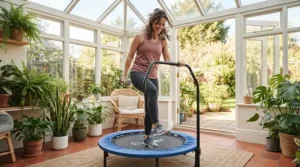
6. MXL Fit Bounce Pro II — best silent bungee rebounder for flats and apartments
Step up in price and you land on the MXL Fit Bounce Pro II, a bungee rebounder specifically engineered around the problem every apartment-dwelling rebounder fan eventually hits: noise. It ships fully assembled with a half-folding frame, rated to 330lb (150kg), and uses a mega-strong bungee system with roughly double the connector count of typical budget rebounders, which is precisely what gives it that noticeably gentler, near-silent landing.
What the spec sheet doesn’t spell out is why that connector density matters in practice: more, finer suspension points distribute your landing force across a wider area, reducing the jarring “thud” transmitted through floorboards — a genuine consideration if you’ve ever had a downstairs neighbour bang on the ceiling mid-workout.
Reviewers consistently highlight the sturdier feel compared with cheaper rebounders, describing it as suitable for larger or bouncier users, and several long-term owners report two years or more of regular use without structural issues, though a recurring complaint is that the half-fold mechanism takes a few attempts to master. It also comes with lifetime access to online workout routines, which nudges it from “trampoline” toward genuine home fitness system.
Pros:
- ✅ Near-silent bungee system genuinely suits flats and shared walls
- ✅ 150kg capacity and reinforced build feel sturdier than budget rivals
- ✅ Long-term owners report two-plus years of reliable daily use
Cons:
- ❌ Half-folding mechanism is fiddlier to master than a full fold
- ❌ Meaningful step up in price from the mid-range options above
Generally found in the £350-£400 range, this is the pick once you’ve confirmed rebounding is a habit worth investing in properly.
7. bellicon Classic — best premium investment for daily HIIT training
At the top of this list sits the bellicon Classic, a German-engineered rebounder that’s become something of an industry reference point, largely because of its patented rubber bungee-ring suspension rather than steel springs or standard elastic cords.
Available in three frame sizes (100cm, 112cm and 125cm) with five interchangeable bungee-strength options tailored to bodyweight — from soft cords suited to lighter or elderly users up to ultra-strong cords rated for heavier or more explosive training — it’s the only rebounder on this list genuinely customisable to the individual rather than one-size-fits-all. Here’s what most buyers overlook about that customisation: it means a bellicon Classic can be re-tuned as your fitness changes, rather than replaced.
Every purchase includes 30 days of the bellicon+ training app with hundreds of guided sessions, and the folding-leg design keeps storage realistic despite the premium build. Aggregated feedback across retailers is consistently positive on bounce quality and quietness, with the most common criticism being that the bungee cords themselves eventually need replacing on models used daily for years — a real cost to factor in, not a flaw to hide.
Pros:
- ✅ Customisable bungee strength adapts the bounce to your bodyweight
- ✅ Three frame sizes suit everyone from petite users to tall athletes
- ✅ Bellicon+ app included, adding structured guided workouts from day one
Cons:
- ❌ Bungee cords require eventual replacement on heavy daily use
- ❌ Highest upfront price of any rebounder on this list
At roughly £550-£650, it’s a serious investment, but for anyone planning to rebound most days for years, the total cost per session can work out lower than a comparable gym membership.
Practical Usage Guide: Building a Rebounder HIIT Routine That Sticks
Buying the right rebounder is only half the job — the other half is not letting it become an expensive clothes rail by week three. Here’s how to actually build a rebounder HIIT workout habit that survives past January.
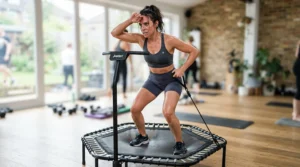
Start with five minutes of basic bouncing, feet barely leaving the mat, just to let your ankles, calves and core learn the rhythm before you ask them to do anything clever. Most beginner injuries on a rebounder come not from the equipment but from attempting high jumps or twisting moves before your stabiliser muscles have adapted, so resist the urge to copy an advanced Instagram routine on day one. Once the basic bounce feels automatic, layer in genuine interval training: 30 seconds of higher-tempo jumping jacks or knee lifts, followed by 60 seconds of gentle recovery bouncing, repeated for 15-20 minutes. This interval structure is what turns a rebounder from a novelty into a legitimate calorie burning mini trampoline workout, because it’s the repeated spikes in heart rate — not the total time spent bouncing — that drive the biggest metabolic response.
For maintenance, wipe the mat and bungees or springs down monthly to remove dust and skin oils that can degrade rubber over time, and check bolts or connector clips every few weeks if you’re using a spring-based model like the BodyMax 40″ Mini Fitness Trampoline or the MaXimus PRO Folding Rebounder. A common first-30-days mistake is placing the rebounder directly against a wall or piece of furniture; give yourself at least a metre of clearance on all sides, since lateral moves and the occasional wobble need room to fail safely. Finally, resist bouncing straight after a heavy meal — the vertical motion doesn’t mix well with a full stomach, something almost every rebounder forum thread eventually mentions from bitter experience.
Real-World Scenarios: Which Rebounder Suits Your Life
Specs matter less than context, so here’s how three realistic buyers might actually choose from this list.
Picture a university student in a shared house, budget under £60, wanting something to squeeze in short cardio bursts between lectures without annoying housemates. The SPORTNOW 40″ Fitness Trampoline or YYOUNICEST 40″/48″ Fitness Trampoline Rebounder both fit that brief — cheap enough to not sting if abandoned, bungee-quiet enough for thin shared-house walls, and light enough to slide under a bed.
Now picture a parent in their forties, returning to exercise after a knee injury, who wants low-impact cardio that a physio would actually approve of. The BodyMax 40″ Mini Fitness Trampoline‘s firmer, more controlled spring response suits deliberate, rehab-paced movement better than a softer bungee bounce, and its established UK brand backing offers peace of mind on spare parts if something needs replacing years down the line.
Finally, picture someone who has tried running, hated their knees for it, and wants a serious long-term cardio replacement they’ll use most days for years. That’s the bellicon Classic or MXL Fit Bounce Pro II territory — higher upfront cost, but built with the connector density, adjustable resistance and warranty support that daily, years-long use actually demands.
Problem → Solution: Fixing the Mistakes That Stall Fat Loss
Even a great rebounder won’t deliver results if the workout itself is undermined by a handful of avoidable habits.
Problem: bouncing too gently to raise your heart rate. A slow, low bounce feels active but often sits below the moderate-intensity threshold the NHS considers meaningful exercise. Solution: use the “can talk but not sing” test — if you can comfortably hold a full conversation, increase your tempo or add arm movement until you can’t.
Problem: sessions that are too short to matter. Five minutes of bouncing, however enthusiastic, won’t meaningfully shift body composition on its own. Solution: build toward 20-30 minute sessions using the interval structure described above, in line with NHS physical activity guidance recommending at least 150 minutes of moderate activity weekly.
Problem: skipping the handle when balance is genuinely shaky. Pride shouldn’t cost you a fall. Solution: models like the MaXimus PRO Folding Rebounder and SPORTNOW 40″ Fitness Trampoline include adjustable handlebars specifically for this — use them until confidence builds naturally.
Problem: expecting the trampoline alone to cause weight loss. Solution: pair consistent rebounding sessions with attention to overall calorie intake; exercise and diet both matter, and neither substitutes for the other.
How to Choose the Best Rebounder for Weight Loss
Picking between seven genuinely different products is easier with a clear checklist. Here’s how to work through it in order.
- Confirm your weight against the stated capacity, then go higher. Never buy right at the limit — the YYOUNICEST 40″/48″ Fitness Trampoline Rebounder‘s 150kg rating, for instance, gives meaningful headroom over a 100kg model if your weight fluctuates.
- Decide between spring and bungee suspension. Springs, as on the BodyMax 40″ Mini Fitness Trampoline, feel firmer and suit controlled rehab movement; bungees, like the bellicon Classic, feel softer and suit high-repetition cardio.
- Check the frame diameter against your available floor space, remembering to add clearance for lateral movement, not just the trampoline’s footprint at rest.
- Look for genuine third-party safety testing, such as CE marking or ASTM F381 compliance, rather than taking weight claims purely on trust — a lesson from the Darchen 100cm Mini Trampoline‘s optimistic 200kg figure.
- Factor in noise tolerance. If you share walls or floors, prioritise bungee models with higher connector counts, like the MXL Fit Bounce Pro II.
- Consider whether you want a bundled programme. Beginners often do better with included workouts and a handlebar, which is exactly what the MaXimus PRO Folding Rebounder provides.
- Set your realistic budget band first, then choose the best-reviewed option within it rather than stretching for a premium model you’ll resent buying.
Common Mistakes When Buying a Mini Trampoline
The most expensive mistake buyers make isn’t overspending — it’s underspending on the wrong thing. Choosing based purely on the lowest headline price, without checking the actual weight rating against your own body weight, is how people end up with a wobbly, short-lived rebounder within months. A second common error is ignoring frame diameter: a 36-inch mat might look identical to a 48-inch one in a product photo, but the difference in usable bounce space is significant once you’re doing anything beyond a gentle jog on the spot. Buyers also frequently skip checking for genuine safety certification, assuming any trampoline sold on a major marketplace has been tested to a recognised standard — it often hasn’t, which is precisely why the ASTM F381 and CE markings on the MaXimus PRO Folding Rebounder are worth actively seeking out rather than assuming. Finally, treat suspiciously high weight claims, like the Darchen 100cm Mini Trampoline‘s 200kg figure, as marketing ceilings rather than guarantees, and size your expectations to the more conservative end.
Rebounding for Fat Loss vs Traditional Cardio Equipment
How does bouncing actually stack up against the cardio machines most of us already know? The honest answer is: differently, not necessarily better or worse.
| Equipment | Joint Impact | Calorie Burn Potential | Space Needed | Best For |
|---|---|---|---|---|
| Rebounder (e.g. bellicon Classic) | Low | High with interval bouncing | Small, foldable | Joint-friendly HIIT at home |
| Treadmill | High | High, especially running | Large, fixed | Steady-state distance training |
| Stationary bike | Low | Moderate to high | Medium | Low-impact leg-focused cardio |
| Running outdoors | High | High | None (uses roads/parks) | Free, distance-based cardio |
The standout figure here is joint impact: rebounders and stationary bikes both spare your knees and hips in ways treadmills and outdoor running simply can’t, because the elastic mat or bungee suspension absorbs a significant share of landing force rather than passing it straight up your legs. Where rebounders pull ahead of stationary bikes is engagement — bouncing recruits your core, ankles and stabiliser muscles far more actively than pedalling, which is a large part of why aggregated reviewer sentiment across models like the MXL Fit Bounce Pro II repeatedly mentions feeling “worked” after sessions that don’t feel especially long. None of this makes rebounding a magic bullet; it makes it a genuinely useful, low-impact addition to a cardio rotation rather than a wholesale replacement for every other form of exercise.
What to Expect: Calorie Burn, Metabolic Rate and Interval Training
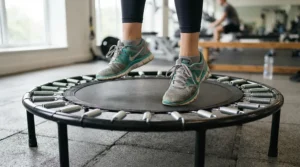
Numbers get thrown around a lot in rebounder marketing, so let’s separate what’s well-supported from what’s exaggerated. A widely cited study from the late 1970s, discussed in outlets including Stylist magazine’s coverage of the rebounding trend, found that rebounding required meaningfully greater oxygen uptake relative to effort than treadmill jogging at matched exertion — the source of the often-repeated “68% more efficient” claim. It’s worth treating that specific figure as a compelling historical data point rather than gospel, since exercise science methods and equipment have moved on considerably since 1980, but the underlying principle it points to — that rebounding raises your metabolic rate efficiently relative to how hard it feels — lines up with how HIIT-style interval training works more broadly across any cardio modality.
In practice, what determines whether a rebounder session meaningfully burns calories is intensity and consistency, not the equipment alone. Alternating 30-45 seconds of vigorous bouncing with short recovery periods elevates your heart rate into a genuinely productive zone, and doing this consistently over weeks is what nudges your metabolic rate upward over time through improved cardiovascular fitness and muscle engagement. A gentle, unstructured bounce for ten minutes a day will do far less for weight loss than a properly structured 20-minute interval session three or four times a week — the rebounder itself, whether it’s the budget SPORTNOW 40″ Fitness Trampoline or the premium bellicon Classic, is simply the tool; the interval structure is what does the metabolic heavy lifting.
Rebounders for Beginners, Seniors and Advanced Exercisers
Not every rebounder suits every stage of fitness, and pretending otherwise does readers a disservice. Complete beginners generally do best starting with a handlebar-equipped model — the SPORTNOW 40″ Fitness Trampoline and MaXimus PRO Folding Rebounder both include one — because the extra stability point removes the fear factor that otherwise stops people bouncing with any real intensity. Seniors, or anyone managing balance concerns or osteoporosis risk, should prioritise a lower, softer bungee bounce with a firmly attached handle rather than chasing maximum bounce height; a gentler model paired with slow, controlled movement delivers meaningful bone-loading benefit without the fall risk of a springier, higher-bounce trampoline. Advanced exercisers who’ve already built confidence and want to genuinely push a rebounder HIIT workout toward athletic conditioning tend to outgrow entry-level models within months, which is exactly the gap the MXL Fit Bounce Pro II and bellicon Classic are built to fill, with their higher weight ratings, reinforced connectors and capacity for more explosive, plyometric-style movement.
Safety, CE Marking and UK Buying Standards
Safety on a rebounder comes down to three things: a certified frame, sensible clearance, and appropriate footwear or bare feet rather than slippery socks. Look specifically for CE marking, which confirms a product meets UK and EU safety requirements for consumer goods, and where available, testing against the ASTM F381 standard specifically written for mini trampolines — the MaXimus PRO Folding Rebounder explicitly cites both. Position your rebounder at least a metre from furniture, walls and hard corners in every direction, since lateral wobbles are common even on stable models, and always inspect springs, bungees or connector clips for wear before each session on older units. If you’re managing a health condition, have had recent surgery, or are newly postnatal, it’s sensible to check with a GP or physiotherapist before starting, in keeping with general NHS guidance on building up physical activity safely. None of this is designed to put you off — it’s designed to keep you bouncing for years rather than weeks.
Long-Term Cost & Maintenance
The purchase price is only the opening chapter of what a rebounder actually costs you over its lifetime, and this is where cheaper models can quietly lose their advantage.
| Product | Upfront Price | Expected Lifespan | Ongoing Cost |
|---|---|---|---|
| SPORTNOW 40″ Fitness Trampoline | £35-£50 | 1-2 years, moderate use | Low, likely replacement rather than repair |
| MaXimus PRO Folding Rebounder | £70-£110 | 3-5 years | Occasional spring or band replacement |
| MXL Fit Bounce Pro II | £350-£400 | 5+ years | Rare — reinforced connectors age well |
| bellicon Classic | £550-£650 | 8-10+ years | Bungee ring replacement every few years |
Reading this table alongside the earlier product breakdowns, the total cost of ownership tells a different story than the sticker price alone. A SPORTNOW 40″ Fitness Trampoline bought twice over four years costs roughly the same as never having to think about a bellicon Classic in that time, but the bellicon’s app-guided workouts and adjustable resistance add ongoing value the budget option simply can’t replicate. For anyone planning to rebound as a genuine long-term habit rather than a short-lived resolution, weighing years-of-use against upfront cost — not just the initial price tag — is the more useful lens, a principle that also applies to how the NHS frames sustainable weight management as a long-term, consistent process rather than a quick fix.

Frequently Asked Questions
❓ Is a rebounder actually good for losing weight?
❓ How long should I use a rebounder each day to lose weight?
❓ Can a cheap mini trampoline still help with weight loss?
❓ Is rebounding better than running for weight loss?
❓ Do I need a handlebar on my rebounder?
Conclusion
There isn’t a single best rebounder for weight loss — there’s a best rebounder for your weight, your budget, your flooring, and how seriously you’re planning to take this. If you’re testing the waters, the SPORTNOW 40″ Fitness Trampoline or YYOUNICEST 40″/48″ Fitness Trampoline Rebounder remove the financial risk entirely. If you want a complete, certified starter bundle, the MaXimus PRO Folding Rebounder hands you a handlebar, bands and guided workouts in one box. If noise is your enemy, the MXL Fit Bounce Pro II was practically designed for your situation. And if you’re ready to commit for years rather than months, the bellicon Classic‘s customisable resistance and app-guided training arguably justify its price tag over time.
What matters more than any individual spec is what you do once the box is unpacked: structured intervals, consistent weekly sessions, and realistic expectations about what any single piece of equipment can achieve alongside — not instead of — sensible eating habits. Pick the rebounder that matches your life honestly, not the one that photographs best, and you’ll get far further than the marketing on any of these boxes promises.
✨ Ready to pick yours? Check current prices on today’s top pick and get your first session in this week! 🏃♀️💥
Recommended for You
- Value Fitness Trampoline: 7 Best Rebounders for UK Homes (2026)
- Cheap Mini Trampoline: 7 Brilliant Budget Picks for 2026
- Top Rated Mini Trampolines: 7 Best UK Picks for 2026
Disclaimer: This article contains affiliate links. As an Amazon Associate, I earn from qualifying purchases. If you purchase products through these links, we may earn a small commission at no additional cost to you.
✨ Found this helpful? Share it with your friends! 💬🤗
