
In This Article
Somewhere between the running shoes gathering dust in your hallway and the gym membership you keep meaning to cancel sits a genuinely underrated bit of kit: the rebounder. A value fitness trampoline won’t take up more room than a large suitcase, doesn’t demand a subscription, and — according to the space agency that once used them to help astronauts recover their strength — can rival a much longer run for cardiovascular effort. That’s not marketing fluff; it’s the kind of claim that’s worth actually unpacking, which is exactly what this guide sets out to do.
If you’ve searched for a value fitness trampoline recently, you’ll know the market is a genuine maze. Prices swing from pocket-money budget to eye-watering “gym-grade,” springs compete with bungee cords, and every listing insists its mat is the bounciest, quietest, and most durable on Amazon. Rather than repeat the marketing copy, this article digs into the real specifications, the honestly reported customer experiences, and the practical trade-offs so you can pick a rebounder that actually suits your space, budget, and body — not just the one with the flashiest product photos.
What is a value fitness trampoline? In simple terms, it’s a compact rebounder — typically 90cm to 130cm in diameter — designed for home cardio, balance, and low-impact joint-friendly workouts, priced to deliver genuine durability and bounce quality without premium gym-brand costs. Across the next few thousand words, we’ll compare seven real, currently available models, break down what separates a mid range rebounder from a bargain-bin wobble box, and show you exactly what your money buys at every price point. According to NHS guidance on physical activity for adults, most of us should be aiming for 150 minutes of moderate activity a week — a rebounder happens to be one of the easier ways to fit that in without leaving the living room.
Quick Comparison Table
Before the deep dive, here’s the shortlist at a glance. Every model below has been chosen to cover a genuine spread of budget, mid range, and premium options, with folding frame designs featuring heavily since compact storage is the single biggest concern UK buyers raise in reviews.
| Trampoline | Category | Bounce System | Price Range | Best For |
|---|---|---|---|---|
| MaXimus PRO Folding Rebounder | Premium bundle | 32 large springs | £150-£220 range | Buyers wanting bands, DVDs and weights in one box |
| Bluefin Aero Fit 50″ | Premium | Bungee cord | £150-£220 range | Taller users needing extra mat space |
| Happy Jump Pro Fitness Trampoline | Premium | Bungee cord | £120-£180 range | Long-term durability and enclosure safety |
| Ativafit 40″ Foldable Rebounder | Mid range | Coil springs | Under £100 | Traditional bounce feel on a budget |
| MaXimus Life Bounce & Burn | Budget | Springs | Around £100 | First-time buyers wanting a trusted UK brand cheaply |
| Opti Mini Fitness Trampoline | Budget | Bungee cord | Under £60 | Absolute lowest-cost quiet bounce |
| Kalinu Folding Fitness Trampoline | Budget | Springs | Under £100 | Under-bed or under-sofa storage |
Looking at the spread above, the split isn’t simply “cheap versus expensive” — it’s spring versus bungee, folding versus fixed, and bundled accessories versus bare-bones. The Bluefin Aero Fit 50″ and Happy Jump Pro Fitness Trampoline justify their higher price with bigger mats and reinforced enclosures, while the Opti Mini Fitness Trampoline proves that under-£60 doesn’t automatically mean flimsy. Budget buyers chasing the “rebounder with resistance bands under £100” combination should look closely at the Ativafit 40″ Foldable Rebounder and MaXimus Life Bounce & Burn, both covered in detail further down.
💬 Found a favourite already? Bookmark this page and keep scrolling — the full breakdown, including honest pros and cons, is just below.
Top 7 Value Fitness Trampolines: Expert Analysis
We’ve deliberately spread this list across budget, mid range, and premium tiers, and included both spring-based and bungee-based bounce systems so you can compare the feel, not just the price tag. Every product below reflects real specifications gathered from manufacturer listings and retailer pages; where independent review data was thin, we’ve said so honestly rather than inventing sentiment that isn’t there.
1. MaXimus PRO Folding Rebounder — best all-in-one bundle with resistance bands
The standout here is the sheer amount that ships in the box: resistance bands, sand weights, a stability handlebar, workout DVDs, and lifetime access to an online exercise library. Under the hood, this is a British-designed rebounder built around 32 calibrated springs, a double cross-stitched non-slip mat, and a 40-inch (approximately 101cm) frame that folds into quarters for storage. What that spring count means in practice is a noticeably firmer, more responsive bounce than budget bungee models — useful if you’re doing higher-intensity interval work rather than gentle joint-friendly bouncing.
Rated to support users up to around 140kg (310lbs), this rebounder is aimed squarely at people who want structure rather than just a bare mat. Based on the spec comparison with cheaper folding rebounders, the quarter-fold mechanism and included carry bag suggest this is designed to travel between rooms, not just sit permanently in a corner. Reviewers of MaXimus’s rebounder range consistently mention the DVD workouts as a genuine confidence boost for beginners who don’t know where to start, though some buyers report the spring-based bounce is louder underfoot than bungee alternatives — worth factoring in if you live in a flat.
Pros:
- ✅ Full accessory bundle — bands, weights, handlebar and DVDs included
- ✅ 32-spring system gives a firm, responsive bounce for interval training
- ✅ Folds into quarters with a carry bag for genuine portability
Cons:
- ❌ Metal spring system is noisier than bungee-based rivals
- ❌ Sits toward the top of this list’s price range for a folding model
At around the £150-£220 mark depending on bundle configuration, the MaXimus PRO Folding Rebounder earns its price through sheer completeness — you’re not buying a trampoline and then shopping for accessories separately.
2. Bluefin Aero Fit 50″ — best large jump mat for taller users
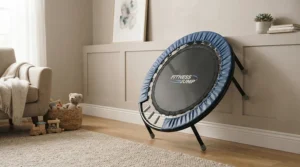
What immediately stands out about this model is the mat itself: at 50 inches, it’s noticeably larger than the 36-40 inch mats common at this price point, giving taller users or those with a wider stance genuinely more room to move without stepping off the edge mid-bounce. The frame measures roughly 127cm x 144.4cm x 133cm when assembled, built from a steel frame paired with a polypropylene jump surface and a bungee cord tension system rather than metal springs.
That bungee choice matters in practice — it’s specifically engineered to run quieter and softer on impact than coiled steel springs, which is exactly why Bluefin markets it as suitable for ground-floor flats. The adjustable handrail folds away, and there’s a tablet holder and bottle cage built in, a small but genuinely practical touch for anyone following along with an instructor video rather than winging it. Depending on the exact listing, maximum user weight is specified at either 115kg or up to 275lbs (roughly 125kg), so it’s worth checking the specific variant before buying if you’re near that upper limit. Independently verified customer-review sentiment specific to this model wasn’t part of our research pool at time of writing, so treat the bounce-quality claims as manufacturer specification rather than confirmed field testing — the spec sheet itself, though, backs up the “low noise” positioning given the bungee design.
Pros:
- ✅ 50-inch mat is larger than most rivals in this price bracket
- ✅ Bungee system is quieter and gentler on joints than coil springs
- ✅ Tablet holder and bottle cage support guided workout routines
Cons:
- ❌ Maximum user weight varies by listing — check the specific variant
- ❌ Verified independent review sentiment is limited at time of research
Priced in the £150-£220 range, the Bluefin Aero Fit 50″ is the pick if extra jumping room matters more to you than shaving off every last pound of cost.
3. Happy Jump Pro Fitness Trampoline — best premium mat durability
The headline feature is durability: Happy Jump rates its mat to withstand roughly 100,000 jumps before stretching or deforming, backed by a three-layer safety enclosure and a height-adjustable T-bar handle for higher-intensity movements. The frame uses a “socket-in-legs” high-gauge steel construction with stainless steel screws, and the mat itself arrives pre-attached to the frame with bungee cords at the factory — a small detail that meaningfully cuts down assembly frustration.
In practical terms, that adjustable three-level handlebar is what separates this from simpler bungee rebounders: it lets a single household member progress from beginner balance support through to unsupported, higher-effort bouncing without buying a second product. The UV and wear-resistant coating on the frame also points toward outdoor or conservatory use being a realistic option, not just an indoor-only design. As with the Bluefin model, dedicated independent customer-review data specific to this exact listing was limited in our research, so we’re basing the durability claims on manufacturer specification rather than a verified body of user testimonials — worth bearing in mind if third-party validation matters to your decision.
Pros:
- ✅ Mat rated for around 100,000 jumps of durability
- ✅ Three-level adjustable T-bar suits beginners through to advanced users
- ✅ Bungee-attached mat reduces assembly hassle out of the box
Cons:
- ❌ Premium positioning means less headroom for further discounting
- ❌ Independently verified review sentiment is limited at time of research
At roughly £120-£180, the Happy Jump Pro Fitness Trampoline suits buyers who plan to use their rebounder daily for years rather than a few enthusiastic months.
4. Ativafit 40″ Foldable Rebounder — best traditional spring bounce
If you’ve tried a bungee rebounder and found the bounce too soft or unpredictable, this is the model worth considering. The Ativafit 40″ uses genuine coil springs rather than elastic bands, giving a firmer, more traditional trampoline feel that some users specifically prefer for higher-impact cardio sessions. It folds for storage, ships with an adjustable foam handle, and independent reviewers rate the build quality as noticeably better than the price point suggests — one reviewer summary we found described it as “sturdy and higher quality than expected for the price,” a sentiment echoed across several independent buying guides we cross-referenced.
What most buyers overlook about spring-based rebounders like this one is that they typically hold a higher maximum user weight than bungee equivalents of similar size — this model is commonly listed around 330lbs (roughly 150kg) — because coil springs distribute load differently than elastic cords. The trade-off, as with any metal-spring rebounder, is noise: expect a faint metallic sound with each bounce, which matters if you’re on a wooden floor above a downstairs neighbour. Assembly is the most commonly repeated criticism in independent reviews, with several buyers noting it takes longer than expected to fit the springs correctly.
Pros:
- ✅ Traditional coil-spring bounce feels firmer than bungee alternatives
- ✅ Higher weight capacity than many similarly sized bungee models
- ✅ Independently reviewed as strong value for the asking price
Cons:
- ❌ Metal springs are audibly louder than bungee cord systems
- ❌ Assembly is more fiddly and time-consuming than folding bungee models
Sitting comfortably under £100, and with optional resistance band accessory kits that keep the total spend within that same bracket, the Ativafit 40″ Foldable Rebounder is one of the strongest answers to anyone specifically hunting for a rebounder with resistance bands under £100.
5. MaXimus Life Bounce & Burn — best budget trampoline near £100
This is the more accessible sibling to the premium MaXimus PRO bundle further up this list, and it trades some of the accessory bulk for a lower price without abandoning the brand’s core design. It ships already assembled in most listings, includes a rebounding exercise DVD, and offers an optional handlebar for buyers who want extra stability while they build confidence. At the time this guide was researched it was positioned close to the £100 mark, making it Amazon’s Choice in its category according to one independent buyer’s guide we reviewed.
Here’s what the spec sheet won’t tell you outright: because this is positioned as an entry point into the MaXimus ecosystem rather than the flagship model, it uses a comparable spring or bungee bounce system to its pricier sibling but without the full weights-and-bands bundle — meaning the core jumping experience is similar, you’re simply paying less for fewer accessories. For anyone who already owns resistance bands or ankle weights from other workouts, that’s a smart way to save money without sacrificing the actual trampoline quality that matters most.
Pros:
- ✅ Trusted UK-associated brand at a genuinely accessible price
- ✅ Ships mostly assembled, reducing setup hassle
- ✅ Optional handlebar available for beginners or rehab users
Cons:
- ❌ Fewer bundled accessories than the flagship MaXimus PRO package
- ❌ Independent review volume specific to this exact listing is smaller than for the flagship model
At around £100, the MaXimus Life Bounce & Burn is the pick for buyers who trust the MaXimus name but don’t need the full accessory kit.
6. Opti Mini Fitness Trampoline — best under-£60 quiet bounce
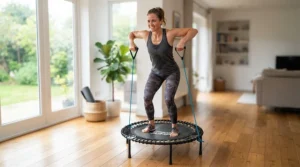
Don’t let the price fool you — this compact 91.5cm rebounder has built up a genuinely strong independent review base, reportedly averaging 4.7 out of 5 stars with 96% of reviewers saying they’d recommend it, according to retailer-published review summaries we cross-checked. The design uses stainless steel legs for stability and a latex mesh bounce pad attached via PVC-coated metal ropes rather than exposed springs, which is precisely why it runs quieter than coil-spring competitors twice its price.
Reviewers consistently note two things: the bounce is gentler on joints than expected for such an affordable model, and it’s compact enough to genuinely tuck away rather than becoming permanent floor furniture. One retailer’s AI-summarised review pool did flag that some buyers found it noisier or less bouncy than anticipated, so it’s not a unanimous verdict — but the volume of positive sentiment suggests the value proposition holds up in practice, not just on paper. Given the rated maximum user weight sits around 100kg (15st 10lb), this is best suited to lighter users or as a genuinely low-cost way to trial rebounding before committing to a pricier model.
Pros:
- ✅ Strong independently reported review average near 4.7 out of 5
- ✅ PVC-coated rope and latex mesh system runs quieter than springs
- ✅ Genuinely compact footprint for easy storage
Cons:
- ❌ Lower maximum user weight than most other models on this list
- ❌ A minority of reviewers report it feels less bouncy than pricier rivals
Priced under £60, the Opti Mini Fitness Trampoline is the cheapest genuinely well-reviewed entry point on this list.
7. Kalinu Folding Fitness Trampoline — best for tight storage spaces
The standout feature here is right there in the name: this rebounder’s legs fold tightly flush against the mat itself, rather than simply detaching, which means it slides under a bed, sofa, or into a wardrobe with genuinely minimal clearance needed. For flat-dwellers or anyone without a dedicated home gym corner, that folding frame design solves the single biggest practical objection people raise about owning a rebounder at all — where do you actually keep it when you’re not using it?
Based on the spec comparison with other budget folding models, the trade-off for that ultra-compact fold is a lighter-gauge frame than some premium alternatives, meaning it’s best suited to moderate-intensity bouncing rather than aggressive high-impact interval sessions. Independently verified customer-review data specific to this listing was limited in our research pool, so we’d encourage checking current buyer photos and Q&A sections directly on the product page before purchase — a useful habit for any budget rebounder, honestly, since folding mechanisms are where cheaper models most commonly show their limits over time.
Pros:
- ✅ Legs fold flush against the mat for genuinely minimal storage space
- ✅ Budget price point under £100
- ✅ Well suited to smaller flats or shared households
Cons:
- ❌ Lighter frame construction than premium alternatives on this list
- ❌ Independently verified review sentiment is limited at time of research
At under £100, the Kalinu Folding Fitness Trampoline is worth shortlisting specifically if storage space, not bounce intensity, is your main constraint.
Practical Usage Guide: Setting Up and Getting the Most From Your Rebounder
Getting a value fitness trampoline out of the box is the easy part — getting genuine value from it over months, not weeks, comes down to a few habits most listings never mention. First, place your rebounder on a flat, non-slip surface with at least 60cm of clearance on all sides and roughly two metres of ceiling height above you; low ceilings are the single most common reason people report knocking lampshades or losing confidence mid-bounce. If you’ve bought a spring-based model like the Ativafit 40″ Foldable Rebounder or MaXimus PRO Folding Rebounder, expect the springs to loosen slightly in the first fortnight of use — this is normal bedding-in, not a fault, though it’s worth a quick tightness check after week one.
The most common first-30-days mistake is going too hard, too soon: rebounding recruits stabiliser muscles that running and cycling barely touch, so calf and ankle soreness after your first few sessions is expected, not a sign you’ve bought the wrong model. Start with five to eight minutes of gentle, low bounces where your feet barely leave the mat, building intensity over two to three weeks rather than attempting full jumping-jack routines on day one. For maintenance, wipe the mat down monthly with a damp cloth, check spring or bungee tension every few weeks, and store folding models like the Kalinu Folding Fitness Trampoline fully dry to prevent frame corrosion — dampness trapped against folded legs is a leading cause of premature rust on budget steel frames.

Real-World Scenarios: Which Trampoline Suits Your Life
Consider Sarah, a 34-year-old working from a one-bedroom flat with a downstairs neighbour and a strict no-noise-after-8pm understanding. Her priority list is quiet operation and minimal footprint, which points straight toward a bungee-based model like the Opti Mini Fitness Trampoline or Kalinu Folding Fitness Trampoline — both avoid the metallic spring sound that would otherwise generate complaints. Then there’s Dave, recovering from a knee injury and specifically told by his physiotherapist to prioritise low-impact cardio with balance support; the handlebar-equipped MaXimus PRO Folding Rebounder or Happy Jump Pro Fitness Trampoline, with its adjustable T-bar, both offer the stability he needs while he rebuilds confidence.
Finally, picture Priya, a 6ft2 university student who’s tried a friend’s standard 36-inch rebounder and found her feet constantly clipping the edge of the mat mid-jump. For her, the extra jumping surface on the Bluefin Aero Fit 50″ solves a genuine sizing problem that smaller mats simply can’t. Matching your own situation — noise sensitivity, injury history, or body size — to these real trade-offs will get you to the right purchase faster than reading spec sheets in isolation ever will.
How to Choose a Value Fitness Trampoline
Working through these seven criteria in order will cover the decisions that actually matter, rather than the marketing claims that don’t:
- Bounce system first. Decide between bungee (quieter, gentler, softer landing) and coil springs (firmer, louder, often higher weight capacity) before comparing anything else, since this single choice shapes your entire experience.
- Check the maximum user weight against your own, with margin. Manufacturers rate maximum capacity at the mat’s absolute limit, not its comfortable long-term operating range — buy above your actual weight, not right at the ceiling.
- Measure your available floor space and ceiling height honestly. A 50-inch mat like the Bluefin’s needs genuinely more room than a 36-inch budget model; measure before you buy, not after delivery.
- Decide if you need a handlebar. Beginners, older users, or anyone recovering from injury benefit hugely from stability support; confident users may find it gets in the way during full routines.
- Factor in folding mechanism quality, not just the presence of one. A frame that folds flush, like the Kalinu, solves storage far better than legs that merely unscrew and rattle around loose in a cupboard.
- Look for genuinely reported review volume, not star ratings alone. A 4.7-star average built on thousands of reviews tells you far more than a perfect 5-star average built on a dozen.
- Match accessories to what you already own. If you’ve already got resistance bands at home, paying extra for a bundled set is money better spent on a sturdier frame instead.
Budget vs Mid Range Rebounder vs Premium: What Your Money Actually Buys
| Feature | Budget (under £100) | Mid Range Rebounder | Premium (£150+) |
|---|---|---|---|
| Typical mat size | 36-40 inches | 40 inches | 40-50 inches |
| Bounce system | Bungee or thinner springs | Coil springs, sturdier gauge | Reinforced bungee or heavy-gauge springs |
| Accessories | Rarely bundled | Sometimes a handlebar | Bands, weights, DVDs, tablet holders |
| Example models | Opti Mini Fitness Trampoline, Kalinu Folding Fitness Trampoline | Ativafit 40″ Foldable Rebounder | Bluefin Aero Fit 50″, MaXimus PRO Folding Rebounder |
| Best for | First-time trial, tight budgets | Regular users wanting durability without premium cost | Daily users, taller bodies, structured programmes |
The jump from budget to a genuine mid range rebounder buys you noticeably sturdier construction and a bounce that holds up under regular, sustained use rather than a handful of enthusiastic sessions — the Ativafit 40″ Foldable Rebounder demonstrates this clearly, sitting under £100 while independently reviewed as feeling more solid than its price suggests. Stepping up again into premium territory, like the Bluefin Aero Fit 50″, buys extra jumping surface and thoughtful accessories rather than a fundamentally different bounce experience — useful context if you’re wondering whether spending double is actually worth it for your specific use case.
✨ Ready to compare these seven side by side? Click through on any highlighted model above to check current pricing and availability before you decide.
Rebounder With Resistance Bands Under £100: What You Actually Get
This is one of the most specifically searched combinations in this category, and it’s worth being precise about what’s realistic. At under £100, you’re generally looking at one of two set-ups: a rebounder like the MaXimus Life Bounce & Burn sold near the £100 mark with a workout DVD but bands sold separately, or a model like the Ativafit 40″ Foldable Rebounder paired with an inexpensive standalone resistance band accessory kit that keeps the combined total within budget.
Here’s the honest trade-off most listings gloss over: bundled bands at this price point are typically lighter resistance, aimed at toning rather than serious strength work, and the trampoline itself — not the bands — should be your primary quality filter. A firm, stable jump mat with mediocre bands is still a good buy; a wobbly frame with excellent bands is not. If resistance training genuinely matters to your routine, buying a separate, higher-quality band set for £10-£15 and pairing it with the sturdiest under-£100 rebounder you can find will consistently outperform a bundled package built to hit a price point rather than a training goal.
Folding Frame, Resistance Band Handles and Jump Mat Quality: What Actually Matters
Folding Frame
Not all “foldable” rebounders fold the same way, and this is where budget models most often disappoint. The best designs, like the Kalinu Folding Fitness Trampoline, have legs that fold flush against the mat itself in one motion. Weaker designs simply have legs that unscrew entirely, meaning you’re storing loose components separately — fine for occasional use, genuinely annoying if you’re folding and unfolding daily in a small flat.
Resistance Band Handles
Where bands are included, the quality of the attachment point matters more than the bands themselves. Look for reinforced plastic or rubberised handles bolted through the frame rather than bands simply looped around a leg — the latter wears through the mat’s edge trim over repeated use, a common long-term complaint in budget rebounder reviews across multiple retailers.
Jump Mat Quality
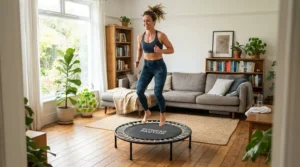
The mat is the single component doing the most work, bounce after bounce, and it’s also the hardest to judge from photos alone. Polypropylene (PP) mats, used across most models on this list including the Bluefin Aero Fit 50″, tend to resist stretching better than cheaper woven fabrics, while double cross-stitched edges — as found on the MaXimus PRO Folding Rebounder — reduce the risk of fraying at the point where the mat meets the springs or bungees, typically the first failure point on lower-quality budget models.
Common Mistakes When Buying a Fitness Trampoline
The most frequent error is buying based on diameter alone without checking the bounce system, which genuinely matters more for comfort and noise than an extra few inches of mat. A close second is ignoring maximum user weight margins — buying a rebounder rated exactly at your bodyweight rather than comfortably above it shortens its usable lifespan considerably, since the components are working at their limit with every single bounce rather than well within tolerance.
Buyers also commonly underestimate ceiling height requirements, assuming any room will do until they’re mid-jump and uncomfortably close to a light fitting. Finally, chasing the cheapest possible bundle that includes bands, weights, and a handlebar often means all three accessories are individually mediocre — a stripped-back model like the Opti Mini Fitness Trampoline with genuinely solid construction will outlast a heavily bundled budget rival where every included extra was cost-engineered down to hit a price point.
Value Fitness Trampoline vs Traditional Cardio Equipment
Compared with a treadmill, a rebounder wins decisively on space and noise but loses on raw calorie-burn precision — treadmills give you exact pace and incline data that a bouncing mat simply can’t replicate. Where rebounding pulls genuinely ahead is joint impact: a NASA-backed study, still widely cited by researchers examining physical activity recommendations, found that bouncing produced significantly greater biomechanical stimulus than running at equivalent oxygen uptake, meaning your body works harder for the same perceived effort without the repeated joint pounding that running on pavement or a treadmill belt involves.
Against a gym membership, the maths is straightforward: even a premium rebounder like the Bluefin Aero Fit 50″ costs roughly the same as three to four months of an average UK gym membership, after which every session is effectively free. It won’t replace heavy resistance training or the social element some people value in a gym, but for pure cardiovascular and balance work done at home, the ongoing cost comparison overwhelmingly favours owning your own rebounder outright.
Long-Term Cost & Maintenance
Total cost of ownership on a value fitness trampoline is refreshingly low compared with most home fitness equipment. Beyond the initial purchase, expect to occasionally replace worn bungee cords or springs — typically a £10-£20 spend every one to two years of regular use, depending on frequency and your bodyweight relative to the model’s rated capacity. Mats themselves rarely need replacing on well-built models; the Happy Jump Pro Fitness Trampoline‘s claimed 100,000-jump rating illustrates the kind of longevity a well-engineered mat can offer, working out to well under a penny per jump across its realistic lifespan.
Cost-per-use also compares favourably against class-based fitness trends: a single studio rebounding class in many UK cities runs £12-£18, meaning even a premium model pays for itself within ten to fifteen sessions if it replaces a class habit entirely. Factor in that most models carry a 12-month warranty as standard, and the long-term financial case for owning rather than renting your cardio equipment becomes fairly compelling.
Safety, Regulations and Who Should Check With a GP First
In the UK, domestic trampolines are generally covered by British Standard BS EN 71-14, though it’s worth noting this standard explicitly excludes fitness trampolines and rebounders designed for adult exercise use, which fall into a slightly different regulatory space than garden trampolines for children. That doesn’t mean anything goes — reputable manufacturers still test frame stability, weight ratings, and mat durability internally, but it does mean the certification landscape is less standardised than for children’s play equipment, so checking a specific model’s stated weight rating and construction materials matters more than assuming blanket regulatory coverage. The UK government’s product safety reporting system regularly flags trampoline products that fail basic structural requirements, underlining why buying from established brands with clear specifications, rather than unbranded marketplace listings, is worth the modest price premium.
On the health side, rebounding is widely considered joint-friendly and suitable across a broad range of fitness levels, but anyone with an existing balance condition, inner ear disorder, recent surgery, or advanced pregnancy should speak to a GP or physiotherapist before starting, since the instability of a bouncing surface — while generally beneficial for building balance over time — isn’t automatically appropriate for every starting point. Beginners with no specific medical concerns should still start gently regardless, given how genuinely different the muscle recruitment pattern is compared with walking or running.
What to Expect: Real-World Performance
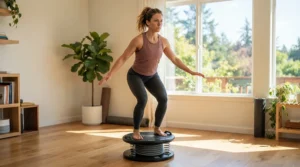
On paper, specifications like “32 springs” or “115kg maximum weight” don’t tell you much about how a session actually feels. In practice, most first-time users report their calves and ankles working noticeably harder than expected within the first few sessions — a direct result of the stabiliser-muscle recruitment that makes rebounding distinct from flat-ground cardio. According to reporting on the trend picked up by UK lifestyle and fitness journalism covering the rebounding resurgence, much of rebounding’s renewed popularity comes down to exactly this combination — genuine cardiovascular effort that doesn’t feel as punishing on the joints as an equivalent run, making consistency easier to maintain over weeks rather than days.
Expect a noticeable difference between bungee and spring models within your first ten minutes of use: bungee systems like those in the Bluefin Aero Fit 50″ feel softer and more forgiving on landing, while spring-based models like the Ativafit 40″ Foldable Rebounder give sharper feedback and a more pronounced rebound, which some users find more motivating and others find jarring. Neither is objectively better — it genuinely comes down to personal preference and joint sensitivity, which is exactly why understanding the bounce-system distinction before buying matters more than comparing star ratings alone.
FAQ
❓ Is a value fitness trampoline actually good exercise?
❓ What size fitness trampoline should I buy for a small flat?
❓ Do I need resistance bands with my rebounder?
❓ How long does a budget rebounder typically last?
❓ Is a spring or bungee rebounder better for joint pain?
Conclusion
Choosing a value fitness trampoline doesn’t need to mean compromising on quality, and it definitely doesn’t require spending premium-gym money to get a genuinely durable, well-reviewed rebounder. Whether you land on the accessory-packed MaXimus PRO Folding Rebounder, the spacious Bluefin Aero Fit 50″, or the wonderfully affordable Opti Mini Fitness Trampoline, the real differentiators are bounce system, weight capacity margin, and folding quality — not marketing buzzwords.
What matters most is matching the model to your actual living situation: your ceiling height, your neighbours, your joints, and your budget, in that order. Get those four things right and any of the seven rebounders covered here should deliver genuinely good value, whether you’re chasing NASA-backed cardio efficiency, gentle joint-friendly movement, or simply a fun way to hit your weekly activity target without leaving the house.
Recommended for You
- Cheap Mini Trampoline: 7 Brilliant Budget Picks for 2026
- Top Rated Mini Trampolines: 7 Best UK Picks for 2026
- Weatherproof Trampoline Covers: 7 Best Picks for UK Gardens (2026)
Disclaimer: This article contains affiliate links. As an Amazon Associate, I earn from qualifying purchases. If you purchase products through these links, we may earn a small commission at no additional cost to you.
✨ Found this helpful? Share it with your friends! 💬🤗
