
In This Article
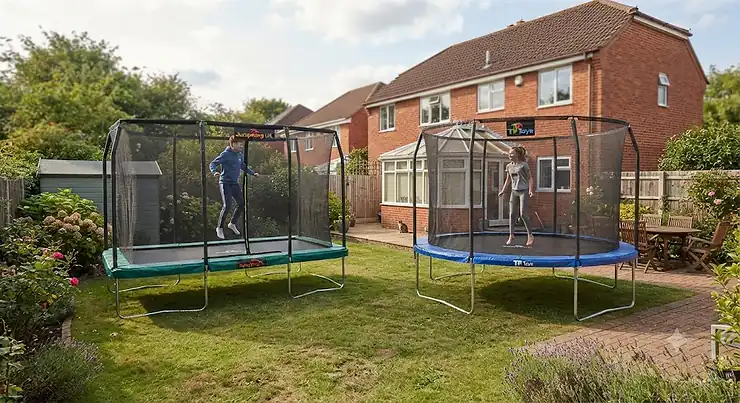
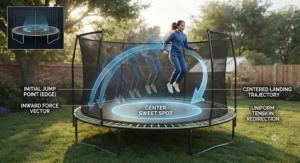
Somewhere between the garden centre aisle and the “add to basket” button, most people freeze on one surprisingly stubborn question: rectangular vs round trampoline — does the shape actually matter, or is it just marketing? Short answer: it matters more than the box art lets on. A rectangular trampoline is, in plain terms, a longer, flatter jumping surface strung with springs arranged along the sides rather than radiating from the centre, which concentrates energy more evenly across the mat and tends to produce a higher, more consistent bounce. A round trampoline uses springs that pull inward from every direction, gently funnelling jumpers toward the middle — brilliant for younger children who wander, less brilliant for a teenager trying to land a backflip on the exact same spot twice.
We’ve spent time digging through real spec sheets, aggregated review data and manufacturer documentation for seven genuine trampolines sold in the UK, spanning budget, mid-range and premium price points, rectangular, round and oval shapes. Along the way we’ll answer the exact questions most UK buyers type into Google — which trampoline shape is better, what the rectangular trampoline advantages over round actually are, how the price gap breaks down, and which shape wins for kids specifically. As the UK’s leading safety charity RoSPA notes in its trampoline safety guidance, new trampolines should also meet a recognised UK safety standard regardless of shape — something we’ll come back to later, because bounce height means nothing if the thing isn’t built properly.
By the end, you should be able to walk into this decision with a shape preference, a shortlist, and a realistic sense of what you’ll actually pay.
Quick Comparison Table: Rectangular vs Round Trampoline
| Factor | Rectangular Trampoline | Round Trampoline |
|---|---|---|
| Bounce style | Higher, more even across the mat | Naturally centres the jumper |
| Best for | Teens, gymnastics practice, multiple jumpers | Younger children, casual family bouncing |
| Typical UK price range | £220–£500+ for garden sizes | £120–£900+ (budget to premium in-ground) |
| Garden footprint | Rectangular — can suit narrow gardens | Circular — needs equal clearance all round |
| Entry-level safety | Springs along two long edges, even tension | Springs pull toward centre, gentler edges |
At a glance, the rectangular trampoline advantages over round come down to bounce consistency and space efficiency in a long, narrow garden, while round models win on cost-per-square-foot at the budget end and on how forgiving they are for wobbly toddlers. Neither shape is objectively “better” — the right pick depends on who’s actually going to be jumping and how much garden you’re prepared to sacrifice. Price is the other big swing factor: a basic 8ft round trampoline can undercut even the cheapest rectangular model by more than half, which matters if this is a first trampoline for a family that isn’t sure it’ll get years of use.
💬 Already leaning one way? Scroll down to the shape that matches your garden and skip straight to our top picks.
Top 7 Trampolines: Expert Analysis
1. Zero Gravity Ultima 5 — best rectangular bounce for serious jumpers
The Zero Gravity Ultima 5 is a rectangular “barrel” design, meaning it keeps the flatter, even-tension jumping surface of a true rectangle while softening the corners into a more space-efficient oval-ish outline. It’s built with a galvanised steel frame, curved double-leg supports for stability, and a UV-resistant tear-resistant jump mat, and it’s sold in three genuine sizes — 10ft x 7ft, 12ft x 8ft and 15ft x 10ft — so you can scale it to your garden rather than the other way round. In practice, the barrel shape means you get noticeably more usable jumping length than a same-footprint round trampoline, which matters once a child starts attempting proper tumbling runs rather than just bouncing on the spot.
Reviewers on the manufacturer’s own storefront have left over 50 verified reviews for the mid-size 10ft x 7ft model at an aggregated rating around 4.7 out of 5, with recurring praise for the bounce quality relative to the price and a handful of comments flagging that the assembly, like most flat-packed trampolines, is a genuine two-person job. Based on the spec comparison with typical round competitors at the same price point, the 52 galvanised conical springs give a firmer, more predictable rebound — ideal for a household with a keen young gymnast, less ideal if you specifically want the gentler bounce round trampolines are known for.
Pros:
- ✅ Even bounce across the full barrel-shaped mat
- ✅ Available in three sizes to fit different gardens
- ✅ Galvanised frame rated for UK weather
Cons:
- ❌ Assembly genuinely needs two adults
- ❌ Firmer bounce may not suit nervous younger jumpers
Prices for the Zero Gravity Ultima 5 sit roughly in the £220–£500 range depending on size, with the 12ft x 8ft mid-size model typically landing around the middle of that band — always check current pricing before buying, as trampoline prices shift with materials costs and seasonal demand.
2. Sportspower Rectangular Trampoline — best compact rectangular for small gardens
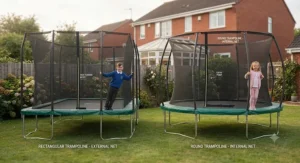
The Sportspower Rectangular Trampoline is a 6ft x 8ft model built specifically to bring rectangular bounce quality to gardens that can’t accommodate a 10ft or 12ft frame. It uses zinc-coated springs and a durable jump mat designed to spread bounce evenly across the surface rather than concentrating it in the centre, which independent testers have specifically flagged as one of its strongest features. The black frame is a deliberately understated design choice — the idea being that a rectangular trampoline this size can slot into a UK garden without dominating it the way a large round model often does.
Independent parent-tester coverage of family trampolines found the bounce responsive and consistent across the full jumping surface rather than concentrated in one spot, making it particularly suited to active children who want room to practise skills as well as bounce for fun. What most buyers overlook about a compact rectangular model like this is that the smaller footprint doesn’t necessarily mean a smaller jumping surface loss compared with an 8ft round — because the corners of a rectangle are usable jumping space too, whereas a circle wastes area at every edge.
Pros:
- ✅ Compact 6x8ft footprint suits smaller gardens
- ✅ Responsive, evenly distributed bounce
- ✅ Understated black design blends into the garden
Cons:
- ❌ Smaller jumping surface than larger rectangular models
- ❌ Less headline capacity for teens and adults
At around £150–£220, the Sportspower Rectangular Trampoline represents genuinely good value for families wanting rectangular bounce characteristics without a rectangular trampoline’s usual larger footprint or price tag.
3. Zero Gravity Ultima 4 — best budget all-rounder round trampoline
The Zero Gravity Ultima 4 is a straightforward round trampoline sold across an unusually wide range of sizes — 6ft right up to 14ft — with a galvanised steel frame, safety enclosure netting and a ladder included as standard. It’s the kind of trampoline most UK households picture when they think “garden trampoline”: circular, springs pulling toward the centre, safety pad covering the spring zone. The 10ft version in particular has become something of a default choice for families wanting a proper family-size round trampoline without stepping into premium territory.
With well over 100 aggregated verified reviews across its size range and a rating consistently above 4.7 out of 5, the pattern in feedback is remarkably consistent: buyers rate it highly for value and straightforward assembly, with the occasional complaint about the padding wearing faster than expected after a full British summer of daily use. Here’s what to weigh: the centring effect that makes round trampolines less exciting for serious jumpers is precisely what makes the Zero Gravity Ultima 4 a sensible pick for households with children under 10, since it naturally discourages them from bouncing dangerously close to the enclosure edge.
Pros:
- ✅ Available in five sizes from 6ft to 14ft
- ✅ Strong aggregated review scores across the range
- ✅ Naturally centres younger, less experienced jumpers
Cons:
- ❌ Safety padding may need replacing sooner than frame
- ❌ Less bounce height than equivalent rectangular models
Depending on size, expect the Zero Gravity Ultima 4 to sit somewhere between £120 and £320, making it one of the widest price-to-size spreads of any round trampoline on this list.
4. Plum Play Outdoor Circular Deluxe Trampoline — best mid-range family round trampoline
The Plum Play Outdoor Circular Deluxe Trampoline, available in 8ft, 10ft, 12ft and 14ft sizes, is built around a heavy-duty galvanised steel frame with weather-resistant, extra-thick safety padding covering both frame and springs. It’s EN71 certified, which matters more than it sounds — this is the toy safety standard specifically covering domestic trampolines, and not every budget import can say the same. The circular jumping surface is designed for consistent, responsive bounce rather than raw height, positioning it firmly as a family fun trampoline rather than a training tool for aspiring gymnasts.
Aggregated customer feedback on Amazon UK for this range is generally positive, with one verified UK buyer specifically praising the value proposition while noting the assembly instructions could be clearer — a common theme across flat-packed trampoline reviews generally, not a Plum-specific flaw. What the spec sheet won’t tell you, but reviewers note repeatedly, is that the enclosure netting fully separating jumpers from the spring zone is one of the more reassuring safety features for parents of younger children, since it removes the temptation to reach through or over the padding.
Pros:
- ✅ EN71 certified for UK toy safety compliance
- ✅ Enclosure netting fully separates jumpers from springs
- ✅ Weather-resistant padding built for year-round UK gardens
Cons:
- ❌ Assembly instructions criticised as unclear by some buyers
- ❌ Circular design limits usable jumping length versus rectangular
Prices for the Plum Play Outdoor Circular Deluxe Trampoline generally fall in the £150–£280 range across the size run, putting it squarely in the mid-market bracket where most first-time trampoline buyers end up shopping.
5. Rebo Base Jump Halo II — best large round trampoline for multiple kids
The Rebo Base Jump Halo II is a round trampoline sold across four sizes with a distinctive Halo enclosure system — rather than a traditional netted cage bolted to external poles, the net attaches directly to the jump mat frame edge, removing several of the pinch points found on older enclosure designs. Spring length and frame height specs put it firmly in family-size territory, particularly at the 14ft end of the range, where there’s genuinely enough surface for two or three children to bounce with reasonable separation.
This is a case where honest reporting means presenting a mixed picture rather than a glowing one. Aggregated reviews on the manufacturer’s own site and testimonials describe a sturdy, well-built trampoline with a noticeably better bounce than cheaper alternatives, and one long-term owner specifically highlighted quick delivery and how the trampoline held up through a Scottish winter. However, independent review aggregation on Trustpilot for the parent company shows a recurring complaint theme around spare parts availability and after-sales support when components like legs are damaged — worth knowing before you buy, particularly if you live somewhere prone to high winds. Based on the spec comparison, the Halo enclosure genuinely is a safety improvement over older pole-and-net designs; it’s the customer service track record that buyers should go in with realistic expectations about.
Pros:
- ✅ Halo enclosure removes traditional pole pinch points
- ✅ Available up to 14ft for multiple simultaneous jumpers
- ✅ Strong bounce quality reported by long-term owners
Cons:
- ❌ Spare parts and after-sales support criticised in reviews
- ❌ Larger sizes need substantial garden clearance
The Rebo Base Jump Halo II typically runs from around £180 for the smallest size up to roughly £350 for the 14ft model — reasonable for the size, provided you factor in the after-sales caveat above.
rectangular vs round trampoline
6. BERG Favorit InGround 330 — best premium in-ground round trampoline
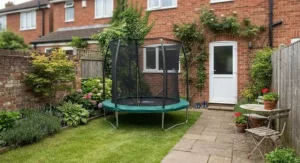
The BERG Favorit InGround 330 takes a genuinely different approach: rather than sitting on legs above the lawn, it sinks flush into the ground, using a galvanised frame that’s protected inside and out against corrosion so it can be left outdoors year-round, even through winter. At 330cm (11ft), it uses 72 SoloSpring springs, a standard-quality jump mat and UV3-rated protection, and it’s tested to withstand loads several times its stated maximum user weight — the kind of overbuilt engineering that justifies the premium positioning.
Reviewers consistently note the build quality as a step above typical above-ground trampolines, with specific praise for how superbly the seams and padding are finished. What most buyers overlook about in-ground trampolines generally is the hidden cost: excavating a pit, fitting a retaining wall, and potentially hiring help for the groundwork, none of which shows up on the trampoline’s own price tag. On paper, this means the BERG Favorit InGround 330 delivers a genuinely premium, low-profile bounce experience — but only for buyers willing to treat it as a semi-permanent garden installation rather than something they can relocate next summer.
Pros:
- ✅ Corrosion-protected frame built for year-round outdoor use
- ✅ Low-profile in-ground design with no visible legs
- ✅ Tested to several times its rated weight capacity
Cons:
- ❌ Excavation and groundwork add significant hidden cost
- ❌ Effectively a permanent garden fixture once installed
Expect the trampoline itself to sit in a premium price bracket, typically upwards of £700 before installation costs, so always confirm current pricing and factor in groundworks before committing.
7. Jumpking Oval Professional — best oval hybrid for big families
The Jumpking Oval Professional, at a substantial 10ft x 15ft, splits the difference between the two shapes this whole article is built around. It’s a large, high-capacity model designed for busy family gardens, offering enough room for energetic play while providing a more guided, predictable bounce than a purely rectangular alternative. The oval shape borrows the elongated jumping length of a rectangle while keeping some of the gentler, more centring spring geometry of a round trampoline — a genuinely useful compromise if your household has both a nervous six-year-old and a confident twelve-year-old sharing the same trampoline.
At 10ft x 15ft, there’s plenty of room for children, teens and even adults to bounce comfortably. Here’s what to weigh: an oval this size needs a genuinely large, flat garden area to accommodate both the frame and the recommended clearance zone around it, so this isn’t a realistic pick for a typical terraced house garden. For families with the space, though, the Jumpking Oval Professional avoids the classic rectangular-vs-round trade-off almost entirely by giving you a bit of both.
Pros:
- ✅ Large 10x15ft surface suits multiple ages at once
- ✅ Bounce blends rectangular length with round predictability
- ✅ High weight capacity for teens and adults
Cons:
- ❌ Requires a genuinely large, flat garden
- ❌ Premium size pushes it toward the top of most budgets
Expect the Jumpking Oval Professional to sit in the £400–£550 range, positioning it as a premium option that’s still meaningfully cheaper than a comparable in-ground round trampoline.
Practical Usage Guide: Setup, Maintenance & Getting the Bounce Right
Getting a new trampoline from box to safely bouncing takes longer than the packaging suggests — budget a full afternoon and, ideally, a second pair of hands, since spring-loading is genuinely difficult solo regardless of which of the seven models above you’ve gone for. Start by laying out all parts on the lawn and checking them against the included list before you begin; missing a single leg bracket four hours in is a special kind of frustrating. Ground preparation matters more than most buyers expect: a level, soft surface such as grass or bark chip is essential, and the trampoline should sit at least two metres clear of fences, trees, sheds or washing lines on every side.
Once assembled, the first 30 days matter for longevity. Tighten spring hooks and check enclosure netting attachment points weekly for the first month, since new components can settle slightly as they’re used. A common early mistake is leaving the safety pad slightly misaligned after assembly, exposing a sliver of spring — worth a five-minute check before the first bounce. For ongoing maintenance, inspect springs for rust or stretching every few months, particularly after a wet UK winter, and consider a weatherproof cover if your model didn’t include one; UV exposure degrades jump mats faster than almost anything else. Anchoring kits are a worthwhile add-on for any trampoline over 8ft, since even a moderately gusty day can shift or overturn an unanchored frame.
Real-World Scenarios: Which Trampoline Shape Fits Your Family
If you’re a family with two children under eight and a modest suburban garden, a round trampoline in the 8–10ft range — something like the Zero Gravity Ultima 4 — makes the most practical sense. The centring bounce keeps younger, less coordinated jumpers away from the enclosure edges, and the circular footprint is easier to squeeze into an average-sized lawn without eating the whole garden.
If you’re the parent of a keen 11-year-old gymnast who’s outgrown their childhood round trampoline and wants to practise proper technique, a rectangular model like the Zero Gravity Ultima 5 delivers the flatter, more even bounce that supports skill progression, and the barrel shape keeps the footprint more manageable than a full rectangle. If you’re a larger family with three children spanning ages 6 to 15, sharing one trampoline, the Jumpking Oval Professional or a large round option like the 14ft Rebo Base Jump Halo II gives enough surface area for simultaneous use without everyone colliding in the centre. And if you’re renovating a garden long-term and want something that disappears into the landscape rather than dominating it, the BERG Favorit InGround 330 is worth the extra outlay and groundwork, provided the trampoline’s permanence suits your plans for the space.
Rectangle or Round Trampoline: Which Is Best?
There isn’t a single universal answer to rectangle or round trampoline which is best, because the two shapes are engineered to do genuinely different jobs. A rectangular trampoline uses springs arranged along the perimeter of a long, flat mat, distributing tension more evenly across the surface and producing a higher, more consistent bounce with less pull toward the centre. That makes it the preferred shape for gymnastics clubs, serious young jumpers, and anyone who wants to practise the same trick in the same spot repeatedly without drifting.
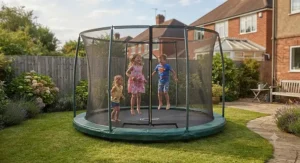
A round trampoline, by contrast, uses springs pulling radially toward the middle from every direction, which naturally nudges jumpers back toward the centre of the mat regardless of where they land. For a family with younger children who bounce more chaotically than deliberately, that self-centring effect is a genuine safety benefit, not just a budget compromise. Which trampoline shape is better ultimately comes down to who’s using it: choose rectangular for skill-focused, older jumpers, and round for general family fun with a wider age spread — and if you genuinely can’t decide, an oval model like the Jumpking Oval Professional is a reasonable middle ground.
Rectangular Trampoline Advantages Over Round Explained
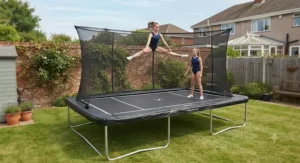
Beyond the headline bounce-height difference, the rectangular trampoline advantages over round extend into a few areas buyers often don’t think about until they’re already jumping. First, usable surface area: because a rectangle’s corners are still fully usable jumping space, a rectangular trampoline of a given footprint typically offers more genuinely usable mat than a round trampoline of similar dimensions, which waste area at every curved edge. Second, multi-user safety: because rectangular springs don’t funnel everyone toward one central point, two or three jumpers can use different zones of the mat with less risk of colliding mid-air — a real consideration for households with more than one child.
Third, and often overlooked, is garden fit. A narrow, rectangular garden — common in a lot of UK terraced housing — can accommodate a rectangular trampoline running along a fence line in a way a round trampoline of equivalent jumping area simply can’t, since a circle needs equal clearance on every side. The trade-off, and it’s a real one, is price and complexity: rectangular trampolines are mechanically more involved to build and typically cost more than a same-size round model, and the firmer, higher bounce isn’t necessarily what a nervous younger child wants from their first trampoline experience.
Trampoline Shape Bounce Physics: What’s Actually Happening Under Your Feet
The bounce itself comes down to basic energy transfer: springs compress under load and store elastic potential energy, then release it as kinetic energy that propels the jumper back upward, with the whole cycle governed by essentially the same principle described in Hooke’s Law. Where shape comes in is how that stored energy is distributed across the mat. On a round trampoline, springs pull radially toward a central point, so energy naturally concentrates there — which is exactly why round trampolines centre jumpers so reliably. On a rectangular trampoline, springs run along two long parallel edges, spreading the load more evenly along the mat’s length and reducing the pull toward any single point.
Researchers studying energy transfer on trampolines have shown mathematically that when two jumpers land on a trampoline with only a small time-lag between them, it’s possible for kinetic energy to transfer almost entirely from one jumper to the other through the mat — a real phenomenon behind games like “seat drop war,” and one reason multiple jumpers on any trampoline, regardless of shape, is generally discouraged by safety bodies. In practice, what this means for buyers is straightforward: if raw bounce height and predictable landing zones matter most, the physics favours rectangular; if a gentler, more contained bounce for a less experienced jumper matters more, round wins on the same physics, just applied differently.
Best Trampoline Shape for Kids: Age-by-Age Guide
For toddlers and children under six, most safety guidance suggests trampolining isn’t appropriate at all regardless of shape, since younger children haven’t developed the physical control to manage their own bouncing safely. From around age six to nine, a round trampoline is generally the better shape — the natural centring effect compensates for less coordinated jumping, and the lower cost of entry-level round models like the Zero Gravity Ultima 4 means a first trampoline doesn’t need to be a major investment. Children and young people are also generally recommended to get an average of at least 60 minutes of moderate to vigorous activity a day, and a garden trampoline is a genuinely effective, low-friction way to help hit that target without a scheduled activity or a car journey.
From around age ten upward, particularly for children showing interest in gymnastics, cheerleading or trampolining as a sport, a rectangular model starts to make more sense — the flatter, more consistent bounce supports proper technique development in a way a round trampoline’s centring pull can actually work against. Mixed-age households are the trickiest case, and this is where an oval trampoline like the Jumpking Oval Professional or a larger round model genuinely earns its premium price by giving both age groups a workable experience on the same equipment.
How to Choose Between Rectangular and Round: 6-Step Framework
- Measure your garden first. Know your actual usable, flat, obstacle-free space before looking at any product page — this single step eliminates more options than any spec comparison will.
- Identify your primary user. A household built around one serious young jumper leans rectangular; a household with multiple younger children leans round.
- Set a realistic budget band. Decide whether you’re shopping budget, mid-range or premium before you start browsing, since round trampolines offer a wider spread of entry price points than rectangular.
- Check the safety certification. Look specifically for EN71-14 compliance, and confirm the enclosure netting design fully separates jumpers from the spring zone.
- Factor in installation type. Above-ground models are simpler and relocatable; in-ground models like the BERG Favorit InGround 330 need permanent groundwork but deliver a lower-profile look.
- Read aggregated reviews, not just the star rating. A 4.8-star average with a recurring complaint about spare parts, as seen with some Rebo feedback, tells you more than the headline number alone.
Common Mistakes When Buying a Trampoline
The single most common mistake is buying based on garden footprint alone without checking the recommended safety clearance zone around the frame, which for most models adds a genuine two to three metres on every side beyond the trampoline itself. A close second is underestimating assembly time and difficulty — flat-pack trampolines routinely take two adults two or more hours, and springs require real physical strength to load, something first-time buyers rarely anticipate. Buyers also frequently skip checking the maximum user weight rating against who will actually be using it; a trampoline rated for children can be quietly overwhelmed once teenagers or adults start joining in.
Another recurring error is choosing the cheapest available option without checking safety certification, since not every budget import trampoline sold through third-party marketplaces meets the EN71-14 domestic trampoline standard. Finally, many buyers forget to budget for ongoing costs — a weatherproof cover, anchor kit, and eventual spring or padding replacement — treating the upfront trampoline price as the total cost rather than the starting point.
Safety, Regulations & Compliance in the UK
New trampolines sold in the UK should meet the European Standard EN71-14:2014, “Safety of toys – Trampolines for domestic use,” and should ideally be placed on energy-absorbing ground such as soft, springy lawn or bark chip rather than concrete or hard-packed mud. This applies regardless of shape — a round trampoline without a proper enclosure net is no safer than a rectangular one lacking the same feature, and vice versa. RoSPA maintains dedicated advice on garden trampoline safety (linked earlier in this guide) covering positioning, supervision and enclosure use that’s worth reading in full before your first purchase, particularly if this is a first trampoline for the household.
Beyond the standard itself, a few practical points apply to every model on this list. Only one jumper at a time is the consistent safety recommendation from UK bodies, since the majority of trampoline-related injuries involve multiple simultaneous users regardless of shape. Adult supervision for younger children, a secured and fully closed enclosure entrance, and regular checks of spring hooks and padding for wear all matter more to real-world safety outcomes than the rectangular-versus-round decision itself — shape affects bounce characteristics, but proper setup and use affects whether anyone actually gets hurt.
Long-Term Cost & Maintenance: Rectangular Trampoline Price vs Round
Comparing rectangular trampoline price vs round at face value can be misleading, because the cheapest entry point in each category sits at very different levels. Budget round trampolines, such as the smallest sizes of the Zero Gravity Ultima 4, can be found for well under £150, while the cheapest genuinely rectangular models, like the Sportspower Rectangular Trampoline, generally start closer to £150–£220. At the premium end, the gap narrows and sometimes reverses entirely — an in-ground round trampoline like the BERG Favorit InGround 330 comfortably outprices most above-ground rectangular models once groundwork is included, simply because of the installation complexity rather than the trampoline itself.
Total cost of ownership matters more than the sticker price over a multi-year timeframe. Springs, safety padding and jump mats all degrade with UV exposure and use, typically needing replacement within three to six years depending on how much of the year they’re left outdoors uncovered. A weatherproof cover, costing a modest fraction of the trampoline’s original price, is consistently one of the better-value add-on purchases across every model in this guide, since it meaningfully slows padding and mat degradation. Factoring in these ongoing costs, a mid-range trampoline of either shape, properly maintained, tends to work out cheaper per year of use than a bargain-basement model replaced every two seasons.
Frequently Asked Questions
❓ Is a rectangular or round trampoline better for bounce height?
❓ Which trampoline shape is safer for young children?
❓ Do rectangular trampolines cost more than round ones?
❓ Can adults use a round trampoline safely?
❓ What size trampoline is best for a small UK garden?
Conclusion
If you’ve made it this far, the rectangular vs round trampoline question probably feels less like a coin flip and more like a genuine decision with a right answer for your household. Round wins for younger children, tighter budgets and gardens that need equal clearance on every side. Rectangular wins for older, skill-focused jumpers, narrow gardens that suit a long footprint, and anyone prioritising a higher, more consistent bounce over a gentler centring effect. Oval and in-ground options, like the Jumpking Oval Professional and BERG Favorit InGround 330, exist precisely because plenty of families don’t fit neatly into either camp.
Whichever shape you land on, the safety fundamentals stay identical: proper clearance space, a certified enclosure, regular maintenance checks and one jumper at a time. Get those right, and the shape debate becomes exactly what it should be — a genuine preference rather than a safety compromise.
✨ Ready to Choose Your Trampoline?
🔍 Compare current prices and availability on any of the seven models above, and pick the shape that actually matches how your family bounces. Click through to check today’s pricing before it changes!
Recommended for You
- Rectangular Trampoline Gymnastics: 7 Best Picks for 2026
- Best Rectangular Trampoline UK 2026: 7 Top Picks Reviewed
- Oval Trampoline Narrow Garden: 7 Top 2026 Picks (Ranked)
Disclaimer: This article contains affiliate links. As an Amazon Associate, I earn from qualifying purchases. If you purchase products through these links, we may earn a small commission at no additional cost to you.
✨ Found this helpful? Share it with your friends! 💬🤗
