
In This Article
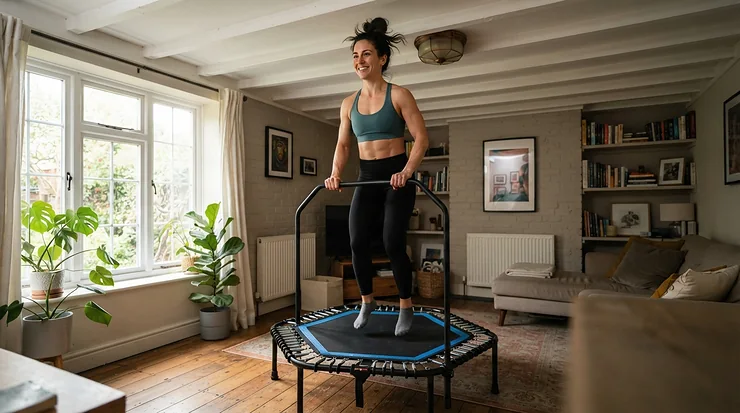
Picture a typical British weeknight. It’s raining sideways, the gym is a twenty-minute drive away, and the sofa is making its usual case. Two small, cheap pieces of kit can win that argument: a wobbly round mini trampoline, or a coil of cord with handles. Both get your heart rate up inside your own four walls, and both cost less than a month at most gyms. They feel completely different to use, though.
So here’s the real question behind rebounder vs skipping rope for fitness. Which one suits your body, your flat and your attention span? I’ve compared specs, pulled out the recurring themes in published reviews, and weighed the evidence on calories, bones and joints. Nothing here comes from hands-on testing. It’s analysis, and I’ve flagged where the evidence is thin.
The yardstick is the NHS guidance for adults. That means 150 minutes of moderate activity a week, or 75 vigorous, plus strengthening work on two or more days. Either tool can help you get there. Which one gets you there with the fewest excuses is the interesting part.
Quick Comparison: 7 Picks at a Glance
Here are five rebounders and two skipping ropes side by side. Prices are broad ranges from the time of research, so check current price before you buy, because Amazon shifts them daily.
| Product | Type | Typical price range | Storage | Best For |
|---|---|---|---|---|
| BCAN BT2 | Bungee rebounder, foldable | Around £80-£130 | Folds, handlebar | Quiet bouncing in flats |
| BCAN SP2 | Spring rebounder, foldable | Around £50-£90 | Folds to roughly a quarter | First-time buyers |
| MaXimus Pro Folding Rebounder | Spring rebounder, folding | Around £100-£150 | Folds, bag included | Heavier users, travel |
| SPORTSOUL 40″ Folding Fitness Rebounder | Spring rebounder, folding | Around £45-£80 | Folds, handle | Tightest budgets |
| JumpSport 350f | Elastic-cord rebounder | Well above £200 | Folding legs | Long-term investment |
| Beast Gear Beast Rope | Speed rope | Around £12-£25 | Fits in a pocket | Fast cardio, travel |
| Gritin Skipping Rope | Foam-handle rope | Around £8-£15 | Fits in a pocket | Comfort, beginners |
The pattern jumps out immediately. The ropes cost a fraction of the rebounders, while the rebounders give you a cushioned landing and a handlebar for balance. If your budget is firm, Gritin Skipping Rope and SPORTSOUL 40″ Folding Fitness Rebounder are the cheapest ways in. The sweet spot for most households is probably BCAN SP2, which usually sits under the £100 line without feeling flimsy.
💬 Just one click — help others make better buying decisions too!😊
What Is Rebounder vs Skipping Rope for Fitness?
Rebounder vs skipping rope for fitness is a comparison of two compact home cardio tools. A rebounder is a mini trampoline that cushions each landing and lets you bounce, jog or dance on it. A skipping rope is a handheld cord you jump over on the floor. Both raise your heart rate quickly, but they load your joints, calves and coordination very differently.
Rebound exercise is described as an elastically leveraged, low-impact activity done on a mini trampoline, descended from the sporting trampoline. Skipping is older and simpler, and it’s far more demanding per minute.
Think of it this way. A rebounder is the sports car with air suspension: forgiving and fun, but you can cruise on it. A skipping rope is the stripped-out track bike. It’s brutally efficient, and it punishes sloppy technique.
Top 7 Rebounders and Skipping Ropes: Expert Analysis
I’ve split these into five rebounders and two ropes so the two sides get a fair hearing. Every comparison below rests on published specs and aggregated review themes, not on any claim of hands-on testing.
1. BCAN BT2 — quietest bounce for flats and thin floors
The bungee suspension is the headline here. Instead of metal springs, thick elastic cords carry your weight, and that’s why this model keeps coming up as the quiet option in review roundups. If a neighbour lives below you, that matters more than any spec on the box.
Listings describe an alloy frame, a height-adjustable handlebar and a foldable design in 40-inch and 48-inch sizes. The handlebar turns a wobbly first week into a confident one, while the bungee gives a softer, deeper landing than most springs. That cushioning is relevant to joint impact, because a slower, deeper rebound spreads the load over more time.
Based on the spec comparison, this suits cautious beginners and anyone with a downstairs neighbour. Reviewers consistently praise the low noise and the sturdy feel, though one roundup flagged that the folding mechanism takes a little practice. Capacity figures vary by size and listing, so check the exact variant.
Pros:
- ✅ Bungee cords keep noise genuinely low
- ✅ Adjustable handlebar steadies beginners
- ✅ Softer, deeper landing than springs
Cons:
- ❌ Often sits right at or above £100
- ❌ Folding mechanism needs a little practice
Price: around £80-£130 depending on size, so it’s a stretch for a strict under-£100 budget but fair value for what the bungee buys you.
2. BCAN SP2 — best all-round foldable under £100
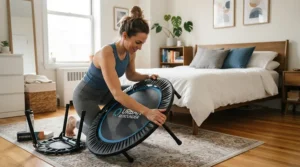
Where the BCAN BT2 is the refined option, the BCAN SP2 is the pragmatic one. It uses conventional springs, folds down to roughly a quarter of its open size, and carries a foam-padded handlebar. That fold is the real selling point for small homes.
A 40-inch mat is big enough that you won’t feel cramped while marching, jogging on the spot or doing gentle side-steps. The spring system gives a firmer, livelier bounce, which suits people who want to push the pace. In practice that means better cardio per minute, and slightly more noise.
One roundup credits the BCAN SP2 with an unusually large review base on retail listings. A big sample is useful, because it shows how a rebounder holds up after months, not just in week one. Springs on any rebounder can start to squeak with age, so it’s worth a quick check every few weeks.
Pros:
- ✅ Folds small enough for a wardrobe
- ✅ Usually sits under the £100 mark
- ✅ Padded handlebar suits beginners and older users
Cons:
- ❌ Springs are noisier than bungee cords
- ❌ Firmer bounce may feel jarring to some
Price: around £50-£90, which makes it the strongest value pick in this guide.
3. MaXimus Pro Folding Rebounder — best for travel and heavier users
This is the most “serious” rebounder here under £150. It’s a 40-inch folding frame with 32 springs, a stability bar, a storage bag and, per the listing, resistance bands and an online workout library. The brand markets it as British, which helps with after-sales support.
One older roundup puts the weight limit around 287 lb, or roughly 130 kg, for the Pro Gym version. That’s a genuine advantage if you’re a heavier user or want a bit of headroom. The legs detach and the mat folds in four, which owners say makes it easy to stash behind a sofa or carry to the car boot.
The listing claims a joint-impact reduction of over 87 per cent. That’s a manufacturer’s figure, so treat it as marketing rather than independent evidence. Review themes are strongly positive on build quality and storage, with several owners describing it as a gentle way back into exercise.
Pros:
- ✅ Higher weight limit than most rivals
- ✅ Legs detach and mat folds for storage
- ✅ Stability bar and storage bag included
Cons:
- ❌ Usually priced just above £100
- ❌ Manufacturer’s joint-impact claims aren’t independent
Price: around £100-£150, so it’s a premium-budget buy rather than a bargain.
4. SPORTSOUL 40″ Folding Fitness Rebounder — cheapest way into rebounding
If your absolute ceiling is £60, this is where I’d start looking. It appears in a UK retailer’s 2026 buying guide as a 40-inch folding rebounder with a handle. That’s the baseline kit you actually need.
I could verify only the headline specs, and the review base looked thinner than the BCAN SP2. So treat it as a calculated gamble rather than a proven workhorse. The sensible move is to read the current reviews for weight capacity, handle stability and spring noise before you commit.
On paper, a 40-inch mat with a handle gives you a similar workout to pricier models. What the extra money buys is longevity and fit and finish. If you’re unsure rebounding is for you, a cheap trial makes sense, and you can upgrade later.
Pros:
- ✅ Lowest entry price among the rebounders
- ✅ Folding design with a handle
- ✅ Gives you a risk-light way to try rebounding
Cons:
- ❌ Thinner verified review base
- ❌ Likely shorter lifespan than premium models
Price: around £45-£80, which makes it the clearest “try it and see” pick.
5. JumpSport 350f — premium benchmark for the long haul
This one sits far outside the under-£100 brief, so think of it as a yardstick rather than a recommendation. It’s a roughly 39-inch rebounder with elastic-cord suspension and folding legs, and it’s marketed as a compact, serious home option.
Why include it? Because it shows what extra money buys. Premium cord systems are generally quieter and more consistent than cheap springs, and they tend to hold their bounce for longer. If you plan to rebound five days a week for years, the cost per session drops quickly.
For most readers it’s overkill. If you’re still deciding between a rebounder and a rope, spending several times the price of an entry-level model before you know you’ll stick with it is hard to justify. Wait until you’ve done six weeks on something cheaper.
Pros:
- ✅ Premium cord suspension for a consistent bounce
- ✅ Folding legs suit compact storage
- ✅ Built for frequent, long-term use
Cons:
- ❌ Far above any budget cardio equipment threshold
- ❌ Overkill if you’re still testing the habit
Price: well above £200, so it only makes sense for committed bouncers.
6. Beast Gear Beast Rope — fast, adjustable and pocketable
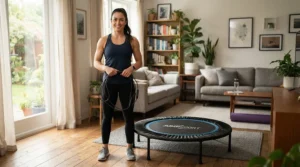
The Beast Gear Beast Rope is a coated-cable speed rope, and review roundups consistently describe it as fast, sturdy and easy to adjust. It also comes with a carry bag. The thin cable cuts through the air with little drag, which is why it suits quick, rhythmic skipping.
Here’s the real-world meaning. A speed rope rewards short, sharp sessions, and as the intensity climbs, so does the calorie cost. Skipping is commonly rated at around 11 METs, roughly the energy cost of running an 8.5-minute mile. On that basis, ten minutes costs a 70 kg adult about 130 calories, though your own figure will vary with pace and body weight.
The catch is the learning curve. A fast rope punishes poor timing with a sting on the shins. Beginners who want a gentler start may prefer a slightly thicker rope. For a pocketable piece of portable fitness gear that you can take on holiday, it’s hard to beat.
Pros:
- ✅ Lightweight, quick-turning cable
- ✅ Adjustable length with a carry bag
- ✅ Fits in a coat pocket
Cons:
- ❌ Thin cable stings if your timing slips
- ❌ Needs ceiling and floor space to swing
Price: around £12-£25, which is excellent value as budget cardio equipment.
7. Gritin Skipping Rope — comfort-first rope for beginners
The Gritin Skipping Rope appears in UK roundups as the pick for hand comfort. It has soft memory-foam handles and swivel ball bearings, and it’s often recommended to people who have struggled with hard, slippery grips.
That matters more than it sounds. Most beginners abandon skipping within a fortnight, usually because their hands are sore or the rope tangles. A comfortable, smooth-turning rope removes two of the biggest friction points. It also works for boxing-style warm-ups, which gives it a second life.
Reviewers broadly like the comfort and the price. Because the rope is a basic design, it won’t have the refinement of premium ropes. For someone testing whether they can stick with skipping, though, that’s rarely a problem.
Pros:
- ✅ Memory-foam handles are kind to hands
- ✅ Smooth bearings reduce tangling
- ✅ Very low price for a first rope
Cons:
- ❌ Basic rope won’t suit double-under practice
- ❌ Less durable than premium ropes
Price: around £8-£15, so there’s almost no risk in trying it.
Here’s a spec snapshot to pull the seven together.
| Product | Impact feel | Noise | Skill needed | Review picture | Best For |
|---|---|---|---|---|---|
| BCAN BT2 | Soft, deep | Low | Low | Quiet and sturdy themes | Flats |
| BCAN SP2 | Firmer, lively | Medium | Low | Large review base | Beginners |
| MaXimus Pro Folding Rebounder | Firm, stable | Medium | Low | Strong build themes | Heavier users |
| SPORTSOUL 40″ Folding Fitness Rebounder | Firm | Medium | Low | Thinner base | Trial buyers |
| JumpSport 350f | Smooth, consistent | Low | Low | Premium reputation | Long-term use |
| Beast Gear Beast Rope | Hard floor landing | Low | High | Fast and sturdy themes | Speed work |
| Gritin Skipping Rope | Hard floor landing | Low | Medium | Comfort-led themes | Beginners |
The table makes the trade-off plain. The rebounders ask for floor space and money but forgive clumsy form, while the ropes ask almost nothing financially and quite a lot in technique. If you can’t decide, a Gritin Skipping Rope plus a BCAN SP2 costs less than most premium options and gives you both experiences.
Top Rebounders Under £100: What You Realistically Get
Searching for top rebounders under £100 is sensible, but the number needs context. At that price you’re buying a steel frame, a 36-to-40-inch mat and either springs or basic bungee cords. You are not buying lab-grade suspension.
In practice the genuine sub-£100 candidates are the BCAN SP2 and the SPORTSOUL 40″ Folding Fitness Rebounder. The BCAN BT2 and the MaXimus Pro Folding Rebounder hover around or above the line, depending on size and the day you look. Keep that gap in mind when you read “under £100” headlines.
So what should you prioritise within the budget? Three things in this order:
- A stated weight limit comfortably above your own weight.
- A handlebar or stability bar, if you’re new to this.
- A foldable design if floor space is tight.
Skip gimmicks like built-in bells, bundled DVDs of dubious quality or “detox” claims. They add nothing to your fitness. The best sub-£100 rebounder is the one with the sturdiest frame and the most honest listing.

Folding Rebounder Trampoline Review: What to Check Before You Buy
A folding rebounder trampoline review should really be a stress test of the hinges. Foldable designs earn their keep in small homes, but the fold is the part most likely to fail or loosen.
Here’s what to scan for in reviews. Look for comments about legs wobbling after a month, hinge pins loosening, and springs developing a squeak. Those are the genuine long-term signals, because a rebounder that feels perfect on day one can feel shaky by week eight.
Folding styles also differ. Some, like the BCAN SP2, fold the mat into roughly a quarter of its open size. Others, like the MaXimus Pro Folding Rebounder, let the legs detach so the unit stores almost flat. A detachable-leg design is usually sturdier when open, but it takes longer to set up.
Practical test: if you’ll put it away after every session, pick the quickest fold. If it’ll stay out in a spare room, pick the sturdiest frame and ignore the fold entirely.
Joint Impact: Rebounder vs Skipping Rope for Fitness
Joint impact is where the rebounder’s reputation is strongest. A cushioned mat spreads each landing over more time, so the peak force on ankles and knees is lower than on a hard floor. That’s why rebounding is popular after injury, though check with a physio first if you have a specific condition.
Skipping surprises people. Several sources point to a 2019 Gait & Posture study suggesting bounce-style skipping produced lower hip and knee loads than running. Technique is the hinge, because small, soft jumps with bent knees dissipate force through muscle rather than joints. Landing flat-footed or hopping high does the opposite.
There’s a caveat. One biomechanics study in adolescents flagged extreme extension at the toe joint as a possible injury risk during skipping. In plain English, if your forefoot hurts, your form needs work, or your surface is too hard.
The verdict on joint impact: a rebounder is gentler for almost everyone, but a well-executed rope on a forgiving floor is kinder than its reputation. If your knees or ankles are already sore, start with the rebounder.
Budget Cardio Equipment: Cost Per Session
The cheapest equipment isn’t automatically the best value, because value is cost divided by use. Here’s the arithmetic for budget cardio equipment, using round numbers.
| Option | Upfront cost | Sessions in a year | Cost per session | Best For |
|---|---|---|---|---|
| Gritin Skipping Rope | Around £10 | 100 | About 10p | Testing skipping |
| Beast Gear Beast Rope | Around £20 | 150 | About 13p | Regular skippers |
| BCAN SP2 | Around £70 | 150 | About 47p | Low-impact routines |
| MaXimus Pro Folding Rebounder | Around £120 | 200 | About 60p | Heavier users, daily use |
| Gym membership | Around £25 monthly | 150 | About £2 | Variety and classes |
These are illustrative figures, not quotes, so swap in your own prices and habits. Even so, the message is clear: every option here undercuts a typical gym membership per session. The main variable is whether you actually use it.
That’s why the BCAN SP2 and the Gritin Skipping Rope make such a strong pairing. Total spend is under £100, and you’ll know within a month which one you reach for.
Portable Fitness Gear: Travel, Flats and Small Spaces
Portable fitness gear matters more than most buyers admit, because the best equipment is the kind you can reach in under thirty seconds. A rope wins this comfortably. The Beast Gear Beast Rope and Gritin Skipping Rope weigh next to nothing and live in a bag or a coat pocket.
Rebounders are more portable than they look. The MaXimus Pro Folding Rebounder fits in a car boot, according to owner reviews, and the BCAN SP2 folds small enough for a wardrobe. Still, a rebounder is a piece of furniture in the way a rope never is.
For flats, think vertically. Standard UK ceilings are around 2.4 metres, which leaves room for gentle bouncing but not for high jumps on a raised mat. Skipping needs your height plus a comfortable arc, so low ceilings and ropes don’t mix well.
Floor matters too. Put a rebounder on a rug or mat to stop it creeping, and skip on carpet over a firm base rather than concrete. Little tweaks like that protect both your joints and your downstairs neighbour.
How to Choose Between a Rebounder and a Skipping Rope
If you want a quick, snippet-friendly answer, work through these six steps.
- Check your joints and history. Sore knees, ankles or lower back? Lean towards a rebounder. A softer landing is the point.
- Measure your space. A rebounder needs about 1.2 metres of clear floor, and a rope needs height and arc room.
- Be honest about coordination. Rebounders forgive mistakes, while ropes punish them with shin stings until your timing settles.
- Set your budget. Under £20, buy a rope. Around £50 to £100, a rebounder like the BCAN SP2 becomes realistic.
- Consider noise. Flats favour bungee models like the BCAN BT2 or a rope used on a mat.
- Match the tool to your routine. If you travel, buy portable fitness gear. If you work from home, a rebounder in the corner invites two-minute breaks.
The aim is a decision you’ll still be happy with in October, not just in January. Both tools get you moving, and the one you’ll use is the right one.
Rebounder vs Skipping Rope vs Traditional Cardio
Let’s set both against the usual suspects: running, cycling and gym classes.
| Factor | Rebounder | Skipping rope | Running | Gym membership |
|---|---|---|---|---|
| Upfront cost | £45-£150 | £8-£25 | Trainers | Monthly fee |
| Joint impact | Lowest | Moderate | Highest | Varies |
| Weather-proof | Yes | Mostly | No | Yes |
| Calorie burn per minute | Lower to moderate | High | High | Varies |
| Best For | Gentle, long sessions | Short, intense blasts | Outdoor lovers | Variety seekers |
Rebounding is typically rated around the 3.5 METs mark for gentle recreational bouncing, though vigorous routines climb higher. Skipping sits at about 11 METs. That gap explains why ten minutes of rope work feels brutal and ten minutes of bouncing feels like a stroll.
The famous 1980 NASA trampoline study gets quoted constantly, but it was tiny. Eight men aged 19 to 26 took part, and critics argue its “68 per cent” figure is routinely misread. Treat it as an interesting data point rather than proof that bouncing beats running.
Common Mistakes When Buying and Using These Tools
Mistakes here are predictable, which makes them preventable.
Buying on price alone. A £30 rebounder with a vague weight limit is a false economy. Check the stated capacity and read the one-star reviews first.
Ignoring ceiling height. Skipping under a low ceiling ends in a knock on the head or a flattened wrist. Measure before you buy.
Skipping on hard floors. Tile and concrete transmit every landing straight into your shins. A mat or sprung floor turns a harsh session into a manageable one.
Overdoing week one. Both tools feel easy for about forty seconds. Then your calves complain for three days. Start with five or ten minutes.
Wrong rope length. A rope that’s too long catches the floor, and one too short trips you. Stand on the middle and the handles should reach roughly your armpits.
Believing the “detox” hype. Lymphatic claims in sales copy aren’t backed by strong independent evidence. Buy for cardio and balance, which are real.
Your First 30 Days: A Practical Setup and Progression Guide
This is the part Amazon listings never give you. Treat it as a simple month-long plan.
Week one: set up and settle in. Place the rebounder on a flat, non-slip surface with clear space around it. Do five minutes of gentle bouncing, feet staying in contact with the mat. If you’re using a rope, practise the jump without it first.
Week two: build rhythm. Aim for ten minutes, three days a week. On a rebounder, add marching and gentle jogging. With a rope, try 30 seconds on, 30 seconds off, repeated.
Week three: add intensity. Now push for 15 minutes. Use intervals, such as 40 seconds hard and 20 seconds easy on the BCAN SP2, or alternating skipping styles with the Beast Gear Beast Rope.
Week four: lock in the habit. Hit three or four sessions and tie them to something fixed, like the kettle boiling or the end of your work day.
Maintenance matters too. Check hinges and springs monthly, wipe the mat, and replace worn rope cable before it frays. A neglected rebounder gets noisy fast.
Real-World Scenarios: Who Should Buy What
Three quick profiles show how this plays out.
The flat-dweller with a downstairs neighbour. She wants 20 minutes of cardio after work without complaints. The BCAN BT2‘s bungee cords make it the best fit, and a foam mat underneath keeps vibration down.
The commuter who travels weekly. He needs something that fits in a rucksack. The Beast Gear Beast Rope costs next to nothing and works in any hotel corridor. Add the Gritin Skipping Rope as a spare.
The returning exerciser with sore knees. She hasn’t trained for years and wants a gentle restart. The MaXimus Pro Folding Rebounder‘s stability bar and generous weight limit make sense, and a quick word with a GP or physio first is wise.
All three are budget-conscious, and each lands on a different answer. That’s the honest takeaway: there’s no universal winner.
Buyer’s Decision Framework: If This, Choose That
Here’s a short checklist you can scan in under a minute.
- If you live in a flat and noise worries you, choose a bungee rebounder like the BCAN BT2, because the cords are quieter than springs.
- If your total budget is under £30, choose a rope like the Gritin Skipping Rope, because it removes almost all financial risk.
- If you want a gentle, joint-friendly start, choose the BCAN SP2, because its foldable frame and padded handle make early sessions easy.
- If you travel often, choose the Beast Gear Beast Rope, because it weighs almost nothing.
- If you’re a heavier user, choose the MaXimus Pro Folding Rebounder, because its published weight capacity is higher.
- If you want one tool for years, consider the JumpSport 350f, because a premium cord system pays back over thousands of bounces.
Still torn? Buy the cheapest rope and the SPORTSOUL 40″ Folding Fitness Rebounder, use each for a month, then keep the winner.
Safety and Standards Guide for UK Buyers
Fitness equipment is easy to buy and easy to misuse, so a few safety basics help. First, check the stated weight limit and stay well under it. Second, look for UKCA or CE marking and clear manufacturer information on the listing. Children’s mini trampolines fall under separate toy-style rules, so don’t buy a kids’ model for adult workouts.
Rebounders are generally considered relatively safe when used appropriately. As Today’s Dietitian notes, injuries do happen, and trampoline injury data in children shows how often hospital visits occur. Use a handlebar if balance is uncertain, and keep the area clear.
Pelvic floor leakage is a genuine consideration for both bouncing and skipping, and many people don’t realise it. If you notice it, stop and speak to a GP or pelvic health physio. The same applies to back pain, dizziness or chest discomfort.
Finally, rope and rebounder are both vigorous enough to need a sensible warm-up. Five minutes of marching, shoulder rolls and ankle circles is plenty.
Frequently Asked Questions
❓ Is a mini trampoline better than skipping for weight loss?
❓ Can I use a rebounder in a flat without annoying neighbours?
❓ How long should a beginner rebound or skip each day?
❓ What size rebounder do I need for home workouts?
❓ Is it worth buying both a rebounder and a skipping rope?
Conclusion: Pick the One You’ll Actually Use
So, rebounder vs skipping rope for fitness: who wins? On calorie cost and portability, the rope. On joint impact, comfort and forgiveness, the rebounder. On value, both beat most gym memberships by a mile.
If I had to give one-line guidance, it would be this. Choose a rebounder like the BCAN SP2 if comfort and low impact come first, or a Beast Gear Beast Rope if speed, travel and budget matter more. Combining them is the quiet winner for anyone under £100 overall.
Remember the bigger target too. The NHS asks adults for 150 minutes of moderate activity a week plus strength work, and no single gadget does everything. Pair either tool with bodyweight strength moves twice a week and you’re covered.
Whatever you pick, start small, protect your joints and keep it somewhere visible. The best kit is the kit that’s within arm’s reach.
✨ Ready to start your home cardio routine?
🔍 Check current prices on the picks above and choose the tool that fits your space, budget and joints. Your future self will thank you! 🚀
Recommended for You
- Rebounder Vs Treadmill For Cardio: 7 Best Picks For UK Homes (2026)
- Rebounder For Over 50s: 7 Best Joint-Friendly Picks (2026)
- Mini Trampoline For Weight Loss: 7 Best Picks For UK Homes (2026)
Disclaimer: This article contains affiliate links. As an Amazon Associate, I earn from qualifying purchases. If you purchase products through these links, we may earn a small commission at no additional cost to you.
✨ Found this helpful? Share it with your friends! 💬🤗
